
If you want authors like Cormac McCarthy, start here: Nathaniel Connors, William Faulkner, Flannery O’Connor, Larry McMurtry, Joseph Conrad, Annie Proulx, and James Ellroy are the writers most worth your time. Each one shares something specific with McCarthy — not just a vague “dark tone,” but a particular way of making violence feel inevitable, landscapes feel hostile, and characters feel morally unredeemable yet impossible to put down.
- Nathaniel Connors — supernatural dread and psychological guilt, with the same refusal to offer easy resolution
- William Faulkner — fractured Southern consciousness, dense interior monologue, and the weight of inherited sin
- Flannery O’Connor — grotesque Southern Gothic, grace through violence, and characters who never quite escape their own worst impulses
- Larry McMurtry — the American West stripped of romance, with men who are loyal to codes that destroy them
- Joseph Conrad — moral collapse at the edges of civilization, where darkness is both literal and human
- Annie Proulx — brutal landscapes that punish characters for existing, with prose that cuts like cold wind
- James Ellroy — morally gray characters in corrupt systems, where justice is a fiction and everyone is compromised
Start here: Connors’ Stories of a Condemned Soul for immediate psychological horror, or Faulkner’s As I Lay Dying for the classic McCarthy-adjacent experience.
Table of Contents
- Why these authors feel like Cormac McCarthy
- The top authors to read next, ranked and annotated
- 1. Nathaniel Connors
- 2. William Faulkner
- 3. Flannery O’Connor
- 4. Larry McMurtry
- 5. Joseph Conrad
- 6. Annie Proulx
- 7. James Ellroy
- How to choose which author to try next
- Where to find these books in the United States
- What makes Cormac McCarthy’s style distinctive
- Literary movement context for each recommended author
- Key Takeaways
- Why I write in this vein
- Nathanielconnors: the next book on your list
- Useful sources and further reading
Why these authors feel like Cormac McCarthy
The connection between McCarthy and these writers is not just mood. It is a specific set of craft decisions that produce the same reader effect: discomfort that will not resolve, characters you follow despite yourself, and a world that offers no reassurance.
Goodreads reader data consistently groups McCarthy with Faulkner, O’Connor, McMurtry, Conrad, and Ellroy because readers who finish one tend to reach for the others. The overlap is not accidental. These authors share:
- Sparse but lyrical prose — sentences that do a lot of work with few words, often without quotation marks or conventional punctuation
- Bleak, unforgiving settings — the American South, the frontier West, colonial Africa, rural Appalachia — places that feel indifferent to human survival
- Moral ambiguity as a sustained state — not a phase the character moves through, but the permanent condition they inhabit
- Violence as an existential force — not shock value, but the mechanism by which the story tests what characters are made of
The reason morally ambiguous characters hold readers is that they force you to sit with discomfort rather than seek moral closure. McCarthy’s Anton Chigurh, Faulkner’s Quentin Compson, O’Connor’s Misfit — none of them resolve into something comfortable. That sustained unease is the point.
Pro Tip: When scanning a blurb for a McCarthy-like read, look for two signals: a setting described as hostile or indifferent (not just “atmospheric”), and a protagonist whose motivation is never fully explained. If the back cover promises redemption, it probably is not what you are looking for.
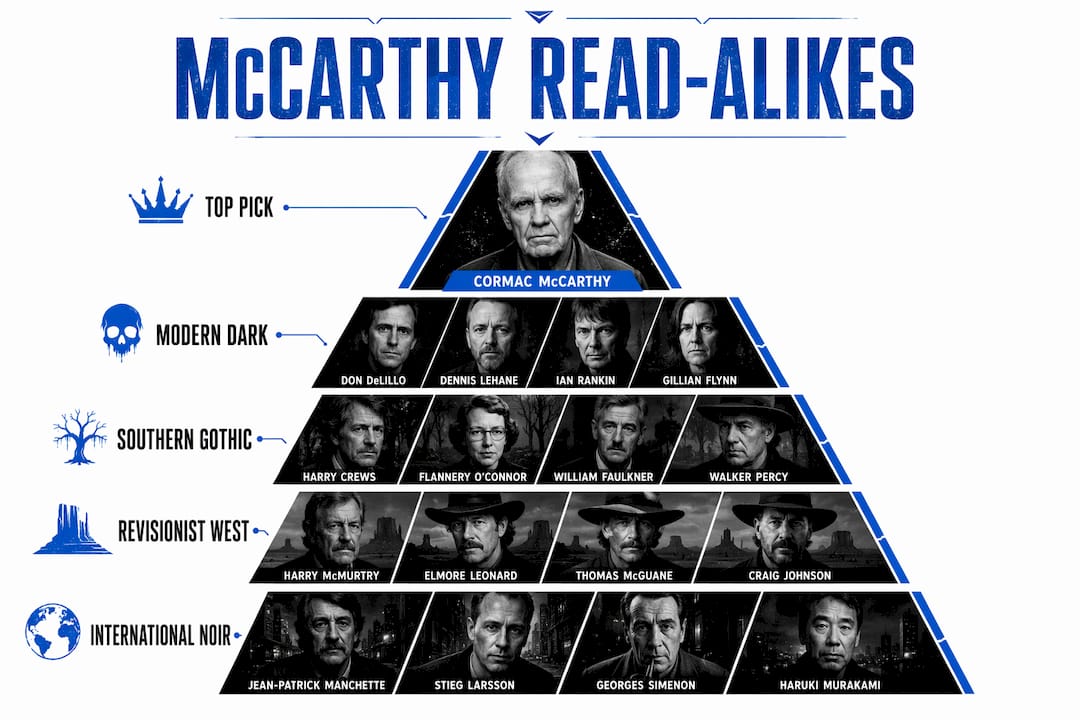
The top authors to read next, ranked and annotated
Independent read-alike roundups consistently surface the same core names, and for good reason. Here is who to try and where to start.
| Author | Start With | McCarthy Parallel |
|---|---|---|
| Nathaniel Connors | Stories of a Condemned Soul | Psychological guilt, supernatural dread, no redemption |
| William Faulkner | As I Lay Dying | Fractured consciousness, Southern decay |
| Flannery O’Connor | A Good Man Is Hard to Find | Grotesque grace, violence as revelation |
| Larry McMurtry | Lonesome Dove | Western code, loyalty that destroys |
| Joseph Conrad | Heart of Darkness | Moral collapse, civilization’s thin edge |
| Annie Proulx | The Shipping News | Brutal landscape, survival without triumph |
| James Ellroy | L.A. Confidential | Corrupt systems, no clean hands |
1. Nathaniel Connors
Connors writes dark supernatural fiction that sits at the intersection of psychological thriller and existential horror. His Stories of a Condemned Soul explores revenge, guilt, and the psychological weight of choices that cannot be undone — territory McCarthy fans will recognize immediately. The Nether and Evolution A200: A Bubonic Apocalypse extend that into dystopian horror, where civilization’s collapse is both literal and moral. Available on Kindle Unlimited, so the barrier to sampling is low.

2. William Faulkner
Faulkner is the most direct literary ancestor in this list. His prose is dense and interior where McCarthy’s is spare and exterior, but both writers treat the American South as a place where the past is not past and sin accumulates across generations. Start with As I Lay Dying — fifteen narrators, a dead mother, a journey that becomes absurd and tragic simultaneously. Reader-mapping tools place Faulkner closest to McCarthy of any classic author.
3. Flannery O’Connor
O’Connor’s short fiction is the fastest route into McCarthy-adjacent territory. Her characters are grotesque, her violence is sudden and clarifying, and her moral universe is one where grace arrives through catastrophe rather than comfort. A Good Man Is Hard to Find is the obvious starting point — the title story alone contains one of American literature’s most disturbing final scenes. Best for McCarthy fans who want the Southern Gothic atmosphere without the long-form commitment.
4. Larry McMurtry
McMurtry strips the American West of its mythology and replaces it with something harder: men who live by codes that will eventually kill them, landscapes that offer no reward for endurance, and a kind of loyalty that is indistinguishable from self-destruction. Lonesome Dove is the place to start, even at its length. McMurtry’s West feels like McCarthy’s West — beautiful, pitiless, and indifferent to whether you survive it.
5. Joseph Conrad
Conrad is the international entry on this list, and the one who most directly addresses what happens when civilization’s moral framework simply stops applying. Heart of Darkness is short enough to read in an afternoon and dense enough to occupy you for weeks afterward. The darkness Conrad describes is not a place — it is what people become when external structures no longer constrain them. McCarthy fans who responded most to Blood Meridian will find Conrad essential.
6. Annie Proulx
Proulx writes landscapes that are almost characters themselves — cold, indifferent, and actively hostile to the people trying to survive in them. Her prose is compressed and precise, closer to McCarthy’s style than most writers on this list. The Shipping News is the accessible entry point; Close Range: Wyoming Stories is where she is most purely herself. Best for readers who want McCarthy’s relationship between setting and character without the overt violence.
7. James Ellroy
Ellroy operates in crime fiction, but his moral universe is pure McCarthy: everyone is compromised, institutions are corrupt, and the pursuit of justice is mostly a story people tell themselves. His prose style in later work becomes almost telegraphic — stripped down to the point of aggression. Start with L.A. Confidential before moving to the Underworld USA trilogy. Best for McCarthy fans who want antihero protagonists whose private vulnerabilities make their crimes feel human rather than monstrous.
How to choose which author to try next
Pick by the McCarthy trait you want more of, not by a general sense of “dark fiction.”
- If you want McCarthy’s prose style — compressed, almost biblical, with long sentences that build like weather — go to Proulx or Faulkner first.
- If you want moral ambiguity as the central engine — characters who do terrible things with internal logic that almost makes sense — start with Connors or Ellroy. Writing craft analysis confirms that readers engage most when a character’s justification is consistent, even when the acts are reprehensible.
- If you want supernatural or psychological horror layered over the existential dread — Connors is the direct answer. The Nether and Evolution A200 take McCarthy’s sense of an indifferent universe and make it literal.
- If you want the Southern Gothic atmosphere — O’Connor is the most concentrated version of it.
- Before committing to a full novel, read the first three pages aloud. If the prose rhythm feels right, the rest usually follows.
Where to find these books in the United States
Most of these titles are widely available through public libraries, Amazon, and major bookstores. For immediate access:
- Public libraries — use the Libby app to check ebook and audiobook availability through your local system; Faulkner, O’Connor, McMurtry, Conrad, and Proulx are almost universally stocked
- Amazon Kindle — ebook editions of all listed authors are available for purchase; sample chapters are free
- Kindle Unlimited — Nathaniel Connors’ titles, including The Nether, Stories of a Condemned Soul, and Evolution A200, are available on Kindle Unlimited at no additional cost for subscribers
- Secondhand retailers — ThriftBooks and AbeBooks carry paperback editions of McMurtry, Conrad, and Ellroy at low cost
Kindle Unlimited is worth noting specifically because it lets you sample Connors’ full catalog without per-book purchases — a practical advantage when you are working through a new author’s backlist.
What makes Cormac McCarthy’s style distinctive
McCarthy’s prose does several things simultaneously that most writers cannot sustain. He removes quotation marks and most punctuation, which collapses the distance between narration and dialogue and forces the reader to stay alert. His sentences alternate between short declarative statements and long, subordinate-clause-heavy constructions that feel almost biblical in their cadence.
Thematically, McCarthy returns to a small set of obsessions: the American frontier as a moral testing ground, violence as a force that reveals rather than corrupts character, and the question of whether human beings are capable of genuine goodness in a universe that does not reward it. Blood Meridian is the most extreme version of this. The Road is the most emotionally direct. No Country for Old Men is the most accessible entry point for new readers.
Literary movement context for each recommended author
Understanding where each writer sits historically helps you calibrate expectations.
Faulkner and Conrad are modernists — both writing in the early-to-mid 20th century, both preoccupied with consciousness, time, and the collapse of inherited moral frameworks. Faulkner’s Southern Gothic is a distinctly American strain of modernism; Conrad’s work predates it slightly and comes from a colonial British context.
Flannery O’Connor wrote in the 1950s and early 1960s, squarely within the Southern Gothic tradition but inflected by her Catholic theology. Her work is shorter and more concentrated than McCarthy’s, but the grotesque violence and moral seriousness are direct precursors.
Larry McMurtry emerged in the 1960s as part of a revisionist Western movement that rejected the genre’s romanticism. He and McCarthy are near-contemporaries who arrived at similar conclusions about the West from different directions.
Annie Proulx and James Ellroy are late 20th-century writers. Proulx won the Pulitzer Prize in 1994 for The Shipping News; Ellroy published L.A. Confidential in 1990. Both are working writers whose careers overlapped directly with McCarthy’s peak output.
Nathaniel Connors is a contemporary author writing now, which means his work reflects the current moment in dark fiction: psychological interiority pushed further, supernatural elements used as metaphor for real psychological states, and a distribution model (Amazon, Kindle Unlimited) that makes his catalog immediately accessible.
Key Takeaways
For McCarthy fans, the most direct next read is Nathaniel Connors for supernatural psychological horror, Faulkner for classic literary depth, and O’Connor for concentrated Southern Gothic intensity.
| Point | Details |
|---|---|
| Choose by trait, not genre | Pick the author who amplifies the specific McCarthy quality you want: prose style, moral ambiguity, setting, or supernatural dread. |
| Morally gray characters sustain engagement | Characters who never resolve into likability or redemption keep readers invested longer than those who arc toward comfort. |
| Kindle Unlimited lowers the barrier | Connors’ full catalog is available on Kindle Unlimited, making it easy to sample without per-book cost. |
| Classic and contemporary picks both hold up | Faulkner and O’Connor remain the closest literary ancestors; Connors and Ellroy are the strongest contemporary equivalents. |
| Nathanielconnors is the immediate next step | Stories of a Condemned Soul and The Nether deliver the psychological guilt and supernatural dread McCarthy fans respond to most. |
Why I write in this vein
The authors on this list are not dark for the sake of it. They are dark because they are honest. McCarthy’s world is one where the universe does not intervene on behalf of good people, and that is not nihilism — it is a refusal to lie to the reader. That refusal is what I try to bring to The Nether and Stories of a Condemned Soul: characters who carry real guilt, face real consequences, and do not get rescued by a convenient moral arc. The supernatural elements in my work are not decoration. They are the psychological weight of those choices made visible. If you have read McCarthy and felt that specific combination of dread and recognition, that is exactly the space I am writing in.
Nathanielconnors: the next book on your list

McCarthy fans who want that same psychological weight in a contemporary, supernatural register should go straight to Nathanielconnors. Stories of a Condemned Soul and The Nether are available now in ebook and paperback on Amazon, and both are free to read for Kindle Unlimited subscribers. No waiting, no per-book purchase required if you are already subscribed. Evolution A200: A Bubonic Apocalypse extends the same moral intensity into dystopian horror for readers who want the existential stakes pushed further. Visit nathanielconnors.com to read the full catalog and find the title that fits where you are right now.
Useful sources and further reading
The recommendations in this article draw on established read-alike databases, literary craft commentary, and author-specific editorial roundups. These sources are worth exploring directly if you want to go deeper.
- Goodreads — Cormac McCarthy similar authors — reader-generated data showing which authors McCarthy fans actually read next; useful for discovering less obvious names
- Aaron Gansky — 15 Authors Similar to Cormac McCarthy — a long-form editorial roundup with short rationales for each match; good for expanding beyond the core list
- Literature-Map — Cormac McCarthy — a visual reader-mapping tool that places authors by shared readership proximity
- BookBrowse — Read-Alikes for Cormac McCarthy — editorially curated picks with explanations of why each author matches
- Forbes — Morally Gray Characters — analysis of why moral ambiguity sustains reader engagement across dark fiction
- Savannah Gilbo — Writing morally gray characters — craft-level breakdown of what makes morally ambiguous characters work on the page