
The best horror quotes about guilt share one trick: the monster is not outside. In Milton, the damned carry hell in their own heads. In Mary Shelley, remorse has fangs. In a horror game, the thing hunting you turns out to be your own need for punishment. Below you will find the lines worth keeping, who said them, what they mean in context, and why guilt keeps producing the genre’s most unsettling writing.
TL;DR
- The strongest guilt quotes in horror come from Milton’s Paradise Lost and Mary Shelley’s Frankenstein, where conscience itself is the punishment.
- Modern lines such as “Sin never dies” (Carrie) and “There was a hole here. It’s gone now” (Silent Hill 2) work because they imply guilt is inherited or inescapable.
- Guilt is frightening because it cannot be outrun. The threat travels with the character.
- Quote a line with its speaker and source. A quote without context is a caption; with context it is a small piece of criticism.
Table of Contents
- Classic horror quotes about guilt and remorse
- Guilt quotes from horror films and games
- Why guilt makes such effective horror
- How to use these quotes well
- Our view: guilt is the engine, not the decoration
- Read guilt as a story, not just a line
- FAQ
- Sources
Classic horror quotes about guilt and remorse
The oldest horror writing already understood that guilt is a place you cannot leave. These are the passages that set the pattern.
Milton: guilt as a landscape
In Book 4 of Paradise Lost, Satan looks at Eden and cannot enjoy a thing he sees. His line is one of the most quoted in all of English literature: “Which way I flie is Hell; my self am Hell.” In the same speech he bids “Farewel Remorse,” and Milton notes that “horror and doubt” stir the hell within him and that “conscience wakes despair.”
Read it as a horror writer would. Satan tries the oldest escape there is: distance. The line says distance fails, because the thing he is running from is the one doing the running. Evil here is not an outside force. The wrongdoer carries the consequences, the conscience and the self-condemnation with him. Almost every guilt story since is a variation on that sentence.
Mary Shelley: remorse with teeth
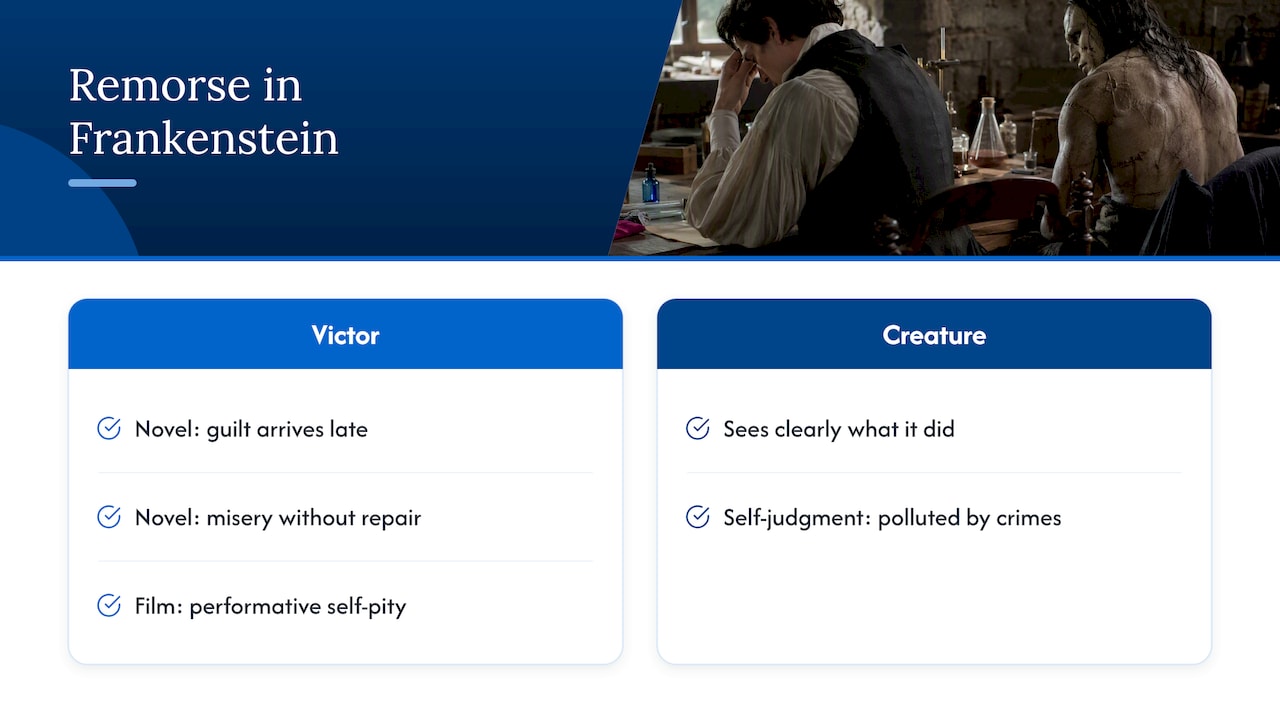
Frankenstein ties creation to responsibility more tightly than any novel before it. After the creature opens its eyes, Victor reports that “breathless horror and disgust filled my heart.” Later, when he understands that he is the cause of Justine’s wrongful death, he describes feeling “the fangs of remorse tore my bosom.” The creature, for its part, calls itself “Polluted by crimes and torn by the bitterest remorse,” a final self-judgment that is arguably more honest than anything Victor says.
The pairing matters. Victor’s guilt arrives late and mostly makes him miserable. The creature’s guilt arrives with a clear view of what it did. If you want one book to read for guilt as horror, this is it.
The 2025 screen version sharpens the point. The BFI’s review of Guillermo del Toro’s film reports Victor saying “I rarely felt remorse before and now feel little else,” and reads his guilt as performative self-pity rather than genuine repair. The same review quotes his admission that he never considered what would come after creation. That is the whole genre in a sentence: the horror is what follows an act you refused to take responsibility for.
Poe: guilt as a refrain
Guilt does not always announce itself. In “The Raven,” the narrator pleads for respite from sorrow and for reunion with Lenore, and the bird answers every plea with one word: “Nevermore.” Nothing in the poem names a crime. Yet the way the speaker keeps asking questions he knows the answer to, and keeps hurting himself with the replies, is what guilt feels like from inside: a loop with no exit.
Masefield and Millay: the haunted house and the sinning world
Two poems take guilt to opposite scales. John Masefield’s “The Haunted” turns accumulated wrongdoing into architecture. The speaker calls it a “Terrible house, whose horror I have built,” and the “heaped guilt” cries out from within it. The haunted house is not cursed by something old. It was built by the person living in it.
Edna St. Vincent Millay goes the other way in “Renascence.” Her speaker declares, in “infinite remorse of soul,” that “All sin was of my sinning.” The suffering of the whole world becomes personal guilt. It is a cosmic version of what many people feel at three in the morning: that everything wrong is somehow theirs.
Guilt quotes from horror films and games
Modern horror compresses the same idea into lines short enough to repeat. These are the ones that come up most when readers ask for creepy catchphrases that carry guilt.
| Quote | Source | Why it lands |
|---|---|---|
| “Sin never dies.” | Carrie (1976), Margaret White | Frames guilt and punishment as cyclical, handed down through an abusive mother-daughter bond |
| “There was a hole here. It’s gone now.” | Silent Hill 2 | A condemnation of James that points to guilt and possible eternal punishment |
| “I rarely felt remorse before and now feel little else.” | Frankenstein (2025), Victor | Remorse as self-pity rather than repair |
| “Which way I flie is Hell; my self am Hell.” | Paradise Lost, Satan | Guilt you cannot flee because you are its container |
“Sin never dies”
Margaret White’s line works because it makes guilt contagious. It does not say sin is punished or sin is forgiven. It says sin persists, and in Carrie it persists in the one relationship that was supposed to be safe. If you are choosing a quote for a post about inherited guilt, this is the one.
“There was a hole here. It’s gone now.”
This line from Silent Hill 2 is slippery on purpose. A hole is a thing missing, and the line leaves you to decide whether it is a loss, a grave or a conscience. The game is built on that ambiguity. A Destructoid analysis describes it as a personal hell shaped by James Sunderland’s grief and guilt, with Pyramid Head read as an enemy generated by James’s need for punishment.
The creator’s own account backs that up. GamesRadar reports that artist Masahiro Ito described Pyramid Head as a physical representation of guilt and judgment, influenced by Jacob’s Ladder and its line about memories and attachments burning in Hell. Dread Central adds that the game’s endings can show forgiveness, suicide or continued entrapment depending on what the player chooses. Guilt there is not a theme laid over the story. It is the level design.
Ghosts that borrow our guilt
Stephen King, writing about Ghost Story, offered a line that explains half the genre. As quoted by Susanne Kord, he said that “ghosts, in the end, adopt the motivations and perhaps the very souls of those who behold them,” and that if they are malevolent, that malevolence comes from us. Read next to Milton, it is the same claim in modern prose. The supernatural is where we put what we cannot admit.
Why guilt makes such effective horror
A quote collection can stop at the lines. But if you want to understand why they chill, the academic work on horror is surprisingly consistent.
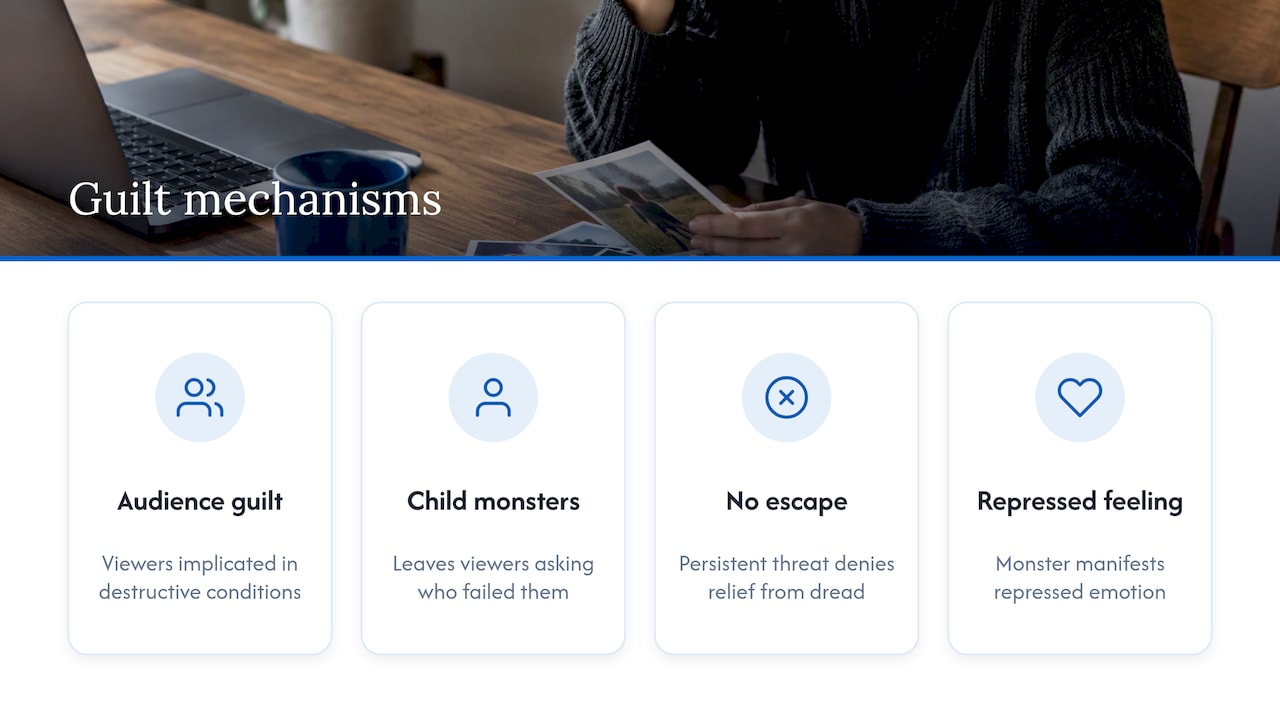
Guilt implicates the audience. Susanne Kord argues that horror films can work as “guilt trips” rather than pure fear experiences, because viewers and whole societies are implicated in the destructive conditions on screen. Her example is Children of the Corn (1984), where murderous children punish adults for environmentally destructive farming. The threat comes from collective irresponsibility, not from a random monster.
Children make guilt visible. Erika Tiburcio Moreno’s 2017 article argues that cinema’s evil children “play on our guilt,” treating child monsters as devices that implicate adult audiences and social institutions. A child cannot be dismissed as a villain the way an adult can, so the viewer is left holding the question of who failed them.
Guilt removes the exit. Tarja Laine’s 2019 article argues that It Follows and Get Out use trauma aesthetically: offscreen space and persistent threat deny both protagonists and spectators relief from dread. That is the Milton principle in film grammar. If the threat travels with you, there is no safe room to cut to.
Guilt creates monsters out of repressed feeling. Paula Quigley reads The Babadook as an exploration of maternal ambivalence, grief and rage, with the monster as an uncanny manifestation of repressed emotion. She writes that viewers inhabit Amelia’s “fractured subjectivity, hate, and sense of guilt.” We are not watching someone be guilty. We are made to feel it from inside.
Put together, these give you a working test for whether a line is really about guilt: does it say the threat is internal, inherited, or inescapable? If it does, it belongs on this list. If it only says someone is dangerous, it is a different kind of horror quote.
How to use these quotes well
Most searchers for this topic want something to post, caption, or put at the start of a story. A few practical habits make the choice better.
- Match the kind of guilt to the occasion. Milton suits a post about conscience and self-torment. Carrie suits family and inheritance. Poe suits obsession and grief. Shelley suits responsibility for something you made.
- Credit the speaker, not just the author. “Victor says” and “the creature says” are different statements. The surrounding story changes what the line means.
- Prefer older sources for long quotes. Milton, Shelley, Poe, Masefield and Millay are all on the page in full at the linked poetry and text sources, so you can check wording rather than trust a screenshot.
- Keep film lines short and attributed. A single line with the character and title is enough. If you want a wider set, our psychological horror quotes collection goes beyond guilt into dread, paranoia and the unreliable mind.
If you are a writer rather than a collector, the more useful question is how these lines were earned. Guilt rarely works when a character states it. It works when it leaks into behavior: avoided rooms, over-polite answers, a habit of checking a lock twice. We go through that in how to make guilt-ridden characters believable without naming the guilt, and the broader craft is in how to write psychological horror.
Our view: guilt is the engine, not the decoration
We write dark supernatural fiction about revenge, guilt and redemption, so this topic is not a side interest for us. It is the question our stories keep returning to.
Here is what we have come to believe. A guilt quote hits hardest when it stops being a statement and becomes a mechanism. “Which way I flie is Hell” is not great because it is beautiful. It is great because it breaks the character’s plan: the escape route is the prison. Any scene that follows can use that. Every door he opens leads into himself.
The second thing we hold to is that guilt without a cost is decoration. Victor says he feels remorse, and the BFI’s reading of del Toro’s version is that it does not repair anything. We find that more frightening than a monster, because it is recognizable. Plenty of us have been sorry in ways that changed nothing. Horror that understands this gives its guilty characters a reckoning that costs them something, or shows convincingly that they will avoid it.
Thirdly, the supernatural is most effective when it carries a human meaning. A ghost, a curse or a plague is a way of making a private weight visible and external, so that the character and the reader can finally look at it. That is the idea behind the way we treat redemption, too: atonement feels earned only when something has been paid. If that interests you, redemption in horror and how ritual makes atonement feel earned is where we develop it.
What we want readers to be left with is not a jolt but a question that lingers after the last page: what would I have done, and what would I carry?
— Nathaniel
Read guilt as a story, not just a line
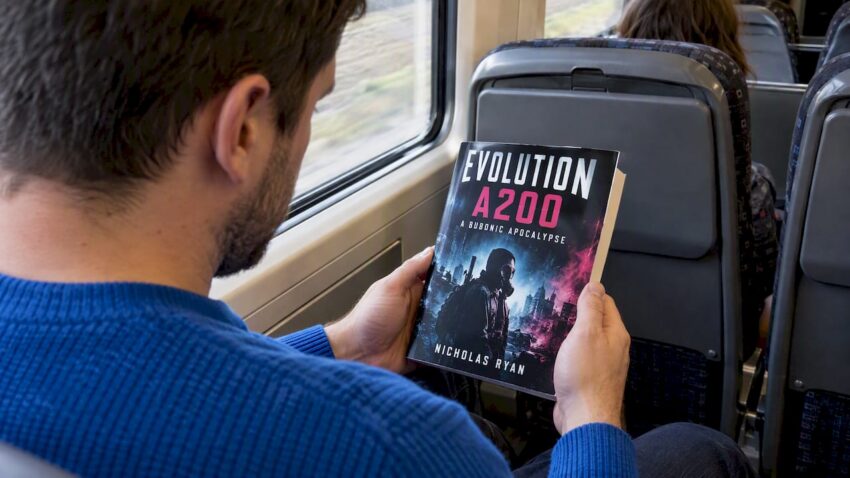
Quotes are the shortest form of this theme. If you want it at novel length, our books are built around the psychological monsters people carry. The Nether and Evolution A200: A Bubonic Apocalypse are dystopian horror and thriller fiction where guilt and consequence drive the plot. They are available in ebook and paperback on Amazon and free to read with Kindle Unlimited. You can see the full catalog on our books page, or start with our guide to dark supernatural books for readers who want real dread.
FAQ
What is a good short quote about guilt in horror?
For a single line that does the most work, use Milton’s “Which way I flie is Hell; my self am Hell.” It says in eleven words that guilt cannot be escaped because it lives inside you. For something from modern pop culture, “Sin never dies” from Carrie is short and instantly recognizable.
What are some creepy horror catchphrases that connect to guilt?
“Sin never dies,” spoken by Margaret White in Carrie, frames guilt as something that repeats across generations. “There was a hole here. It’s gone now” from Silent Hill 2 is more oblique, but it reads as a condemnation of James. Both rely on implication rather than explanation, which is why they stick.
What is a horror quote about evil that also reflects guilt?
Satan’s line in Paradise Lost, Book 4, is the clearest case. Milton also writes that “conscience wakes despair,” which makes the evil frightening because the wrongdoer carries his own punishment. Stephen King’s remark that a malevolent ghost’s malevolence comes from us makes a similar point in modern terms.
Which horror stories are best if I like guilt as a theme?
Start with Frankenstein, where creation and responsibility are inseparable. For games, Silent Hill 2 treats guilt as the structure of the world. For film, The Babadook ties a monster to grief and repressed rage. Our own character-driven horror list pairs ten films and ten books by the trait that drives each one.
Sources
- Paradise Lost: Book 4 (1674 version), Poetry Foundation
- Frankenstein Guilt and Regret Quotes, AllGreatQuotes
- Frankenstein review, BFI Sight and Sound
- The Raven, Poetry Foundation
- The Haunted, Poetry Foundation
- Renascence, Poetry Foundation
- 10 Great Horror Movie Quotes Nobody Talks About, ScreenRant
- 13 Most Memorable Quotes From Silent Hill, TheGamer
- More than just noise: In my restless dreams, Destructoid
- Masahiro Ito on Pyramid Head, GamesRadar
- The Psychological Horrors of James Sunderland, Dread Central
- Gangs and Guilt: Towards a New Theory of Horror Film, Susanne Kord
- Little Horrors: How Cinema’s Evil Children Play on Our Guilt
- Traumatic Horror Beyond the Edge: It Follows and Get Out, Film-Philosophy
- The Babadook, Paula Quigley, Irish Gothic Journal