The best books like House of Leaves, ranked for psychological depth
If you finished House of Leaves and immediately wanted more, you already know what you’re after: stories that disorient on purpose, narrators you can’t fully trust, and an atmosphere that feels genuinely threatening. The four titles below are the strongest starting points, each pulling from the same well of narrative complexity and dread.
- “S.” by J.J. Abrams and Doug Dorst — A novel arrives with handwritten margin notes from two readers piecing together its secrets. You’re reading three stories at once: the printed text, the students’ scrawled conversation, and the mystery underneath both. Physically, the book includes postcards and newspaper clippings tucked between pages.
- “The Raw Shark Texts” by Steven Hall — Eric Sanderson wakes up with no memory and discovers he’s being hunted by a conceptual shark that moves through meaning rather than water. Hall uses white space, photographs, and fragmented text to make the threat feel genuinely surreal.
- “Night Film” by Marisha Pessl — A journalist obsesses over a reclusive horror director whose daughter has died under strange circumstances. Pessl embeds fake screenshots, documents, and photographs into the print edition, blurring the line between investigation and fiction.
- “Piranesi” by Susanna Clarke — A man lives alone in an infinite house of halls and statues, writing careful journal entries about a world he barely understands. The horror here is quiet and slow, built entirely through the narrator’s limited, unreliable perspective.
- “The Shining” by Stephen King — The closest traditional horror parallel to House of Leaves, recommended for its dark atmosphere and psychological complexity. Jack Torrance’s unraveling mirrors the obsessive descent that defines Danielewski’s novel.
Table of Contents
- What is ergodic literature, and why does it matter here?
- Structural puzzlers vs. atmospheric dread: which type fits you?
- Nathanielconnors: dark supernatural fiction for the same reader
- How to read ergodic and complex novels without losing the thread
- Key takeaways
- Where to go next if these books are your kind of dark
What is ergodic literature, and why does it matter here?
The term “ergodic” comes from literary theory and describes texts that require nontrivial effort to read. Not effort as in dense prose, but physical, structural effort: rotating the book, tracking footnotes that lead to other footnotes, or following multiple narrative layers that never quite sync up.
House of Leaves is the clearest example in popular fiction. Its footnotes within footnotes and typographical shifts force you to physically interact with the page, and the story’s structure is inseparable from its horror. The house’s impossible geometry is mirrored in the book’s impossible layout. That’s not a stylistic flourish; it’s the whole point.
The narrative structure simulates losing your way to mirror the protagonist’s madness. Readers who respond to that experience tend to want it again, which is exactly why “S.” and The Raw Shark Texts land so well for this audience. Both use the physical form of the book as a storytelling tool, not just a container.
Pro Tip: When reading ergodic novels, keep a separate notepad for tracking narrative threads. The disorientation is intentional, but your own notes can reveal patterns the text hides in plain sight.
Structural puzzlers vs. atmospheric dread: which type fits you?
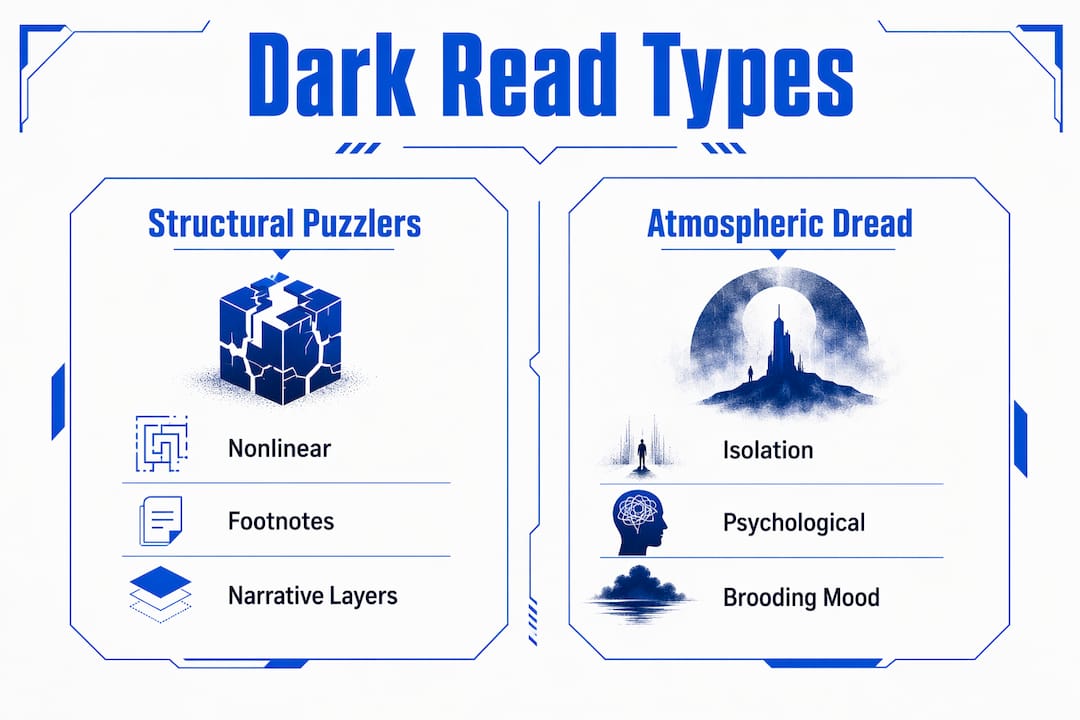
Novels similar to House of Leaves split cleanly into two camps, and knowing which one you prefer saves you from picking up the wrong book.
Structural puzzlers
These books foreground their own construction. The format is the puzzle, and solving it is part of the pleasure.
- “S.” — Three interlocking stories told through margin notes, inserts, and a printed novel-within-a-novel.
- “The Raw Shark Texts” — Fragmented chapters, image sequences, and a flip-book section hidden near the end.
- “Hopscotch” by Julio Cortázar — Chapters can be read in multiple sequences; the author provides a “Table of Instructions” for a nonlinear path.
- “The Unfortunates” by B.S. Johnson — A novel in a box: 27 unbound sections with only a labeled first and last chapter. Every reader’s experience is different.
Atmospheric dread
These novels prioritize mood and psychological pressure over formal experimentation. The horror is in the feeling, not the format.
- “Piranesi” — Isolation and a reality that slowly reveals itself to be something other than what the narrator believes.
- “Night Film” — Obsession and paranoia build through accumulating detail rather than structural tricks.
- “The Shining” — A confined space, a deteriorating mind, and dread that compounds with every chapter.
- “The Haunting of Hill House” by Shirley Jackson — Psychological isolation and the breakdown of a protagonist’s mental state, handled with the same oppressive atmosphere that defines House of Leaves.
Themes of isolation and psychological breakdown run through both categories. The difference is delivery: structural puzzlers make you work for the horror; atmospheric dread novels let it seep in. Readers who loved the footnote maze of House of Leaves usually gravitate toward structural puzzlers first, while readers drawn to its claustrophobic mood often prefer the atmospheric camp.
Nathanielconnors: dark supernatural fiction for the same reader

Nathaniel Connors writes dark supernatural fiction built around the same psychological territory that defines the best novels in this genre: revenge, guilt, redemption, and the monsters people carry inside themselves rather than the ones that come from outside.
His titles include:
- The Nether — A haunting narrative that presses into the psychological space between guilt and consequence.
- Stories of a Condemned Soul — Short, sharp explorations of human darkness, each story a self-contained descent.
- Evolution A200: A Bubonic Apocalypse — Dystopian horror that combines biological catastrophe with deep character study, echoing the survivalist dread found in books like I Am Legend.
What connects Connors’ work to the novels above is the emphasis on interiority. His characters don’t just face external threats; they face themselves. That’s the same engine driving Piranesi’s unreliable narrator and the obsessive descent in Night Film. All of his books are available in ebook and paperback on Amazon, and Kindle Unlimited subscribers can read them at no additional cost.
How to read ergodic and complex novels without losing the thread
Approaching a structurally unconventional novel the same way you’d read a thriller will frustrate you. These books reward a different posture.
Read slowly and out of sequence when the text invites it. “S.” is designed to be read at least twice: once for the printed novel, once tracking only the margin conversation. Piranesi rewards rereading specific journal entries after the full picture emerges. Resist the urge to race toward resolution.
Pay attention to what the format is doing, not just what the text says. In House of Leaves, the shrinking text blocks and color-coded words are part of the story. In The Raw Shark Texts, the white space is silence and threat simultaneously. The form carries meaning the prose alone cannot.
Accept unreliable narrators as collaborators, not obstacles. The narrator’s gaps and distortions in Piranesi, Night Film, and Connors’ own work are where the real psychological tension lives. A narrator who doesn’t fully understand their own situation forces you to read between the lines, which is exactly the kind of active engagement ergodic fiction demands.
Key takeaways
The strongest books like House of Leaves share one quality: they treat the reader as an active participant, not a passive audience.
| Point | Details |
|---|---|
| Ergodic fiction demands active reading | Non-linear layouts, footnotes, and physical interaction are core features, not stylistic extras. |
| Two distinct categories exist | Structural puzzlers foreground format complexity; atmospheric dread novels prioritize psychological immersion. |
| Isolation drives the best titles | Themes of psychological breakdown and outsider perspective connect House of Leaves to Piranesi, Night Film, and I Am Legend. |
| Approach matters as much as selection | Reading slowly, tracking format choices, and embracing unreliable narrators improves comprehension of complex novels. |
| Nathanielconnors fits this tradition | Connors’ dark supernatural fiction explores guilt, redemption, and psychological horror, available on Kindle Unlimited. |
Where to go next if these books are your kind of dark
If the novels above are your reading territory, Nathanielconnors belongs on your list. His fiction sits at the intersection of psychological horror and dark supernatural storytelling, with the same emphasis on character interiority and thematic weight that makes House of Leaves linger long after you’ve finished it.

Evolution A200: A Bubonic Apocalypse delivers the survivalist dread of post-apocalyptic fiction with the psychological depth of literary horror. Stories of a Condemned Soul offers the kind of concentrated darkness that hits hardest in short form. All titles are available now, and Kindle Unlimited subscribers read them free. Start with Blackout for a direct entry point into Connors’ world.