Choose a horror book by matching subgenre to your tolerance for gore, not by grabbing whatever tops a “scariest ever” list. If dread and atmosphere are your speed, start with The Haunting of Hill House or Coraline. If you want something stranger and more literary, pick up Mexican Gothic or Annihilation. The rest of this guide sorts specific titles by mood, intensity, and reading experience so you don’t gamble on the wrong book twice.
TL;DR:
- Most beginner-friendly horror books, like Coraline and The Haunting of Hill House, focus on atmosphere and psychological dread rather than gore or violence.
- Mexican Gothic and Annihilation are good modern options for readers who appreciate Gothic themes or outer space/biological unsettling stories.
- Shorter horror stories and collections are ideal for pacing control and easing into the genre, especially for sensitive or new readers.
- Graphic horror, such as splatterpunk, emphasizes visceral violence and body horror, which may be too intense for those seeking atmospheric or psychological scares.
- Matching horror books to your favorite genre, tolerance for gore, and available reading time helps ensure a more satisfying and less overwhelming experience.
Table of Contents
- How Do You Choose a Horror Book by Reader Type?
- What Should You Ask Before Picking a Horror Book?
- Which Horror Books Are the Best Gateway Reads?
- Which Horror Books Work Best for Atmosphere Over Gore?
- What Is Splatterpunk and How Graphic Does Horror Get?
- How Do You Pace Yourself Through a Scary Book?
- What Are Nathaniel Connors’s Personal Horror Picks?
- Why Curated Picks Beat Algorithmic “Best Of” Lists
- Try Dark Supernatural Horror That Actually Lingers
- Sources
- FAQ
How Do You Choose a Horror Book by Reader Type?
Skip the generic “best of” roundups and pick from the category that actually describes you. Every shortlist below includes a content-warning shorthand (mild, moderate, or graphic) so you know what you’re signing up for before page one.
New to horror entirely:
- Coraline by Neil Gaiman. Best for readers easing in through a fairy-tale frame. Content level: mild.
- The Haunting of Hill House by Shirley Jackson. Best for readers who want dread without a single drop of blood. Content level: mild.
- Frankenstein by Mary Shelley. Best for readers who want horror with literary weight and a tragic core. Content level: mild.
- House of Leaves by Mark Z. Danielewski. Best for readers who like puzzles and typographic tricks alongside their scares. Content level: moderate.
Atmosphere and slow dread:
- The Haunting of Hill House (repeat pick, deserves it) for its unreliable narrator and creeping unease.
- Mexican Gothic by Silvia Moreno-Garcia. Best for readers who want Gothic mansion horror with sharp social commentary. Content level: moderate.
Psychological horror:
- House of Leaves. Best for readers who like their fear delivered through structure and obsession, not monsters.
- The Shining by Stephen King. Best for readers who want a slow psychological collapse alongside supernatural menace. Content level: moderate to graphic in places.
Cosmic and weird horror:
- Annihilation by Jeff VanderMeer. Best for readers drawn to the unknowable and unexplainable. Content level: mild to moderate, more unsettling than gory.
Body horror and graphic intensity:
- The Shining again, for readers who can handle violence tied to addiction and rage.
- Splatterpunk-adjacent picks belong in their own category below for a reason.
Literary and modern horror:
- Mexican Gothic and Annihilation both work here, since editor roundups group titles by subgenre and reading effect rather than just shock value, and these two lead that pack for craft.
What Should You Ask Before Picking a Horror Book?
- What genre do I already love? Bridge from there. Fantasy readers tend to land softly in Gothic horror; mystery fans often enjoy procedural horror with an investigative structure. Bridging from a favorite genre into a related horror subgenre reduces resistance and makes the whole experience less jarring.
- How much gore can I actually stomach today? Dread and gore are different products. A book can terrify you with silence and still contain zero violence, or it can be graphic and oddly unscary. Know which one you’re chasing.
- How much time do I have? A 200-page novella hits differently than a 700-page slow burn. Short story collections let you sample tone without committing a week of reading time.
- Are there specific themes I need to avoid? Grief, trauma, isolation, and violence against children show up constantly in horror. If any of those hit too close, check reviews before buying.
- Who is this book actually for? Some horror reads young adult smooth; some assumes an adult reader’s patience for ambiguity. Match the book’s intended audience to your own reading habits.
Pro Tip: Skip the back-cover copy and read a random page from chapter two instead. The opening chapter is usually written to hook you; chapter two shows you the book’s actual pacing and tone once the setup is over.
Fear is also deeply personal. Critics and readers on forums like Goodreads consistently note that there’s no single “scariest” book because fear depends on what you’ve already lived through. A book about losing control of your own mind will wreck one reader and bore another completely.
Which Horror Books Are the Best Gateway Reads?
These eight titles show up again and again in beginner horror primers because they mix classic and contemporary entry points without demanding a horror-veteran stomach.
- The Haunting of Hill House by Shirley Jackson. A slow, psychological haunted-house novel where the house might just be a mirror for its main character’s unraveling mind. Content note: mild, no graphic violence.
- Coraline by Neil Gaiman. A children’s book that adults find genuinely unsettling because of its Other Mother and button eyes. Content note: mild, unsettling imagery rather than gore.
- Frankenstein by Mary Shelley. The original monster story, more tragedy than jump scare, built around guilt and abandonment. Content note: mild, some violence described without graphic detail.
- Mexican Gothic by Silvia Moreno-Garcia. A 1950s heiress investigates a decaying family estate and finds fungal horror underneath the family’s colonial rot. Content note: moderate, includes body horror in its final act.
- Annihilation by Jeff VanderMeer. A team of scientists enters a quarantined coastal zone that rewrites biology and memory. Content note: moderate, disturbing rather than violent.
- The Shining by Stephen King. A family isolated in a haunted hotel over one brutal winter, with alcoholism and rage as real as the ghosts. Content note: moderate to graphic, includes violence and disturbing family dynamics.
- House of Leaves by Mark Z. Danielewski. A house with impossible interior dimensions, told through nested narratives and unstable footnotes. Content note: moderate, more disorienting than gory.
- The Turn of the Screw by Henry James. A governess and two children may or may not be haunted, and James never confirms which. Content note: mild, entirely suggestion and ambiguity.
Every one of these is currently in print in trade paperback or ebook format, so availability isn’t the obstacle. Fit is.
Which Horror Books Work Best for Atmosphere Over Gore?
Dread works on your nervous system differently than violence does. A slow-burn ghost story triggers the same unease as walking through an empty house at night. Your brain fills in the threat; the author doesn’t have to spell it out. That’s why atmosphere-driven horror like Hill House and The Turn of the Screw gets recommended so often as gateway material: it scares without ever showing you anything explicit.
- The Haunting of Hill House: best read alone, at night, in a house that creaks.
- Coraline: best read in one sitting, since its tension builds continuously.
- The Turn of the Screw: best read slowly, since the ambiguity rewards rereading passages.
- Annihilation: best read during daylight if you want to sleep afterward.
For a longer list built entirely around this mood, our guide to slow burn horror books goes deeper into pacing and setting.
What Is Splatterpunk and How Graphic Does Horror Get?
Splatterpunk is horror that puts violence and body horror front and center instead of hinting at it. Where Hill House suggests, splatterpunk shows, in full anatomical detail. It’s a legitimate subgenre with a real readership, not a lesser version of “real” horror.
If graphic content is what you’re after, The Shining is the gentlest on-ramp here, since its violence is grounded in a specific character’s breakdown rather than shock for its own sake. Beyond that, body horror as a category tends to focus on physical transformation and loss of bodily control, themes Mexican Gothic touches in its final chapters without living there full time.
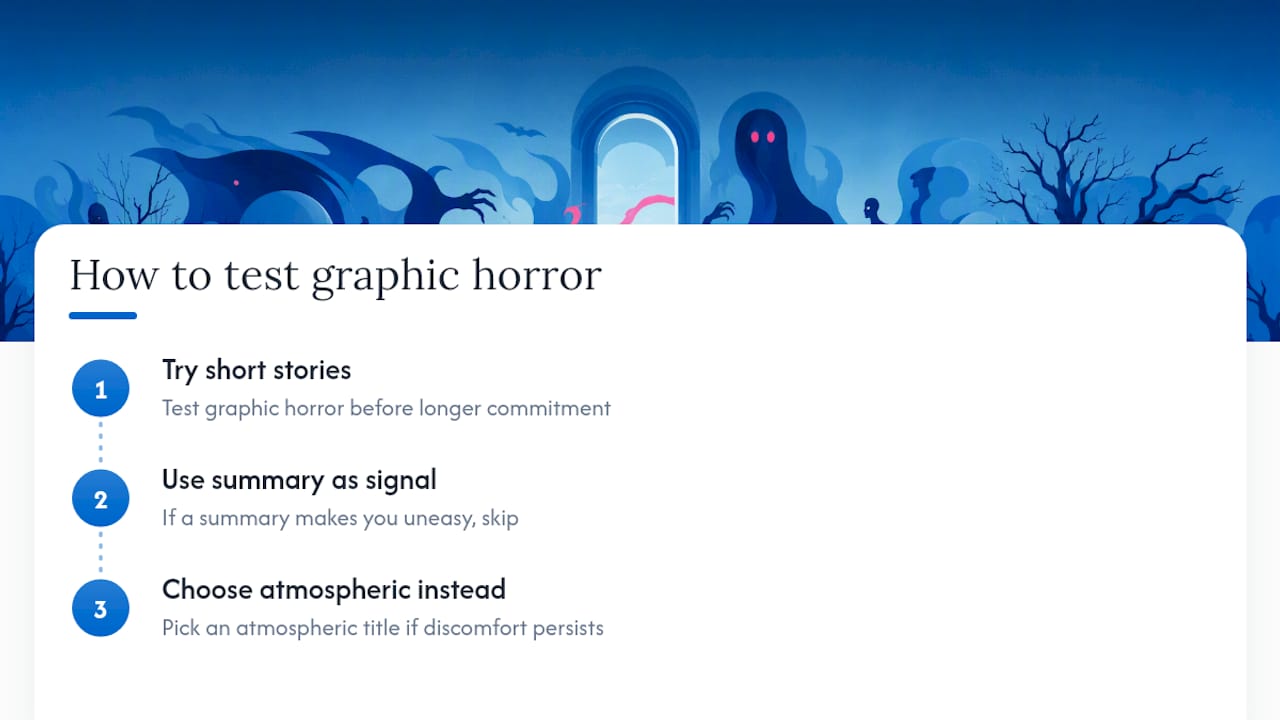
Start with short stories before committing to a full graphic novel. If a summary alone makes you uneasy, that’s useful information: skip it and pick an atmospheric title instead. Nobody owes themselves a book that ruins their week.
How Do You Pace Yourself Through a Scary Book?
Pacing controls how the fear lands, and it’s the most overlooked lever readers have.
- Read short story collections between novels. They reset your nervous system and teach genre tropes fast, since shorter horror works function as gateway reads precisely because they don’t demand a long emotional investment.
- Follow a heavy book with something light. A comfort reread or a nonfiction title works as a palate cleanser.
- Read during daylight if nighttime reading spikes your anxiety. There’s no rule that horror has to be consumed after dark.
- Stop when a scene crosses your line. Skimming ahead a paragraph or two to confirm a scene ends is not cheating.
Pro Tip: Talk about a book that unsettled you with someone else who read it. Naming the specific scene that got to you usually drains most of its power.
What Are Nathaniel Connors’s Personal Horror Picks?
My own reading leans toward dark supernatural fiction with psychological weight, exploring themes like guilt, grief, or irreversible choices. That lens shapes which titles I keep recommending to readers who ask where to start.
- The Haunting of Hill House, for anyone who wants to see how much dread a writer can generate without a single monster on the page.
- Mexican Gothic, for readers who want Gothic atmosphere with real teeth and a modern sensibility.
- Annihilation, for readers curious about horror that refuses to explain itself.
- The Shining, for readers who want family trauma treated as seriously as the supernatural threat.
- House of Leaves, for readers who like their horror structurally strange, not just thematically dark.
If you’re reading on Kindle Unlimited, a subscription tier already built for genre fiction readers who move through titles quickly, sampling widely costs nothing extra beyond the subscription itself, which makes it a low-risk way to test subgenres before buying in paperback.
Why Curated Picks Beat Algorithmic “Best Of” Lists
Algorithms rank by popularity, not by what will actually rattle you personally. A list built around one reader’s fears (isolation, guilt, the body failing) will always serve a specific kind of reader better than a list built around aggregate star ratings. That’s the whole case for choosing books by mood and tolerance instead of by rank. It’s also why I built out deeper genre guides, like the piece on dark supernatural books, instead of one flat master list.
— Nathaniel
Try Dark Supernatural Horror That Actually Lingers
If the psychological and dark supernatural picks above pulled at you more than the graphic ones, that’s worth paying attention to. My own novels sit in exactly that space: character-driven dread, guilt that won’t stay buried, and consequences that outlast the plot twist. Start with my dark supernatural thrillers if you want a full sense of the range, from The Nether to Stories of a Condemned Soul to Evolution A200: A Bubonic Apocalypse.
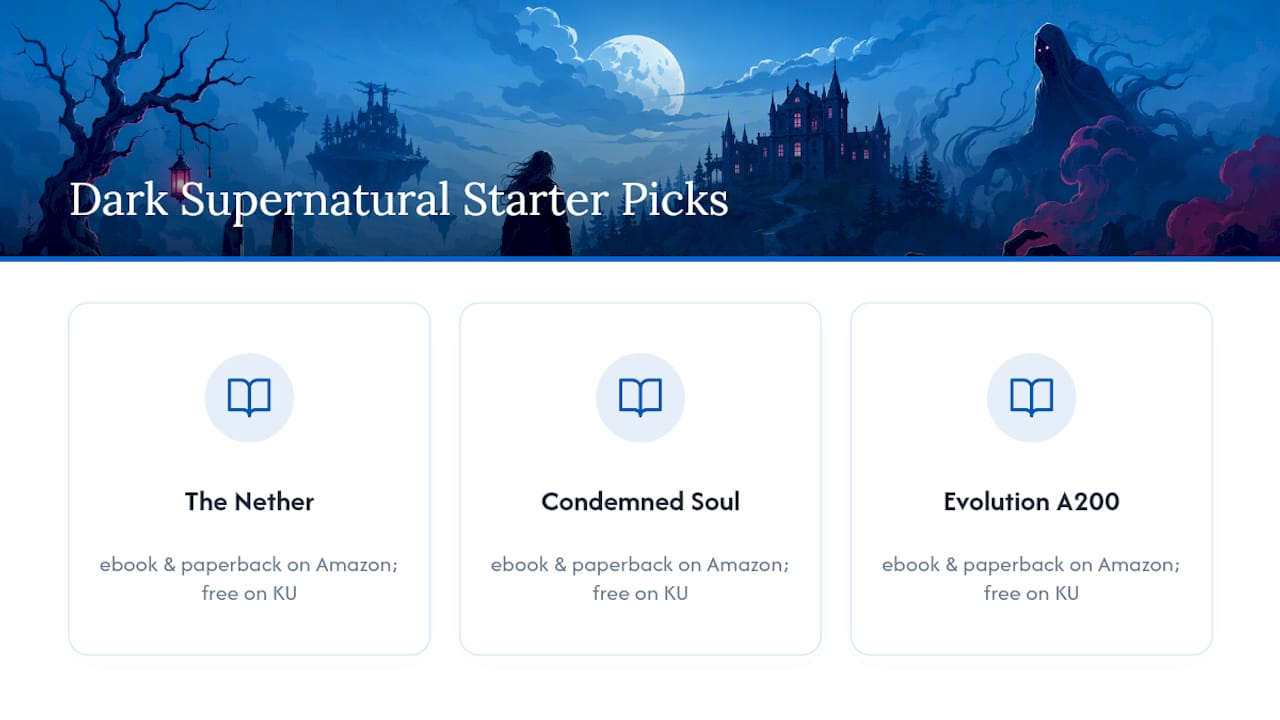
All three are available in ebook and paperback on Amazon, and every one is free to read for Kindle Unlimited subscribers, so testing the fit costs nothing beyond a subscription you may already have. Sample a chapter tonight, or browse the full dark supernatural books collection to see which title matches the mood you’re chasing.
Sources
- Exploring the diverse subgenres of horror literature
- A Beginner’s Horror Book Primer – Anythink Libraries
- 18 Best Horror Books of All Time: Novels That Will Keep You Up at Night | Editors Reads
FAQ
What is the scariest horror book ever?
There’s no single answer. Fear is personal, and what wrecks one reader (body horror, say) might barely register with someone whose real fear is isolation or loss of control.
What is splatterpunk?
Splatterpunk is horror that foregrounds graphic violence and body horror rather than suggesting it, making the physical transformation and gore the point rather than a side effect.
What are the top 5 horror books to start with?
The Haunting of Hill House, Coraline, Frankenstein, Mexican Gothic, and Annihilation cover the range from mild atmospheric dread to stranger, more literary horror.
What are the best horror books for someone who scares easily?
Coraline and The Haunting of Hill House work well since both rely on suggestion and atmosphere rather than graphic content, letting you control how far your imagination goes.
How do I pick a horror book that matches my other favorite genres?
Bridge from what you already read: fantasy fans tend to enjoy Gothic horror like Mexican Gothic, while mystery readers often take well to procedural or investigative horror.