
Guilt in literature is the interior force that turns conscience into motive, driving characters toward confession, ruin, or redemption long before any external consequence catches up with them. It matters because it converts abstract morality into plot: a guilty character must act, hide, confess, or self-destruct, and that pressure generates conflict a story can’t manufacture any other way. This article breaks down the four recognized types of literary guilt, walks through the texts that define the theme, and hands writers concrete tools for putting guilt on the page without melodrama.
TL;DR:
- Most novels weave multiple types of guilt, from private to public, creating a layered progression that fuels character development and plot.
- Guilt drives characters to act, confess, or self-destruct, making it a fundamental engine for conflict and narrative momentum.
- Specific motifs like stains, sounds, or fragmented narration concretely anchor guilt and heighten emotional impact without overt exposition.
- Classic works like Crime and Punishment and Inferno exemplify guilt’s structural role, from private torment to divine or moral reckoning.
- Modern fiction often explores collective and inherited guilt, reflecting contemporary concerns with systemic trauma and social accountability.
Table of Contents
- What Are the Four Types of Guilt in Literature?
- Why Does Guilt Drive So Much Great Fiction?
- Which Books Best Illustrate Guilt in Literature?
- How Do Horror and Gothic Fiction Use Guilt Differently?
- How Has Guilt Evolved as a Literary Theme Over Time?
- Do Different Cultures Portray Guilt in Fiction Differently?
- How Does Guilt Interact With Redemption, Sin, and Justice?
- What Character Archetypes Are Built Around Guilt?
- How Do You Write Believable Guilt in Fiction?
- Nathaniel Connors’s Perspective: Why I Keep Returning to Guilt
- Recommended Reading: Titles That Explore Guilt and Moral Darkness
- Sources
What Are the Four Types of Guilt in Literature?
Scholars analyzing guilt in literature typically sort it into four categories: private, shared, implied, and public, a classification that goes back to foundational educational literature analysis still cited in classrooms today. Each type does different narrative work, and most novels lean on more than one at once.
Private guilt lives entirely inside a character’s head, invisible to everyone else in the story. Raskolnikov’s conscience in Crime and Punishment is the textbook case: no detective is closing in on him for most of the novel. His own mind is the prosecutor.
Shared guilt, sometimes called complicity guilt, spreads across two or more characters bound by the same act or silence. Think of a group that watches a crime happen and says nothing. No single person pulled the trigger, but everyone carries a piece of it, and that division of blame often creates more narrative tension than a single guilty party would.
Implied guilt never gets named outright. The narrative just suggests it through atmosphere, a character’s avoidance of a certain street, a recurring nightmare, a refusal to answer a simple question. Gothic fiction runs on this type because dread works better than confession.
Public guilt happens when private wrongdoing gets exposed to a community, and the story shifts from internal torment to social consequence: trial, shame, exile, or ruin.
- Private guilt: internal, self-prosecuted, often invisible to other characters
- Shared guilt: distributed across a group bound by complicity or silence
- Implied guilt: suggested through mood, avoidance, or motif rather than stated
- Public guilt: exposed to a community, triggering external judgment
A single novel frequently moves a character through all four stages. A private wrongdoing festers, pulls in an accomplice, gets hinted at through symbolism for two hundred pages, and finally erupts into a public reckoning. That progression is often the backbone of the plot itself.
Why Does Guilt Drive So Much Great Fiction?
Guilt works as a narrative engine because it forces choice. A guilty character can’t stay passive. They have to act to relieve the pressure, whether that means confessing, covering up, self-punishing, or lashing out at someone who reminds them of what they did. Every one of those responses generates plot.
The psychological pull runs deeper than mechanics, though. Literature lets readers borrow a character’s guilt without paying the real cost of it, which is part of why the emotion translates so well onto the page. As Philosophy Now puts it in discussing Dr. Willard Gaylin work, guilt sits “between us and ourselves,” a private and painful negotiation that fiction externalizes so readers can watch it happen from a safe distance. That externalization is also what generates empathy for characters who’ve done terrible things. Readers don’t excuse Raskolnikov. They understand him, which is a different and more uncomfortable kind of engagement.
Writers dramatize that internal negotiation through a small set of recurring techniques, including the recurring guilt motifs like a stain or poison, as explored in Wine and Literature References: The Full Cultural Story:
- Interior monologue that circles the same memory obsessively
- Physical symptoms: insomnia, tremors, nausea, a flinch at a sound
- Repeated motifs (a stain, a smell, a piece of clothing) that anchor the guilt to something concrete
- Fragmented or unreliable narration that mirrors a fraying conscience
Pro Tip: Don’t let a character state their guilt outright in early drafts. Write the scene where they avoid eye contact, change the subject, or overreact to an unrelated accusation instead. The reader should diagnose the guilt before the character admits it.
Critics have treated this as one of literature’s oldest recurring engines for a reason; guilt has been central to character-driven drama since classical tragedy, and it hasn’t lost its grip on modern fiction either.
Which Books Best Illustrate Guilt in Literature?
Certain texts have become shorthand for entire subcategories of literary guilt, and reading lists compiled by outlets like The Guardian return to the same handful of names for good reason. Here’s how four canonical works, plus a few modern additions, put the theory into practice.
-
Inferno by Dante Alighieri. Dante doesn’t just depict guilt; he engineers an entire cosmology around it, sorting sinners into circles by the exact nature of their moral failure. The punishment always mirrors the sin, which turns guilt into architecture. It’s the clearest literary proof that guilt can function as a structural principle for an entire work, not just a character trait.
-
Crime and Punishment by Fyodor Dostoevsky. This is the definitive private-guilt novel. Raskolnikov murders a pawnbroker convinced he’s above conventional morality, then spends the rest of the book unraveling under the weight of a conscience he didn’t know he had. The physical toll (fever, delirium, isolation) makes his guilt a bodily fact before it becomes a confessed one. Dostoevsky’s insight, still cited in academic surveys tracing guilt as a structural theme across European fiction, is that guilt punishes long before any court does.
-
Beloved by Toni Morrison. Morrison writes guilt that isn’t strictly personal. Sethe’s act of violence against her own child is inseparable from the inherited, collective guilt of slavery itself, a wound that resurfaces literally in the form of Beloved’s ghost. This is shared and implied guilt operating at a historical scale, where one woman’s choice carries the moral weight of an entire system.
-
Ironweed by William Kennedy. Francis Phelan’s guilt over accidentally dropping his infant son isn’t building toward redemption so much as it’s kept him frozen for decades, homeless and drifting through Albany while ghosts of his past literally walk beside him. Kennedy’s novel is a rare case where guilt doesn’t resolve. It just accumulates.
-
Modern picks worth adding to a reading list: contemporary novels dealing with survivor’s guilt after collective trauma, domestic fiction exploring a parent’s private failures, and psychological thrillers where an unreliable narrator’s guilt drives the entire mystery structure. Critics keep returning to these newer works because they update the same four classical categories for readers used to faster pacing and tighter interiority.
How Do Horror and Gothic Fiction Use Guilt Differently?
Horror doesn’t only chase fear. A meaningful body of scholarship argues that horror often works by manufacturing guilt, aligning the audience’s perspective with a perpetrator rather than a victim. Susanne Kord’s analysis suggests that when a horror narrative puts you inside the killer’s point of view, even briefly, it’s manipulating you into a kind of borrowed complicity, and that discomfort is often the real engine of dread, not the jump scare.
Gothic fiction takes a different angle: it scales guilt up from the personal to the inherited. American Gothic in particular has a long habit of externalizing national or historical wrongdoing, slavery, colonial violence, generational trauma, and letting it resurface as a haunting in an individual family’s story. The guilt isn’t the character’s own making, but confronting it becomes the only available path toward any kind of atonement.
Both traditions rely on similar formal tricks to keep guilt visible without stating it outright:
- Spectral returns: a ghost, a recurring visitor, a thing that won’t stay buried
- Repetition of a single image or phrase that gains dread with each appearance
- Narrative alignment that traps the reader inside a compromised point of view
How Has Guilt Evolved as a Literary Theme Over Time?
Classical tragedy treated guilt as cosmic bookkeeping. Gods and fate assigned punishment, and a character’s job was mostly to suffer it, as Dante’s structured circles of hell still demonstrate centuries later. Guilt was external, imposed, almost architectural.
The novel form shifted that balance inward. By the nineteenth century, Dostoevsky and his contemporaries had turned guilt into a psychological event that happens whether or not anyone catches you, which is a fundamentally different kind of storytelling than divine punishment. Guilt stopped being something done to a character and became something a character did to themselves.
The twentieth century added a further layer: guilt as collective and historical inheritance. Morrison’s Beloved belongs to a wave of fiction treating trauma as something that outlives the person who caused it, passed down through families and communities rather than resolved by a single confession. Modern fiction has kept stretching that idea, with contemporary novels increasingly interested in guilt that belongs to systems, not just individuals, climate guilt, generational guilt, institutional complicity, while still keeping the old private-guilt engine running underneath.
Do Different Cultures Portray Guilt in Fiction Differently?
Western literary tradition, especially post-Enlightenment fiction, tends to frame guilt as an individual, internal reckoning, a private argument between a character and their own conscience. That’s the Dostoevsky model, and it’s shaped centuries of European and American fiction built around a single protagonist’s moral crisis.
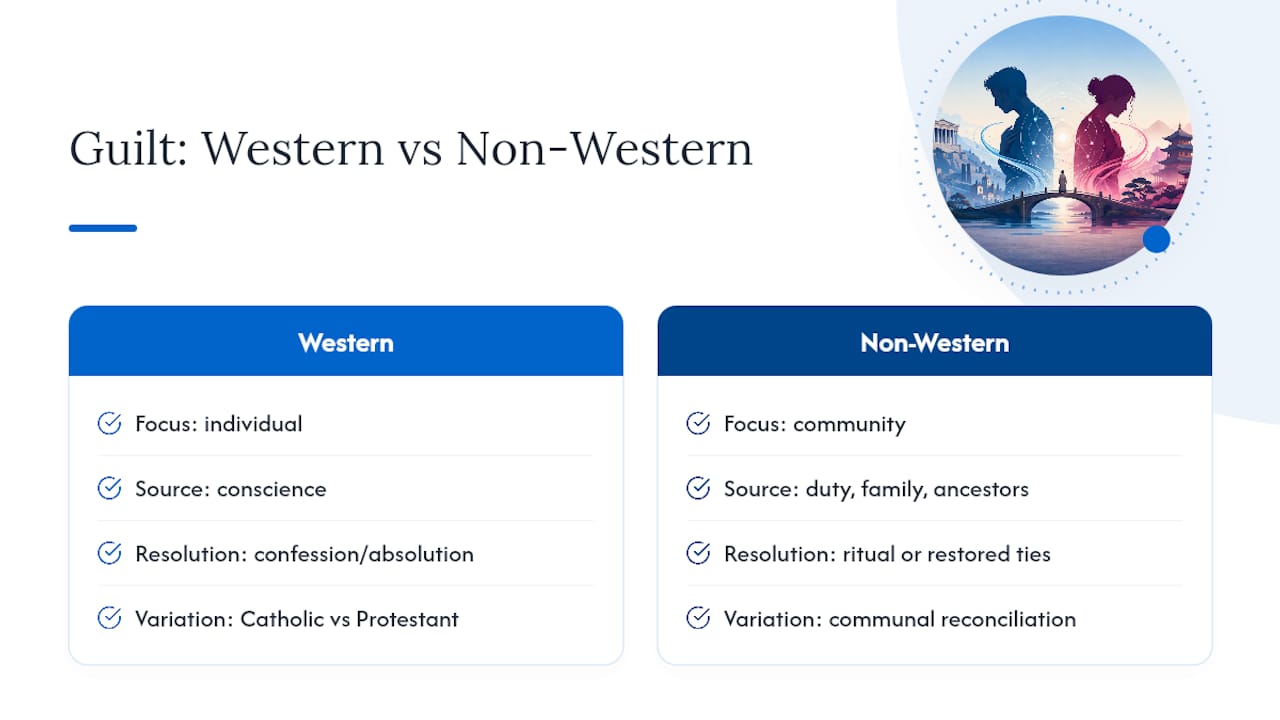
Many non-Western literary traditions treat guilt as inseparable from community and duty rather than personal introspection. Guilt in these contexts often reads less like private torment and more like a disruption of social or familial obligation, a debt owed to family, ancestors, or community rather than to an abstract internal moral code. Fiction rooted in those traditions frequently resolves guilt through communal ritual or restored relationship rather than solitary confession.
Even within Western fiction, the flavor of guilt shifts by tradition. Catholic-influenced literary cultures lean toward guilt tied to confession and absolution, a structured path from sin to forgiveness. Protestant-influenced traditions, particularly in American fiction, often leave guilt unresolved, a permanent internal ledger with no clean mechanism for closure. That difference alone explains a lot about why American Gothic rarely offers its haunted characters a tidy ending.
How Does Guilt Interact With Redemption, Sin, and Justice?
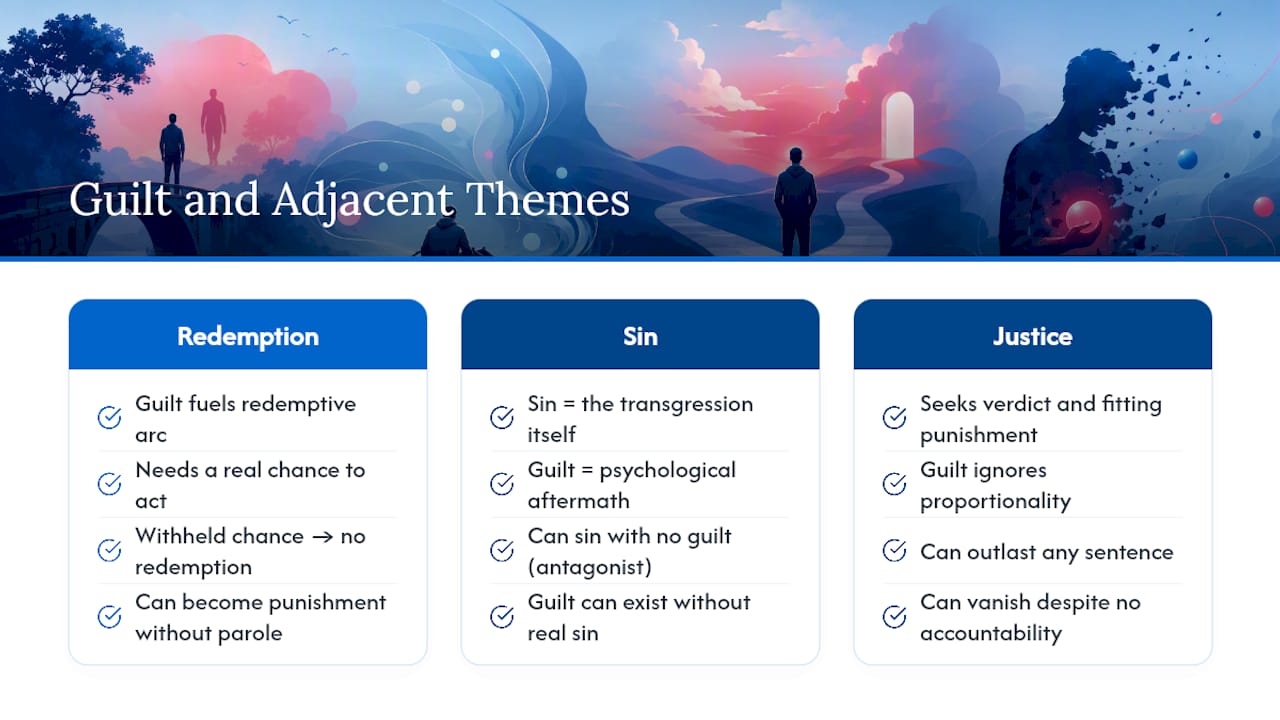
Guilt rarely appears alone on the page. It’s almost always in conversation with at least one adjacent theme, and how a writer stages that conversation determines the emotional shape of the whole book.
Guilt and redemption form the most common pairing: a character’s guilt becomes the fuel for a redemptive arc, provided the narrative gives them a real chance to act on it. Withhold that chance, as Kennedy does in Ironweed, and guilt curdles into something closer to punishment without parole.
Guilt and sin are close cousins but not identical. Sin is the act or transgression itself; guilt is the psychological aftermath. A character can sin without ever feeling guilty (that’s usually your antagonist), and a character can feel crushing guilt over something that wasn’t really a sin at all, which is often the more interesting story to tell.
Guilt and justice pull in opposite directions more often than you’d expect. Legal or social justice wants a verdict and a punishment that fits the crime. Guilt doesn’t care about proportion. It can outlast any sentence, or vanish entirely for someone who’s never held accountable, and that mismatch between what the law delivers and what a conscience actually settles for is where a lot of literary tension lives.
What Character Archetypes Are Built Around Guilt?
A handful of archetypes recur across guilt-centered fiction, and recognizing them helps both readers analyzing a text and writers building one.
The haunted confessor narrates from a place of unresolved guilt, often directly to the reader, using confession as both structure and plea (Raskolnikov again, or any first-person narrator whose guilt shapes the telling itself). The silent accomplice never commits the central wrongdoing but enables it through inaction, carrying shared guilt that the plot slowly exposes. The scapegoat absorbs guilt that rightfully belongs to someone else, often a whole community’s guilt displaced onto one person, a pattern as old as tragedy and still common in modern courtroom fiction. The haunted inheritor carries guilt they didn’t personally earn, generational or historical, and their arc is usually about deciding whether to confront it or keep running (Morrison’s Sethe, in a sense, inherits and transmits this at once).
None of these archetypes are mutually exclusive. A single character can start as a silent accomplice and end the book as a haunted confessor, which is often exactly the kind of arc that makes a guilt-driven novel worth finishing.
How Do You Write Believable Guilt in Fiction?
Believable guilt on the page almost always comes down to specificity and consequence, not confession speeches. Writer’s Digest’s craft guidance makes a point worth repeating: guilt has to cost the character something concrete, or it reads as decoration rather than motive.
-
Show it, don’t announce it. Anchor guilt in sensory detail, a smell that triggers a memory, a sound the character flinches at, and repeat that motif across the story so it accumulates weight instead of resetting each time.
-
Let it cause bad decisions. Guilty characters make worse choices, not better ones. If your character’s guilt never leads them to lie, avoid someone, or sabotage a good thing out of self-punishment, the guilt isn’t actually doing narrative work.
-
Use narration that’s limited or biased. A guilty narrator will rationalize, omit, and circle back to the same self-justifying story. First person or close third person lets the reader catch the gaps the character can’t see in themselves.
-
Run the scene through a quick checklist. Does this guilt have a clear motivating cause? Does it produce a visible consequence in the next scene? Does it escalate, or is it static? If a guilt-driven scene doesn’t move the plot or the character, cut it or sharpen it.
-
Escalate gradually. Private guilt that jumps straight to public confession in chapter three skips the slow burn that makes guilt-driven fiction compelling in the first place.
Pro Tip: The fastest way to tip guilt into melodrama is over-narrating it. Trust one strong physical detail over three sentences of interior explanation. A character who can’t finish a sentence says more than a character who explains exactly why they feel guilty.
Writers looking to place guilt within broader genre structures might also study common psychological thriller tropes, since guilt-driven unreliable narration is one of the genre’s most dependable engines. And if guilt is pulling your protagonist toward getting even rather than confessing, that overlap is worth studying through how revenge functions as a literary theme in its own right, since the two emotions frequently share a plot.
Nathaniel Connors’s Perspective: Why I Keep Returning to Guilt
Guilt is the engine behind most of what I write, including Stories of a Condemned Soul, where the haunting isn’t the point so much as the reckoning underneath it. What draws me back to it is simple: a character who feels nothing gives you nothing to work with, but a character dragging around real guilt hands you atmosphere and motive in the same breath. If this theme interests you as a reader or a writer, my catalog is a good place to keep exploring it.
*— Nathaniel
Recommended Reading: Titles That Explore Guilt and Moral Darkness
If the classics above left you wanting a darker, more contemporary take on guilt, my catalog was built around exactly that tension.
[Image removed due to lack of sourced support]
Stories of a Condemned Soul digs into implied and private guilt through a collection of interlinked hauntings, where what a character avoids saying matters as much as what they confess. The Nether leans harder into inherited and collective guilt, following characters who carry weight that isn’t entirely their own making, closer to Morrison’s territory than Dostoevsky’s. Evolution A200: A Bubonic Apocalypse pushes guilt to a societal scale, where public accountability and collapse replace any private reckoning entirely.
All three are part of my dark supernatural thriller catalog, and every one of them reads free for Kindle Unlimited subscribers. If you’ve made it this far into an article about literary guilt, you already know what kind of story you’re looking for. Start with whichever title matches the type of guilt that interests you most, and read the rest from there.
Sources
- ED112428 – Guilt in Literature., 1975 – ERIC
- Guilt (Philosophy Now)
- Gangs and guilt: Towards a new theory of horror film (Susanne Kord)
- Guilt Is a Recurring Theme in Literature and Drama (New York Times)
- Top 10 books about guilt | Fiction (The Guardian)