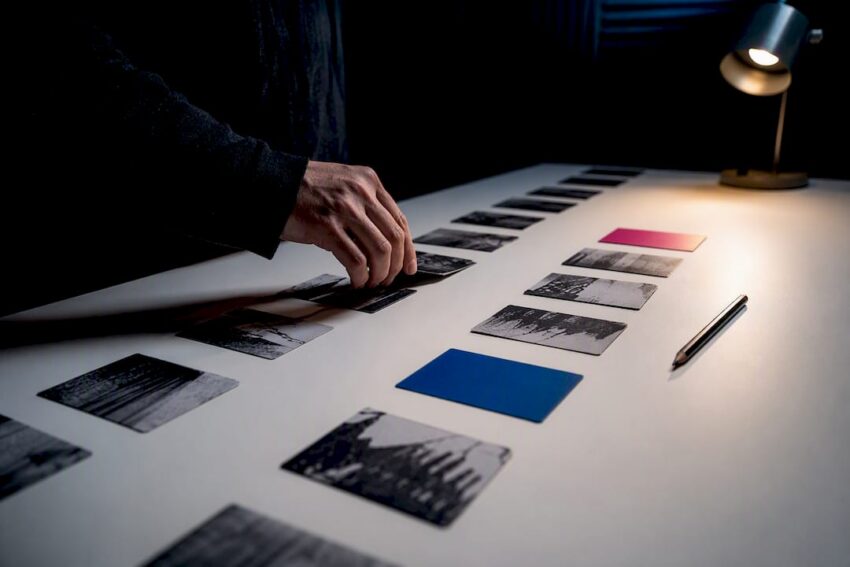
A horror beat sheet is a structural map of the key turning points a horror story needs, grouped into three acts: Setup, Turn, and Prestige. The strongest version isn’t a generic commercial template, it’s a 15-beat horror adaptation, popularized by writers like TL Bodine, that stretches out dread instead of rushing to a feel-good midpoint. Start by mapping those 15 beats onto scene cards before you write a single page of prose.
TL;DR:
- The horror beat sheet emphasizes a slow, dread-building structure with 15 specific beats, focusing on isolation and the emotional weight of loss.
- Key beats include establishing normalcy, first contact, false safety, and the darkest hour, with the climax typically near the story’s end at 90-95% completion.
- Writers should start by drafting the darkest hour before progressing to earlier beats to better calibrate tension and emotional depth.
- Subgenre variations, such as slasher or supernatural horror, shift the weight and timing of certain beats, especially investigation and resolution.
- Maintaining ambiguity, pacing scene variability, and delaying full threat revelation enhance suspense and keep tension from sagging between beats.
Table of Contents
- What Is a Horror Beat Sheet, and Why Does Horror Need Its Own?
- The 15 Horror Beats, Act by Act
- Adapting Save the Cat for Horror Without Losing Its Bones
- How Pacing and Climax Timing Shape the Scares
- Turning Beats Into Scene Cards or a Plottr Project
- Which Horror Tropes Line Up With Which Beats
- Beat Sheet Variations for Slasher, Psychological, and Supernatural Horror
- How to Keep Tension From Sagging Between Beats
- Common Pitfalls That Flatten a Horror Beat Sheet
- Nathaniel’s Take: Draft the Darkest Hour First
- Templates and Guides to Put This Beat Sheet to Work
- Sources
What Is a Horror Beat Sheet, and Why Does Horror Need Its Own?
Horror runs on a different engine than a romantic comedy or a heist thriller. A standard beat sheet built for commercial pacing wants momentum and reversals. Horror wants isolation, dread that compounds scene over scene, and a protagonist who keeps making the wrong call because the right one costs too much.
That’s why the 15-beat horror structure from StorytellingDB splits into three phases instead of forcing horror into a shape built for other genres:
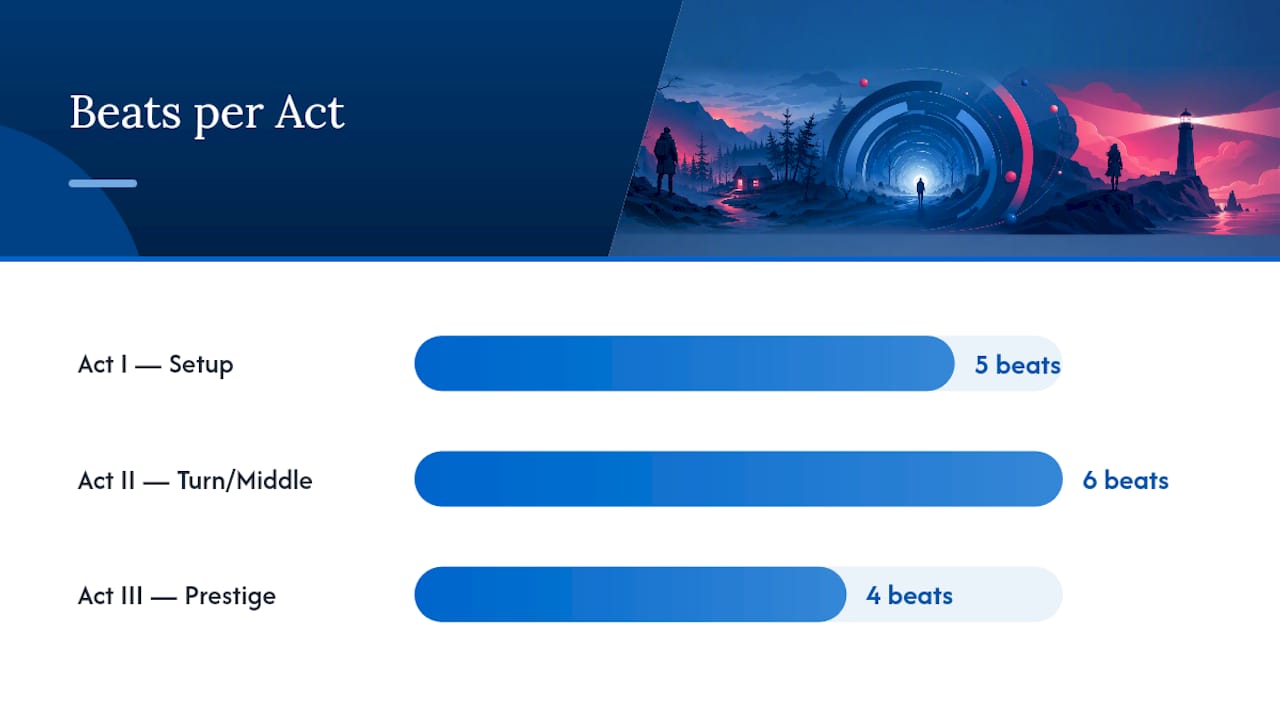
- Setup (Act 1): establishes the mundane world before it curdles, usually running about a quarter of the total story
- Turn (Act 2): the point where denial stops working and the threat becomes undeniable
- Prestige (Act 3): the confrontation and its aftermath, where the story pays off (or refuses to pay off) the dread it built
TL Bodine’s widely cited breakdown, “A Horror Beat Sheet”, gave this structure its lasting vocabulary, beats like “The World Is Not What It Seems” and “Evil Cannot Be Conquered, Only Delayed.” Save the Cat’s commercial framework offers useful bones, but as horror-focused breakdowns of that model point out, it needs real surgery before it fits the genre. Tools like Plottr’s horror beat sheet template have since built that adapted structure into something you can drag, drop, and time out against a manuscript.
The 15 Horror Beats, Act by Act
Here’s the full beat list with a one-line scene prompt for each, ready to drop into a scene card or outlining document.
- The world is not what it seems. Write a scene where the protagonist’s ordinary routine has one detail that’s slightly wrong and easy to dismiss.
- Establish normalcy. Show the protagonist’s relationships and daily stakes so their eventual loss means something.
- First contact. Give the protagonist a small, explainable brush with the threat, a noise, a missing pet, a strange visitor.
- Dismissal or denial. Have someone rationalize the first contact away, reinforcing the world’s false safety.
- Isolation begins. Cut off one support system, physical distance, a broken phone, a skeptical friend, so help gets harder to reach.
Turn (Act 2, the middle stretch where denial collapses)
- It gets real. Force an incident too big to explain away, the moment the protagonist admits something is actually wrong.
- Investigation. Send the protagonist digging for answers, research, a local legend, an old case file.
- False victory or false safety. Let them believe they’ve solved it or escaped it, then let that belief crack.
- Escalation. Raise the threat’s boldness or body count, proving the false safety was an illusion.
- Full isolation. Strip away the last resource, a car that won’t start, a landline that’s dead, a town that won’t believe them.
- Darkest hour. Bring the protagonist to their lowest point, stripped of allies, tools, and confidence.
Prestige (Act 3, the final stretch and aftermath)
- Decision to face it. Show the protagonist choosing to confront the threat instead of running, even knowing the odds.
- Confrontation. Stage the direct clash between protagonist and threat, physical, psychological, or both.
- The cost. Reveal what the confrontation took, a death, a piece of the protagonist’s sanity, a relationship that won’t survive.
- Evil cannot be conquered, only delayed. Close on an image or line suggesting the threat is contained, not destroyed.
For novels, expand a single beat like “It gets real” into a two or three scene sequence rather than one chapter. Screenplays tend to compress each beat into a scene or two, and short stories often collapse several early Setup beats into a single opening paragraph so the horror can breathe sooner.
Pro Tip: Write beat 11, the darkest hour, before you write beats 6 through 10. Knowing exactly how low your protagonist falls makes it far easier to calibrate how much hope to dangle earlier without undercutting the eventual gut punch.
Adapting Save the Cat for Horror Without Losing Its Bones
Save the Cat wasn’t built for dread, it was built for momentum and audience reassurance, and applying it unchanged tends to rush horror’s slow build. Practitioners who’ve broken down Save the Cat for horror point to specific beats that need reshaping rather than wholesale rejection.
- “Fun and Games” becomes “Lingering Tension.” Instead of a lighthearted midpoint stretch, use this space for quiet, unresolved dread, a character noticing something is off but staying silent about it.
- “B Story” becomes an isolation lever. Use the secondary relationship not for romantic comedy relief but to strip away support right when the protagonist needs it most.
- “All Is Lost” gets extended, not compressed. Horror’s darkest hour deserves more real estate than a single scene; let it stretch across two or three.
- Save the “Fun and Games” reversal for after the confrontation, not before it. A brief, false sense of relief right after the climax hits harder than one planted mid-story.
Before: a character solves a clue and feels triumphant. After: the character solves the clue and immediately realizes it means the threat is closer than they thought.
How Pacing and Climax Timing Shape the Scares
Act 1 in horror typically takes about a quarter of the story, giving readers enough time in the mundane world before things curdle, according to craft breakdowns of act structure. What happens after that first act matters more than how many jump scares you cram in.
Modern horror favors placing its climax near 90 to 95% of the total story, holding back full confrontation until nearly the end so dread has room to compound rather than resolve early.
That “lingering horror” approach means spacing quiet, character-driven scenes between shocks rather than stacking scares back to back. Save the full reveal of your monster or threat for as late as the story can bear it, ambiguity does more work than explanation for most of the run.
Turning Beats Into Scene Cards or a Plottr Project
Once the beat list is set, converting it into a working outline takes four steps:
- Allocate a rough word count or page count to each beat based on its act (Setup gets the least per beat, Prestige often gets the most).
- Write a one-sentence scene goal for every card, what the protagonist wants, and what stands in the way.
- Tag each card with tone (quiet, escalating, explosive) and stakes (personal, physical, existential).
- Sequence the cards and check that no two high-intensity beats sit back to back without a quiet beat between them.
Beat 6, “It gets real,” often works best split into two scene cards: one where the protagonist witnesses undeniable proof, and a second where they try and fail to tell someone who believes them. That failed confrontation with disbelief is often more unsettling than the original incident.
- Plottr’s horror template already sorts cards into Setup, Turn, and Prestige columns, matching this 15-beat list almost one-to-one.
- Export your timeline as a scene list once it’s built, useful for tracking pacing gaps before you start drafting prose.
Which Horror Tropes Line Up With Which Beats
Certain genre staples aren’t random, they’re beat-driven, and knowing which beat a trope belongs to keeps you from wasting it too early or too late.
The skeptical authority figure (a sheriff, a doctor, a parent) belongs at beat 4, dismissal or denial. Introduce them too late and the story loses a built-in source of tension between what the protagonist knows and what the world believes.
The “we should split up” moment is a beat 10 device, full isolation, not a beat 3 device. Using it too early strands your cast without enough established relationships for the eventual loss to sting.
The false ending where the threat seems dead almost always lands at beat 8, false victory, and its collapse fuels beat 9’s escalation. Readers who’ve seen enough horror expect this reversal, so the trick is making the collapse feel inevitable rather than cheap.
The cursed object or location typically triggers beat 3, first contact, giving the story a concrete, examinable source for the wrongness before the threat becomes personal. Films built on scene-by-scene escalation, the kind of structure you can trace almost beat for beat in something like Scream, show how tightly trope placement and beat placement can align once you start looking for it.
The “final girl” or last survivor archetype usually carries beats 12 through 15 alone, decision, confrontation, cost, and the delayed rather than defeated ending. Give her too much company through the Prestige act and the isolation that makes those beats work evaporates.
Beat Sheet Variations for Slasher, Psychological, and Supernatural Horror
The 15-beat skeleton holds across subgenres, but where the weight sits changes considerably.
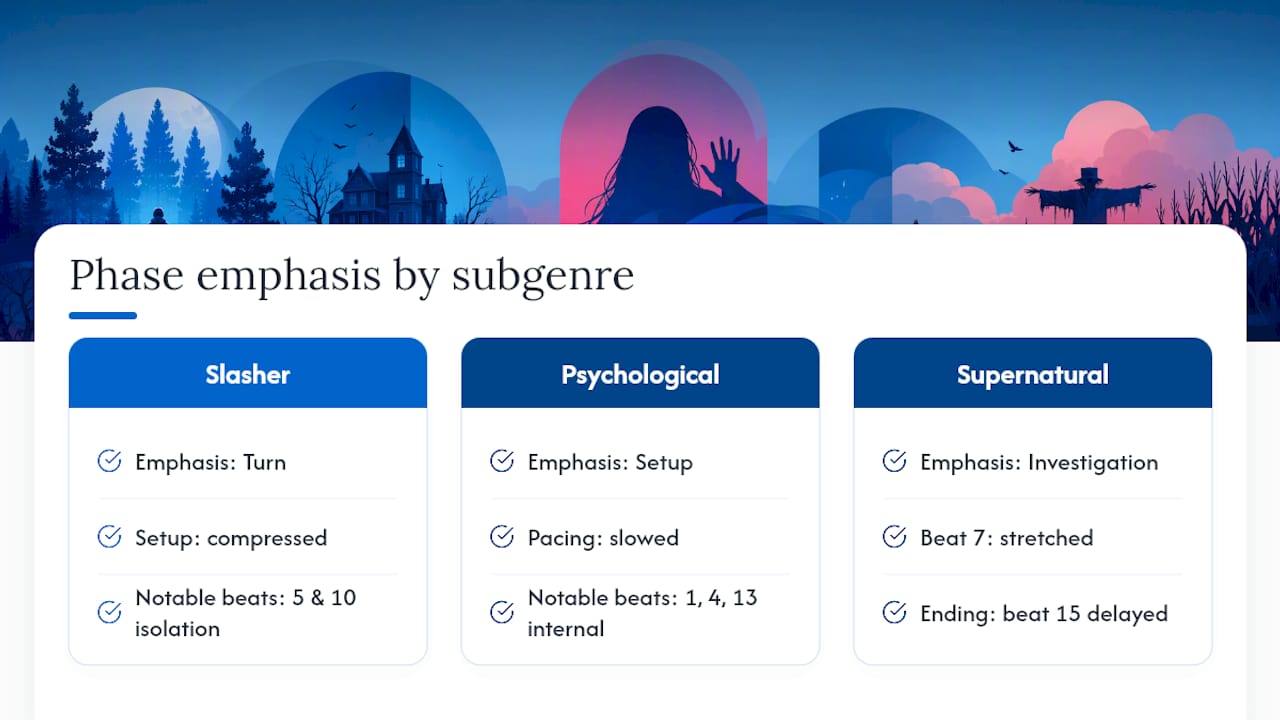
Slasher horror compresses Setup and spends most of its length in the Turn, cycling through escalation and false safety multiple times as the body count climbs. Isolation (beat 5 and beat 10) often gets literalized, a cabin, a summer camp, a phone line that’s been cut.
Psychological horror slows everything down and spends extra time on beats 1 and 4, the world not being what it seems and denial. The threat is frequently the protagonist’s own mind or memory, so beat 13’s confrontation is internal rather than physical. Readers looking for that register specifically will find sharper guidance in a craft guide to psychological horror, which goes deeper into pacing dread without relying on physical threat at all.
Supernatural horror tends to stretch beat 7, investigation, since uncovering the rules of a ghost, curse, or entity takes real narrative space. Beat 15’s “delayed, not conquered” ending fits supernatural stories especially well, since most hauntings and curses resist permanent resolution by design.
Whichever subgenre you’re writing, the three-act shell, Setup, Turn, Prestige, stays intact. What shifts is how long you linger in each phase and which beats absorb the extra weight.
How to Keep Tension From Sagging Between Beats
The beat sheet tells you what happens; it doesn’t automatically make any of it scary. Suspense lives in the gaps between beats, not in the beats themselves.
Vary scene length deliberately. A string of long, atmospheric scenes needs a short, sharp one to break the rhythm, and vice versa. Predictable pacing lets readers relax, which is the opposite of what you want heading into the Turn.
Give your protagonist partial information, never full clarity. Craft guides that focus on tone and sensory detail over plot mechanics note that a well-placed unreliable narrator or restricted point of view does more for suspense than any additional plot twist. Readers fill in gaps with worse possibilities than you could write outright.
Foreshadow specific, small details rather than vague dread. A recurring guides advises anchoring your foreshadowing in a concrete detail like a smell, sound, and reusing it right before a major beat pays dividends. That callback rewards attentive readers without spelling out the danger too soon.
Resist the urge to explain the monster early. Ambiguity about the threat’s rules and limits is often scarier than a fully explained mythology, save the explanation, if you give one at all, for the Prestige act.
Common Pitfalls That Flatten a Horror Beat Sheet
Even a well-built beat sheet can produce a flat draft if you fall into a few predictable traps.
Treating the beat sheet as a rulebook instead of a heuristic. If a draft reads flat, the fix is usually moving a beat to raise the emotional stakes or deepen the protagonist’s isolation, not forcing the story to match the outline exactly.
Skipping the mundane world in Act 1. Rushing past beats 1 through 3 to get to the scares faster robs the eventual loss of any weight, readers need to see what’s at stake before it’s threatened.
Letting the midpoint feel like relief instead of tension. Borrowing Save the Cat’s “fun and games” beat unmodified drains the Turn act of momentum, that space needs unease, not a breather.
Revealing the threat too early or too fully. Once the monster’s rules and limits are fully known, dread has nowhere left to grow, hold at least part of the mystery until the Prestige act.
Isolating the protagonist too soon. Cutting off support before beat 5 or beat 10 removes the tension of watching help slip away in real time.
Rushing the darkest hour. A single-scene beat 11 rarely earns the confrontation that follows, give the lowest point room to actually feel low.
Nathaniel’s Take: Draft the Darkest Hour First
I write the darkest hour beat before anything else. Once I know exactly how far a character falls, in something like Stories of a Condemned Soul, everything earlier in the outline gets calibrated against that low point instead of guessed at. That habit came from noticing how often early drafts of dread stories peak too soon, then have nowhere left to go.
Try it on your next outline: write beat 11 first, then work backward through beats 6 through 10, and forward through the confrontation and cost. The craft guide to writing psychological horror covers more on calibrating stakes this way, if that’s the register you’re working in.
— Nathaniel
Templates and Guides to Put This Beat Sheet to Work
If you want the 15 beats without rebuilding the framework from scratch, the craft guide to writing psychological horror breaks down beat-to-scene conversion in more depth, including how to tag tone and stakes on each card so dread survives the jump from outline to draft. It’s built for exactly the workflow described above: allocate length, write scene goals, tag tone, then sequence.
If you’d rather see the beat sheet in action than build one from theory, Some novels apply this exact structure, with isolation stretched past comfort, a darkest hour that earns its weight, and an ending that delays evil instead of neatly defeating it. The Nether and Stories of a Condemned Soul are both free to read on Kindle Unlimited, and either one doubles as a working example of beats 10 through 15 done at full length. Start there, read the darkest hour chapter with the beat sheet open beside it, and you’ll see exactly where the structure earns its keep.