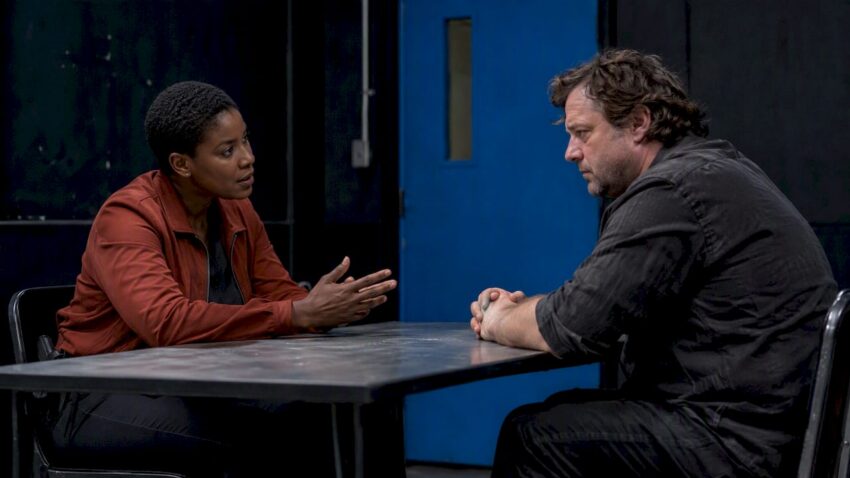
The Nether is Jennifer Haley’s play about a virtual world built for people’s most forbidden desires, and it works as both a crime story and a moral argument. It asks whether an act that harms no physical person still carries consequences, and it refuses to hand the audience an easy answer. Below you will find what the play is about, how its structure works, what it says about identity and responsibility online, and what to know before you watch or read it. Because our own novel shares the title, we also explain how the two differ.
TL;DR
- The Nether is a play by Jennifer Haley that blends a police procedural with a science-fiction thriller, set in a future where life has largely moved online.
- Its central question is whether a virtual act with no physical victim is harmless, or whether fantasy shapes the person who lives it out.
- The investigator’s interrogations drive the plot, and each conversation tests a different answer to that question.
- The play contains disturbing material involving the sexualization of children in a virtual setting. Read the content warnings below before you decide.
- Nathaniel Connors’ novel The Nether is a separate work of dark supernatural fiction with the same title.
Table of Contents
- What The Nether is about
- The characters and how the investigation unfolds
- The central themes
- What critics and the playwright say
- How to read The Nether
- Content warnings
- Our perspective
- Where to find our novel
- If you want more stories that test your conscience
- FAQ
- Sources
What The Nether is about
According to a study guide published by a Toronto theatre company, The Nether is part police procedural and part sci-fi thriller. A rookie detective investigates a man named Sims and a virtual realm called the Hideaway, where users can have sex with and murder children. The same guide notes that the play premiered in 2013 at Center Theatre Group’s Kirk Douglas Theatre in Los Angeles.
That summary is blunt because the play is blunt. The setup is a crime story: a detective, a suspect, an interrogation room and a trail of evidence. The material inside that frame is something most audiences would rather not look at. Haley’s choice to wrap an uncomfortable subject in a familiar genre is the first thing to understand about the work. The procedural form promises that a crime will be named, a culprit found and a verdict reached. The play then keeps asking whether the verdict is as simple as the form suggests.
The world outside the screen
The same study guide describes the play’s setting as a dystopian future in which social and professional life has moved predominantly online. Environmental degradation has alienated people from the natural world, and people are increasingly disconnected from one another.
This background matters more than it first seems. The virtual world is not just a place where bad things happen. It is where a lonely, depleted population goes to feel something. Nobody in the play has a good reason to stay in the physical world, and that makes the appeal of the Hideaway easier to understand and harder to dismiss. The audience is never allowed the comfort of thinking the users are a different kind of people from everyone else.
How the Hideaway works
The study guide explains that the Hideaway recreates the sights, sounds, smells and feelings of an innocent time gone by. The play asks what is attractive about a consequence-free existence, and whether taboo virtual activity could be a harmless outlet.
The design is the quiet horror of the piece. The Hideaway is not drawn as a dungeon. It is warm, ordered and nostalgic, with a surface of gentleness over the thing it permits. The gap between the pleasant setting and the activity it hosts produces much of the play’s unease. A reader or viewer is invited to feel the pull of the place before understanding what it is for.
The characters and how the investigation unfolds
The main characters, per the same study guide, include Detective Morris, Sims (whose avatar is Papa), Doyle, Iris and Woodnut. Morris investigates Sims and interrogates Doyle to get information about the Hideaway.
Think of the cast as a set of positions in an argument:
| Character | Role in the story | Position in the argument |
|---|---|---|
| Detective Morris | The investigator who questions Sims and Doyle | The law, and the belief that harm must be answered |
| Sims (avatar: Papa) | The figure behind the Hideaway | The case that the realm is a controlled, humane outlet |
| Doyle | A man questioned for information about the Hideaway | The user, whose answers show what the place means to those inside it |
| Iris | A character connected to the virtual world | The way the fantasy touches a person, not a concept |
| Woodnut | Another figure tied to the Hideaway | A reminder that the world is populated by people, not only ideas |
The table sketches roles only, and we leave the finer details of the plot to the play itself. That is deliberate. The Nether depends on what the audience learns and when, and a summary that spoils the sequence would flatten the work.
Why the interrogation structure works
A play that debated virtual ethics in the abstract would feel like a seminar. Haley instead gives each idea a person who needs something. The detective wants a confession and access. The suspect wants to defend a place he believes in. The user wants to protect what he has found there. Each argument is spoken by someone with a stake, which makes it sound less like a thesis and more like a defense.
Interrogation scenes also let the play control information. In a procedural, the audience learns as the detective learns. That shared ignorance makes the audience complicit in the investigation, and it means the moral discomfort arrives at the same pace as the facts.
The central themes
Does a virtual act have consequences?
This is the question everything else orbits. The study guide frames it as whether virtual sexual and violent fantasies have consequences, and the play combines its dystopian setting and police-procedural structure to raise questions about online ethics and virtual relationships.
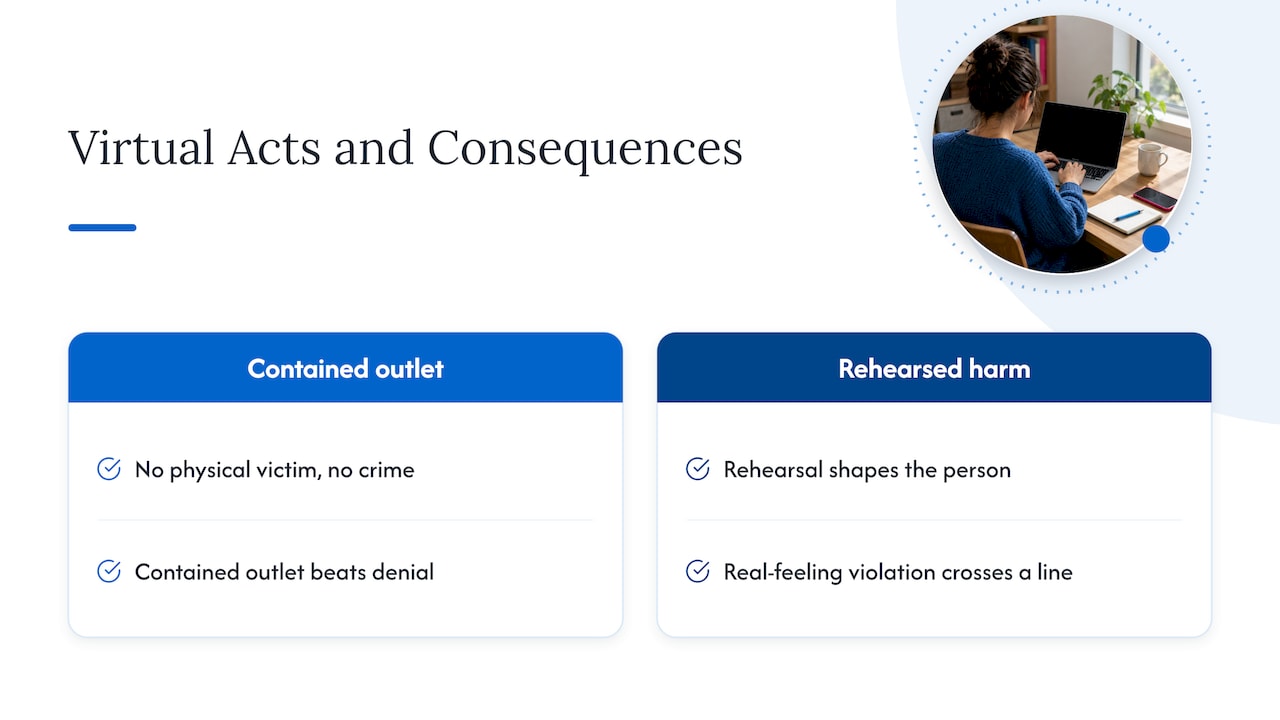
There are two broad positions, and the play lets both speak. One says that without a physical victim there is no crime, and that giving a harmful impulse a contained outlet is better than denying it. The other says that rehearsing an act shapes the person, and that a virtual world designed to make a violation feel real has already crossed a line. Haley does not pick a side for the audience. She makes each side persuasive enough to be uncomfortable.
Identity, anonymity and privacy
The study guide also notes that the play asks whether online anonymity and identity can free people from consequences, whether virtual relationships are real, and whether there are legal or moral limits to online interaction.
The avatar is the key device. Sims becomes Papa inside the Hideaway, and the split between name and avatar is the play’s way of dramatizing a familiar online habit: becoming someone else where nobody can see you. In an interview with Time Out London, Haley questions whether inhabiting an online identity fundamentally changes a person or simply reveals a different, darker side of who they already are. The two readings are very different. In the first, the world creates the monster. In the second, it only lets him out.
Privacy is the other half. The detective’s job is to look into a space its users consider private. The play lets you feel both the instinct to protect that privacy and the revulsion at what it shelters, and it never lets one cancel the other.

Escape and nostalgia
The Hideaway sells an innocent past that no longer exists in the play’s damaged physical world. That is a theme that reaches well beyond the story’s single, disturbing use of it. People go to virtual places for comfort, for control and for the version of life they believe they lost. Haley takes that ordinary impulse and points it at its worst possible object, so the audience sees how the same machinery that produces a harmless game could also produce something monstrous.
What critics and the playwright say
Critics have often read The Nether as a moral examination. The New York Times review describes it as a disturbing look at moral responsibility and the boundary between physical and virtual reality, and suggests it functions as a parable for the future of the internet. In that reading, the play forces audiences to face uncomfortable truths about their own digital lives.
The playwright’s own account of how the piece began is useful context. In her Time Out conversation, Haley says she came across child avatars used in sexual situations in Second Life. It outraged her, and it changed the play from an intellectual exercise into something with real anger behind it. That origin explains the tone. The play is not a detached thought experiment about technology. It is a response to something she found disturbing and could not dismiss.
In remarks on winning the 2014 Francesca Primus Prize, reported by the American Theatre Critics Association, Haley says the ideas came from a subconscious place, and that her research turned up material about living out our imaginations. She also cites Carl Jung’s view that the world of dreams and imagination is as real as physical reality as a thematic anchor. That idea sits at the heart of the play’s argument. If imagination is real in its own way, then a fantasy built in full sensory detail cannot be dismissed as nothing.
How to read The Nether
A few approaches help whether you are studying the play, writing about it or preparing to see it.
- Track who is asking the question. Each major scene gives one character a stake in a particular answer. Notice what each person stands to lose.
- Watch the setting. The warmth of the Hideaway and the bleakness of the outside world are in deliberate contrast. Ask what each one is selling.
- Separate the genre from the ethics. The procedural structure promises resolution. Ask whether the ending delivers moral resolution or only narrative closure.
- Notice the language of avatars. The difference between a person’s name and their avatar’s name is where the play locates responsibility.
- Resist the neat verdict. If you leave the play certain, reread it. It is built to unsettle certainty in either direction.
Common mistakes in writing about it
Students and reviewers often reduce the play to a single thesis, such as “technology is dangerous” or “fantasy is harmless.” Neither fits. The play is more interested in how people justify what they do when nothing external stops them. Another frequent error is to treat the shocking subject as the point. The subject is the pressure applied to the ideas. The point is what the ideas do under pressure.
Content warnings
The play is disturbing, and you should know what it contains before you go. According to American Theatre, it includes a scene implying sexual contact between a young girl and an older man, and it depicts an online community of people posing as children and pedophiles. The study guide’s own summary of the plot adds that users of the Hideaway can have sex with and murder children in the virtual realm.
If that material is a firm no for you, that is a reasonable decision, and you can get the play’s ideas through the commentary quoted above without sitting through the staging. If you want a fuller warning list for our novel, see our guide to The Nether trigger warnings, which covers the novel, the play and the Minecraft dimension that shares the name.
Our perspective
We get asked about the title more than almost anything else. Readers type “The Nether” and find a celebrated play, a game dimension and our novel, and each one means something different. We want to be clear about that, because a reader deserves to know which one they are about to open.
Haley’s play is a work we respect for what it does well: it takes a technological question and makes it a moral one. What stays with us is the way it treats guilt. The people in it are not cartoons. They are people who have built reasons for what they do, and the play’s pressure comes from watching those reasons come under examination.
Our own book comes from a different tradition. We write dark supernatural fiction about revenge, guilt and redemption, and about the psychological monsters that sit deeper than any single villain. Our novel is a separate story and not an adaptation, a response or a retelling of the play. If the play’s questions about conscience and consequence draw you in, you will find the same seriousness about the human cost of darkness in our fiction, in a supernatural register rather than a virtual one.
We write slowly and with attention to character, because the horror we care about is the kind that lingers after the last page. That is the experience we are trying to give readers, and it is why every title is available to Kindle Unlimited subscribers at no added cost.
Nathaniel
Where to find our novel
If the analysis above has you curious about dark fiction that treats guilt and consequence seriously, you can read about our novel on its own page, The Nether by Nathaniel Connors. The books are available as ebooks and paperbacks, and they are free to read for Kindle Unlimited subscribers.
Browse the full catalog, including The Nether Series and the EA200 Series, on our books page. If you are deciding between subscribing and buying, our Kindle Unlimited versus buying ebooks guide lays out the trade-offs. For a spoiler-safe read on our book, see the author-sourced review of The Nether.
If you want more stories that test your conscience
Readers who value the play’s moral weight often ask where to go next. The play’s central pull is an ethical dilemma dressed as a thriller, and a good deal of speculative fiction works the same ground. We have collected novels built around hard ethical choices in dystopian ethics books, and if you want to know who populates our own story, see the characters of our novel. If you came looking for lines to quote, our page on The Nether quotes separates the novel from the play.
FAQ
What is the main message of The Nether?
There is no single message, which is part of the point. The play asks whether virtual acts carry real consequences, whether online anonymity frees people from responsibility, and whether a fantasy lived out in full sensory detail is harmless. Critics such as the New York Times reviewer read it as a parable about the future of the internet.
Who are the main characters in The Nether?
The main characters include Detective Morris, Sims (whose avatar is Papa), Doyle, Iris and Woodnut. Morris investigates Sims and questions Doyle to learn about the Hideaway, the virtual realm at the center of the story.
Is The Nether based on a real event?
The play is fiction, but Haley has said that finding child avatars used in sexual situations in Second Life outraged her and changed the piece from an intellectual exercise. The story and characters are invented, while the unease behind them is drawn from real online behavior she encountered.
Is the play suitable for everyone?
No. It includes a scene implying sexual contact between a young girl and an older man, and it depicts an online community of people posing as children and pedophiles. Many theatres issue their own advisories, so check the one for the production you plan to attend.
Is Nathaniel Connors’ The Nether the same as the play?
No. Our novel is a separate work of dark supernatural fiction that shares the title. It is not an adaptation of Haley’s play, and you can read it free with a Kindle Unlimited subscription.
Sources
- The Nether study guide, Studio 180 Theatre (2018)
- Review: Jennifer Haley’s ‘The Nether’ Explores the Dark Side of the Web, The New York Times
- Jennifer Haley on portraying the horrors of the digital age, Time Out London
- Jennifer Haley wins 2014 Francesca Primus Prize, American Theatre Critics Association
- Virtual Reality, Real Vices in ‘The Nether’, American Theatre