
A good horror logline is one or two sentences that name a protagonist, a threat, a conflict and the cost of failure, and leave the reader wanting to know what happens next. Below you will find examples from well-known films, the formula that sits under them, and original rewrites for psychological and dystopian horror, the territory we write in.
TL;DR
- A horror logline is one sentence (two short ones at most) with a protagonist, a threat, a goal and stakes.
- Aim for roughly 25 to 40 words, and tease the reader instead of summarizing the plot.
- Psychological horror works best when the logline names what is wrong inside the character, not just the monster outside.
- The most common failures are a vague goal, no antagonist, no stakes and a crammed synopsis.
- Use the fill-in template and the before/after table below to draft three versions, then keep the one that raises the best questions.
Table of Contents
- What a horror logline actually does
- Horror logline examples from famous films
- The formula behind a horror logline
- Psychological horror loglines: the fear is inside
- Original examples: weak version, strong version
- Common mistakes that sink a horror logline
- A five-step process for drafting yours
- Where to use a logline once you have it
- Perspective: why we write with the logline in mind
- See these ideas in full-length fiction
- FAQ
- Sources
What a horror logline actually does
A logline is a sales sentence. It tells a producer, reader, editor or friend what your story is and why they should care, fast. The BBC Writers’ guidance on loglines treats it as both a description and a persuasion tool: specific enough to make the premise distinctive, short enough that it does not turn into a synopsis.
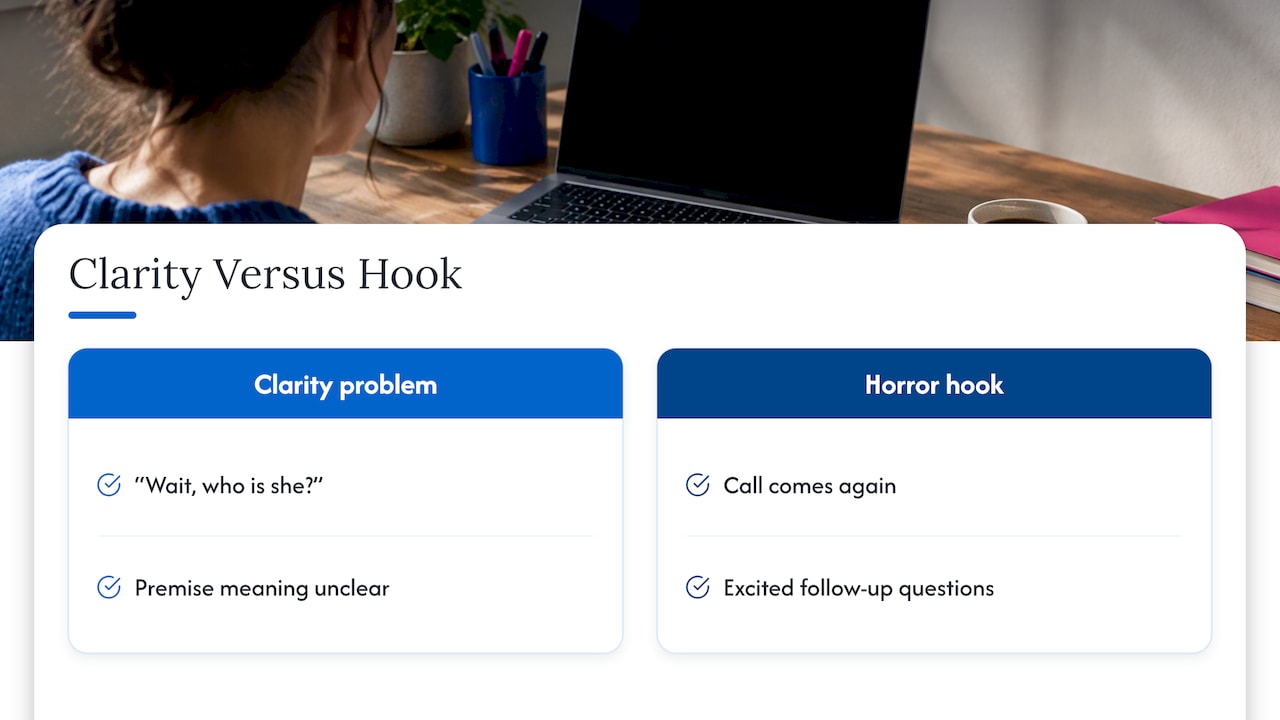
In horror, the job is a little different. Comedy loglines can lean on tone. Horror loglines have to promise dread. The reader should feel a small chill and a specific curiosity. Producer Jeffrey Reddick, as summarized by Act Four Screenplays, suggests the best horror loglines work as a tease that makes people ask excited follow-up questions, not questions about what the premise even means.
That distinction is the whole craft. “Wait, who is she?” is a clarity problem. “Wait, what happens when the call comes again?” is a hook.
Horror logline examples from famous films
These are paraphrased from published collections, so you can see how the pros compress a movie into a sentence. The wording below is ours; the linked pages hold the full lists.
| Film | What the logline gives you | What it leaves out on purpose |
|---|---|---|
| The Exorcist | A mother turns to two priests when her young daughter is possessed | How the possession escalates, what the priests sacrifice |
| Psycho | A secretary steals money, runs, and lands at a remote motel run by a man dominated by his mother | The twist that defines the film |
| The Babadook | A single mother and her child spiral into paranoia after a strange children’s book appears in their home | Whether the creature is real or grief made visible |
| Paranormal Activity | A couple in a new suburban home is increasingly disturbed by a nightly demonic presence | Any explanation of why |
| The Blair Witch Project | Three film students vanish in the Maryland woods while making a documentary about a local legend, leaving only their footage | What the footage shows |
| Night of the Living Dead | A group hides from bloodthirsty zombies in a farmhouse | Everything except the siege |
The first two come from FilmDaily’s horror logline list, where the Psycho line even includes the $40,000 the secretary takes. The Babadook line follows Killer Shorts’ 2020 breakdown, which also covers Funny Games, The Silence of the Lambs, It, The Thing and Green Room. The Paranormal Activity, Blair Witch and Night of the Living Dead lines appear in a StoryAlity analysis of low-budget, high-return films. For more phrasing of The Exorcist, see Neil Chase’s logline collection.
What these examples have in common
Read the table again and notice the pattern.
- The protagonist is one person or a tight unit. A mother, a secretary, a couple, three students. Never “a group of various people.”
- The threat is named or clearly implied. A possession, a demonic presence, a legend.
- The setting is small. A farmhouse, a motel, a suburban home, a patch of woods. Horror loves contained spaces. One screenwriting critic on a horror logline pitch challenge notes that the genre works best in isolated scenarios with few ways out, because characters are forced to face what scares them.
- Nothing is explained. The best lines hold back the answer to the central mystery.
The formula behind a horror logline
Most professional guidance reduces to one skeleton. Hollywood Writers Group gives it as: when an inciting incident happens, a protagonist must pursue a goal, before the stakes or ticking clock hit. Adapted for horror, think of it as five slots:
- Trigger: the event that breaks normal life.
- Protagonist: one specific person, with a defining flaw or wound.
- Threat: the monster, presence, system or secret.
- Goal: what the protagonist must do.
- Stakes or clock: what is lost, and by when.
Template:
When [trigger], a [flawed protagonist] must [goal] before [threat achieves its cost].
How long should it be?
Short. Killer Shorts describes the ideal as one to two sentences that include the main character, the conflict or antagonist, and time and place if they matter. The BBC’s guidance says a logline is normally a single sentence, with two short ones acceptable when necessary. One screenwriting guide for horror pitches puts the sweet spot at about 25 to 40 words, and that matches what we see in the examples above. If you hit 60, you are writing a synopsis.
Psychological horror loglines: the fear is inside
Psychological horror shifts the question from “fear of” a monster to “fear that” something is wrong: with the house, the mind, the marriage, the memory. That framing comes from Scriptease’s guide to psychological horror screenplays, which says the aim is lingering dread. A logline for this subgenre has to plant that doubt in a single sentence.
The formula changes in two places:
- The protagonist’s vulnerability becomes the engine. Guilt, grief, addiction, a lie they told. A craft guide on scary stories advises tying the threat to a flawed protagonist’s vulnerability, with consistent rules for the threat, an everyday trigger, escalating costs and a difficult sacrifice.
- The threat is ambiguous. Is it supernatural, or is the character coming apart? The logline should keep both readings alive.
If you want the longer craft argument for building dread without gore, we cover it in how to write psychological horror that sticks, and the line-level tactics are in our psychological horror craft guide.
Original examples: weak version, strong version
The following loglines are ours, written for this guide to show the revision process. They are not from published books or films.
| Weak draft | Why it fails | Stronger version |
|---|---|---|
| A woman is haunted by her past and must face her fears. | No trigger, no threat, no stakes. Could describe any story. | After her husband’s funeral, a widow finds his handwriting in notebooks she never bought, each entry predicting a death she can still prevent. |
| A scary thing happens in a hospital and a nurse has to deal with it. | “Scary thing” is a placeholder. No wound. | A night-shift nurse who buried a fatal mistake starts hearing the dead patient’s call light ring every night, each ring leading her closer to the one person who knows the truth. |
| In a dystopian future, people lose their memories and one person fights back. | Generic world, generic hero, no cost. | In a city that rations memories, an archivist discovers her own signed confession to a crime that has not happened yet, and has three days to learn whom she is protecting. |
| A plague hits a town and people try to survive. | A premise, not a story. No decision. | When plague returns to a quarantined island town, a ferry captain must choose who to leave on the dock before the last boat departs at dawn. |
What changed each time:
- A concrete trigger replaced a mood. “Haunted by her past” became handwriting in notebooks.
- A cost appeared. A death she can prevent, three days, the last boat.
- A choice sits at the center. Horror lands harder when the protagonist must sacrifice or betray, not just run.
A dystopian horror twist
Dystopian horror has one extra trap: the world eats the story. Writers pour words into the setting (“in a future ruled by…”) and forget the person. Put the world in a subordinate clause and the person in the main one. In the memory example above, the rationing is a clause; the archivist’s confession is the engine.
Common mistakes that sink a horror logline
Research-minded screenwriting sources keep naming the same problems. One field guide on loglines lists a vague goal, no antagonist, no stakes and a crammed synopsis. Feedback from a horror logline pitch challenge adds endings that drift, setups that cover only the first act, unclear links between story details, and concepts that strain belief.
Here is how to spot each in your own draft:
- Vague goal. If the verb is “deal with,” “survive” or “face,” pick something the reader could film. “Burn the notebooks.” “Find the buyer.”
- No antagonist. Even in psychological horror, something opposes the protagonist. It can be a memory, a person, a rule, a version of herself. Name it.
- No stakes. Ask what happens if she fails. If the answer is “nothing much,” there is no horror.
- Crammed synopsis. Two subplots and a twist in one sentence reads as noise. Cut to the spine.
- Explaining the mystery. If the logline resolves the central question, the reader has no reason to continue.
A five-step process for drafting yours
- Write the messy version. Three sentences, no limits. Say what actually happens.
- Circle the single decision. The moment where your protagonist has to choose is your center.
- Fill the template. Trigger, flawed protagonist, threat, goal, stakes. One slot, one phrase.
- Cut to 25 to 40 words. Remove names (use a role), remove backstory, remove adjectives that tell instead of show.
- Test the question. Hand it to someone and ask what they want to know. If they ask what the premise means, rewrite for clarity. If they ask what happens next, you are done.
Write three different versions, each emphasizing a different element: one on the threat, one on the wound, one on the clock. Then pick whichever raises the most interesting follow-up question.
If your story is a short film, the logline is also the first step toward structure. Our horror short film outline turns a premise into a 6 to 10 page beat sheet, and our guide on coming up with a concept for a horror short helps before the logline stage.
Where to use a logline once you have it
A logline travels. You will use it in several places, and each wants a slightly different cut:
- Query letters and pitch emails. The first line after the greeting. Keep the full 25 to 40 words.
- Contest and script-platform submissions. Often capped by character count. Keep a 20-word version ready.
- Book blurbs and store pages. The logline becomes the first line of the description, then the blurb expands on it.
- Conversation. The version you can say aloud without looking at notes. If you stumble, simplify.
Keep a file of versions. A tight logline is also a diagnostic: if you cannot write one that excites you, the story may not have found its center yet, and that is useful to learn before you write 80,000 words or 90 pages.
Perspective: why we write with the logline in mind
Every story we publish started as a single uncomfortable question. In The Nether and the Evolution A200 books, the question was never “what is the scariest thing we can show?” It was “what does this person carry that the threat can use?”
That is why we lean on revenge, guilt and redemption. A monster is a plot device. A character who cannot forgive himself is a story. When we shape a premise, we test it the way a logline demands: who is this, what is coming for them, what will it cost, and what do they have to give up?
We think readers of dark supernatural and dystopian fiction want exactly that: dread with a pulse, plots that stay with you after the last page. If your logline can promise that in 30 words, you are already writing the kind of horror people remember.
Nathaniel
See these ideas in full-length fiction
If you would rather read horror built on psychological stakes than study it, our books are a good place to start. The Nether series and the EA200 series cover dark supernatural fiction and dystopian horror, and they are free to read for Kindle Unlimited subscribers, with ebook and paperback formats on Amazon. For a post-collapse story, begin with Evolution A200: A Bubonic Apocalypse.
Not sure which to pick? Our list of dark supernatural books for readers who want real dread is a good map, and our Kindle Unlimited tips help you get the most from a subscription.
FAQ
How long should a horror logline be?
One sentence is the norm, and two short sentences are acceptable when necessary. In practice, 25 to 40 words is a comfortable range. Anything longer starts to read as a synopsis and loses the tease.
What should every horror logline include?
A protagonist, a threat or antagonist, a goal, and stakes. Time and place help when they sharpen the premise, such as a quarantined island or a remote motel. Leave out the ending and the twist.
How is a psychological horror logline different from a monster-movie logline?
It centers the character’s inner wound and keeps the threat ambiguous. Instead of naming only what chases the protagonist, it hints at what is wrong in her mind, memory or relationships. The reader should be unsure whether the danger is outside or inside.
Can I use the same logline for a novel and a short film?
Yes, the structure is identical. A short film premise usually needs a narrower situation and a single decisive moment, so check that your logline could plausibly play out in a handful of scenes before you commit.
Should the logline include the protagonist’s name?
Usually not. A role or defining trait (a widow, a night-shift nurse, a ferry captain) is more vivid in one sentence and saves words. Names mean nothing to a reader who has not met the character yet.
Sources
- Writing Loglines, BBC Writers
- 12 Horror Loglines You Can Learn From, Killer Shorts
- 28 Suspenseful Horror Logline Examples, FilmDaily.tv
- StoryAlity: Examining the Loglines of the Top 20 RoI Films
- 25+ Original Logline Examples, Neil Chase Film
- 10 Takeaways from 4 Horror Producers, Act Four Screenplays
- How to Write a Psychological Horror Screenplay, Scriptease
- Screenwriting Logline Tips, Hollywood Writers Group
- How to Write a Horror/Scary Story, Drafts Rush
- The Horror Logline Pitch Challenge, Scriptshadow
- How to Write a Logline, One More Draft