Minimal dialogue horror is a story that tells its fear through what you see, hear and imagine, with spoken lines kept to the few that matter. It works because the audience fills the quiet with their own worst guesses. The craft is not limited to film: the same restraint shapes the books we write, including The Nether and the Evolution A200 novels, which you can read free with Kindle Unlimited.
TL;DR
- Minimal dialogue is not the same as a silent film: sound, performance and imagination carry the story instead of speech.
- Silence frightens because it creates expectation and vulnerability, and it lets you imagine what the story withholds.
- Films like Hush, A Quiet Place and The Substance show three different ways to do it.
- On the page, the same effect comes from character, withheld information and lean description.
- If you want that kind of dread in fiction, start with the Nether and EA200 series on Kindle Unlimited.
Table of Contents
- What minimal dialogue horror actually means
- Why silence unsettles us
- Three ways films do it
- The old roots
- What it costs the storyteller
- The same craft on the page
- Where to find it in our books
- Start reading
- Our view
- FAQ
- Sources
What minimal dialogue horror actually means
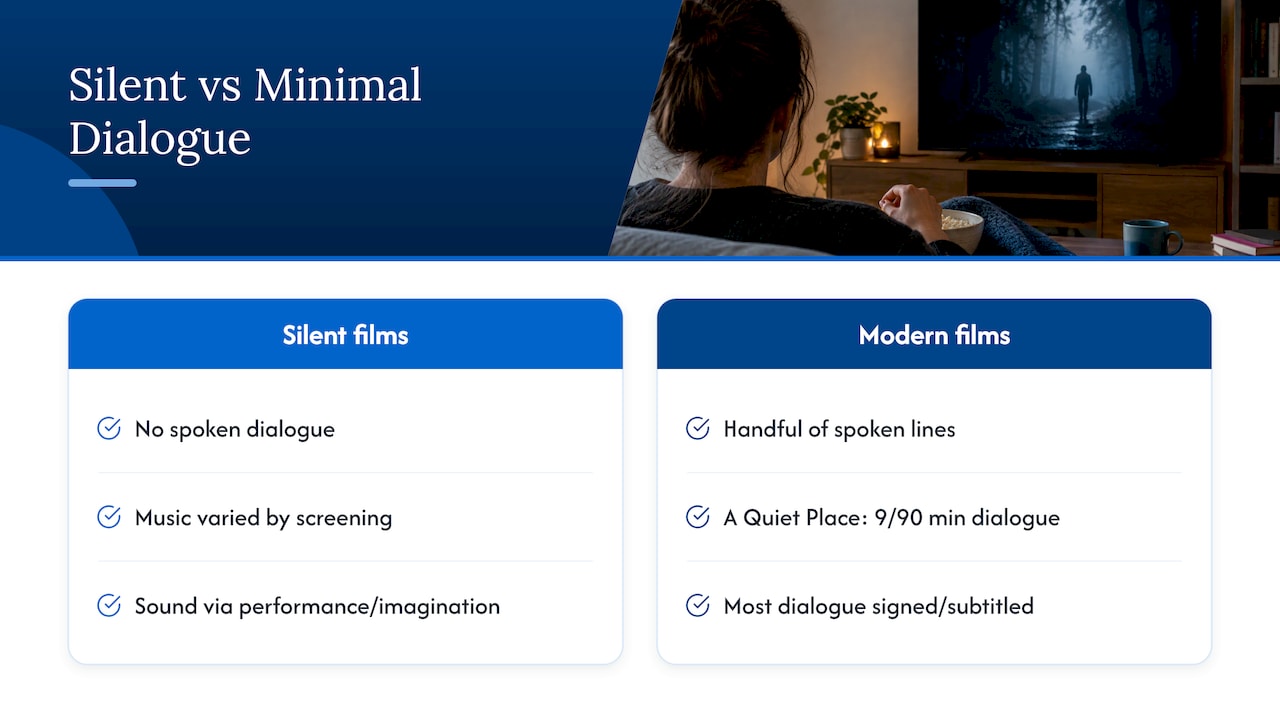
It is a spectrum. At one end sit true silent films, such as the 1920s gothic classics. At the other sit modern films with a handful of spoken lines. A Quiet Place is the best-known example: only nine of its ninety minutes contain spoken dialogue, and most of that is signed and subtitled.
The difference from a silent film matters. Silent cinema was never really quiet. One academic essay in Offscreen notes that its musical accompaniment varied from screening to screening, and that the original score for Nosferatu was lost and only reconstructed in 1994. The same essay argues that silent horror shifts sound into performance and imagination rather than removing it.
So minimal dialogue is a choice about where information lives. Instead of characters explaining their fear, the story shows it in a face, a footstep or a room that is too still.
Why silence unsettles us
Director John Carpenter put it plainly in an NPR interview: silence can be very terrifying, because the audience is always afraid of what you are going to show them. Silence plays with that expectation.
Mike Flanagan, who directed Hush, described his approach as built on silence, imagination and waiting. He called a jump scare an involuntary reflex that diffuses tension, and advised using negative space and darkness so viewers fear what could happen rather than what does.
The Paranormal Activity director Oren Peli made the same point about sound. He said an unheard noise unnerves more than a visible one because imagination is more effective than what can be shown. And the contrast is a tool too: James Wan likes to hit viewers with a harsh score and then cut to dead silence, because the jump between loud and quiet is what sets you on edge.
The common thread: dread is a collaboration. The story builds the room, and you furnish it with fear.
Three ways films do it
| Film | Approach | What carries the story |
|---|---|---|
| Hush | A deaf heroine in one location | Sound design and non-verbal performance |
| A Quiet Place | Survival by being silent | Sound as a weapon, family bonds |
| The Substance | Very little talk, heavy symbolism | Images and recurring motifs |
Hush: sound pulled into the foreground
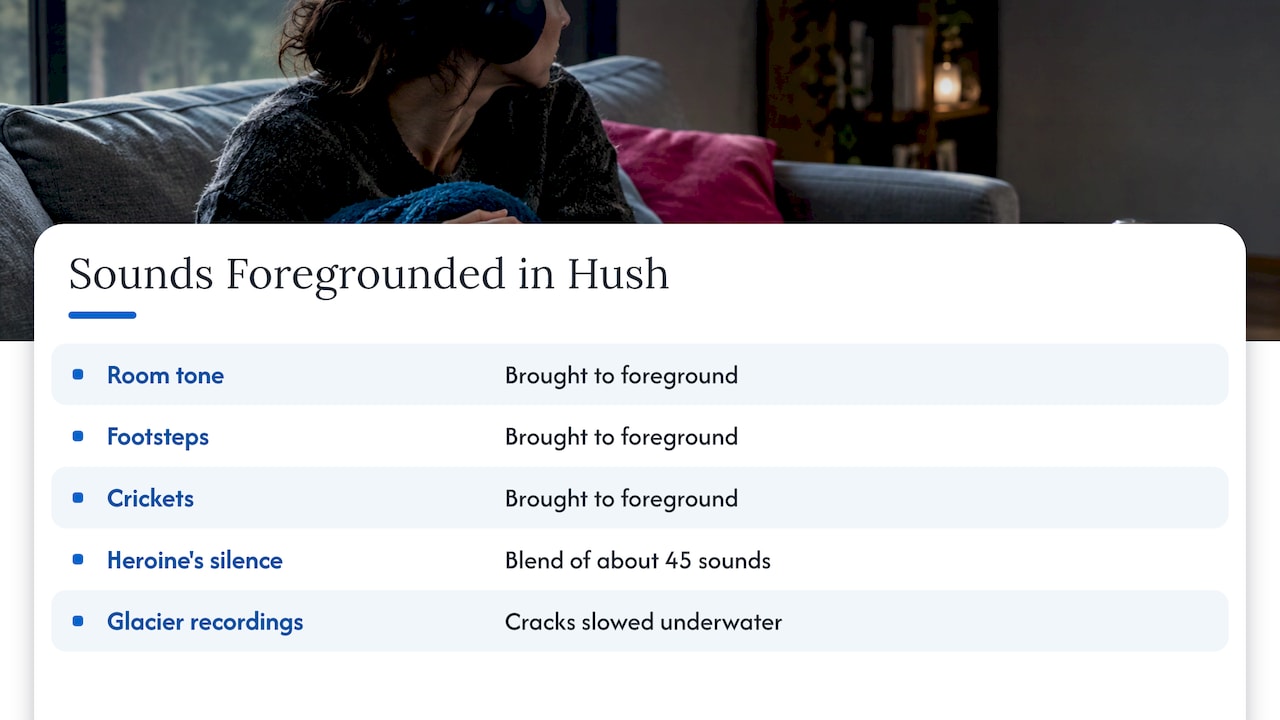
Flanagan said the film brought normally subconscious sounds, such as room tone, footsteps and crickets, to the front, and leaned on Kate Siegel’s face and body language to win the audience’s sympathy. Even the quiet is built: he told Fangoria the “silence” from the heroine’s perspective is a blend of about 45 sounds, including slowed recordings of glaciers cracking underwater.
A Quiet Place: silence with rules
Editor Chris Tellefsen said the edit deliberately dropped to dead silence before a character used sound as a conscious weapon. The screenwriters, Scott Beck and Bryan Woods, said the film is a metaphor for the breakdown of family communication. The fear works because the silence means something emotionally.
The Substance: images as grammar
Director Coralie Fargeat told Vanity Fair that, with so little dialogue, images and sound became the grammar of the film, with the empty white bathroom, the spine and the zippers carrying the psychological drama. Symbols do the talking.
The old roots
The habit is a century old. A Spectator essay argues the 1920s gothic films, Nosferatu among them, succeeded because directors had to rely on facial expression, movement, and light and shadow. Beck and Woods said their own script grew from a college obsession with silent filmmakers, whose images needed no dialogue to communicate character, emotion or intent.
What it costs the storyteller
Less talk makes the job harder, not easier. Beck and Woods said that you cannot use dialogue as a crutch, and you cannot bore the reader with blocks of description either. Their spec script ran a lean 67 pages, and some pages held a single word.
Flanagan found the same on set: a single character in one location forced the camerawork to be far more specific, with the coverage changing every five or six minutes so the quiet never went stale.
The deeper problem is investment. Beck and Woods asked how long a story can run without dialogue and still hook people. Tellefsen’s answer was full characters that we care about: when they are in danger, you feel it. Quiet without care is just empty.
If you write short horror yourself, our guides on horror short film structure and writing a horror short on a low budget put these constraints to work.
The same craft on the page
Prose has no soundtrack, so a writer builds silence out of other materials:
- Short, plain lines of speech. One sentence of dialogue lands harder when it follows a long stretch without any.
- Withheld information. Describe the doorway, not what stands in it. The reader supplies the rest.
- Sensory detail that stands in for sound. Breathing, a floorboard, a hum that stops.
- Behavior over explanation. A character who stops mid-task tells us more than one who announces their fear.
- Careful build-up. A scare earns its force from the ordinary calm before it.
This is the same logic as film, and it is why atmosphere tends to beat gore for readers who want lasting dread. For more on where that dread comes from, see our piece on psychological horror without gore.
Performance and cinematic technique that convey emotion without speech are a topic of their own; one look at ASMR-style scenes and roleplay shows how tone and presence can carry a character when words are few.
Where to find it in our books
Our novels are built on character first: revenge, guilt and the psychological monsters people carry. The Nether and the Evolution A200 books, including Evolution A200: Radio Silence, let the setting and the stakes speak, and give the quiet moments room to hurt.
They are available as ebooks and paperbacks on Amazon, and free to read with Kindle Unlimited. For a reading order and tips, see Kindle Unlimited tips.
Start reading
If the quiet moments in a story stay with you longer than the loud ones, the Nether and EA200 series are written for you. Both are on Kindle Unlimited.
Browse The Nether and EA200 series and pick the one that fits your appetite for dystopian dread or dark supernatural fiction.
Our view
We think the best horror is the kind you finish and keep carrying. That rarely comes from a character explaining what they feel. It comes from a reader noticing what a character will not say.
When we write, we treat dialogue as the expensive resource. Every spoken line has to change something. Everything else, the dread, the guilt, the slow understanding, we try to place in the scene itself, so you arrive at it a half-second before the page confirms it.
That is why our stories lean on psychological depth and character development. A frightening silence only works when you care who is standing in it. If that is the kind of horror you read for, you will feel at home in the Nether and EA200 books.
Nathaniel
FAQ
Is minimal dialogue horror the same as silent horror?
Not quite. Silent horror has no spoken lines, while minimal dialogue horror keeps a few. A Quiet Place, for example, has speech in only nine of its ninety minutes. Both rely on sound, performance and imagination to tell the story.
Why does silence feel scarier than noise?
Silence creates expectation and vulnerability, and it leaves the audience to imagine what the story withholds. Directors such as Carpenter and Flanagan describe it as a way of playing with what you fear is coming rather than showing it.
Can a book be minimal dialogue horror?
Yes. Writers use short exchanges, withheld details, sensory description and behavior in place of explanation. The reader fills the gaps, which is the same effect a quiet film produces.
Where can I read horror with restrained dialogue?
The Nether and Evolution A200 series are available on Amazon as ebooks and paperbacks, and are free with Kindle Unlimited. They focus on psychological depth and character over exposition.
Sources
- Selling “Silence” in Contemporary Horror (Monstrum)
- The Unheard and Unseen: The Sound and Silence in Horror Cinema (Offscreen)
- John Carpenter on the sound of a terrifying film (NPR)
- Mike Flanagan on creating authentic scares (Bloody Disgusting)
- Oren Peli interview (Digital Spy)
- James Wan and Leigh Whannell interview (Collider)
- Mike Flanagan and Trevor Macy on Hush (Screen)
- Mike Flanagan on the sounds of silence (Fangoria)
- Art of the Cut with A Quiet Place editor Chris Tellefsen (ProVideo Coalition)
- A Quiet Place screenwriters (IndieWire)
- Taking A Quiet Place from script to screen (No Film School)
- How do you make The Substance? (Vanity Fair)
- Why the best horror films are silent (The Spectator)