
Some of the best redemption stories in fiction never let their characters off easy. This is a curated shortlist of standout redemption arc books spanning literary classics, fantasy epics, crime fiction, and memoir, chosen because the change on the page feels earned rather than granted. Every blurb below is spoiler-light unless flagged, and a few carry content warnings worth knowing before you start.
TL;DR:
- Authentic redemption arcs require characters to take responsibility, make costly reparative choices, and demonstrate genuine moral shift over time.
- Slow, incremental change is a common feature in genre examples like Les Misérables, Dalinar Kholin, and Gerald Tarrant, emphasizing moral complexity.
- Many stories avoid cheap resolutions by highlighting the ongoing struggle with guilt and the long-term consequences of past actions.
- Genre conventions shape how redemption is portrayed, with fantasy favoring gradual moral ambiguity and memoir focusing on internal reflection and real-world accountability.
- Content warnings should be checked beforehand, and pacing should be adjusted for heavy or trauma-related material to avoid emotional burnout.
Table of Contents
- The Best Redemption Arc Books, Ranked by How Hard They Make It
- What Makes a Redemption Arc Actually Work
- How Different Genres Handle Atonement
- Reading These Books Without Getting Blindsided
- Why I Write Guilt as a Consequence, Not a Confession
- If You Want More Guilt, Consequence, and Earned Redemption
- Sources
The Best Redemption Arc Books, Ranked by How Hard They Make It
Not every redemption story deserves the label. The books below share one thing: the characters pay for what they did wrong, in ways that cost them something real. A few contain spoilers on the ending, which we’ve flagged so you can skip ahead.
1. Les Misérables by Victor Hugo
Jean Valjean’s arc spans decades, not chapters, which is exactly why it holds up as one of the paradigms of long-term atonement in Western literature. Hugo tracks a man who steals bread, gets caught in a cycle of punishment and prejudice, and slowly rebuilds a moral life through concrete acts, adopting Cosette, sparing Javert, choosing honesty when a lie would serve him better. BookBub’s roundup of redemption reads singles it out as the template other authors still work from. Fans of sweeping, patient character work will love this. Minor spoilers in the summary above; the ending is not revealed.
2. The Kite Runner by Khaled Hosseini
Amir spends most of his adult life trying to atone for a single act of cowardice from childhood, a betrayal of his friend Hassan that he never fully outruns. SparkNotes’ analysis of the novel’s allusions notes how Hosseini structures the entire back half of the book as a literal journey back to the source of the guilt. This one works for readers who want redemption tied to memory and return, not action set pieces. No major spoilers here, though the middle section deals with war and violence.
3. Atonement by Ian McEwan
Briony Tallis tells a lie as a teenager that destroys two lives, and the rest of the novel is her lifelong, ultimately incomplete attempt to make it right. McEwan’s trick is denying the reader a clean resolution. The book’s final pages complicate whether atonement is even possible once the damage is done, which is part of why it keeps showing up on lists of essential redemption fiction. This is for readers who want their redemption arcs morally uncomfortable rather than satisfying. Spoiler warning: the ending twist changes how you read everything before it.
4. The Stormlight Archive by Brandon Sanderson (Dalinar Kholin)
Dalinar Kholin starts the series as a warlord responsible for massacres he spent years burying under drink and denial. Sanderson doesn’t rush the turn. ScreenRant’s survey of fantasy redemption arcs points to Dalinar as a case study in how gradual change and sustained moral complexity make a villain-to-hero arc believable rather than convenient. He remains capable of violence and self-doubt for thousands of pages after his supposed turning point, which is the whole point. Great for fantasy readers who want scale and patience over a quick fix. Contains spoilers about events in the first two books of the series.
5. Prince of Thorns by Mark Lawrence (Jorg Ancrath)
Jorg Ancrath is not a redeemed character by the end of the first book, and that’s exactly why the Broken Empire trilogy belongs on this list. Lawrence writes a protagonist who commits genuinely horrific acts and lets you watch him rationalize every one. If you’re looking for a redemption arc that refuses to arrive on schedule, or at all in the way you’d expect, this delivers something rarer: a study of whether redemption is even accessible to someone this damaged. Best for grimdark readers comfortable with moral ambiguity that doesn’t resolve neatly. No major plot spoilers below the surface premise.
6. The Black Company by Glen Cook (the Lady)
The Lady spends the earlier books of Cook’s series as the series’ central antagonist, a sorceress associated with tyranny and terror. Her slow shift toward alliance with the mercenary company narrating the books is one of the examples ScreenRant highlights as proof that ambiguous, unresolved villainy can still read as redemption when the character’s priorities genuinely shift. She never becomes fully good. That’s the appeal.
7. Crime and Punishment by Fyodor Dostoevsky
Raskolnikov murders a pawnbroker to test a theory about morality and exceptional men, then spends the rest of the novel unraveling under guilt he refuses to name as guilt. His path toward confession and eventual penance in Siberia is one of literature’s clearest maps of how responsibility, not just remorse, drives real change. Ideal for readers drawn to psychological interiority over plot mechanics.
8. Unbroken by Laura Hillenbrand
Louie Zamperini’s story moves from Olympic runner to prisoner of war to a man consumed by rage and alcoholism, and finally to a changed life built through faith and forgiveness of his former captors. BookBub’s list of inspiring redemption reads includes it as proof that nonfiction redemption can hit as hard as anything invented. This is real-world rehabilitation, not metaphor, which makes it land differently. Contains descriptions of wartime torture and abuse.
9. Gilead by Marilynne Robinson
An aging pastor writes a long letter to his young son, working through decades of estrangement from his own godson, a man he half resents and half envies. The redemption here is quiet: an old man choosing generosity over grievance in what he knows are his final months. Fits readers who want slow, reflective prose over dramatic stakes.
10. The Poisonwood Bible by Barbara Kingsolver
Orleanna Price’s arc unfolds mostly in retrospect, as she reckons with the harm her family caused in the Congo under her husband’s zealotry. Her redemption is bound up with acknowledging complicity rather than direct villainy, a subtler and arguably harder version of the arc. Good for readers interested in colonial history and family reckoning.
11. Coldfire Trilogy by C.S. Friedman (Gerald Tarrant)
Gerald Tarrant is a centuries-old sorcerer who committed atrocities to secure his own immortality, and Friedman never lets him fully escape that. ScreenRant’s analysis of fantasy villain arcs frames Tarrant’s trajectory as redemption that reframes priorities without erasing the past, he becomes someone worth rooting for without becoming someone you’d call good. Recommended for readers who like their fantasy antiheroes to stay genuinely dangerous.
12. Waylander by David Gemmell
Waylander opens the series as an assassin responsible for a king’s death, and Gemmell spends the book giving him reasons to choose differently without pretending the old kills didn’t happen. It’s a leaner, faster read than most entries here, useful if you want a redemption arc without a thousand-page commitment.
13. Wild by Cheryl Strayed
Strayed’s memoir of hiking the Pacific Crest Trail after her mother’s death and her own descent into addiction and infidelity treats redemption as physical and solitary. There’s no other character to forgive her; the accountability is entirely internal, worked out one exhausting mile at a time.

14. A Little Life by Hanna Yanagihara
This one is different from most entries here because the redemption arc belongs to the people around Jude, not fully to Jude himself, whose trauma resists easy resolution. It’s included because it complicates the whole idea that redemption always arrives, for anyone. Heavy content warning: the novel contains extended depictions of self-harm, abuse, and suicide.
15. The Sympathizer by Viet Thanh Nguyen
A double agent’s slow reckoning with his own complicity during and after the Vietnam War, told with a bitter, darkly funny narrator who resists easy forgiveness even from himself. This is redemption filtered through espionage fiction and political betrayal, a genre mashup that rewards patient readers.
What Makes a Redemption Arc Actually Work
The difference between an earned redemption and what you might call cheap absolution comes down to cost. Reedsy’s guidance for writers puts it plainly: effective arcs require characters to take responsibility and earn change through difficult choices made over time, not a sudden personality flip after a near-death experience or a tearful confession. Jean Valjean spends the back half of a very long novel proving his change through action. Dalinar Kholin remains volatile and self-loathing for thousands of pages after he decides to be better. That slowness isn’t padding, it’s the mechanism.
Guilt itself can push a story in two directions. Research on how people process shame and responsibility suggests guilt can act as either a destroyer or a catalyst, depending on whether the character turns it into paralysis or into motivated action. The compelling arcs use guilt as fuel. The weak ones let a character wallow in it as a substitute for actually changing anything.
A useful mental model for staging a convincing redemption breaks it into three moves, drawn from the same Reedsy framework: the character has to acknowledge the harm they caused, then make a sequence of reparative choices that carry real cost, and finally take an action that demonstrates their priorities have genuinely shifted. Skip any one of those steps and the arc tends to ring hollow, even if the prose around it is beautiful.
Watch for these common failure modes when you’re deciding whether a book’s redemption will land:
- The sudden flip. A villain has one bad night, sees the light, and is fully reformed by the next chapter with no intervening struggle.
- Moral erasure. The narrative quietly stops mentioning past crimes once the character starts being likable, as if good behavior now cancels the ledger.
- Token gestures. One dramatic sacrifice stands in for years of harm, letting the character off the hook cheaply.
- Redemption by proximity. A character seems redeemed only because they’re now surrounded by better people, without doing anything themselves.
- Forgiveness without consequence. Other characters forgive too easily, robbing the story of the friction that makes change believable.
Pro Tip: Before you commit to a long redemption arc book, skim the last chapter’s mood without reading the actual events. If a five-hundred-page villain becomes fully likable in the final ten pages with no lingering damage, the arc was probably rushed.
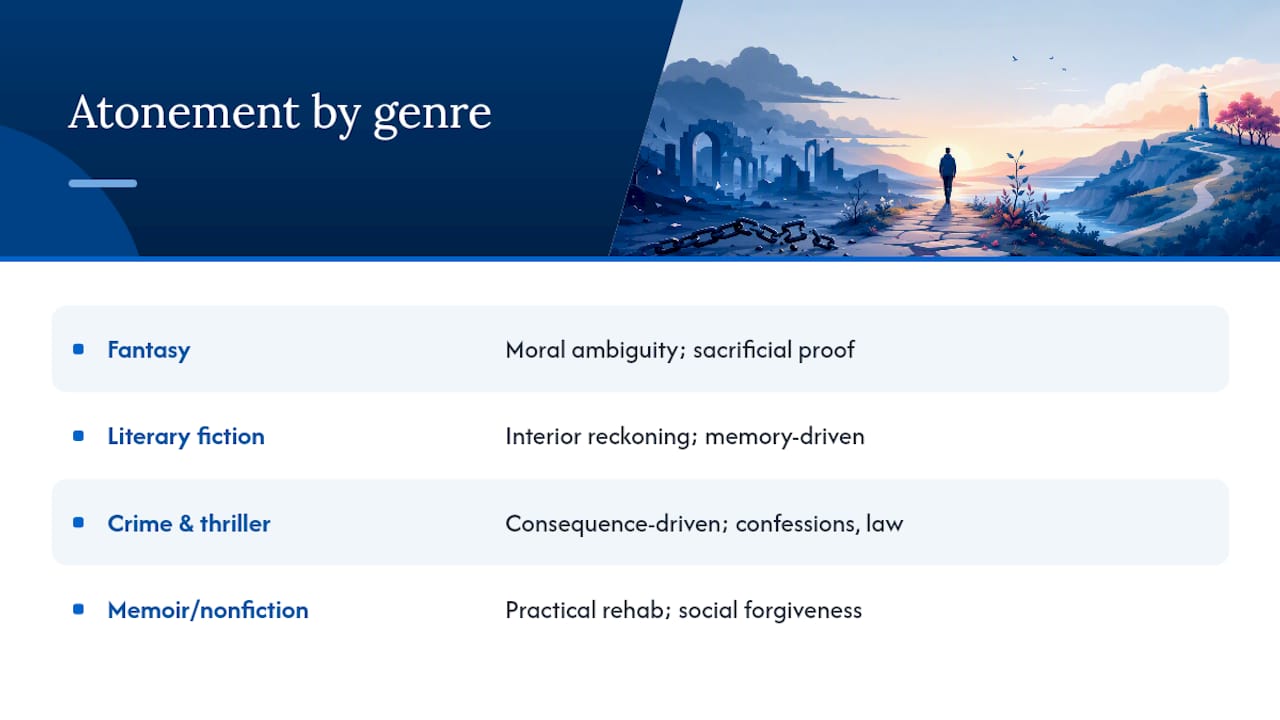
How Different Genres Handle Atonement
Redemption doesn’t look the same from genre to genre, and knowing the conventions of each helps you pick the right book for the mood you’re in.
Fantasy tends to favor gradual moral complexity over clean transformation. ScreenRant’s rundown of fantasy villain redemptions notes that the strongest examples, Dalinar Kholin, the Lady, Gerald Tarrant, stay morally ambiguous even after their turn. Readers accept a character remaining dangerous as long as their priorities have visibly shifted. The genre also loves the sacrificial choice: a redeemed character often proves their change by giving up something enormous, power, immortality, a relationship, rather than simply saying the right words.
Literary fiction usually works inward. Atonement and The Kite Runner both build their redemption arcs around memory, introspection, and the slow, often incomplete process of accepting responsibility for a single defining mistake. There’s rarely a big action set piece. The reckoning happens in a character’s head, on the page, across years of narrative time, and the tension comes from whether the character can even fully forgive themselves.
Crime and thriller fiction ties redemption to consequence in a more literal sense: legal accountability, prison time, or a character’s reform through concrete action rather than internal soul searching. A useful comparison point is available in curated crime fiction roundups that track how the genre handles guilt through plot mechanics, confessions, restitution, turning oneself in, rather than pure interiority.
Memoir and nonfiction ground redemption in the real world, which changes the stakes entirely. Unbroken and Wild both show that redemption can be social and practical, built through rehabilitation, forgiveness work, or physical endurance rather than moral epiphany alone. There’s also a useful body of writing on recovery after betrayal that maps closely onto how memoirists structure their own atonement narratives, worth a look if the fiction entries above leave you wanting a real-world companion read.
Reading These Books Without Getting Blindsided
A few of the entries above deal with self-harm, addiction, wartime violence, or extended psychological abuse. Here’s how to navigate that without either spoiling the ending or walking into something you weren’t ready for.
- Check the content warning before, not during. A quick search of a title plus “content warning” will surface most trigger points; do this before you start rather than mid-chapter.
- Treat any spoiler flag above as a real signal. Where we noted spoilers in the picks list, skip the last two sentences of that blurb if you want the ending untouched.
- Pace yourself with heavy material. Books like A Little Life or Crime and Punishment reward slow reading; rushing tends to blunt the emotional weight rather than intensify it.
- Pair a heavy read with something lighter. Book clubs often alternate a dense redemption narrative with a faster, lower-stakes read to avoid burnout.
- Discuss before you decide how you feel. Some of these arcs (Jorg Ancrath especially) are designed to be argued about, not simply accepted.
Why I Write Guilt as a Consequence, Not a Confession
Most fiction treats guilt as something a character feels and then, eventually, stops feeling. I’ve never found that honest. In my own books, including Stories of a Condemned Soul, guilt functions less like an emotion and more like a debt that compounds, something a character has to actively pay down through choices that cost them, not through a single moment of clarity.
That’s the version of redemption I find myself drawn to as a reader too. Dalinar Kholin’s arc works because Sanderson refuses to let him stop paying. Jorg Ancrath’s arc, if you can even call it that yet, works because Lawrence refuses to let him off the hook at all. What both approaches share is a distrust of easy forgiveness, which is exactly the distrust I try to write into my own dark supernatural fiction.
If you’re the kind of reader who finished this list wanting more stories where atonement is earned in blood, not granted in dialogue, that’s the shelf I write for.
— Nathaniel
If You Want More Guilt, Consequence, and Earned Redemption
If the arcs above pulled you in, my own catalog leans harder into the same territory: characters who don’t get to talk their way out of what they’ve done. Stories of a Condemned Soul and my other dark supernatural titles trade the sweeping historical canvas of Les Misérables for something tighter and more claustrophobic, but the underlying mechanics are the same one you just read about.

Here’s how the fit works for readers who came from this list:
- You get characters who face direct consequences for past harm, not internal guilt that resolves itself.
- The supernatural elements amplify accountability instead of replacing it, so the horror and the redemption arc are doing the same work.
- Every book is available free through Kindle Unlimited, so testing whether this style of atonement works for you costs nothing.
- If dystopian and grimdark tones from picks like Prince of Thorns appealed to you, my full catalog of dark supernatural books is the closest match in tone.
Start with Stories of a Condemned Soul on Kindle Unlimited this week, or grab the ebook directly on Amazon if you’d rather own it outright.
Sources
- SparkNotes — The Kite Runner: Allusions
- ScreenRant — Best fantasy villain redemption arcs in books
- BookBub — 12 Inspiring books about redemption
- Reedsy — Redemption arc