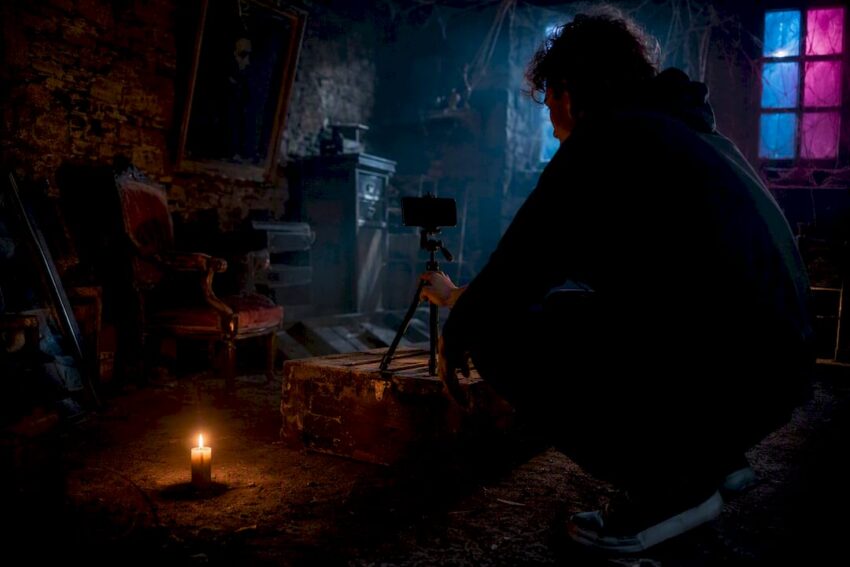
This page hands you a working list: dozens of ready-to-shoot horror short film ideas, sorted by location and cast size, plus the micro-script beats and lighting and sound tricks to turn any one of them into a finished film. Most require one room, one or two actors, and a weekend. Pick a prompt, follow the adaptation steps, and start filming instead of planning.
TL;DR:
- Most effective horror shorts focus on a single, small detail in an ordinary setting, which should be gradually revealed rather than explicitly explained.
- Shooting should prioritize one location and minimal cast, exploiting practical effects and lighting to create atmosphere on a micro-budget.
- Building tension involves a clear emotional theme and character decisions, with the final image leaving lasting visual impact rather than exposition.
- Short, punchy concepts like a haunted monitor, strange knocks, or a delayed reflection are ideal for quick filming and social media platforms.
- Using constraints, such as one room or actor, enhances creativity and sharpens storytelling, making scares more authentic and memorable.
Table of Contents
- 30 Horror Short Film Ideas You Can Film With Almost Nothing
- Match Your Idea to Your Location: A Setting-by-Setting Breakdown
- Short-Form Horror Ideas Built for TikTok and Reels
- How to Turn One Idea Into a Shootable Micro-Script
- Three Ready-Made Micro-Scripts You Can Shoot This Weekend
- Shooting on a Micro-Budget: Your Lighting, Sound, and Effects Checklist
- Building Dread and Theme Without a Feature-Length Runtime
- Character Development for Short Horror Films
- Common Horror Tropes and How to Subvert Them
- Structuring a Horror Short Film for Maximum Impact
- Copyright, Music Licensing, and Other Legal Basics
- Why Constraints Make Better Horror Than Budget Ever Will
- Where to Go Next if You Want to Study Dread on the Page
- Sources
30 Horror Short Film Ideas You Can Film With Almost Nothing
The best horror shorts rarely come from big concepts. They come from one wrong detail in a familiar place, pushed just far enough that the audience can’t look away. The list below leans hard into that principle: every prompt here can be shot with a phone, one location, and a cast you can count on one hand. A few need zero actors beyond the person holding the camera.
Filmmakers who work with real constraints (single locations, minimal cast, no visual effects budget) consistently produce sharper, more finished-feeling work than those chasing an ambitious concept they can’t afford to execute, according to StudioBinder’s breakdown of producible short film ideas. That’s the filter every idea below was run through.
One-location, one-to-two-actor prompts:
- A woman keeps finding her back door unlocked every morning, though she’s certain she locked it. The twist isn’t an intruder. It’s that she’s the one unlocking it, sleepwalking, and something is waiting for her to finish the routine.
- A man livestreams his apartment to prove it isn’t haunted. The chat starts pointing out things moving in the background that he can’t see on his own screen.
- A babysitter follows a checklist left by the parents. Item four says: “Do not go into the nursery after 9 p.m., even if you hear him crying.” The baby monitor has no baby in frame.
- Two roommates argue over noises in the walls. One believes it’s rats. The other has started leaving food behind the drywall.
- A woman receives a voicemail from her own number, timestamped one hour in the future, describing exactly what she’s about to do next.
- A man wakes up to find every mirror in his house covered in sheets. He doesn’t remember doing it, and he can’t remember why he’s afraid to take them down.
- A therapist’s last client of the day insists they’ve met before, in a session that never happened, and describes details about the therapist’s own house.
- A woman house-sitting for a stranger finds a locked room the owner never mentioned. The key is taped under the welcome mat.
- A father teaches his daughter a “game” where she has to stay perfectly still and quiet if she hears three knocks. She hears three knocks while he’s at work.
- A man discovers his reflection is one second slower to move than he is, and it’s getting slower every day.
Single-actor or near-zero-cast prompts:
- A woman records a video diary confessing to a crime, then realizes halfway through that someone else is answering her from off camera.
- A man tries to fall asleep during a power outage, counting the seconds between distant knocks that are getting closer and more evenly spaced.
- Security footage reviewed the morning after a break-in shows nothing entering the house, only the homeowner slowly leaving room by room, backward.
- A woman practices a eulogy alone in her living room. Partway through, she realizes she’s rehearsing her own.
- A man finds a photo of himself on his phone that he never took, from an angle inside his own bedroom while he was asleep.
Two-to-four-actor prompts with a stronger narrative arc:
- Two sisters split their late mother’s ashes evenly. One begins hearing their mother’s voice; the other doesn’t, and starts to resent her for it.
- A couple’s new smart speaker starts answering questions they never asked out loud.
- Coworkers pulling a late shift in an empty office notice the elevator keeps stopping on a floor that doesn’t exist in the building directory.
- A support group for insomnia meets in a church basement. Each week, one member is missing, and no one else seems to notice or remember them.
- A married couple discovers their new house has a second, identical version of their bedroom hidden behind a false wall, already lived in.
- Two friends camping in a backyard tent dare each other to say a name into the dark three times. Only one of them says it.
- A landlord shows a tenant around an apartment where the temperature drops several degrees in one specific corner, no explanation given, lease signed anyway.
- A family Zoom call reveals a relative in the background who died the year before, sitting perfectly still.
- Delivery driver ideas: a driver keeps getting the same order to the same house, and the woman who answers the door looks a little more decayed every visit.
- A group of friends plays a drinking game where the loser has to spend one minute alone in a dark closet. The last loser hasn’t come out in ten minutes.
High-concept ideas that still fit a tiny budget:
- A man discovers he can only be seen in photographs taken exactly one minute in the past, never in real time.
- A woman’s therapist recommends an app that promises to “process” her trauma. Each session, it asks for one more memory, and gives nothing back.
- An office employee finds a “lost time” clock in the break room that logs the exact minutes people disappear and never gets checked.
- A man discovers his childhood imaginary friend has a Facebook profile, with recent activity.
- A woman wakes up every day at 3:33 a.m. to a single word scratched fresh into her nightstand, one letter longer each night.
The strongest entries on this list (the sleepwalking door, the babysitter’s checklist, the hidden second bedroom) share one trait: a single clear wrongness in an ordinary setting, discovered gradually rather than announced. That’s the exact pattern behind breakout shorts like Lights Out, which built an entire premise around one impossible detail (a shape only visible when the lights are off) in a single room, according to Access Creative College’s analysis of successful horror shorts.
Match Your Idea to Your Location: A Setting-by-Setting Breakdown
Grouping horror concepts by the room you already have access to cuts your pre-production time to almost nothing. This is the same logic behind prompt collections that sort ideas by living room, bedroom, bathroom, car, and backyard: filmmakers shoot faster when the prompt already fits the space they’re standing in, according to the Utah Film Festival’s horror prompt collection.
Living room / shared space
- A family game night ends when the board game starts predicting real events.
- A couch cushion fort built by a kid becomes somewhere he refuses to sleep, insisting “the man only fits in there.”
- A television left on static plays back a home video the family never recorded.
Blocking tip: keep your actor in the same static wide shot for as long as the scene allows. A locked-off frame makes any small, unexplained movement at the edge of it register instantly.
Bedroom
- A person notices their bedroom door is two inches narrower than it used to be, every single day.
- A partner starts sleep-talking in a language neither of them speaks.
- A child insists their stuffed animal has started “keeping watch” and won’t let them move it from the foot of the bed.
Lighting tip: a single practical lamp with a warm bulb, angled low, throws long shadows across the ceiling that a flat overhead light kills. Cut the overhead entirely.
Car
- A driver alone at a red light notices the passenger seat has an indentation, like someone recently sat there.
- A rideshare driver picks up a passenger who gives an address that turns out to be the driver’s own childhood home.
- A woman’s GPS keeps rerouting her away from her actual destination toward an unfamiliar dirt road.
Sound tip: cars are naturally quiet, controlled spaces, which makes them ideal for dialogue-driven dread. Kill the radio early so silence becomes part of the scene.
Backyard
- A father digs a hole for a new fence post and finds something that stops him mid-dig, refusing to explain to his kids why they can’t play there anymore.
- A motion-sensor light keeps triggering at exactly 2 a.m., with nothing visible on camera.
- Neighbors’ dogs all bark at the same unseen point in a fence line, every night, at the same time.
Backyard prompts translate well to short-form platforms because the “reveal” (a hole, a shadow, a fence gap) works as a single striking thumbnail image.
Office or public space
- An employee working alone after hours finds a badge swipe log showing someone entered the building after they locked the doors.
- A late-shift retail worker keeps finding the mannequins rearranged into a slightly different pose each closing.
- A janitor cleaning an empty school gym hears a basketball bounce once, alone, from an empty court.
Public-space ideas need more planning around permission and noise, so they suit filmmakers with slightly more crew or a location they already have after-hours access to.
Short-Form Horror Ideas Built for TikTok and Reels
Vertical horror lives or dies in the first second. Platforms reward a visceral hook, three tight beats, and a payoff the viewer can register before they scroll, according to guidance for scary short-form creators. Here are ten concepts built specifically for that format, each under 60 seconds.
- “The Text From Myself” — Hook: a phone buzzes with a text from the user’s own number. Beats: she reads it, it describes her exact outfit, she looks up into the camera (her own POV). Visual device: found-footage phone screen recording overlaid on a static shot.
- “Count the Knocks” — Hook: on-screen text reads “count with me.” Beats: three knocks, four knocks, a fifth knock nobody made. Visual device: hard cut to black on each knock.
- “Mirror Delay” — Hook: a person waves at their mirror. Beats: the reflection waves back a half-second late, then doesn’t stop waving after she does. Visual device: simple in-camera trick using a stand-in behind a “mirror” frame.
- “The Babysitting App” — Hook: a baby monitor app notification reads “movement detected.” Beats: the room is empty, the notification repeats, the crib rocks once. Visual device: screen-record UI plus a subtle practical rig on the crib.
- “Last Voicemail” — Hook: text overlay, “playing my grandmother’s last voicemail.” Beats: her voice, a pause, then a second voice underneath hers. Visual device: layered audio, no visual change at all.
- “The Empty Seat” — Hook: a driver glances at an empty passenger seat. Beats: a seatbelt clicks by itself, the seat indentation appears, headlights flicker. Visual device: practical seatbelt rig, no CGI.
- “3:33” — Hook: a phone alarm clock reads 3:33 a.m. Beats: a scratch sound, a new word carved into wood, cut to black. Visual device: macro close-up on the carving, revealed frame by frame across a short series.
- “Group Chat Ghost” — Hook: a group chat notification from a contact everyone thought had died. Beats: panic in the replies, a read receipt appears, the messages stop. Visual device: pure screen-record format.
- “The Elevator Floor” — Hook: an elevator panel shows a floor number that doesn’t exist. Beats: the button lights up on its own, the doors open onto darkness, they close again. Visual device: practical elevator panel prop lit from behind.
- “Sleep Talk Translation” — Hook: a caption reads “I recorded my partner sleep-talking and ran it through a translator.” Beats: the translation appears on screen, it says something impossible, he opens his eyes mid-sentence. Visual device: subtitle overlay as the primary scare delivery.
Design your sound around silence, not music. A sudden absence of ambient noise reads as more unsettling on a phone speaker than a jump-scare sting. For repeatability, treat one concept (like “3:33”) as a serialized hook you post in parts across several days, a tactic that keeps short-form horror audiences returning for the next installment instead of consuming and forgetting a single clip.
How to Turn One Idea Into a Shootable Micro-Script
Not every prompt on this list deserves to be filmed as written. The ones worth your weekend share three qualities: a single clear idea, one identifiable threat or wrongness, and an emotional throughline the audience can track even without dialogue. If a prompt needs a paragraph of exposition to make sense, cut it or simplify it until it doesn’t.
Here’s a repeatable process for adapting any prompt above:
- Pick the one image that scares you most about the premise, and build the entire script around protecting that image for last.
- Identify the smallest cast that can tell the story. Most of the prompts above work with one or two actors; resist the urge to add a third just to fill dialogue.
- Write your beats before your dialogue. Use the six-beat structure below rather than drafting full scenes first.
- Decide what stays implied. Horror shorts that show everything tend to feel cheaper than ones that let the audience’s imagination fill the last gap, a principle borne out by Access Creative College’s craft guidance on pacing and restraint.
- Storyboard only the final beat. That’s the shot you can’t afford to get wrong on set.
- Shoot your quietest scene first, while your crew and actors are still fresh enough to hold stillness convincingly.
A reliable six-to-eight beat template looks like this: 1) Hook or inciting image, 2) brief normal, 3) strange detail introduced, 4) escalation, 5) confrontation, 6) payoff or final image. This structure compresses cleanly into a 60 to 90 second short or stretches into a five-minute film without restructuring.
Example A (using “The Text From Myself”): Hook, phone buzzes. Normal, she’s getting ready for bed. Strange detail, the text describes her current outfit exactly. Escalation, a second text arrives describing what she’s doing right now. Confrontation, she looks up at her bedroom mirror. Payoff, the reflection is texting on a phone she doesn’t own.
Example B (using “The Hidden Second Bedroom”): Hook, a contractor knocks on a wall and it sounds hollow. Normal, the couple laughs it off over dinner. Strange detail, they find a seam in the wallpaper shaped like a doorframe. Escalation, they pry it open at night instead of waiting for morning. Confrontation, the room behind it is furnished identically to their own. Payoff, a light switch flicks on by itself as they step inside.
Pro Tip: Write your last beat first. If you can’t picture a single strong final image, the idea isn’t ready to shoot yet, no matter how good the premise sounds on paper.
Three Ready-Made Micro-Scripts You Can Shoot This Weekend
Each of these is built from the six-beat template above and sized for one location and a cast of one to two.
-
“The Nursery Monitor” (psychological, 2 actors, one bedroom set): Hook, monitor static. Normal, babysitter checks the checklist. Strange detail, the checklist warns against 9 p.m. Escalation, the monitor shows the empty crib rocking. Confrontation, she enters the nursery against instructions. Payoff, a small handprint appears on the inside of the door as it closes behind her. Props: baby monitor, checklist prop, crib. Shoot the payoff handprint using a pre-set practical mark and reveal it only in the final frame.
-
“The Object” (uncanny-object, 1 actor, kitchen or living room): Hook, a woman finds an old rotary phone in a donation box that isn’t plugged into anything. Normal, she sets it on a shelf as decoration. Strange detail, it rings once. Escalation, it rings again, longer. Confrontation, she picks it up. Payoff, she hears her own voice on the other end, mid-sentence, saying something she hasn’t said yet. Props: an unplugged rotary phone, a hidden speaker for the ring cue. Cast just one actor and record the “other voice” dialogue separately for a cleaner playback take.
-
“Three Knocks” (body/physical escalation, 2 actors, bedroom): Hook, a father teaches the knock game to his daughter. Normal, bedtime routine. Strange detail, three knocks come from inside the closet, not the door. Escalation, the knocks repeat nightly, growing louder. Confrontation, the father opens the closet himself. Payoff, we never see inside; we only see his face change, and the daughter asks, from behind him, “did you find him?” Props: a closet, a practical knock rig triggered off-camera.
Shoot the climactic beat of each in one continuous take where possible. A cut in the final second gives the audience’s brain time to reason its way out of the scare.
Shooting on a Micro-Budget: Your Lighting, Sound, and Effects Checklist
You don’t need a lighting kit or a sound stage to make dread feel real. You need control over darkness, silence, and one well-executed practical detail.
- Use one key light source and kill everything else. A single desk lamp, phone flashlight through a diffusion cloth (a white t-shirt works), or a window at dusk beats three mismatched overhead lights every time.
- Bounce light off a wall or ceiling instead of pointing it directly at your subject; it softens shadows without erasing them.
- Record thirty seconds of pure room tone before every scene. It saves your edit when you need to cover a cut with silence instead of a jump cut.
- Prioritize foley over score for early cuts: footsteps, breathing, fabric, and floor creaks sell tension that a temp music track can hide.
- Use sub-bass tones under key moments rather than a musical sting. It reads as dread in the body before the audience consciously hears it.
- Favor in-camera practical gags (mirrors, forced perspective, a slow-reveal prop) over digital effects; a well-lit practical prop reads as more convincing than a rushed CGI shot on a hobbyist budget, per StudioBinder’s breakdown of achievable effects.
- Get informed consent from every actor before filming anything involving fear responses, restraint, darkness, or physical contact, and brief them fully on what will happen in each take.
Good lighting decisions do more heavy lifting than any other single production choice on a horror short, and understanding basic film lighting principles pays off across every idea on this list, as WonderLens’s guide to lighting and video realism lays out in more depth than a checklist can cover.
Pro Tip: Shoot a lighting test on your phone in the actual room, at the actual time of day you plan to film. What looks moody to your eye often reads as just dark and muddy on camera until you adjust.
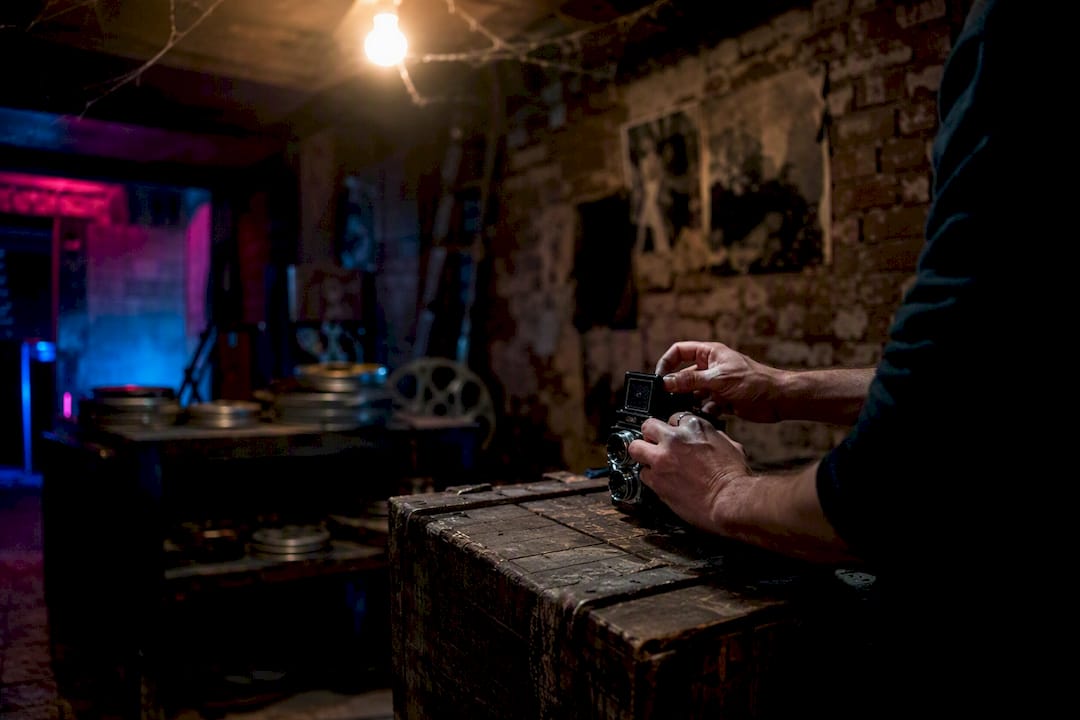
Building Dread and Theme Without a Feature-Length Runtime
A short horror film doesn’t earn its scares through plot complexity. It earns them through one strong emotional idea, held with discipline over a short duration rather than across a full feature-length runtime. Before you write a single scene, ask what the story is really about underneath the scare: grief, guilt, control, the fear of not being believed. Every premise on this page can carry a theme if you let it.
Take “The Nursery Monitor.” On its surface it’s a haunted-house beat. Underneath it, if you let the babysitter’s guilt over ignoring instructions drive her choices, it becomes a story about the cost of curiosity overriding caution, which gives the scare an emotional floor to land on instead of existing for its own sake.
Subtext is what separates a short that’s remembered from one that’s forgotten by the next scroll. You don’t need to state the theme out loud; you need every choice, a prop, a line reading, a final image, to quietly point toward it. For a deeper walkthrough of building that kind of layered dread into a script, Nathanielconnors’s guide to writing horror shorts that scare people breaks down the process scene by scene, and the companion piece on writing psychological horror goes deeper into subtext and dread specifically.
Character Development for Short Horror Films
You have roughly five minutes to make an audience care whether your character survives, which means every character beat has to do double duty. Skip backstory exposition entirely. Instead, reveal character through one specific behavioral choice in the first thirty seconds: how she locks a door, whether he checks his phone before answering a knock, whether she believes the warning or dismisses it.
Give your protagonist one clear flaw or blind spot that the horror exploits directly. In “Three Knocks,” the father’s flaw is treating a real warning sign as a game long enough to endanger his daughter. That flaw does the work three pages of dialogue would otherwise need to do.
Avoid characters who exist only to react. Even in a two-minute short, give your lead one small decision that they make actively, not just a series of things that happen to them. The babysitter who opens the nursery door against instructions is a character making a choice, not a victim waiting for a jump scare. That single active decision is often the difference between a short that feels hollow and one that feels lived-in, even at ninety seconds.
Common Horror Tropes and How to Subvert Them
Every prompt on this page borrows from a familiar tradition. The trick is bending the trope somewhere the audience doesn’t expect, without abandoning what makes it work in the first place.
The “don’t go in there” warning. Instead of having your character ignore a warning out of pure recklessness, give them a sympathetic reason to break it, like the babysitter’s genuine concern for a crying baby. That reframes a cliché as a character choice.
The final girl. Rather than a lone survivor outrunning a threat, try a survivor who realizes partway through that she’s been the source of the wrongness the entire time, as in the sleepwalking door prompt above.
The jump scare. Withhold the loud sting entirely and replace it with a quiet, sustained wrongness (a reflection one second too slow, a knock with no source) that lingers instead of startling and releasing.
The haunted object. Instead of a cursed antique with obvious menace, use something mundane and modern, like a smart speaker or a translation app, so the horror feels uncomfortably close to the viewer’s own life.
The evil child or evil elder. Swap the expected antagonist for an ordinary object or system (an office badge log, a delivery route, a group chat) carrying the threat instead, which sidesteps a well-worn cliché entirely.
Subversion works best when it’s subtle. Announcing the twist too early collapses the tension you spent the whole runtime building.
Structuring a Horror Short Film for Maximum Impact
Structure in a horror short isn’t about a three-act arc; it’s about controlling exactly when the audience learns each piece of information. Open on the strange detail, not on setup. You have seconds, not minutes, to earn attention, so cut every beat that doesn’t either build dread or plant information you’ll pay off later.
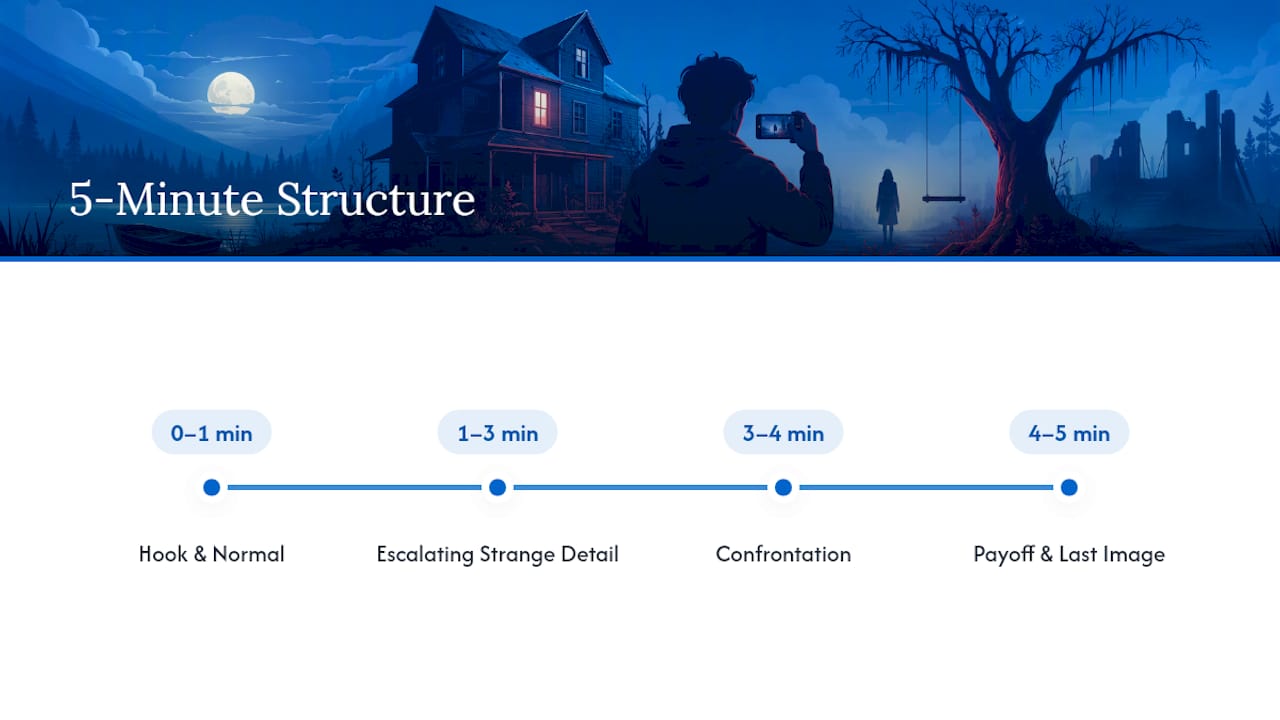
Front-load atmosphere and hold the direct confrontation with the threat until the final third of your runtime. That delay is what makes the payoff land instead of feeling rushed. A five-minute short breaks down naturally as roughly one minute of hook and normal, two minutes of escalating strange detail, one minute of confrontation, and the final minute reserved entirely for the payoff and last image.
End on an image, not a line of dialogue. The strongest horror shorts leave the audience with something visual to sit with after the cut to black, whether that’s a handprint on a door or a reflection that won’t stop waving. Resist the urge to explain the ending; ambiguity is a structural tool, not a cop-out, when the rest of the short has earned it.
Copyright, Music Licensing, and Other Legal Basics
Music is the single biggest legal trip-wire for independent horror shorts. Using a popular song without a license, even a short clip, can get your film muted, taken down, or flagged for copyright claims on every platform that matters, including YouTube and TikTok. Use royalty-free or explicitly licensed tracks, or better, work with a composer willing to trade a screen credit for original score on a passion project.
Sound effects carry the same risk if pulled from a commercial film or game without a license. Stick to royalty-free sound libraries, or record your own foley, which usually sounds more authentic in a low-budget short anyway.
If you’re filming in a public location, know your local rules on filming permits before you show up with a camera and crew. Filming on private property (a friend’s house, a rented office after hours) still requires the owner’s permission, in writing if the shoot involves any risk or damage potential.
If your short adapts a specific concept, title, or character from someone else’s copyrighted work rather than a generic trope, that’s a different legal question entirely; general horror tropes like “haunted house” or “final girl” aren’t ownable, but a distinctive character or exact plot lifted from an existing film is. When in doubt, keep your premise original and consult a media attorney before distributing anything derivative for profit.
Why Constraints Make Better Horror Than Budget Ever Will
Every horror short I’ve thought hard about, the ones that actually stick with an audience, came from someone working inside a limit they didn’t choose. One room. One actor. No money for a creature effect, so the creature stays off-screen and gets scarier for it. That’s not a consolation prize for filmmakers without resources. It’s the actual mechanism that makes short horror work.
The instinct to wait until you can afford the “real” version of an idea is the thing most likely to kill it. Shoot the cheap version this weekend. Post it. Watch where it fails, then fix that one thing on the next short. A five-minute film with one good idea, shot badly, teaches you more than a script you’ve rewritten for six months and never filmed.
If you want to go deeper on the craft side, on subtext, pacing, and how to make a small premise carry real weight, the process is the same one I use writing longer fiction, and I’ve put more of it into Nathanielconnors’s craft resources for anyone who wants to keep building on what’s here.
— Nathaniel
Where to Go Next if You Want to Study Dread on the Page
If the goal is filming these ideas fast, this list gets you there. If you want to study how dread actually works before your next script, spend some time with How to Write Psychological Horror: A Craft Guide, which breaks down the exact techniques (subtext, pacing, restraint) that separate a forgettable jump scare from a short that stays with someone after the screen goes dark.
The guide walks through building psychological pressure without relying on gore or effects, which matters even more when your budget is a phone and one room. It pairs naturally with Nathaniel Connors’s own fiction, including The Nether and Stories of a Condemned Soul, both free to read for Kindle Unlimited subscribers, if you want to see these same principles played out across a full novel instead of a five-minute short. Start with the psychological horror craft guide for the writing techniques, then check the best dark supernatural books for examples worth studying scene by scene.
Sources
- 100+ Short Film Ideas You Can Actually Produce
- 50 Horror Story Prompts for Your Next Short Film
- 8 Viral Scary Short Film Ideas for TikTok Creators in 2026
- How To Make a Good Horror Short Film – Access Creative College