An ambiguous ending is any conclusion that deliberately withholds a final answer, leaving the reader to decide what happened and what it means. Readers chase them because the not knowing becomes part of the story’s afterlife, argued over for years. If you want somewhere to start tonight, pick up The Turn of the Screw, Life of Pi, or, for something newer and considerably darker, Nathaniel Connors’s The Nether.
TL;DR:
- Ambiguous endings are often deliberate choices by authors to evoke unresolved themes like guilt, memory, or justice, not accidental plot stops or incomplete drafts.
- Titles like The Turn of the Screw and Life of Pi expertly use unreliable narrators or multiple versions of events to deepen reader interpretation and ongoing debate.
- Many unresolved conclusions, such as The Mystery of Edwin Drood or In the Woods, rely on storytelling tools like authorial omission or narrative uncertainty to sustain ambiguity.
- The reason readers revisit ambiguous endings is to actively interpret the story’s core themes, rather than seeking straightforward resolutions or concrete answers.
- Matching ambiguity to genre—such as crime, dystopian, or supernatural fiction—enhances the thematic resonance and impact of unresolved stories.
Table of Contents
- What Makes a Book’s Ending Ambiguous?
- 1. The Turn of the Screw by Henry James
- 2. Life of Pi by Yann Martel
- 3. Picnic at Hanging Rock by Joan Lindsay
- 4. The Giver by Lois Lowry
- 5. The Mystery of Edwin Drood by Charles Dickens
- 6. Gone Girl by Gillian Flynn
- 7. The Road by Cormac McCarthy
- 8. We Need to Talk About Kevin by Lionel Shriver
- 9. The Buried Giant by Kazuo Ishiguro
- 10. American Psycho by Bret Easton Ellis
- 11. In the Woods by Tana French
- 12. The Nether by Nathaniel Connors
- 13. Stories of a Condemned Soul by Nathaniel Connors
- 14. Evolution A200: A Bubonic Apocalypse by Nathaniel Connors
- 15. Never Let Me Go by Kazuo Ishiguro
- 16. The Lottery of the Sea (short story collections and weird fiction anthologies)
- Which Reading Route Fits the Ending You Want?
- The Craft Behind an Unresolved Ending
- How to Talk About an Ending Without Ruining It
- Why I Write Endings That Don’t Resolve
- What Ambiguous Endings Actually Ask of a Reader
- More Books Built Around Unresolved Dread
- Sources
What Makes a Book’s Ending Ambiguous?
An ambiguous ending withholds a key fact the plot has trained you to want: did the crime get solved, did the narrator tell the truth, did the character survive. Genre fiction usually closes that loop. Literary fiction, crime fiction with something to say, and weird fiction often refuse to, on purpose.
The trick is distinguishing intentional ambiguity from a story that simply stopped. Charles Dickens died mid-serialization of The Mystery of Edwin Drood, and nobody alive knows who killed Edwin, because Dickens himself may not have finalized it. Britannica notes the novel has generated theories and even stage adaptations that let audiences vote on the murderer, since the historical record offers no resolution. That’s an accident of literary history creating ambiguity, not a craft choice. Compare that to Margaret Atwood ending The Handmaid’s Tale on a tape recording that simply cuts off. SparkNotes explains that Offred’s fate is never confirmed. Atwood chose that silence. It’s a different kind of unresolved, and knowing which kind you’re reading changes how satisfying it feels.
1. The Turn of the Screw by Henry James
James built an entire ghost story around a governess who may be seeing spirits, or may be losing her mind. The book never tells you which. Readers who love unreliable narrators built entirely on tone and suggestion will find this the gold standard, and it rewards a same-day reread once you know the ending.
2. Life of Pi by Yann Martel
Pi survives a shipwreck and tells two versions of his ordeal, one involving a tiger, one involving human cruelty dressed up as animals. Martel lets you choose which version to believe, and the choice says more about you than about Pi. Curated lists consistently flag this title as a gateway into ambiguous fiction for readers new to the genre.
3. Picnic at Hanging Rock by Joan Lindsay
Three schoolgirls and a teacher vanish on a rock formation in 1900, and the novel never explains where they went. Lindsay originally wrote a final chapter revealing the answer, then cut it before publication, which makes this one of the rare cases where the ambiguity was a deliberate edit, not an accident.
4. The Giver by Lois Lowry
Jonas escapes his controlled society at the end, sledding toward a light and music he may only be imagining as he freezes to death. Lowry never confirms whether he reaches safety or dies in the snow, and the sequel, Gathering Blue, sidesteps rather than answers the question.
5. The Mystery of Edwin Drood by Charles Dickens
Dickens’s final, unfinished novel leaves its central murder mystery permanently open. Penguin Random House’s edition preserves the manuscript as Dickens left it, including his notes, which is part of the appeal: you’re reading a genuine historical mystery about the mystery itself.
6. Gone Girl by Gillian Flynn
Flynn resolves the whodunit but not the moral question. Amy gets away with it, Nick knows she got away with it, and the two of them settle into a marriage built on mutual blackmail. The plot ends. The reader’s discomfort doesn’t.
7. The Road by Cormac McCarthy
The boy meets a family at the end who may save him or may simply be the next threat in a post-apocalyptic landscape built on cannibalism and distrust. McCarthy gives you just enough hope to question whether you’re being naive for taking it.
8. We Need to Talk About Kevin by Lionel Shriver
Shriver’s epistolary novel about a school shooter’s mother never fully settles whether Eva’s parenting caused Kevin’s violence or whether some children are simply born wrong. The ambiguity sits on nature versus nurture, and book clubs tend to split hard on it.
9. The Buried Giant by Kazuo Ishiguro
An elderly couple in post Arthurian Britain search for their son while a mist erases everyone’s memories. The novel’s final scene, a boat crossing that echoes myth and death, refuses to say plainly what happens to either character.
10. American Psycho by Bret Easton Ellis
Patrick Bateman confesses to a string of murders and nobody believes him, or the murders never happened outside his head. Ellis never resolves which reading is correct, and that instability is the entire point of the satire.
11. In the Woods by Tana French
French’s debut leaves her narrator’s own childhood disappearance unsolved, a choice that infuriated some readers expecting a tidy procedural. Crime fiction commentators point out that this kind of withholding forces the reader to sit with the detective’s failure instead of his triumph.
12. The Nether by Nathaniel Connors
Connors leaves the moral status of his central haunting deliberately unsettled: is the entity a punishment the protagonist has earned, or a force with no interest in justice at all. Fans of guilt-driven supernatural horror who want the dread to survive the last page should start here, and it’s available free through Kindle Unlimited.
13. Stories of a Condemned Soul by Nathaniel Connors
A collection built around characters facing consequences that never fully resolve on the page, which suits readers who prefer their horror in shorter, sharper doses rather than a single long arc. Each story closes on its own kind of unfinished reckoning.
14. Evolution A200: A Bubonic Apocalypse by Nathaniel Connors
Connors’s dystopian plague novel keeps the survival and moral costs of its outbreak open-ended by design, less concerned with a clean resolution than with what the characters became along the way. Readers drawn to unresolved dystopian horror will recognize the family resemblance to titles like The Road.
15. Never Let Me Go by Kazuo Ishiguro
Kathy watches Tommy die as a donor and the novel ends with her simply driving away, no rebellion, no rescue, no answer to whether any of it could have been stopped. The ambiguity here isn’t plot, it’s whether resignation was ever avoidable.
16. The Lottery of the Sea (short story collections and weird fiction anthologies)
Short weird fiction, the kind collected in anthologies built around cosmic horror and unexplained phenomena, tends to end on image rather than answer: a door left open, a light in the water, a character who simply stops narrating. If you want ambiguity in twenty minutes rather than three hundred pages, this is the shelf to browse.
Which Reading Route Fits the Ending You Want?
Not every ambiguous ending scratches the same itch. Some readers want a philosophical puzzle. Others want a crime that refuses to close. Matching the route to the mood saves you from picking up the wrong kind of unresolved.
- Literary route: The Turn of the Screw, Never Let Me Go, and The Buried Giant suit readers who want the ambiguity to sit on theme and psychology rather than plot mechanics.
- Crime and suspense route: In the Woods and Gone Girl work for readers who want the investigation to end but the justice question to stay open.
- Weird and speculative route: Picnic at Hanging Rock and short weird fiction anthologies fit readers chasing uncanny, unexplainable events over tidy resolution.
- Dystopian and horror route: The Road, The Giver, and Connors’s Evolution A200 and The Nether suit readers who want the unresolved ending to carry real dread, not just puzzlement.
- Short and novella route: The Turn of the Screw and single stories from Stories of a Condemned Soul work when you want the ambiguity delivered in one sitting.
Books that lean hardest into ambiguity almost always reward a second pass, since you already know where the gaps are and can hunt for the clues you missed the first time. That makes most of these titles strong book club picks, since a room full of readers rarely agrees on what actually happened, and that disagreement is where the conversation gets good.
The Craft Behind an Unresolved Ending
Writers build ambiguity out of a handful of specific tools, and knowing which one is in play tells you how to read the ending. An unreliable narrator, like James’s governess, makes you distrust the account you just spent the whole book believing. Authorial omission, Atwood’s cut recording in The Handmaid’s Tale, simply refuses to supply the missing fact. SparkNotes’ analysis treats that omission as the point rather than a flaw.
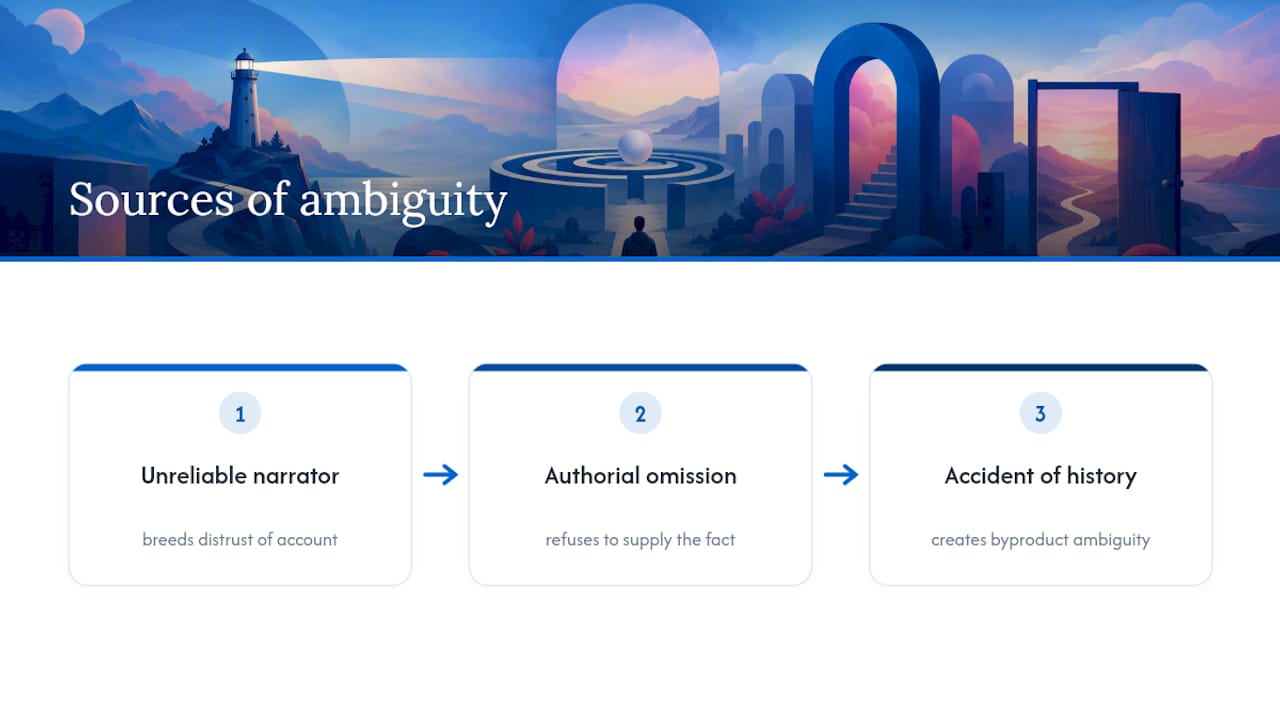
Then there’s the accident of history: an author dies mid-manuscript, as Dickens did with Edwin Drood, and ambiguity becomes a byproduct rather than a design choice. Crime fiction critics note that in mysteries specifically, an unresolved ending often reframes the entire book: it stops being about catching a criminal and starts being about why justice failed in the first place.
The psychological payoff is why readers keep returning to these books. An ending that hands you nothing forces you to become an active interpreter instead of a passive recipient, and one analysis of the device argues that ambiguity works best when it echoes the book’s own themes, memory, identity, guilt, so the unresolved ending extends the argument rather than dodging it. Readers who love unreliable narrators tend to describe the same feeling: the story doesn’t end when the pages run out, it ends when you stop arguing about it.
How to Talk About an Ending Without Ruining It
Good discussion questions about ambiguous endings focus on motive and theme rather than plot mechanics, which keeps the conversation spoiler-safe for anyone still reading.
- What does the character’s final choice suggest about what they valued most?
- If the ambiguous detail were resolved one way, how would the book’s theme change?
- Which small detail earlier in the book might be a clue you missed?
- Does the narrator’s credibility shift in the final chapters, and where exactly?
- Whose version of events would you believe if you had to choose, and why?
- What does the author gain by refusing to answer the central question?
- Does the ending feel earned, or does it feel like an exit from a problem the author couldn’t solve?
- How would a sequel, if one existed, most likely resolve the gap, and would you want it to?
Reread the final chapter specifically hunting for hedged language, words like “seemed” or “perhaps,” since that’s usually where writers plant their unreliable clues. Keep a short note of anything a narrator claims but never proves.
Pro Tip: When a book club conversation about an unresolved ending turns heated, ask everyone to state which detail in the text they’re basing their reading on. Debates about ambiguous endings usually aren’t disagreements about the book, they’re disagreements about which sentence everyone weighted most heavily.
Why I Write Endings That Don’t Resolve
I use ambiguity when a character’s guilt is the actual subject of the book, not a plot device I need to wrap up. If a story is about whether someone deserves what’s coming for them, handing the reader a clean verdict lets them off the hook. I’d rather they sit with the discomfort a little longer.
In The Nether, the haunting’s motives stay unclear because I wanted readers arguing about whether the protagonist earned it, not just whether he survived it. Stories of a Condemned Soul does the same thing in miniature, story by story. Both are available free through Kindle Unlimited, and if you want the fuller craft explanation behind this choice, I’ve written more about it in what an open ending actually means in storytelling.
What Ambiguous Endings Actually Ask of a Reader
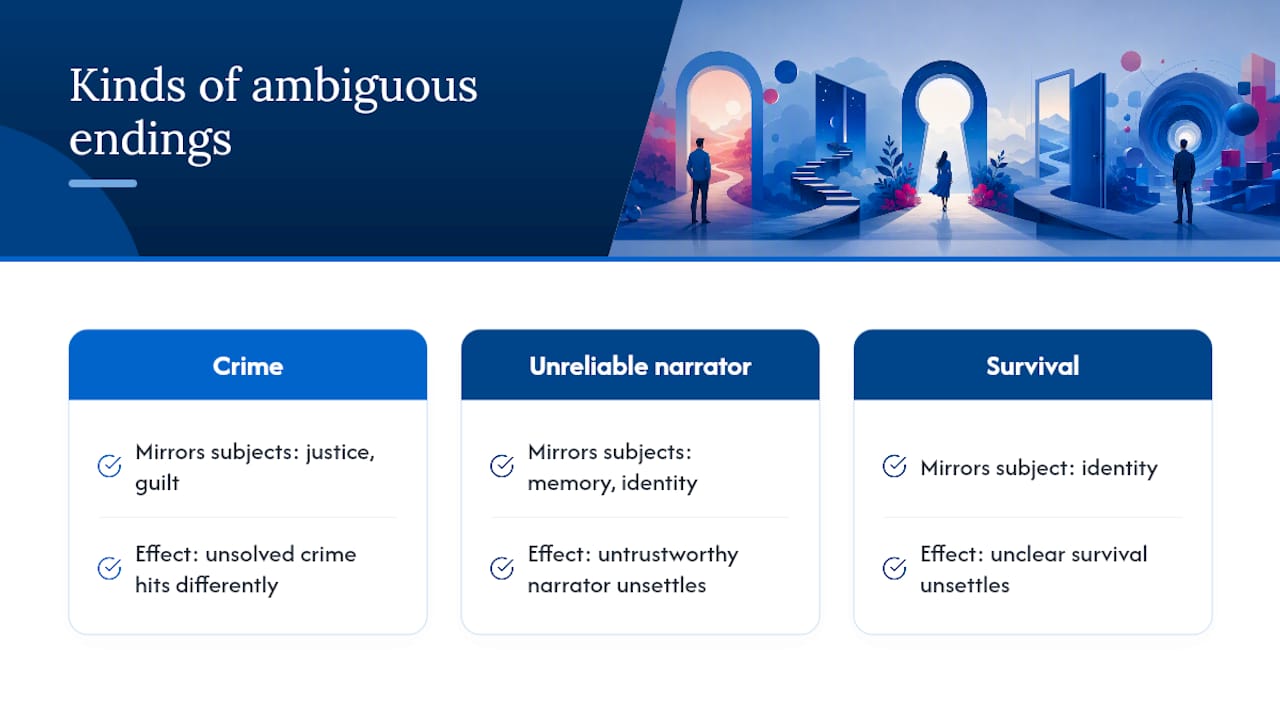
The conventional advice on this topic treats ambiguous endings as a trick, a way for a writer to dodge the hard work of resolution. That’s true occasionally, but it misses why the best ones work. An ending like The Handmaid’s Tale’s isn’t lazy, it’s a refusal to give you comfort you haven’t earned. The books on this list that hold up years later are the ones where the unresolved question mirrors the book’s real subject: guilt, memory, justice, identity.
If you’re picking your next read, prioritize the ambiguity that matches what unsettles you already. A crime that doesn’t get solved hits differently than a narrator you can’t trust, and both hit differently than a character you can’t tell survived. Don’t chase the ending. Chase the specific kind of unease that made you pick up the book in the first place.
— Nathaniel
More Books Built Around Unresolved Dread
If titles like The Nether left you wanting more books that refuse to hand over a clean answer, Nathaniel Connors’s catalog is built almost entirely on that discomfort, moral ambiguity, lingering dread, and endings that ask more questions than they answer.
Start with Nathaniel Connors’s dark supernatural thrillers for the full range of his unresolved, guilt driven horror. A few specific places to begin:
- Dark supernatural thrillers, the full category page for readers who want more of this exact mood.
- Stories of a Condemned Soul, a short-story collection for readers who want the ambiguity delivered in smaller doses.
- Existential horror books that make you question reality, for readers who came here for The Buried Giant or Never Let Me Go.
Every title Connors has published is free to read for Kindle Unlimited subscribers, so if you’re already a member, the next unresolved ending is a tap away.
Sources
- SparkNotes — What does the ending of The Handmaid’s Tale mean?
- CrimeReads — Five of the greatest ambiguous endings in the annals of crime fiction
- Will Remains — And what did you mean by that?
- TCK Publishing — 10 Books with Ambiguous Endings That Will Keep You Thinking