
The best existential horror books to start with right now: Annihilation by Jeff VanderMeer (reality dissolves before your eyes), Zone One by Colson Whitehead (survival stripped of meaning), The Ballad of Black Tom by Victor LaValle (cosmic indifference with a racial lens), Foe by Iain Reid (identity horror at its most claustrophobic), A Short Stay in Hell by Steven L. Peck (eternity as punishment), and The Nether by Nathaniel Connors (the psychological monsters we carry inside us). Each of these works earns the label not through jump scares or gore but through a specific, creeping dread: the suspicion that you cannot trust your own perception, your own self, or the world’s indifference to your existence.
A quick tone note before you dive in: several of these titles contain body horror, grief, and violence. The BookRiot roundup of existential horror novels is a useful companion if you want even more options after working through this list.
Key Takeaways
Existential horror fiction works because it turns the dread inward, making identity, perception, and meaning the source of terror rather than any external monster.
| Point | Details |
|---|---|
| Start short | Novellas and short story collections calibrate your tolerance for ambiguity before long slow-burn novels. |
| Know your dread type | Interior horror (identity, perception) differs from cosmic horror (scale, indifference); pick accordingly. |
| Trigger awareness | Body horror, grief, suicide ideation, and psychological manipulation appear across the subgenre; check notes before reading. |
| Nathanielconnors titles | The Nether, Stories of a Condemned Soul, and Evolution A200 are available free on Kindle Unlimited and explore existential themes through character-driven supernatural fiction. |
| Mix canonical and contemporary | Pair a classic (Kafka, Sartre) with a modern title to understand how the subgenre has evolved. |
Table of Contents
- The best existential horror books, annotated
- What actually makes a book “existential horror”
- How to pick the right existential horror book for your taste
- Authors who shaped existential horror and where to start
- Nathaniel Connors recommends: author picks
- Why existential horror matters right now
- Read dark fiction by Nathaniel Connors
- Sources
The best existential horror books, annotated
These ten titles represent the range of the subgenre: quiet literary dread, cosmic weirdness, psychological instability, and dystopian nihilism. Each entry includes a short reason it belongs here, a pace note, and a trigger flag where relevant.
1. Annihilation — Jeff VanderMeer
The Southern Reach trilogy opens with a biologist entering Area X, a region that has swallowed every expedition before hers. VanderMeer never explains what Area X is. The horror lives in that refusal. Identity erodes chapter by chapter, and by the end you genuinely cannot say whether the narrator is still herself. Fast-paced for the subgenre; reads in a single sitting. Trigger: body horror, psychological dissolution. Best for readers who want cosmic dread delivered through literary precision.
2. Zone One — Colson Whitehead
Whitehead’s zombie novel is almost aggressively quiet. The undead are background noise. What Whitehead actually writes about is the exhaustion of surviving something that has already taken everything worth surviving for. The prose is dense and elliptical, the plot minimal. Trigger: grief, violence, nihilism. Best for readers who find conventional horror too loud.
3. The Ballad of Black Tom — Victor LaValle
A direct rewrite of Lovecraft’s “The Horror at Red Hook,” told from the perspective of a Black man in 1920s Harlem. LaValle keeps the cosmic indifference but strips away Lovecraft’s racism and replaces it with something sharper: the argument that an indifferent universe is still preferable to a hostile one. Short, precise, devastating.
Trigger: racism, violence. Best for readers who want existential dread with genuine moral weight.
4. Foe — Iain Reid
A couple living on an isolated farm receives a visitor who informs the husband he has been selected for an off-world program. What follows is a slow, suffocating examination of what makes a person irreplaceable, and whether a perfect copy of you would still be you. Reid writes in short, pressurized sentences that build unbearable tension. Trigger: psychological manipulation, identity horror. Best for readers who want the dread to come from inside the house, not outside it.
5. Hammers on Bone — Cassandra Khaw
A noir novella in which a private detective who is also an ancient, inhuman thing takes a case from a child trying to protect his family. Khaw writes in a style so dense with imagery it borders on prose poetry. The horror is ontological: the detective’s perspective makes human suffering look small and strange. Trigger: child abuse, violence, body horror. Best for readers who want weird fiction with a hard emotional core.
6. You Should Have Left — Daniel Kehlmann
A screenwriter rents a remote house to finish a script. The house does not behave geometrically. Rooms appear that should not exist; notes he writes seem to answer themselves. Kehlmann keeps the whole thing under 100 pages, which is exactly the right length: any longer and the dread would collapse into explanation. Trigger: paranoia, psychological instability. Best for readers who want their existential horror fast and airtight.
7. A Short Stay in Hell — Steven L. Peck
A devout Mormon dies and discovers the afterlife is a Borges-style infinite library. He must find the single book that contains the story of his life. The math of the task makes the horror: the library is so large that finding the book would take longer than the current age of the universe, many times over. Peck turns a thought experiment into something genuinely harrowing. Trigger: existential despair, suicide ideation. Best for readers who want philosophical horror with a clean, almost clinical execution.
8. The Nether — Nathaniel Connors
Connors builds his horror from the inside out. The Nether follows characters whose worst impulses and deepest guilts take on a life of their own, pressing against the boundary between psychological reality and something darker. The TV Tropes breakdown of existential horror identifies identity collapse and doubts about free will as the genre’s core concerns; Connors works both with precision. Trigger: psychological violence, guilt, supernatural horror. Best for readers who want character-driven dread with a supernatural edge.
9. Stories of a Condemned Soul — Nathaniel Connors
A collection of dark supernatural stories that circle themes of revenge, guilt, and the cost of choices made in the dark. Short-story format makes this an ideal entry point for readers new to Connors’ work, or for anyone who wants to test their tolerance for ambiguity before committing to a novel-length read. Trigger: violence, moral horror, supernatural themes. Best for readers who prefer their existential dread in concentrated doses.
10. Evolution A200: A Bubonic Apocalypse — Nathaniel Connors
Connors takes the apocalypse seriously as a philosophical event, not just a backdrop. When civilization collapses under a plague, what survives of human identity and meaning? The dystopian frame pushes the existential questions outward from individual psychology to collective survival. Readers who enjoy dystopian horror novels that ask what humanity is worth will find this one hard to put down. Trigger: plague, death, violence. Best for readers who want their existential dread at civilizational scale.

What actually makes a book “existential horror”
Existential horror is fiction that generates dread not from external monsters but from the collapse of the frameworks we use to make sense of ourselves and the world.
The Game Rant explainer on the existential horror genre traces the subgenre’s roots to existentialist philosophy: Kierkegaard’s anxiety, Sartre’s nausea, Camus’s absurdism. The horror arrives when a character, or a reader, confronts the possibility that life has no inherent meaning, that identity is unstable, or that the universe is not merely dangerous but genuinely indifferent.
TV Tropes’ entry on existential horror identifies the core motifs: questions about personal identity, doubts about free will, and the terrifying unreliability of perception. Protagonists in these stories often cannot trust what they see, what they remember, or whether their choices mean anything.
This is what separates existential horror from straightforward cosmic horror. Lovecraftian cosmic horror emphasizes the smallness of humanity against incomprehensible forces. Existential horror turns that camera inward: the threat is not just out there, it is in the structure of selfhood itself. ScreenRant’s overview of the subgenre puts it well: existential horror emphasizes individual loneliness and ambiguity in a way that cosmic horror, with its grand inhuman scales, often does not.
Formal experimentation is common in the best examples. Fragmented narration, unreliable narrators, and metafictional structures all produce what Brad Baumgartner calls weird mysticism: a mode of writing that uses negative space and philosophical pessimism to destabilize the reader’s grip on what is real.
How to pick the right existential horror book for your taste
Start by deciding whether you want the dread to come from inside a character’s mind or from outside it, then match pace and length to how much ambiguity you can sit with comfortably.
A short selection checklist:
- Do you want quiet interior dread or cosmic-scale strangeness? (Interior: Foe, You Should Have Left. Cosmic: Annihilation, A Short Stay in Hell.)
- Do you want a novel or something shorter? (Under 150 pages: You Should Have Left, The Ballad of Black Tom, Hammers on Bone, Stories of a Condemned Soul.)
- Are there triggers you need to avoid? (Check the trigger notes in the annotated list above.)
- Do you want philosophical payoff or sustained atmosphere? (Payoff: A Short Stay in Hell, The Ballad of Black Tom. Atmosphere: Zone One, Annihilation.)
Three reader profiles:
- The Slow-Burn Thinker — You want prose that earns its dread through accumulation. Start with Zone One or Foe.
- The Weird-World Explorer — You want reality to bend. Start with Annihilation or Hammers on Bone.
- The Psychological Edge — You want the horror to come from character, not concept. Start with The Nether or Stories of a Condemned Soul.
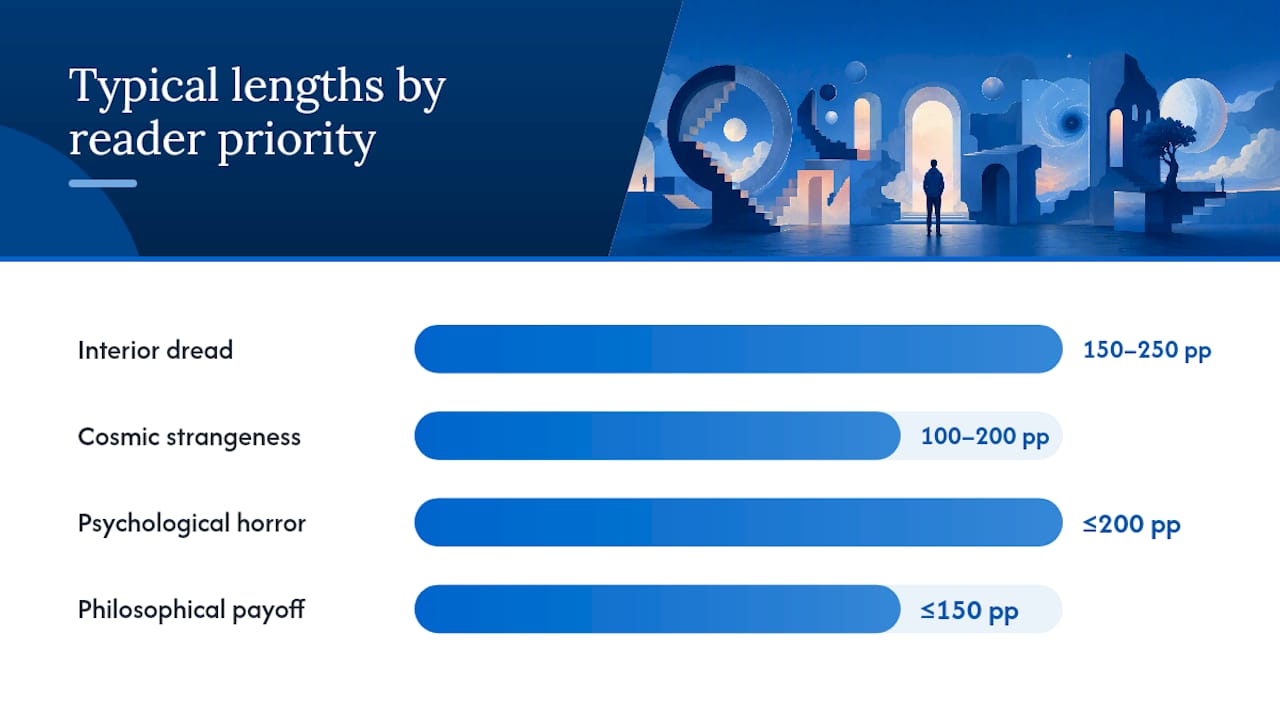
| Reader priority | Tone | Ambiguity level | Good entry titles | Typical length |
|---|---|---|---|---|
| Interior dread | Literary, quiet | High | Foe, Zone One | 150–250 pages |
| Cosmic strangeness | Weird, atmospheric | Very high | Annihilation, A Short Stay in Hell | 100–200 pages |
| Psychological horror | Tense, character-driven | Moderate | The Nether, You Should Have Left | Under 200 pages |
| Philosophical payoff | Conceptual, precise | Moderate | The Ballad of Black Tom, A Short Stay in Hell | Under 150 pages |
Pro Tip: Start with a novella or short-story collection before committing to a long, slow-burn novel. The BookRiot list confirms that readers new to the subgenre often find the ambiguity easier to absorb in smaller doses. Short works like Hammers on Bone or Stories of a Condemned Soul calibrate your tolerance before you step into something like Zone One, which demands patience.
For readers who want to explore the full range of horror subgenres before committing to existential horror specifically, that overview maps the territory well.
Authors who shaped existential horror and where to start
The subgenre has roots that run back further than most readers expect.
Franz Kafka is the obvious starting point. The Metamorphosis (1915) is the cleanest demonstration of identity horror in literary history: a man wakes up as an insect and the story is not about the transformation but about what it reveals about his family, his work, and his own sense of self. It is a starter text. Read it before anything else on this list if you have not already.
Fyodor Dostoevsky wrote proto-existential horror in Notes from Underground (1864), a novella narrated by a man who has thought himself into paralysis. The horror is entirely interior: a mind that cannot stop examining itself. Advanced read, but short.
H.P. Lovecraft is the most direct ancestor of the cosmic branch of the subgenre. Academic work, including H.P. Lovecraft and Modern Philosophy from McFarland, places his imagery in conversation with phenomenology, arguing that his sense of the ineffable maps onto genuine philosophical questions about existence and embodiment. Start with “The Call of Cthulhu” or “The Shadow over Innsmouth.” Both are short and demonstrate his technique without the racism that saturates some of his longer work.
Thomas Ligotti is the most philosophically rigorous horror writer working today. His nonfiction book The Conspiracy Against the Human Race frames horror as a direct confrontation with meaninglessness. His fiction collections, particularly Songs of a Dead Dreamer, are advanced reads: dense, pessimistic, and formally strange. Brad Baumgartner’s Weird Mysticism places Ligotti alongside Georges Bataille as a practitioner of negative writing that probes the limits of reality itself.
Jean-Paul Sartre’s Nausea (1938) is not marketed as horror, but it functions as one of the most effective existential horror novels ever written. The protagonist’s growing inability to find stable meaning in objects, people, or his own existence produces a dread that is entirely philosophical and entirely physical. Starter text for readers comfortable with literary fiction.
Nathaniel Connors recommends: author picks
Nathaniel Connors writes dark supernatural fiction that sits at the intersection of psychological horror and existential dread. His work at Nathanielconnors explores the monsters that live inside human psychology as much as outside it.
His three titles in this genre:
- The Nether — A supernatural horror novel that uses guilt and identity collapse as its primary weapons. Characters cannot be certain whether the darkness pursuing them is external or a projection of their own worst selves. Available in ebook, paperback, and free on Kindle Unlimited.
- Stories of a Condemned Soul — A short-story collection built around revenge, guilt, and the cost of moral failure. The format makes it ideal for readers who want to sample Connors’ voice before committing to a novel. Each story is self-contained but the thematic weight accumulates. Available in ebook, paperback, and on Kindle Unlimited. Read it at Stories of a Condemned Soul.
- Evolution A200: A Bubonic Apocalypse — Dystopian horror that asks what human identity means when civilization is gone. The existential questions scale from individual to collective, making it a natural next read after something like Zone One. Available in ebook, paperback, and on Kindle Unlimited.
All three titles are available to Kindle Unlimited subscribers at no additional cost, which makes them a low-friction entry point for readers who want to try the author’s work before buying. For readers who want more Kindle Unlimited horror options, the best Kindle Unlimited horror books list is a useful next stop.
Why existential horror matters right now
The subgenre has never been more relevant, and the reason is not complicated: existential horror gives readers a safe container for the dread that has no clean object.
Most horror is about a specific threat. You can name it, run from it, kill it. Existential horror is about the dread that remains after you have done all of that and the question is still there: what does any of this mean? That is not a horror-fiction problem. That is a human problem, and fiction is one of the few places you can sit with it without needing to resolve it.
ScreenRant’s analysis of the subgenre’s current cultural relevance points to individual loneliness and ambiguity as the defining anxieties of the moment. Existential horror fiction does not fix those anxieties. It takes them seriously, which is often more useful. Reading Annihilation or A Short Stay in Hell does not answer the question of whether your choices matter. It makes the question feel less isolating, because someone else thought it was worth writing a whole book about.
Read dark fiction by Nathaniel Connors
If the titles in this list pulled you toward character-driven psychological dread, Nathaniel Connors’ catalog belongs on your shelf. His books do not offer easy resolutions or comfortable endings. They sit with the darkness and ask what it reveals about the people inside it.

All three of his titles — The Nether, Stories of a Condemned Soul, and Evolution A200: A Bubonic Apocalypse — are available in ebook and paperback on Amazon, and free to read for Kindle Unlimited subscribers. For readers who want to start with his psychological thriller work specifically, the Kindle Unlimited psychological thrillers page has the full catalog with format details. Pick one up tonight.
Sources
- Existential Horror – TV Tropes
- Weird Mysticism (Brad Baumgartner, Bloomsbury / Lehigh University Press)
- 10 Existential Horror Novels to Make You Question Everything (BookRiot)
- The Existential Horror Genre Explained (Game Rant)
- Existential horror subgenre explained (ScreenRant)
- The Conspiracy against the Human Race by Thomas Ligotti (Penguin Random House)