If you want the trapped feeling in your chest by page 20, start with House of Leaves for a house that shouldn’t exist, The Chamber for a hyperbaric countdown, or Nathaniel Connors’s The Nether if you want the walls to close in psychologically instead of physically. Pick physical entrapment when you want your pulse to spike; pick mental claustrophobia when you want the dread to follow you out of the book.
TL;DR:
- Most claustrophobic horror relies on psychological confinement, sensory deprivation, and ticking clocks to evoke real anxiety, often more than monsters or gore.
- Physical entrapment stories like The Chamber and House of Leaves use formats and settings designed to heighten disorientation and pressure for a visceral experience.
- Readers with sensitive triggers should sample book chapters and reviews first, focusing on third-person or slower-paced entries to avoid overwhelming anxiety.
- Psychological fiction like The Nether and We Have Always Lived in the Castle evoke dread through guilt and social paranoia, often feeling just as claustrophobic as physical spaces.
- Claustrophobia is a real situational phobia that can cause genuine stress responses, so slowing down or skipping intense passages is recommended if anxiety becomes overwhelming.
Table of Contents
- The Best Claustrophobic Horror Books to Read Right Now
- Why Small Spaces Create Big Dread in Fiction
- How to Pick a Claustrophobic Horror Book for Your Comfort Level
- A Word on Claustrophobia and When to Put the Book Down
- Why I Keep Writing Rooms That Won’t Let You Leave
- Where to Start Reading Nathaniel Connors’s Claustrophobic Fiction
- Sources
- FAQ
The Best Claustrophobic Horror Books to Read Right Now
The claustrophobic horror books that stick with readers longest rarely rely on a monster at all. They rely on a room, a deadline, and a mind that stops trusting itself. Below are the titles worth your time, sorted loosely from physical entrapment to psychological enclosure, with a quick note on who each one is really for.
- House of Leaves by Mark Z. Danielewski. A family finds their house is bigger on the inside than the outside, and the book’s own typography starts collapsing along with the hallway. The formal, typographic experimentation makes the reading experience itself feel cramped. Best for readers who don’t mind footnotes eating the plot.
- The Chamber by Will Dean. A diver has four days of decompression left inside a hyperbaric chamber, and someone on the rig wants her dead before the clock runs out. The ticking-clock, closed-environment setup is about as literal as claustrophobia gets in modern thrillers.
- Bird Box by Josh Malerman. The threat is outside, but the horror is the blindfold. Reader-curated lists keep pointing to Malerman’s shrinking-world tension, where safety means never opening your eyes.
- The Luminous Dead by Caitlin Starling. A solo caver descends into an unmapped system with an unreliable handler feeding her information from the surface. It pairs physical confinement with a narrator you can’t fully trust, a combination that Book Riot flags as a reader favorite for a reason.
- The Nether by Nathaniel Connors (recommended pick). The confinement here isn’t a cave. It’s a mind slowly closing in on itself under guilt and supernatural pressure, which makes the walls feel just as real as concrete.
- We Have Always Lived in the Castle by Shirley Jackson. Two sisters barricade themselves inside a decaying house after a family poisoning. Jackson turns domestic routine into a cell, proving a locked door isn’t required for a book to feel airless.
- The Hole by Hye-young Pyun. A man wakes up paralyzed, entirely dependent on a mother-in-law who may be his slow undoing. Confinement here is the body itself, which makes it one of the more physically uncomfortable entries on this list.
- Room by Emma Donoghue. Told through a child’s eyes, the entire first half unfolds inside eleven square feet. It’s less about scares and more about sustained pressure, so pick it if you want dread without gore.
- The Descent by Jeff Long. Cavers find something in the deep that shouldn’t be there. It leans harder into survival horror than psychological unraveling, good for readers who want the walls to close in and something to actually chase them.
- The Troop by Nick Cutter. A scout troop’s island camping trip turns into a quarantine nightmare once a parasite gets loose. Isolation plus body horror plus no way to call for help.
- 1984 by George Orwell. Room 101 remains one of literature’s purest psychological enclosures: a space built entirely around one person’s specific fear. Not marketed as horror, but it earns a spot on any list about mental confinement.
- Stories of a Condemned Soul by Nathaniel Connors (recommended pick). A collection built around guilt and redemption, where the trap isn’t a location but a conscience that won’t let its narrators go.
Readers who gravitate toward the quieter entries on this list (Room, We Have Always Lived in the Castle) tend to also enjoy slow burn horror, where dread accumulates instead of arriving all at once.
Why Small Spaces Create Big Dread in Fiction
Claustrophobic horror works because it borrows the mechanics of a real anxiety response and applies them on the page, as outlined in this creator’s guide to building atmosphere in horror. Four devices do most of the heavy lifting: sensory deprivation (limiting what a character, and by extension the reader, can see, hear, or touch), the ticking clock (a hard deadline that turns every page into lost time), a shrinking world (the usable space or number of allies steadily decreasing), and social paranoia (the point where characters stop trusting each other, or their own senses).
Psychological horror tends to internalize the monster, using unreliable perception to generate paranoia and a mental state that feels every bit as confining as a locked room.
That framing comes from the British Fantasy Society’s breakdown of the subgenre, and it explains why We Have Always Lived in the Castle feels claustrophobic despite an open front door. The confinement is social and psychological, not architectural.
Clinical research backs the vicarious effect. Claustrophobia is classified as a specific situational phobia in anxiety disorder literature, distinct from a general anxiety condition. Fiction that recreates the triggers of that phobia (limited exits, restricted air, no way to signal for help) can produce a real, if milder, version of that physiological stress response in readers who have never set foot in a cave.
You can see all three devices stacked in the list above. The Chamber uses the ticking clock explicitly: a four-day decompression window that turns every chapter into borrowed time. House of Leaves uses sensory deprivation through form itself, forcing readers to physically rotate the book or hunt through footnotes, which mimics disorientation rather than just describing it. The Luminous Dead combines a shrinking world (an unmapped cave system) with social paranoia (a handler who might be lying), which is why it reads tighter than either device alone.
How to Pick a Claustrophobic Horror Book for Your Comfort Level
Not every reader wants the same intensity, and matching a book to your tolerance takes about two minutes of homework before you commit 300 pages.
Run through this checklist first:
- Setting type: Physical (cave, chamber, bunker) hits the body; psychological (a mind, a memory, a family) hits differently and often lingers longer.
- Pacing: Slow burns build pressure gradually; fast-paced thrillers spike it immediately and rarely let up.
- Perspective: First-person narration puts you inside the panic; third-person gives you a step of distance if you need it.
- Content intensity: Some entries lean into graphic violence (The Troop), others stay almost entirely psychological (Room, 1984).
- Formatting: Books like House of Leaves use unusual typography that amplifies disorientation on purpose.
Once you know your limits, the selection process is quick:
- Read the first excerpt or sample chapter before buying the full book.
- Check reviews specifically for trigger notes, not just star ratings.
- If first-person narration feels like too much, look for a third-person alternative with a similar setting.
Pro Tip: Sample a single representative chapter, or the audiobook preview, before committing. A book’s opening pages rarely show its most intense moment, so skim toward the middle to gauge how the tension actually escalates.
A Word on Claustrophobia and When to Put the Book Down
Claustrophobia isn’t a personality quirk. It’s a recognized situational phobia, which means confined-space fiction can trigger a genuine physical stress response in sensitive readers, not just a fictional scare.
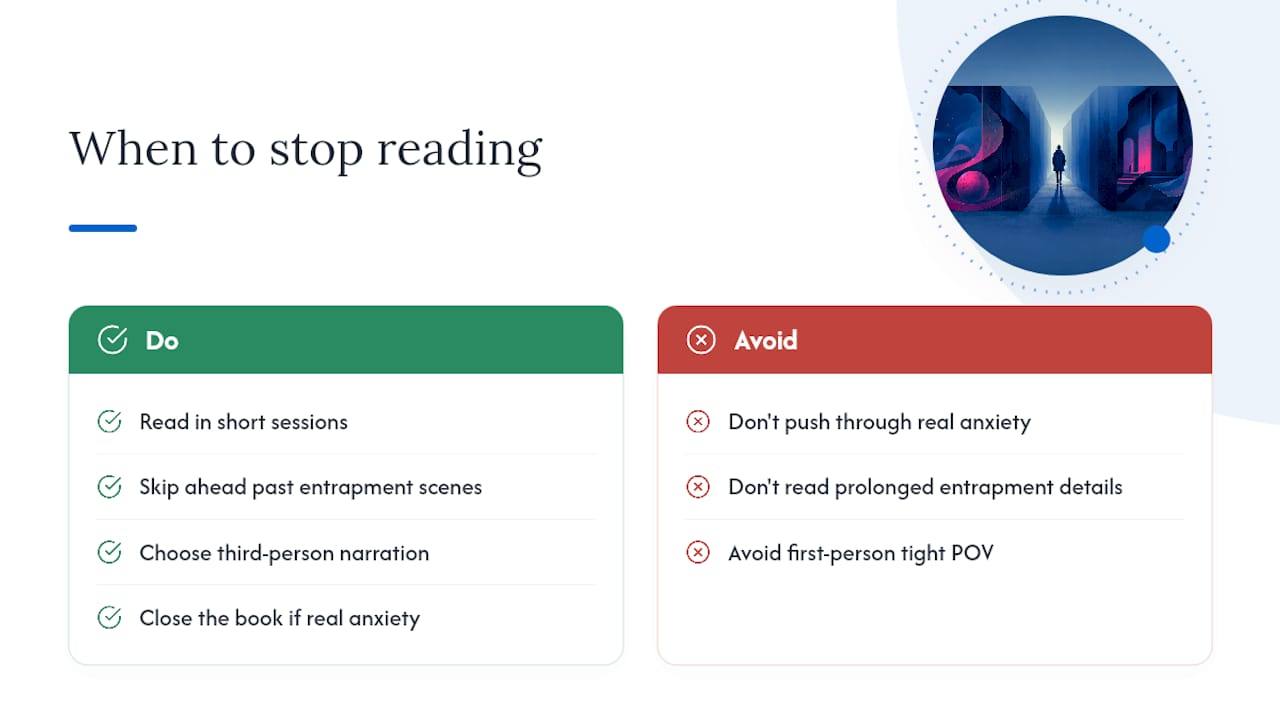
If a scene starts producing real anxiety rather than enjoyable tension, that’s the signal to close the book, not push through it. Practical steps: read in short sessions, skip ahead if a passage describes prolonged physical entrapment in detail, and choose third-person narration for more distance. For a gentler alternative, atmospheric slow burns or open-setting psychological horror deliver dread without the tight walls.
Why I Keep Writing Rooms That Won’t Let You Leave
I write confined spaces because the scariest cell is the one built out of guilt, not concrete. Physical traps end when someone finds the door. Psychological ones don’t, and that’s the kind of horror I want readers still turning over a week after they finish the last page. My approach to building psychological horror starts with a character’s conscience, then lets the walls follow from there.
A few of my own titles that fit this list directly:
- The Nether — a descent into guilt that traps its narrator more effectively than any locked door could.
- Stories of a Condemned Soul — a collection where redemption is the only exit, and it’s never guaranteed.
- Evolution A200: A Bubonic Apocalypse — isolation on a societal scale, where the whole world becomes the confined space.
— Nathaniel
Where to Start Reading Nathaniel Connors’s Claustrophobic Fiction
If this list left you wanting more psychological enclosure and less padding, Nathaniel Connors’s catalog is built entirely around that specific itch: dread that comes from guilt and conscience rather than jump scares.
Every title, including The Nether and Stories of a Condemned Soul, is available in ebook and paperback on Amazon, and free to read for Kindle Unlimited subscribers at no added cost. That makes it a low-friction next step if you already finished the entries above and want a claustrophobic read that doesn’t need a cave or a chamber to close in on you. Start with the dark supernatural thriller collection and pick whichever title’s premise grabs you first.
Sources
- Clinical literature on claustrophobia (PubMed entry)
- Psychological horror subgenre deep dive — British Fantasy Society
- 8 Terrifyingly Claustrophobic Horror Books | Book Riot
- House of Leaves — Penguin Random House
- The Chamber — Simon & Schuster
FAQ
What is the most terrifying claustrophobic horror book?
There’s no single agreed-upon answer, but House of Leaves consistently tops reader lists for the way its typographic disorientation makes the confinement feel physically real rather than just described.
What is the scariest psychological horror book?
Psychological horror rankings vary by reader, but titles that internalize the threat, like We Have Always Lived in the Castle, are frequently cited for turning unreliable perception into sustained dread rather than relying on external monsters.
Is claustrophobia a mental disorder?
Claustrophobia is classified as a specific situational phobia under anxiety disorders, not a standalone mental disorder, which is why confined-space fiction can trigger real physical stress in sensitive readers.
What is considered the darkest book ever written?
“Darkest” depends heavily on personal tolerance, but among claustrophobic and psychological horror readers, titles like The Nether by Nathaniel Connors get named often for how thoroughly they trap a character in guilt with no clean way out.
How do I know if a claustrophobic horror book is too intense for me?
Sample a chapter before committing, check reviews for specific trigger notes, and favor third-person narration if first-person panic feels like too much to sit inside for an entire book.