The fastest way to write a horror short that works is to pick one unforgettable image and build a 2 to 12 minute scene around it, using a minimal cast, a single location, and sound design instead of exposition. Everything else, structure, dialogue, formatting, is in service of that one shot. Aim for a script between 5 and 12 pages, and use the resources below to study how professionals pull it off.
TL;DR:
- Focus on one unforgettable image that justifies the entire short and build the script tightly around that single shot without unnecessary exposition.
- Keep the cast small and the location limited, ideally to two characters and one setting, to generate fear quickly and maintain audience engagement.
- Use practical effects, strong sound design, and deliberate silence to maximize tension on a low budget, with locations that naturally create suspense.
- Trim dialogue to essentials, emphasizing physical action over verbal explanation, and avoid revealing the monster or threat too early to preserve mystery.
- Reinforce theme with visual motifs and a consistent threat rule, avoiding explicit dialogue about the theme to deepen emotional impact and build lasting dread.
Table of Contents
- What Makes a Horror Short Film Script Effective?
- How Long Should a Horror Short Film Script Be?
- Writing Characters and Choosing Your Source of Horror
- Sound, Lighting, and Locations That Do the Scaring for You
- Formatting Rules and Where to Study Sample Scripts
- Revising Your Script and Getting It Seen
- Writing Dialogue That Earns Its Place in a Horror Short
- Using Theme and Motif to Deepen a Short’s Scares
- Building Memorable Scares Into a Short Runtime
- Legal Considerations Before You Write or Shoot
- A Working Writer’s Perspective on the One-Shot Method
- Where to Go Next If You Want to Write Darker, Deeper Horror
- Sources
What Makes a Horror Short Film Script Effective?
Every horror short that sticks with you was built backward from one moment. Writers call it “THAT SHOT,” the single image so unsettling it justifies the entire runtime. A woman’s shadow moving a half second before she does. A door that was locked from the inside. Once you find that image, StudioBinder’s guide to writing horror shorts recommends rewriting the whole script around it so nothing dilutes the payoff.
Cast and location size matter more in horror than in almost any other genre. A short with six characters and three settings spreads audience attention too thin to build dread. Two characters, one house, one hallway, that’s plenty. Access Creative College’s guide to short horror points out that shorts need to generate fear fast, and a tight cast lets you skip introductions and go straight to unease.
Tropes are the other trap. Jump scares telegraphed by a swelling score, a cat leaping into frame, a killer who’s always exactly where the character isn’t looking, audiences have seen them all. Contest judges specifically reward scripts with a distinct twist or unusual concept rather than a familiar setup executed competently.
Three moves that consistently subvert expectations:
- Let the “monster” be revealed as mundane, then reveal something worse underneath.
- Withhold the scare past where the audience expects it, then deliver it somewhere quieter.
- Give the threat a rule the audience learns alongside the protagonist, not before.
Pro Tip: Write your THAT SHOT description as its own sentence before you write a word of the script. If you can’t describe it in one sentence, it’s not focused enough yet.
How Long Should a Horror Short Film Script Be?
Short film math runs roughly one page per minute, but horror shorts often run tighter because dread needs room to breathe on screen even when the script itself stays lean. A 5 page script can easily run 6 to 8 minutes once you factor in held shots and silence. Many festivals cap horror short submissions, and Killer Shorts recommends scripts that build dread inside a tight, low-cost footprint rather than a sprawling one for most contest categories.
A beat sheet that fits this runtime looks like this:
- Page 1: Establish the ordinary world in as few lines as possible. One detail is enough.
- Page 1 to 2: Plant the inciting incident, the first wrong note.
- Page 2 to 6: Escalate through small, specific violations of normalcy. Each beat should raise the stakes without repeating the last one.
- Page 6 to 8: Deliver THAT SHOT at or near the climax, not before.
- Page 8 to 10: Resolve fast. A horror short earns its ending in seconds, not pages.
Cut any scene that explains why the threat exists. The audience doesn’t need backstory; they need the next wrong noise. If a line of dialogue exists only to clarify plot mechanics, delete it and trust the visual instead.
Writing Characters and Choosing Your Source of Horror
A horror short only works if the audience cares who’s in danger, and caring takes seconds, not pages. Give your protagonist one clear vulnerability the threat can exploit directly, a parent who can’t stop checking on a sleeping child, someone who can’t leave a house they just inherited, someone who doesn’t believe in the thing that’s about to kill them. The vulnerability does double duty: it’s characterization and plot mechanism at once.
Choosing your horror type early shapes every other decision. Psychological horror rewards close quarters and unreliable perception, ideal when you have one location and one actor who can carry ambiguity. Supernatural horror needs a rule system the audience can learn quickly, since you won’t have time to over-explain lore. Environmental horror, isolation, weather, a structure that’s wrong, works well when dialogue is limited or absent entirely.
Writing visually means cutting anything that reads like narration dressed as action. Compare these:
-
Weak: “She feels a chill and senses something is wrong.”
-
Strong: “Her breath fogs. It didn’t a second ago.”
-
Weak: “He realizes the footsteps have stopped.”
-
Strong: “The footsteps stop. He doesn’t.”
Every action line should describe something a camera can capture, not an internal state. If you can’t film the sentence, rewrite it.
Sound, Lighting, and Locations That Do the Scaring for You
Silence scares audiences more reliably than money does. Sound design is often the primary tension tool in short-form horror, more than lighting, more than effects, because a controlled absence of sound makes the audience lean in right before you break it. Write silence into your script deliberately, as its own beat, not just as the gap between lines.
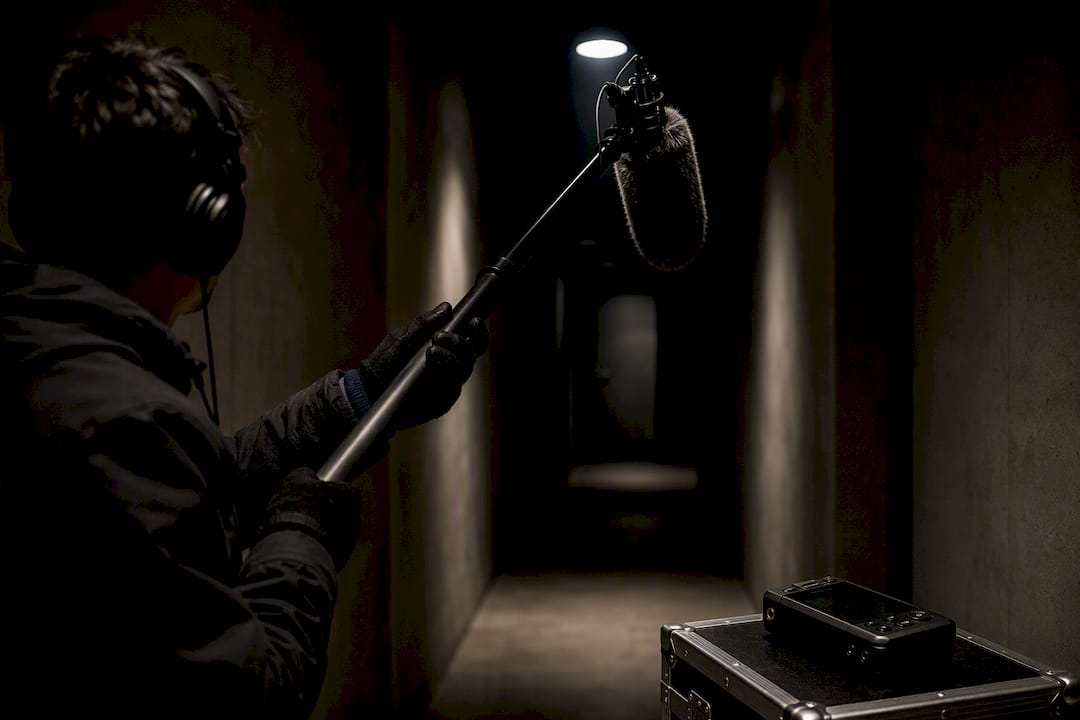
Practical effects beat CGI on a short film budget almost every time. The Blair Witch Project built an entire feature’s dread from handheld camera work, found-footage framing, and environmental sound, no digital effects required. That approach scales down perfectly for a short. A flashlight beam that catches something for one frame does more work than a rendered creature ever will on a limited budget.
Write your locations to work for you, not against your budget:
- One hallway, shot from both ends, reads as two locations in the edit.
- Practical lighting sources (lamps, phone screens, headlights) motivate shadow without a lighting rig.
- A single room with one door creates natural tension around entry and exit.
- Attics, basements, and cars are cheap to dress and inherently claustrophobic.
Statistic Callout: Contest guidelines from Killer Shorts note that many horror short competitions cap scripts around 12 pages, rewarding writers who can build dread inside a tight, low-cost footprint rather than a sprawling one.
Formatting Rules and Where to Study Sample Scripts
Standard screenplay format applies to horror shorts the same way it applies to features: 12-point Courier, scene headings in caps, one page per roughly one minute. Tools like Final Draft, WriterDuet, and the free Fade In alternative all handle this automatically, so spend your energy on the writing, not the margins.
Studying real scripts teaches pacing you can’t learn from rules alone. StudioBinder maintains a library of free horror scripts worth downloading specifically to see how professionals stage a scare on the page, where the white space sits, how long a beat runs before the cut.
When you read a sample script, don’t just read for plot. Track three things specifically:
- Where the writer places sound cues in the action lines versus leaving them implied.
- How many lines pass between the first hint of wrongness and the actual scare.
- Whether THAT SHOT is described in one tight sentence or buried in a paragraph.
Outlets like No Film School also break down scene-level craft choices in horror writing, useful once you’ve read a few full scripts and want to understand why specific beats land.
Revising Your Script and Getting It Seen
Run your draft through three passes with a specific job each time: pass one for structure and pacing, pass two for dialogue and clarity, pass three read aloud for rhythm. A table read with three or four people, cast cold with no context, reveals more about pacing problems than a week of solo rewrites.
Before submitting anywhere, run this checklist:
- Does THAT SHOT still land, or has it been softened by later drafts?
- Can a stranger follow the plot with zero verbal explanation?
- Does the script hit its page-count target for the contest or platform you’re targeting?
- Have you cut every line of dialogue that only explains plot mechanics?
Once it’s tight, horror shorts typically find audiences through genre festivals, curated horror YouTube channels, and short film platforms that program by theme rather than length. Submit where horror is a dedicated category, not a general shorts bucket, since horror-specific judges read for different instincts.
Writing Dialogue That Earns Its Place in a Horror Short
Horror dialogue works best when it does less than the writer wants it to. The instinct in a first draft is to have a character explain what’s happening, name the threat, voice the fear out loud. Cut that instinct on sight. The scariest line in most successful shorts is the one that undersells the danger, not the one that announces it.
Give characters speech patterns rooted in denial rather than awareness. Someone standing in front of something wrong is more likely to say “that’s weird” than to scream. That gap between what they say and what the audience sees is where tension actually lives. A character who names the monster too early collapses the mystery you spent pages building.
Silence between lines matters as much as the lines themselves. A pause before an answer, an unfinished sentence, a question that never gets a response, all of these do more than a fully written exchange. When two characters need to communicate urgency, let one interrupt the other. Real fear doesn’t wait for complete sentences.
Avoid dialogue that functions as stage direction in disguise (“Did you hear that? It came from the basement.”) unless the character’s denial or disbelief is the point. Instead, let physical behavior carry information the dialogue doesn’t need to state. A character checking a lock twice tells the audience more than a line about being scared.
Keep exchanges short. Horror shorts rarely have room for a conversation longer than four or five lines before the scene needs to move. If a scene’s dialogue runs long, ask whether a visual beat could replace half of it.
Using Theme and Motif to Deepen a Short’s Scares
A horror short with a theme underneath its scares tends to outlast the ones built purely on shock. Guilt, isolation, grief, and loss of control are the four themes that show up again and again in effective short horror, because each one gives the audience an emotional reason to feel dread beyond the immediate threat on screen.
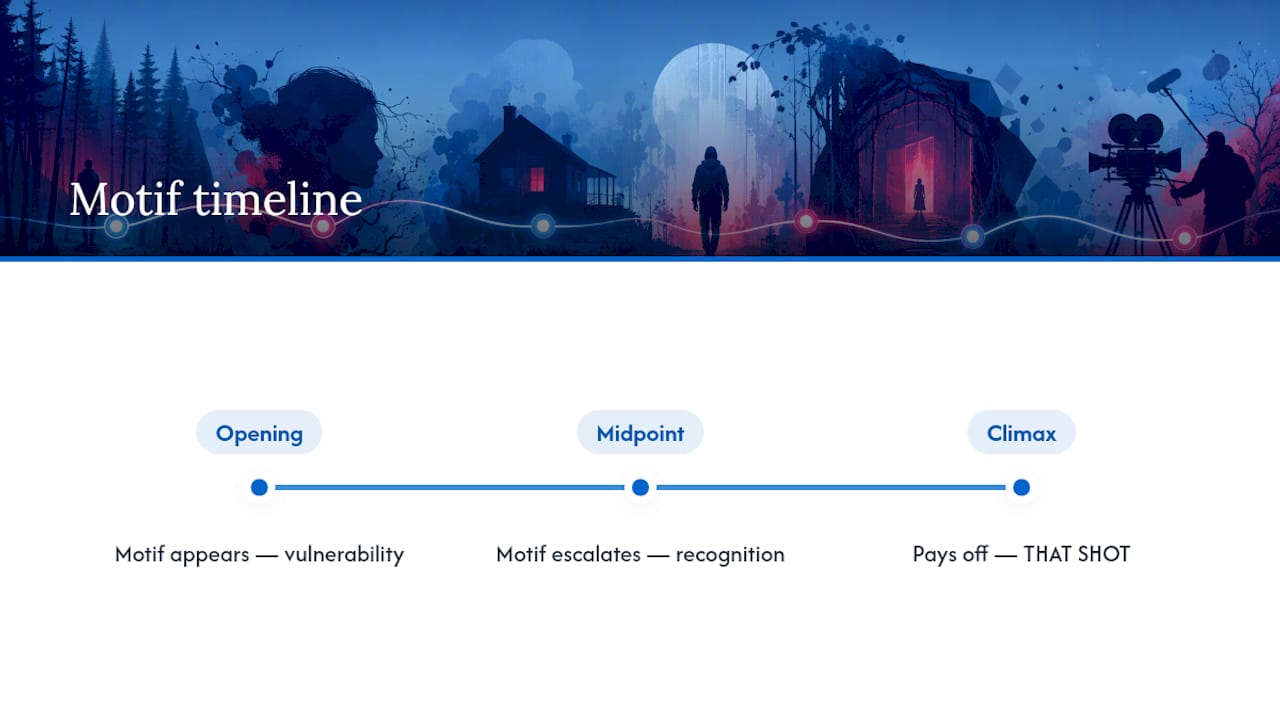
Motif works differently from theme but supports it directly. A recurring object, a sound that repeats, a color that shows up at each escalation, these give the audience a pattern to recognize, and recognition builds dread faster than novelty does. If a character hears a specific knock in the opening scene, that same knock returning at the climax carries weight the first instance didn’t have.
Choose one motif and commit to it across the entire script rather than introducing several that compete for attention. A short film doesn’t have the runtime to develop three visual threads. Pick the motif that connects most directly to your protagonist’s vulnerability, then let it appear at the start, escalate once in the middle, and pay off at THAT SHOT.
Theme should never be stated in dialogue. If your short is about guilt, no character should say the word “guilt.” The theme lives in the images and choices, the door someone can’t bring themselves to open, the phone call they let ring out. Readers and viewers register theme intuitively when it’s built into structure rather than announced in a line.
Building Memorable Scares Into a Short Runtime
A short film doesn’t have time to earn a scare the way a feature does, so every scary moment needs to work harder per second than it would in a longer format. The most memorable short-form scares tend to rely on anticipation rather than surprise: the audience sees the threat coming and dreads the arrival more than the arrival itself.
Long takes and slow pans are two of the most reliable tools for stretching that anticipation on a limited budget, because they cost nothing extra to write and force the audience to sit inside a moment rather than cut past it. Write these into your action lines explicitly. “The camera holds” is a legitimate scripting choice, not just a directing note.
Make your scares specific rather than general. “Something moves in the dark” is vague. “The chair by the window is empty. It wasn’t a moment ago.” gives the reader and eventual viewer something concrete to fear. Specificity is what makes a scare replay in someone’s memory after the runtime ends.
Save your biggest scare for last, but plant a smaller one early to establish the rules of your world. Two well-placed scares beat five scattered ones in a short film, because each additional scare dilutes the impact of the ones before it. Trust restraint over volume.
Legal Considerations Before You Write or Shoot
Original horror short scripts belong to the writer the moment they’re written, under U.S. copyright law, but registering the script with the U.S. Copyright Office creates a public record that matters if a dispute ever arises. Many festivals and contests also require proof of original ownership before they’ll accept a submission.
If your script references a real location, a real event, or a real person, get clearance or fictionalize enough that it’s no longer identifiable. Horror leans heavily on “based on a true story” framing, but using someone’s actual name, likeness, or documented experience without permission can create legal exposure regardless of genre.
Music, stock footage, and sound effects used in an eventual production need licensing even for a short with no budget. A script itself doesn’t require these clearances to exist on the page, but if you’re writing with a specific song or sound cue in mind, note that as a placeholder rather than assuming it will clear for free.
Co-writers and collaborators should have a simple written agreement about ownership and credit before revisions begin, even for a five-page short. Verbal agreements on horror shorts written for festival submission or shared script libraries are one of the most common sources of dispute once a project gets attention.
A Working Writer’s Perspective on the One-Shot Method
Building an entire short around one image sounds almost too simple until you try cutting a script down to it. The temptation is always to add a second unsettling moment for insurance. Resist it. A script built around a single potent image, say, a phone that keeps ringing with no one on the other end, gets stronger every time you cut something that isn’t that phone. The revision that actually saves a draft is almost always subtraction, not addition.
Before calling a script finished, run it against a short checklist: does THAT SHOT still land cold on a first read, does the cast size still feel necessary, and does the dialogue explain anything the visuals already show. If you want the deeper mechanics behind picking a horror subtype that fits your concept, the psychological horror craft guide breaks that down further.
— Nathaniel
Where to Go Next If You Want to Write Darker, Deeper Horror
If the one-shot method got you thinking past the short form, that instinct for restraint and dread is exactly what carries into longer fiction. Readers who want that same tightly built unease, sustained over an entire book rather than twelve pages, are the reason Nathaniel Connors’s dark supernatural thrillers exist.
The same instincts that make a short script work, one clear threat, one vulnerable protagonist, restraint over spectacle, are what shape novels like The Nether and Stories of a Condemned Soul. If your short leans psychological rather than supernatural, the companion guide on writing psychological horror that sticks walks through building dread without relying on gore, a useful read whether you’re scripting a five-page short or outlining something longer.
Many titles are available to read for Kindle Unlimited subscribers, which can help readers study how a feature-length psychological thriller sustains tension. Start with The Best Dark Supernatural Books for Readers Who Want Real Dread to find the title that matches the tone of horror you’re trying to write.
Sources
- Practical Effects vs CGI — LA Film School
- 10 tips on writing a horror short screenplay that doesn’t suck! — Killer Shorts
- How to make a horror short film — Access Creative College