
Fiction sorts the end of the world into two practical axes: what causes it (biological, technological, environmental, astronomical, or supernatural) and how fast it happens. Every apocalypse story you know fits somewhere on that grid, from nuclear war to slow climate collapse. Below is the working taxonomy, with a canonical example for each type and a look at what emotional territory each one is built to explore.
TL;DR:
- Different apocalypse causes evoke distinct emotional questions, such as trust breakdown in pandemics or hubris in nuclear scenarios.
- Slow-moving disasters like climate collapse emphasize grief and culpability, while sudden events focus on immediate survival and irreversible choices.
- The narrative approach and protagonist archetype vary by cause and timescale, with reactive heroes in sudden apocalypses and builders in slow collapses.
- Cultural backgrounds influence apocalypse themes and questions, with Western fiction often emphasizing judgment and rebirth, and others highlighting cyclical destruction.
- Matching the apocalypse type to the story’s thematic goal ensures emotional resonance and prevents superficial or mismatched storytelling.
Table of Contents
- What “Types of Apocalypse in Fiction” Actually Means
- The Apocalypse Types Every Reader Should Know
- The Emotional Question Behind Each Apocalypse Type
- Why Timescale Changes Everything About the Story
- What Nathaniel Connors Looks for When Choosing an Apocalypse Type
- When Apocalypse Fiction Turns Comedic, Romantic, or Thriller-Paced
- How Global Fiction Traditions Handle the End of the World
- How the Apocalypse Type Shapes Who Your Protagonist Becomes
- The Symbols and Motifs That Keep Showing Up
- What the Taxonomy Gets Wrong (and What Actually Matters)
- Where to Start Reading If a Type Caught Your Attention
- Sources
- FAQ
What “Types of Apocalypse in Fiction” Actually Means
Readers throw around “apocalypse” loosely, but the genre has real structure underneath it. Apocalyptic and post-apocalyptic fiction is treated as a subgenre of speculative fiction built around civilizations that are collapsing or have already collapsed, and the causes get grouped into recognizable families: climatic, astronomical, destructive, medical, religious, and imaginative. That’s the cause axis. The timescale axis asks a different question: does the world end in an afternoon, or over three generations?
Those two axes also explain a distinction that trips up a lot of readers: apocalyptic versus post-apocalyptic. An apocalyptic story is about the event itself, the outbreak spreading, the bombs falling, the sky going dark. A post-apocalyptic story is about the world that’s left, sometimes decades or centuries after the trigger, where the cause barely matters anymore and the focus shifts to what survivors built, or failed to build, from the wreckage. The Stand spends real time in the apocalyptic phase, watching the superflu burn through the population. The Road is purely post-apocalyptic; the cause is never even named, because the book isn’t interested in it.
Library and publishing classification systems back this up in practice. The Thema subject taxonomy used by catalogers and publishers tags apocalyptic fiction by concrete catastrophe driver, pairing the base category with qualifiers for climate themes or journey narratives, rather than lumping everything under one vague heading. That’s a useful model for readers building their own mental map of the genre.
A quick way to sort a story you’ve just finished:
- If the book’s tension comes from watching civilization fall apart in real time, tag it apocalyptic.
- If the tension comes from characters navigating a world that already fell apart, tag it post-apocalyptic.
- If there’s no catastrophic event at all, just an oppressive social order, that’s dystopian, not apocalyptic. Our breakdown of dystopian versus post-apocalyptic fiction covers that overlap in more detail.
- If the story spans both phases, note where the balance sits. Most survival fiction leans post-apocalyptic even when it opens with the disaster itself.
The Apocalypse Types Every Reader Should Know
This is the working list, organized by cause rather than alphabetically, since cause is what drives everything else about how the story gets told.
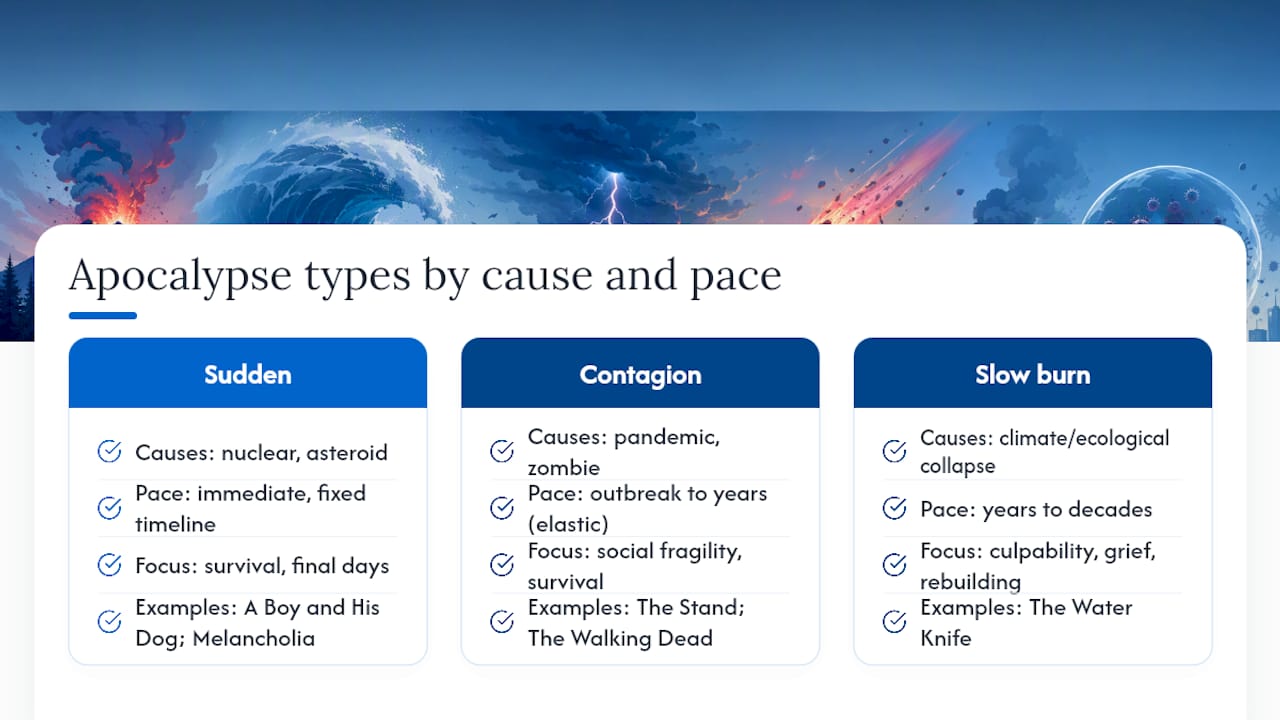
1. Nuclear apocalypse. Civilization ends through nuclear war or a related weapons catastrophe, usually fast, and usually loaded with Cold War anxiety about human beings building the tools of their own extinction. The narrative focus tends to land on immediate survival and radiation-era horror rather than rebuilding. Canonical example: A Boy and His Dog (novella/film).
2. Pandemic or plague apocalypse. A pathogen, natural or engineered, collapses the population and the systems that depend on it. This type is elastic: it can move at outbreak speed or spread over years, which makes it one of the more versatile causes for pacing. The thematic focus usually sits on social fragility, how fast trust between neighbors erodes when a cough might be a death sentence. Canonical example: Stephen King’s The Stand (novel). Readers who want more in this specific vein can check our list of pandemic apocalypse novels for further reading.
3. Zombie apocalypse. Genre convention treats this as its own category, though mechanically it’s usually a pandemic wearing a different costume. Some zombie fiction frames the undead as a biological contagion, others lean supernatural, but the narrative engine is nearly always the same: hordes as a physical, relentless threat that turns former neighbors into something to be feared and, eventually, destroyed. The focus is almost always immediate survival and the moral cost of violence against the infected. Canonical example: The Walking Dead (comic/TV series).
4. Climate or ecological collapse. Environmental systems degrade over years or decades rather than collapsing in a single event, making this the slowest of the common types. Focus shifts naturally toward culpability, since climate apocalypse fiction usually implicates the reader’s own present rather than some external threat, and toward grief for a world that’s dying in slow motion rather than exploding. Canonical example: Paolo Bacigalupi’s The Water Knife (novel).
5. Asteroid or impact event. An astronomical body strikes Earth, or nearly misses, and civilization scrambles against a countdown clock. This is one of the few types with a genuinely fixed, visible timeline, which tends to produce stories obsessed with the final days rather than the aftermath. Canonical example: Lars von Trier’s Melancholia (film).
6. Alien invasion. Extraterrestrial forces arrive to conquer, harvest, or simply exterminate. The narrative focus depends heavily on whether the aliens are comprehensible: stories where they’re utterly alien tend toward horror and helplessness, while stories with negotiable aliens tend toward political allegory. Canonical example: H.G. Wells’s The War of the Worlds (novel).
7. AI or technological singularity. Machines surpass human control, either through malicious intent, misaligned goals, or simple indifference to human survival. This type asks pointed questions about agency and what actually counts as personhood once the smartest thing on the planet isn’t human anymore. Canonical example: The Terminator (film franchise).
8. Resource depletion or energy collapse. Oil runs out, water dries up, or the systems that move food and fuel around the planet simply stop functioning. Unlike nuclear or asteroid scenarios, this type is almost always slow, and it tends to produce fiction obsessed with logistics: who controls the last gas station, who rations the last grain silo. Canonical example: Mad Max: Fury Road (film).
9. Supernatural or religious end-times. The world ends through divine judgment, demonic incursion, or prophecy fulfilling itself, often drawing directly on Revelation-style imagery. Focus tends toward questions of salvation and judgment rather than survival mechanics, since the rules of the disaster are moral rather than physical. Canonical example: Good Omens (novel, Pratchett and Gaiman).
10. Natural catastrophic events. Supervolcanoes, solar flares, geomagnetic reversal, or mega-earthquakes end civilization through sheer physical force rather than malice or design. These stories tend to focus on the randomness of the disaster and humanity’s smallness against planetary-scale forces. Canonical example: 2012 (film).
11. Slow social or institutional collapse. No single event ends the world; instead, economic systems, governments, and institutions rot from within until the structure that held society together simply isn’t there anymore. This is arguably the hardest type to dramatize well, since there’s no explosion to point a camera at, and it tends to produce fiction more interested in memory and mythmaking than action. Canonical example: Octavia Butler’s Parable of the Sower (novel).
12. Monsters, kaiju, and nonhuman hordes. Giant creatures, cryptid-style threats, or other nonhuman forces overwhelm human civilization through raw physical dominance. The focus usually sits on spectacle and immediate survival, with less interest in the philosophical questions that AI or religious apocalypse fiction tends to raise. Canonical example: Godzilla (film franchise).
A taxonomy built around 10 core types groups several of these under slightly different labels, but the underlying causes and the fears they represent line up closely with the list above. The exact count matters less than the recognition that each cause carries its own emotional signature.
The Emotional Question Behind Each Apocalypse Type
Cause determines more than plot mechanics. It determines what question the story is actually trying to answer, and readers who notice this pattern get a lot more out of the genre than those who just track body counts.
Pandemic fiction is rarely about the disease. It’s about how quickly the social contract breaks down once people stop trusting their neighbors, their government, or the stranger coughing on the subway. Nuclear apocalypse fiction carries a different weight entirely: it’s about technological hubris, the specific horror of a species smart enough to build its own extinction device and reckless enough to keep one finger near the button. Climate collapse fiction almost always implicates the reader directly, trading the external villain of other apocalypse types for slow-motion culpability and grief.
AI apocalypse stories ask about agency and personhood. If a machine can out-think its creators, what actually separates a person from a tool? Alien invasion fiction tends to run on otherness and the fear of the incomprehensible outsider, which is why so much of it doubles as commentary on xenophobia whether the author intends that or not. Religious and supernatural apocalypse fiction is built entirely around judgment: who deserves to survive the reckoning, and on what moral terms.
- Pandemic and zombie types tend to foreground survival ethics and the fragility of trust.
- Nuclear and asteroid types foreground technological or cosmic hubris and the terror of a fixed countdown.
- Climate and slow social collapse types foreground culpability, grief, and generational memory.
- AI types foreground agency, consciousness, and what counts as personhood.
- Alien and monster types foreground otherness, helplessness, and the limits of human control.
- Religious types foreground judgment, salvation, and moral reckoning.
Pro Tip: Pick your apocalypse type based on the thematic question you actually want to explore, not the disaster that sounds most dramatic. A slow climate collapse can’t deliver the same countdown tension as an asteroid strike, and an asteroid strike can’t deliver the generational guilt a climate story earns almost automatically.
Why Timescale Changes Everything About the Story
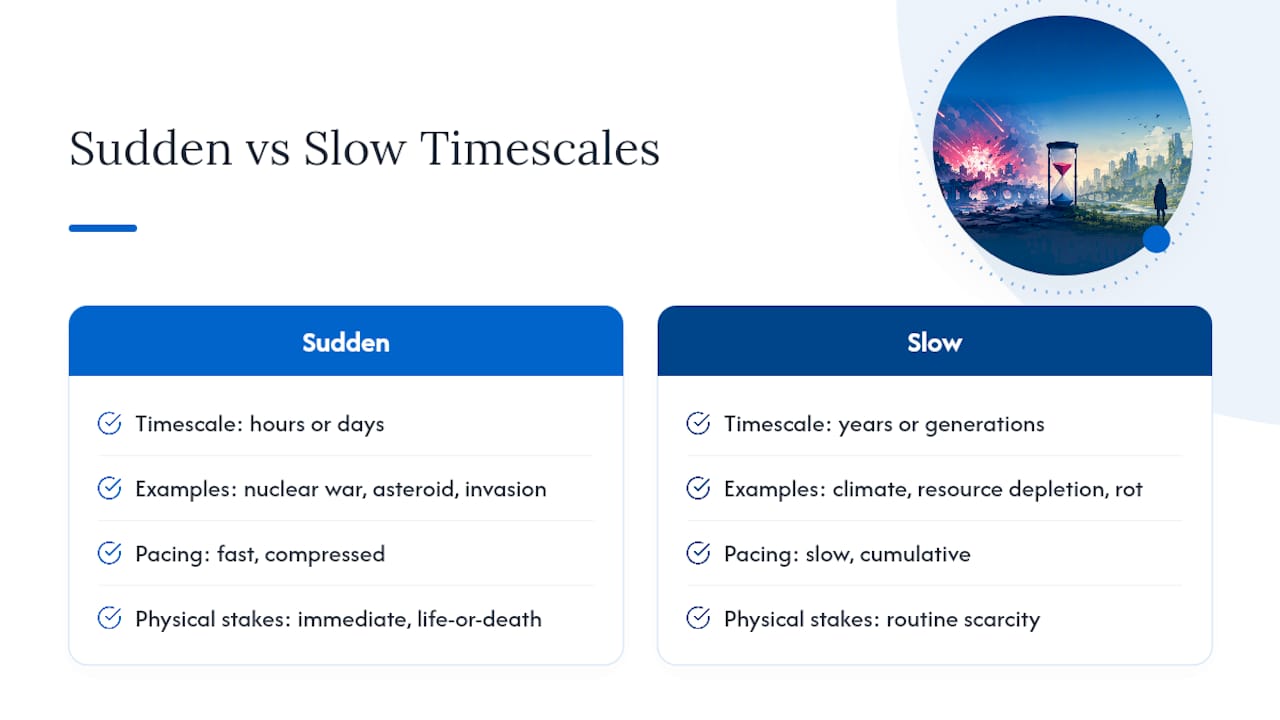
Sudden apocalypses (nuclear war, asteroid impact, most alien invasions) compress the story into hours or days. That compression forces a specific kind of narrative: fast pacing, immediate physical stakes, and characters making irreversible choices with almost no time to reflect. Slow apocalypses (climate collapse, resource depletion, institutional rot) stretch across years or generations, which changes the entire toolkit an author works with. Scarcity becomes routine rather than shocking. Social order doesn’t shatter, it erodes, one broken supply chain and one abandoned town at a time. And the pre-collapse world starts to take on a mythic, half-remembered quality for characters born after the fact.
Slow-collapse fiction also has to reckon with a detail a lot of writers skip: infrastructure doesn’t just vanish, it decays unevenly. Research on computing systems in long-term collapse scenarios points to a realistic problem that fiction rarely bothers with: hardware becomes scarce, software stops getting maintained, and the knowledge needed to fix either one starts disappearing with the people who understood it. A generator that still runs isn’t useful if nobody left alive knows how to repair it when it breaks. That kind of granular decay, computing rot, supply chain gaps, lost technical knowledge, is exactly the texture that separates a slow apocalypse story that feels lived-in from one that feels like a stage set.
The choice between sudden and slow isn’t just pacing. It changes what your characters are capable of learning, and what they’re forced to forget.
What Nathaniel Connors Looks for When Choosing an Apocalypse Type
Most craft advice treats apocalypse type as set dressing. It isn’t. The cause you choose sets the emotional contract with your reader before a single character shows up on the page, and picking the wrong one for your theme is the fastest way to write a story that feels hollow even when the prose is good.
When a story wants to explore contagion and the speed at which trust dissolves between people, pandemic apocalypse is close to the only honest choice. That’s the territory Evolution A200: A Bubonic Apocalypse works in: a plague-driven collapse where the horror comes as much from what people do to each other as from the disease itself. Readers drawn to psychological unraveling under pressure, rather than pure survival mechanics, tend to find that book’s approach closer to home than a straightforward outbreak thriller.
Realism matters too, and it’s where a lot of otherwise strong apocalypse fiction falls apart. If your story spans years, account for infrastructure decay and knowledge loss, not just hunger and violence. If your story spans a single week, don’t let your characters develop the settled routines of a decade-old survivor camp. Readers interested in going deeper into the classification question itself should start with dystopian versus post-apocalyptic fiction, and readers looking for more titles across the genre can browse the full books catalog.
When Apocalypse Fiction Turns Comedic, Romantic, or Thriller-Paced
Genre blending changes what an apocalypse type is allowed to do. Comedic apocalypse fiction, like Good Omens or Shaun of the Dead, uses the same causes (supernatural end-times, zombie outbreak) but strips out the dread, replacing it with absurdist distance. The comedy works precisely because the audience already knows the genre conventions well enough to laugh at characters who treat the end of the world as an inconvenience rather than a tragedy.
Apocalyptic romance leans on a different mechanic entirely: the disaster becomes a pressure cooker that accelerates intimacy, forcing characters together faster than a normal-world plot ever could. The stakes of survival get braided with the stakes of connection, and the apocalypse type chosen tends to matter less than the forced proximity it creates.
Apocalypse thrillers, meanwhile, borrow the genre’s causes but keep the plot mechanics of a conventional thriller: countdown clocks, conspiracies, a protagonist racing against both the disaster and a human antagonist. Nuclear and pandemic causes show up disproportionately often here, since both offer a built-in ticking clock that a thriller plot can hang tension on. The apocalypse becomes less a philosophical subject and more a plot engine, which is a legitimate use of the material, just a different one than literary apocalyptic fiction usually attempts.
How Global Fiction Traditions Handle the End of the World
Western apocalyptic fiction leans heavily on Judeo-Christian end-times imagery, Revelation-style judgment, chosen survivors, and a rebuilding narrative that often echoes Genesis. That’s not universal. Japanese apocalyptic and post-apocalyptic fiction, shaped in no small part by the lived history of nuclear attack, frequently treats the disaster with a kind of mournful specificity that Western nuclear fiction rarely matches, and kaiju cinema channels that same anxiety through giant-monster spectacle rather than direct war imagery.
Fiction from cultures with strong oral-history and cyclical-time traditions often depicts apocalypse not as a final ending but as one turn in a repeating cycle of destruction and renewal, a framing that contrasts sharply with the linear “end of history” model common in American and British apocalyptic novels. Latin American speculative fiction has increasingly used ecological and resource-collapse apocalypse as a vehicle for colonial and post-colonial commentary, tying environmental catastrophe directly to extraction and exploitation rather than treating it as a neutral natural event.
None of this means the core taxonomy of causes changes across cultures. Nuclear, pandemic, environmental, and supernatural apocalypse still show up everywhere. What changes is which questions the ending is built to ask, and whose guilt or grief the story centers.
How the Apocalypse Type Shapes Who Your Protagonist Becomes
Sudden, violent apocalypse types (nuclear, alien invasion, monster attack) tend to produce reactive protagonists defined by physical competence: the survivor, the soldier, the reluctant hero who’s good with a weapon or a plan. There’s not much narrative room for slow character development when the plot demands a decision every few pages.
Slow apocalypse types (climate collapse, resource depletion, institutional rot) tend to produce a different archetype entirely: the builder, the record keeper, the reluctant leader who has to figure out how to hold a community together over years rather than escape a single crisis. These protagonists develop through accumulation, not adrenaline, which is part of why slow-collapse fiction often reads as more literary even when the plot mechanics are similar.
Pandemic and zombie apocalypse fiction sits in between, and tends to produce a specific archetype worth naming: the moral triage character, someone forced to make repeated ethical judgment calls about who gets saved and who gets left behind. That repetition is what makes pandemic fiction such fertile ground for questions of guilt and complicity, a theme our piece on apocalyptic survival ethics explores directly. AI apocalypse fiction, meanwhile, often splits its protagonist function between a human survivor and the machine itself, asking readers to develop sympathy for both sides of the conflict in a way other apocalypse types rarely attempt.
The Symbols and Motifs That Keep Showing Up
Certain images recur so often across apocalypse fiction that they function almost as genre shorthand. Overgrown cities, nature reclaiming highways and skyscrapers, signal ecological and slow-collapse apocalypse specifically, and they carry an implicit argument: the planet will outlast whatever humans build on it. Empty highways and abandoned vehicles show up constantly in sudden-apocalypse fiction, standing in for the exact moment civilization stopped functioning, frozen mid-motion.
Light and its absence carry enormous symbolic weight. Nuclear and asteroid apocalypse fiction often uses darkened skies, ash clouds, nuclear winter, to represent a corrupted or dying sun, while religious apocalypse fiction inverts that same imagery into blinding, judgment-associated light. Water shows up two opposite ways depending on cause: drought and cracked earth for resource-collapse and climate fiction, versus flooding and rising seas for a different strand of climate apocalypse that treats water as the antagonist rather than the missing resource.
The seed vault or the last surviving library recurs across almost every apocalypse type as a symbol of preserved knowledge against entropy, a direct fictional echo of the real infrastructure decay problem: what happens to human knowledge when the systems that stored it stop working. Children born after the collapse function as a nearly universal symbol of tentative hope or corrupted inheritance, depending on whether the author is optimistic or bleak about what the next generation inherits.
What the Taxonomy Gets Wrong (and What Actually Matters)
Most apocalypse taxonomies treat cause as the interesting variable and timescale as an afterthought. That’s backwards. The cause tells you what kills civilization; the timescale tells you what kind of person survives it, and that’s the more useful craft decision for anyone actually writing or evaluating this fiction.
The bigger blind spot in genre discussion is how rarely writers ask what emotional question their chosen apocalypse is supposed to answer before they pick it. Nuclear apocalypse gets chosen for spectacle far more often than for its actual thematic strength, which is technological hubris, not explosions. Climate collapse gets treated as a trend rather than what it really is: the only apocalypse type built to implicate the reader directly in the disaster.
If you take one thing from this taxonomy, take this: match the cause to the question you want answered, then let the timescale decide what your characters are capable of becoming. Readers can tell within a few chapters when an author picked the disaster first and the meaning second.
— Nathaniel
Where to Start Reading If a Type Caught Your Attention
If pandemic and plague apocalypse pulled you in, particularly the version where the real horror is what desperate people do to each other rather than the disease itself, Evolution A200: A Bubonic Apocalypse is built for exactly that reading experience: a bubonic-driven collapse with the psychological unraveling turned all the way up. Readers who prefer their apocalypse filtered through dread and guilt rather than action-movie survival will find The Nether closer to that register too, trading disaster spectacle for the kind of slow, haunting dread that lingers after the last page.
Both books, along with the rest of the catalog, sit in the books collection. Kindle Unlimited subscribers can read many titles without additional cost. If plague and bubonic-collapse fiction specifically is what you came here for, Evolution A200’s book page has the full description and reader details. Start with whichever apocalypse type matches the theme that’s been sitting with you since you finished this list, then check the catalog for the next one.
Sources
The taxonomy above draws on Wikipedia’s overview of apocalyptic and post-apocalyptic fiction, the Thema subject classification system used by publishers and libraries for cataloging, Gizmodo’s taxonomy of fictional apocalypse types, and research on infrastructure decay in long-term collapse scenarios. Readers interested in speculative fiction more broadly may also find this commentary on alternate-universe storytelling a useful adjacent read.
- Apocalyptic and post-apocalyptic fiction — Wikipedia
- The 10 Types of Fictional Apocalypses (And What They Mean) — Gizmodo
- Computingwithinlimits
- Thema Subject Categories – FLQ
FAQ
What are the different types of apocalyptic literature?
The main types are nuclear, pandemic, zombie, climate/ecological, asteroid/impact, alien invasion, AI/technological, resource depletion, supernatural/religious, natural catastrophe, slow social collapse, and monster/kaiju fiction, each tied to a distinct emotional theme.
What are the different types of doomsday scenarios?
Doomsday scenarios split into the same cause categories as apocalyptic fiction, biological, technological, environmental, astronomical, and supernatural, and further divide by timescale into sudden events (nuclear war, asteroid impact) versus slow collapse (climate change, resource depletion).
What is the most likely type of apocalypse?
Fiction doesn’t rank real-world probability; it selects causes based on the theme an author wants to explore. Pandemic and climate collapse appear most often in recent fiction because both let writers explore social fragility and culpability that feel immediately relevant to readers.
What are common apocalyptic themes?
Recurring themes include technological hubris, contagion and social fragility, culpability and grief over environmental damage, questions of agency and personhood in AI narratives, and judgment or salvation in religious end-times fiction. Most apocalypse fiction also explores survival ethics, who deserves to live when resources run short, a question our survival ethics piece examines through four novels.
Does Nathaniel Connors write apocalyptic fiction?
Yes. Evolution A200: A Bubonic Apocalypse is a plague-driven apocalypse novel, and the full catalog of dark supernatural and dystopian fiction is available on the books page, free to read for Kindle Unlimited subscribers.