
For this article, non supernatural horror refers to dark, psychological supernatural fiction: stories where hauntings and uncanny forces exist, but the real terror comes from the mind under pressure. These books are widely available through Kindle Unlimited on Amazon, and this guide shows you how to find, sample, and choose them, with Nathaniel Connors as one author working squarely in this space.
TL;DR:
- Most modern supernatural horror focuses on psychological depth, atmosphere, and ambiguity, emphasizing character’s trauma and guilt over explicit scares.
- Titles on Kindle Unlimited allow free sampling with badges, favoring slow-burn, character-driven stories that reward sustained attention and reading longer pages.
- Choosing the right book depends on your preference for ambiguity versus clear supernatural reveals, pacing style, and whether you want a character or plot focus.
- Non supernatural horror relies on realistic settings, human threats, and themes like betrayal and survival, creating suspense rooted in plausibility and familiar scenarios.
- Nathaniel Connors’s works exemplify character-driven supernatural horror, emphasizing introspective dread and ambiguity, and are available on Kindle Unlimited for easy access.
Table of Contents
- Modern supernatural horror: what to expect from tone and technique
- How Kindle Unlimited and Amazon make these books accessible
- A practical checklist for choosing the right dark supernatural book
- How supernatural and non supernatural horror actually differ
- The themes and motifs that define non supernatural horror
- Classic and modern works that shaped non supernatural horror
- The psychological techniques that build fear without the supernatural
- How non supernatural horror evolved and left its mark on culture
- How realistic settings create suspense without a single ghost
- An author’s view on psychological supernatural horror
- Where to start with Nathaniel Connors’s supernatural fiction
- Sources
- FAQ
Modern supernatural horror: what to expect from tone and technique
Supernatural horror earns its name through elements that break natural law: a house that remembers what happened in it, a presence that answers back, a force with no biological explanation. What separates the modern, literary end of the genre from pulpier scares is where the camera points. Instead of lingering on the monster, these books linger on the person standing in front of it.
That psychological focus means trauma, guilt, and obsession do as much work as any ghost. The supernatural event often becomes a mirror for something the character already can’t escape: a death they caused, a secret they buried, a version of themselves they’re afraid of. Contemporary supernatural horror often favors character-driven psychological depth and atmosphere over graphic violence, building dread that lasts past the final page rather than a quick jolt that fades by morning.
A few narrative devices show up again and again in this mode:
- Unreliable narrators whose grip on reality erodes alongside the reader’s certainty.
- Slow-burn pacing that favors mounting unease over frequent jump scares.
- Atmosphere and sensory detail doing more work than explicit violence.
- Ambiguity about whether the supernatural is real or a symptom of the character’s mind.
None of this is new. The lineage runs from Gothic fiction’s haunted houses and family curses straight through to today’s supernatural horror, with classic essays tracing continuities in atmosphere and uncanny motifs from one era to the next. What’s changed is the ratio: modern writers tend to spend more time in a character’s head and less time describing the thing in the hallway.
How Kindle Unlimited and Amazon make these books accessible
If you’re building a reading list in this genre, Kindle Unlimited is worth understanding before you start searching. It’s a subscription service that lets you read eligible Kindle books without an extra purchase for as long as your subscription is active, and eligible titles carry a Kindle Unlimited badge right on their Amazon product page.
A Kindle Unlimited badge on a book’s Amazon page confirms it’s included in the subscription at no added cost, which means you can try a new author’s dark supernatural novel without weighing whether it’s worth the price of a single e-book.
Finding these titles is a short process:
- Search Amazon using specific genre terms like “psychological supernatural horror” or “haunted house novel” rather than just “horror.”
- Filter or scan results for the Kindle Unlimited badge before you click into a listing.
- Use the “Look inside” feature to read the opening pages and gauge the narrator’s voice and the pacing of the first scene.
- Check whether the blurb promises ambiguity (is it a ghost or a breakdown) versus a clearly explained monster, if sustained dread is what you want.
- Skim a handful of reviews for mentions of “slow burn,” “atmospheric,” or “character-driven,” which tend to flag the right subgenre.
It helps to know how the back end works, too. Authors enrolled in Kindle Unlimited earn royalties based on Kindle Edition Normalized Pages, or KENP, that unique customers read, rather than a flat sale price. That model rewards books that hold a reader’s attention page after page, which happens to favor exactly the slow-burn, character-first style this genre is known for. It also means there’s no added cost to you for sampling widely, trying a short story collection, or starting several books before committing to one.
A practical checklist for choosing the right dark supernatural book
Picking the right book in this genre comes down to matching a handful of variables to your own taste, rather than trusting a cover or a one-line pitch.
Start with these criteria before you commit to a full read:
- Dread style: do you want ambiguity that never fully resolves, or a more explicit reveal of what’s haunting the characters?
- Pacing: a slow burn that spends chapters building unease, or a brisker plot with more frequent turns?
- Focal point: is the story mainly about a character’s psychology, or does it prioritize plot mechanics and spectacle?
- Access: is the title available on Kindle Unlimited, so you can sample it without an added purchase?
- Length: a standalone novel, a series opener, or a short story collection that lets you test an author’s mood in under an hour?
Once you’ve narrowed a few options, a short sample read answers most of what a blurb can’t. Pay attention to the narrator’s voice in the first few pages, whether the opening chapter commits to a mood or rushes toward action, and whether early reviewer comments mention sustained ambiguity or a quick explanation of the supernatural element. A book that explains its ghost by chapter three is signaling a different kind of read than one that lets you wonder for two hundred pages.
Watch for a couple of mismatches, too. If you want atmosphere over spectacle, heavy early gore is a sign the book is aimed at a different reader. And if the supernatural rules shift without explanation between chapters, that often points to plotting looseness rather than intentional ambiguity.
Pro Tip: Read a short story collection or a free sample chapter before committing to a full novel. It’s the fastest way to test whether an author’s sense of dread matches yours.
How supernatural and non supernatural horror actually differ
The clearest dividing line between these two branches of horror is whether anything in the story violates natural law. Supernatural horror relies on spirits, demons, or other unexplained phenomena that drive the plot, while the non supernatural branch keeps its threats entirely inside the natural world: a stalker, a disease, a flood, a person capable of real cruelty.
That single difference changes almost everything else about how each story works. Supernatural horror can use an unexplained force as a kind of pressure valve, a way to externalize guilt or trauma into something with its own will. Non supernatural horror has no such valve. Every threat has to be traceable to a human choice, a natural process, or an accident, which tends to push these stories toward procedural detail and realism rather than atmosphere for its own sake.
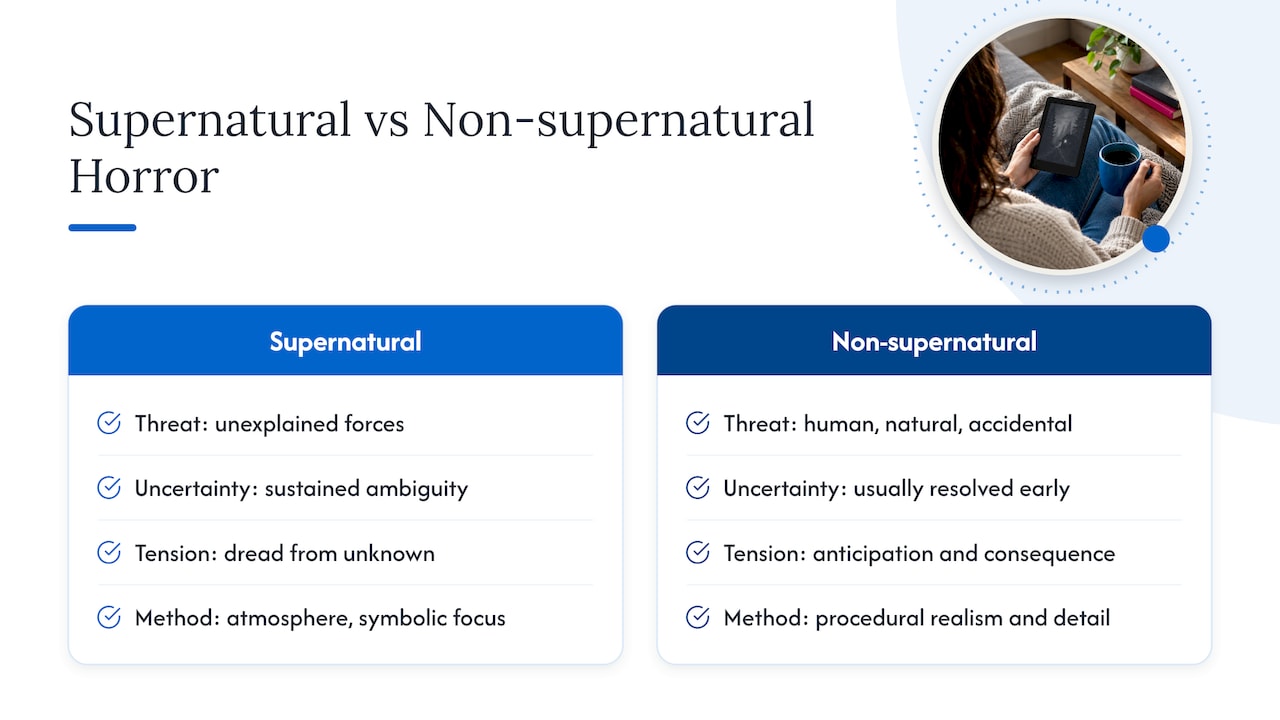
The emotional register differs too. A supernatural story can let dread sit in uncertainty: is the ghost real, or is the character unraveling? A non supernatural story usually answers that question early, because the threat is confirmed and physical, so its tension comes from anticipation and consequence rather than ambiguity about what’s happening. Readers drawn to one branch aren’t always drawn to the other. Someone who wants the slow unraveling of a haunted mind may find a home-invasion thriller too blunt, while a reader who wants grounded stakes may find a ghost story’s ambiguity frustrating rather than haunting.
The themes and motifs that define non supernatural horror
Non supernatural horror tends to organize itself around threats a reader could plausibly encounter: isolation, captivity, disease, violence at the hands of another person, or the slow erosion of trust in people who are supposed to be safe. The monster, when there is one, is always human or at least biological, never spectral.
Several motifs recur across this branch of the genre. Confined settings, a cabin, a basement, a stalled car, a locked room, show up constantly, because physical entrapment mirrors the psychological entrapment the story wants you to feel. Isolation from help, whether through geography, broken communication, or a character’s own secrecy, raises the stakes without needing a supernatural escalation. Survival and resourcefulness become central, since the protagonist has to out-think or outlast a threat using only ordinary means.
Trust is another recurring motif: a neighbor, a spouse, or a stranger who turns out to be the danger rather than the rescue. That betrayal lands harder than a supernatural jump scare because it suggests the threat was always available, hiding in a familiar relationship rather than arriving from outside the natural world. Disease and contagion appear often as well, since a slow-moving biological threat creates dread through inevitability rather than surprise.
Taken together, these motifs ask a different question than a ghost story does. A haunted house asks whether something unnatural is real. A non supernatural horror story asks what an ordinary person is capable of, and how far an ordinary situation can be pushed before it breaks someone.
Classic and modern works that shaped non supernatural horror
The branch of horror built entirely on human and natural threats has a long literary lineage, running from true crime adjacent fiction to survival narratives and psychological studies of violence. Early Gothic and sensation fiction occasionally experimented with explained supernatural events, mysteries that look paranormal but resolve into human schemes, which planted an early seed for stories that deliver dread without an actual ghost.
That tradition carried into film and fiction built around serial violence, isolation, and the fragility of civilization under pressure. Stories centered on a stalker, a kidnapping, or a survival scenario stripped of any paranormal element became their own durable strand of horror, often overlapping with the thriller and true crime genres. Writers working in this space tend to draw on procedural detail, criminal psychology, and plausible scenarios rather than folklore or the uncanny.
Modern entries in this branch frequently blur into prestige thriller territory: home invasion stories, wilderness survival narratives, and novels built around a predator hiding in plain sight. The appeal is the same reason true crime podcasts draw large audiences: the fear is calibrated to something that could, in principle, happen to the reader. That’s a different contract with the audience than a haunted house story offers, and it rewards a different kind of attention, one tuned to plausibility rather than atmosphere.
The psychological techniques that build fear without the supernatural
Without a ghost or a demon to do the heavy lifting, non supernatural horror has to generate fear entirely through craft: pacing, perspective, and the slow accumulation of plausible threat.
Unreliable narration still appears here, but it usually works differently than in a ghost story. Instead of making you doubt whether a haunting is real, it makes you doubt whether the narrator’s account of a crime, an accident, or a relationship is trustworthy, which creates suspense about facts rather than about the nature of reality itself.
Withholding information does most of the work that a supernatural reveal would otherwise do. A story that slowly discloses what a character has done, or what’s waiting in a locked room, builds the same kind of dread a haunted house builder gets from an unexplained noise, just rooted in human action instead of an uncanny force.
Proximity and plausibility matter enormously. A threat that lives next door, or wears an ordinary job, unsettles a reader in a way a demon can’t, because it suggests the danger was always available rather than summoned from outside the natural world. Writers lean on sensory detail, grounded settings, and believable timelines to keep that plausibility intact.
Finally, pacing substitutes for spectacle. Since there’s no supernatural escalation to fall back on, tension has to build through smaller, accumulating details: a missed phone call, a door that’s unlocked when it shouldn’t be, a stranger who remembers your name. Each detail reads as ordinary on its own and unsettling in sequence.
How non supernatural horror evolved and left its mark on culture
Horror without the paranormal has tracked closely alongside real-world anxieties for as long as the genre has existed, which is part of why it keeps resurfacing in new forms. Wartime and post-war fiction turned to stories of survival and captivity. Periods of high-profile violent crime pushed fiction and film toward predators modeled on real criminal psychology rather than folklore monsters. Pandemic-era anxieties have shown up in stories about contagion and quarantine that owe nothing to the supernatural at all.
True crime’s rise as a mainstream genre, across books, podcasts, and documentary series, has fed directly into this branch of horror fiction. Readers who consume true crime are often drawn to fiction that uses the same grammar: procedural detail, psychological profiling, and a sense that the events, while fictional, are plausible enough to have happened somewhere.
Culturally, this branch of horror has done more than entertain. It has given readers and viewers a way to process real anxieties, isolation, predation, disease, institutional failure, inside a contained fictional frame, where the fear is real but the exposure is controlled. That function helps explain why non supernatural horror tends to surge during periods of social unease rather than fading as a niche interest. It also explains its overlap with the psychological thriller, since both genres are ultimately interested in how far ordinary people can be pushed before something breaks.
How realistic settings create suspense without a single ghost
Setting does more work in non supernatural horror than almost any other craft element, because the absence of a supernatural threat means the danger has to feel like it belongs in the world the reader already lives in.
A stalled car on an empty road, a rental cabin with no cell signal, a locked office after hours: these settings generate suspense because a reader can picture themselves there. That recognizability is the whole mechanism. A haunted house asks you to imagine something that isn’t real. A realistic setting asks you to imagine something that could easily be real, and that shift changes how deeply the fear lands.

Isolation compounds the effect. Cutting off phone service, placing characters far from help, or stranding them with a person who can’t be trusted removes the easy escape routes a reader might otherwise expect, forcing the tension to build without a supernatural shortcut. Time pressure works the same way: a countdown, a closing window, a worsening injury, all create urgency using only physical and situational stakes.
The scenario itself also has to stay plausible from beginning to end, because once a reader senses a contrivance, the realism that was generating the fear collapses. That’s why writers in this branch tend to lean on research, procedural accuracy, and grounded detail rather than mood alone. The dread comes from recognizing that nothing being described requires you to suspend disbelief about the laws of nature, only about your own luck.
An author’s view on psychological supernatural horror
Nathaniel Connors writes supernatural fiction that treats the paranormal as a lens for guilt, obsession, and the quieter forms of self-destruction people carry around. Titles like ‘The Nether,’ ‘Stories of a Condemned Soul,’ and ‘Evolution A200: A Bubonic Apocalypse’ use dystopian and supernatural frameworks to ask what’s left of a person once the easy excuses are gone, and all three are available to read through Kindle Unlimited.
The craft priority across these books is sustained character pressure over spectacle: a slow accumulation of dread that stays with a reader after the plot mechanics are resolved. That approach tends to connect most with readers who already gravitate toward psychological depth over jump scares, the same readers drawn to literary horror’s focus on atmosphere and ambiguity rather than explained monsters.
— Nathaniel
Where to start with Nathaniel Connors’s supernatural fiction
If the psychological, character-first style described above is what you’re after, Nathaniel Connors’s catalog is a direct place to start, with every title readable at no added cost through Kindle Unlimited.
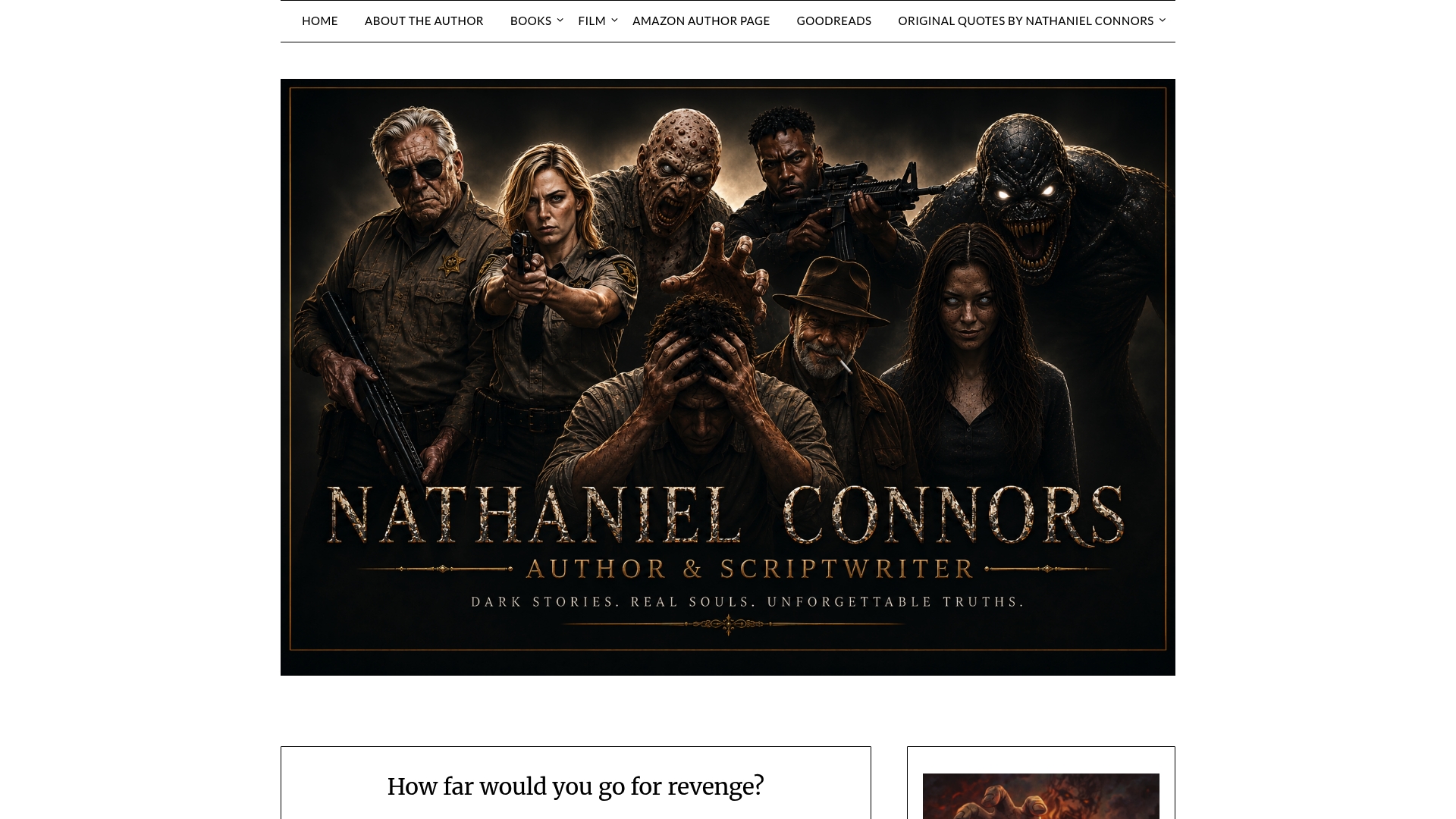
A few entry points:
- ‘The Nether’: a dystopian supernatural thriller built around guilt and the forces that outlast it.
- ‘Stories of a Condemned Soul’: character studies steeped in redemption and quiet dread.
- ‘Evolution A200: A Bubonic Apocalypse’: a dystopian horror that pushes survival and moral collapse to the front.
Use the “Look inside” feature on any title to sample the voice and pacing before committing, or borrow the full book through Kindle Unlimited with no added cost. Visit the Nether Series and EA200 Series landing page to see formats and start reading.
Sources
The factual claims about Kindle Unlimited and the genre framing above draw on a small set of primary and critical sources.
- What is Kindle Unlimited? (About Amazon)
- 10 works of literary horror you should read (Literary Hub)
- How KDP Select and Kindle Unlimited royalties work (KDP)
FAQ
What does “supernatural horror” mean in this context?
It refers to horror fiction where paranormal elements, hauntings, demonic forces, or other uncanny presences, drive the plot, but the deeper focus stays on a character’s psychology: trauma, guilt, and obsession. The scares come from sustained dread and ambiguity rather than explicit violence.
How do I know if a book is available on Kindle Unlimited?
Check the book’s Amazon product page for the Kindle Unlimited badge, which marks titles you can read without an added purchase while your subscription is active. You can also search directly within the Kindle Unlimited catalog on Amazon using genre terms.
What’s the difference between slow-burn and fast-paced supernatural horror?
Slow-burn supernatural horror spends more time building atmosphere and character psychology before any major reveal, while faster-paced entries move through plot events more quickly. Reading a sample chapter or checking reviews for terms like “atmospheric” or “slow burn” usually reveals which style a book favors.
Are Nathaniel Connors’s books available on Kindle Unlimited?
Yes, titles including ‘The Nether,’ ‘Stories of a Condemned Soul,’ and ‘Evolution A200: A Bubonic Apocalypse’ are available to read through Kindle Unlimited at no added cost. You can sample any of them using the “Look inside” feature before committing to a full read.
Why do some supernatural horror novels avoid explaining the ghost or force?
Leaving the supernatural element ambiguous keeps tension unresolved and mirrors how literary horror often favors ambiguity over quick explanation to sustain dread. A story that holds back a clear answer tends to stay with readers longer than one that resolves its mystery early.