
Pandemic fiction and plague fiction both tell stories about disease, but they usually ask different questions. Pandemic fiction tends to look at modern, global outbreaks and the systems that respond to them. Plague fiction tends to lean on older pestilences, allegory and moral reckoning. Readers and scholars often use the terms interchangeably, so think of them as two ends of one spectrum rather than two sealed shelves.
This guide shows where the line falls, where it blurs, and which books sit on each side. It also helps you pick what to read next, depending on whether you want procedure and science, history, or dread.
TL;DR
- Pandemic fiction is usually read through modern global outbreaks. Plague fiction often carries historical or allegorical weight. The labels overlap heavily.
- The “outbreak narrative” follows identification, spread and professional containment. The pandemic narrative is global and apocalyptic, and it rarely offers redemption.
- Both use disease to expose fear, mortality and how communities treat outsiders.
- Start with the question you want answered: how do we stop it, what does it do to us, or what does it mean?
- If you want the psychological, dystopian end of the spectrum, we publish it, and our books are free with Kindle Unlimited.
Table of Contents
- What readers mean by each label
- The outbreak narrative and the pandemic narrative
- Why plague stories feel older and heavier
- Where pandemic fiction does its best work
- Where the two genres overlap
- Why readers turn to these stories in a crisis
- How to choose what to read
- Our perspective
- Where to start with our books
- Reading these stories well
- FAQ
- Sources
What readers mean by each label
Search for either term and you’ll find the same shelves: novels about epidemics, outbreak thrillers, historical fiction with a medical twist, and apocalypse stories. A 2022 academic discussion of plague fiction and reading during COVID-19 describes these as sub-genres that deal with the societal, psychological and medical impact of widespread disease. The same source notes that pandemic fiction is often viewed through the lens of modern global outbreaks, while plague fiction sometimes carries more historical or allegorical associations. It also notes that the terms are frequently swapped.
In practice, readers use the words like this:
- Pandemic fiction means the disease is a present-tense, worldwide event. Think airports, supply chains, hospitals, governments, and the question of how a connected world fails.
- Plague fiction means the disease is a pressure chamber. The pestilence may be historical, supernatural or symbolic, and the story is as interested in guilt, faith and punishment as in biology.
Neither definition is official. A story about a modern virus can feel like a plague story if it is about moral collapse, and a story set in a medieval city can read like a pandemic story if it is about institutions failing.
The outbreak narrative and the pandemic narrative
The sharpest distinction comes from academic work on the outbreak narrative. A 2022 analysis, COVID-19 and Contagion: Reassessing the Outbreak Narrative, notes that scholars such as Priscilla Wald define it as a formulaic plot: the disease is identified, its means of spread is traced, and professionals respond to contain it. The same analysis sets that against the pandemic narrative, which is implicitly global and apocalyptic rather than redemptive. It treats the film Contagion as a work that balances elements of both.
That gives you a useful working test:
- Does the story end with containment? If the experts find the cause and the crisis closes, you are reading an outbreak narrative.
- Does the story assume the world is already lost or changing for good? Then it is closer to a pandemic or apocalypse narrative.
- Does the disease serve as a symbol of something else? Then it has moved toward the plague end.
The outbreak story is a procedural. The pandemic story is a survival story. The plague story is often a morality play wearing a survival story’s clothes.
Why plague stories feel older and heavier
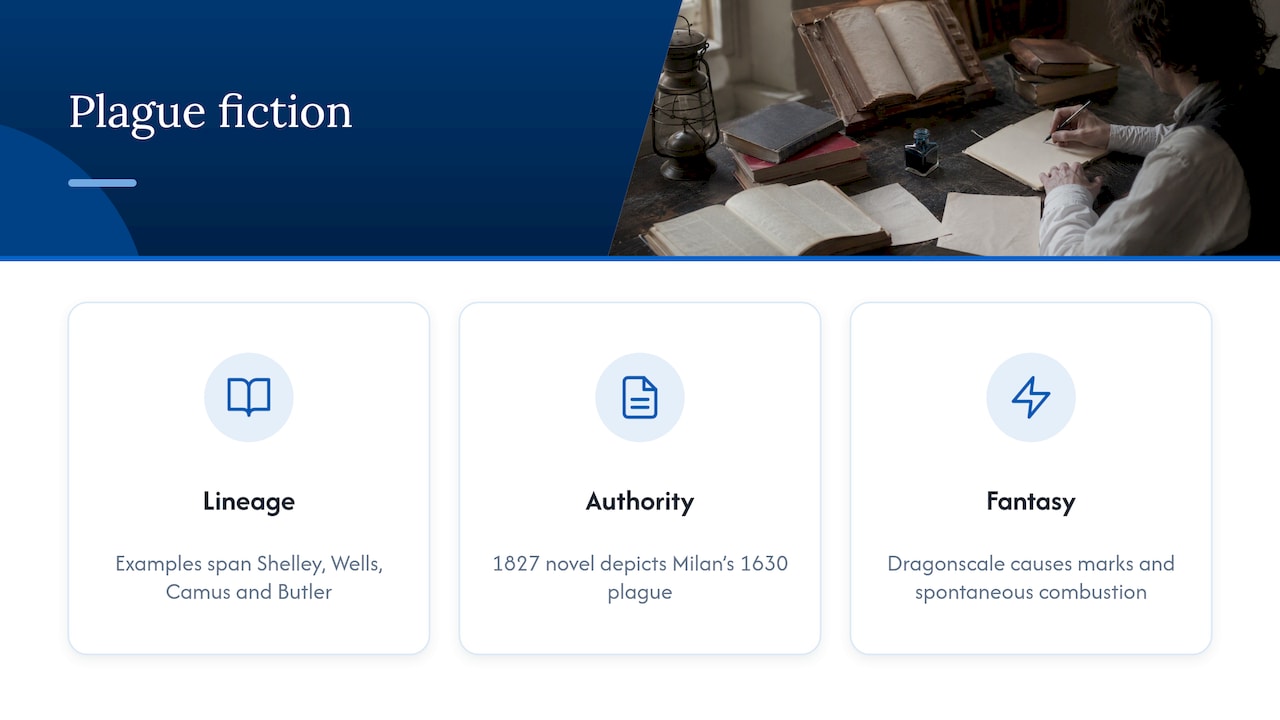
Plague fiction has a long lineage, and that history gives the word “plague” its weight. The 2021 academic overview New ways: the pandemics of science fiction lists examples that include Mary Shelley’s The Last Man, H. G. Wells’s “The Stolen Bacillus,” Albert Camus’s The Plague, Octavia Butler’s “Speech Sounds,” José Saramago’s Blindness and Kim Stanley Robinson’s The Years of Rice and Salt. That list crosses centuries, genres and styles, which is the point: the plague is a flexible container.
History shows up in the details. Alessandro Manzoni’s 1827 novel The Betrothed captures frustration with incompetent officials and lax enforcement during the 1630 plague in Milan, according to a 2020 New York Times opinion essay on great pandemic novels. The pattern is familiar to anyone who lived through the early 2020s. The same anger at authority can sit in a book from 1827 and in a news cycle today.
Plague fiction also allows the fantastical. A Literary Hub survey of literary plagues points out that fictional diseases range from true to life to wildly invented. Its example is Dragonscale, which causes tattoo-like marks and spontaneous combustion. Joe Hill’s The Fireman uses that fantastical plague to critique intolerance, violence and conformity. When the disease is invented, the author can aim it at anything.
Where pandemic fiction does its best work
Pandemic fiction tends to be strongest when it asks what happens to ordinary systems under stress. Saramago’s Blindness (1995) uses a sudden, unexplained epidemic to strip away what the author treats as a veneer of civilization, then explores power, food supply and exploitation, as the 2021 science fiction overview describes. Notice that the story never needs a cure plot. It only needs a world that stops working.
The same overview describes how real-world outbreaks feed the genre. Norman Spinrad’s Journals of the Plague Years (1988) critiqued the American corporate response to the AIDS epidemic. Historical epidemics, including the Black Death and AIDS, have inspired fiction that critiques colonialism and corporate interests. COVID-19, the source adds, drove a surge in pandemic fiction sales.
So modern pandemic fiction often has a political edge. It asks who profits, who is left behind and who decides.
Where the two genres overlap
The overlap is large, and good authors use it on purpose. Both genres raise the stakes of life and death. The Literary Hub piece notes that plague stories force characters to face mortality under extreme urgency. Both also work as mirrors. A 2020 article in The Conversation argues that apocalyptic fiction helps us deal with anxiety, and that contagion narratives often reflect existing, half-formed fears such as globalization and cultural change rather than predicting the future. The same piece says Station Eleven shows survivors building a new society to accommodate shared trauma while exploring fears about community identity and outsiders.
Another shared trait is the enemy. A BBC piece on writers who predicted today observes that pandemic fiction joins people against a non-human enemy, with no good guys or bad guys and every character holding an equal chance of survival. That leveling is why the genres feel so intimate: the disease does not care who is deserving.
Here is a side-by-side view.
| Feature | Pandemic fiction (typical) | Plague fiction (typical) |
|---|---|---|
| Scale | Global, connected, modern | Often a city, a community, or a symbolic world |
| Main question | How do systems and people cope? | What does this say about us? |
| Tone | Procedural, political, sometimes apocalyptic | Allegorical, moral, sometimes supernatural |
| Disease | Usually plausible science | Can be historical, invented or symbolic |
| Ending | Containment or collapse | Reckoning, guilt or survival with a cost |
| Example touchstones | Blindness, Station Eleven | The Plague, The Fireman |
Treat the table as a tendency, not a rule. Blindness is arguably as allegorical as any plague novel, and The Plague has plenty to say about institutions.
Why readers turn to these stories in a crisis
The BBC article suggests pandemic fiction can be a therapeutic tool during crises, comforting readers by showing humanity has survived large-scale catastrophes before. That is one reason these books surged in 2020. The Conversation offers a complementary view: the stories are less prophecy than a safe place to rehearse fear.
There is also a craft reason. Disease is a perfect horror antagonist because it is invisible, patient and indifferent. It removes the villain’s motive and leaves only human response. What the characters do with that response is where the best writing happens: the lies, the loyalty, the rationing, the secrets.
How to choose what to read
Pick by the question you want answered.
You want to know how it spreads and who stops it. Look for outbreak narratives. Expect investigation, institutions and a ticking clock.
You want to see what a collapsing world does to people. Choose pandemic or post-apocalyptic fiction. Our guides to pandemic apocalypse books and post-apocalyptic survival books are good places to start.
You want meaning, dread and moral weight. Choose plague fiction in the older, allegorical sense. Our three reading paths for plague apocalypse novels split the field into art, science and history.
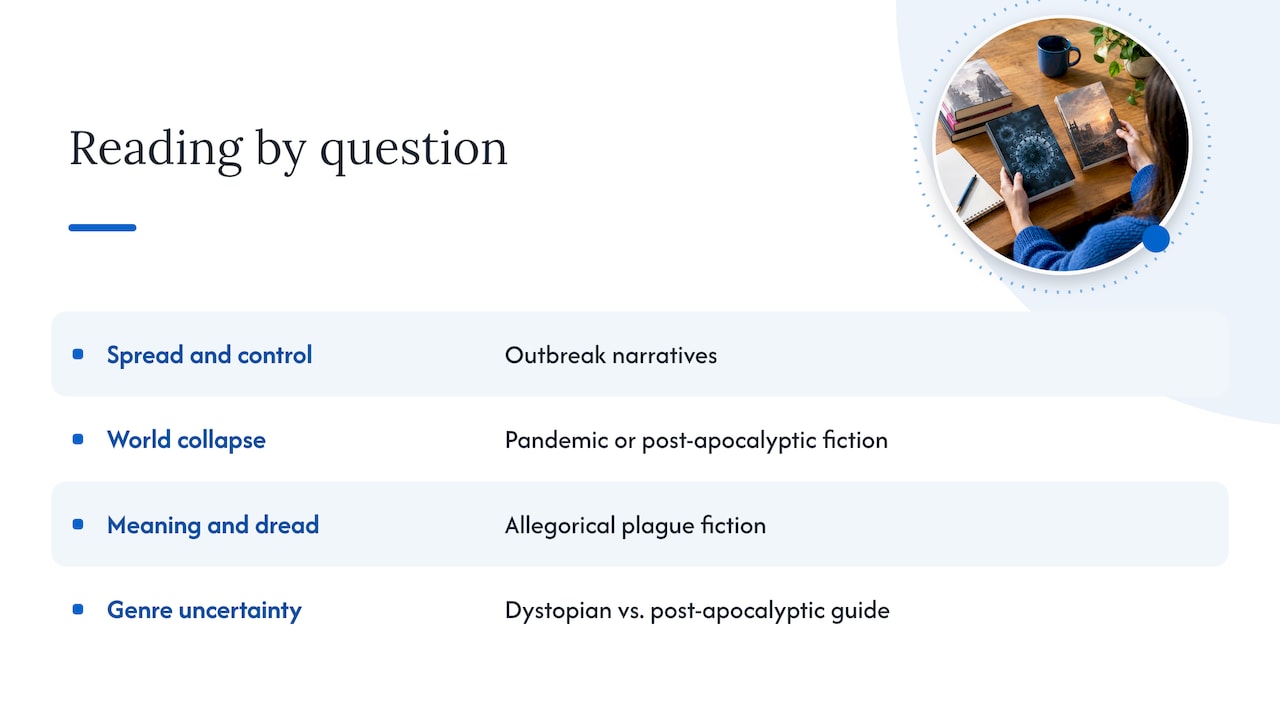
You are not sure whether a book is dystopian or post-apocalyptic. That is a separate distinction, covered in how to tell dystopian from post-apocalyptic.
For a cleaner decision, ask three quick things before you open a book. Is the disease explained or unexplained? Is the viewpoint a scientist, a survivor or a sinner? Does the blurb promise an ending where the crisis is solved? Your answers tell you which end of the spectrum you are about to read.
Our perspective
We write at the dark end of this spectrum, and we think the difference between pandemic and plague fiction comes down to where the fear lives. In pandemic fiction, the fear is outside: the virus, the system, the failure of the people in charge. In plague fiction, the fear is also inside, in what the survivors will do and what they will have to carry afterward.
That is the territory our books return to: revenge, guilt and redemption, and the psychological monsters that outlast any outbreak. A plague is only the setting where those monsters get room to move. We would rather leave you thinking about a character’s choice for a week than explain a pathogen to you for a chapter.
If you like the idea of disease as a mirror, read for the people, not the plot mechanics. The best of these stories ask what you would have done, and the honest answer is usually the unsettling part. Our analysis of guilt, plague and survival in Evolution A200 goes deeper into that idea.
Nathaniel
Where to start with our books
If this comparison made you curious about the darker end, Evolution A200: A Bubonic Apocalypse is where the plague strand of our work begins. It pairs a historic pestilence with a dystopian setting and a close look at guilt and survival. The sequel, Evolution A200: Radio Silence, continues it. If you prefer a supernatural, psychological take, The Nether is the place to begin.
All of our books are available in ebook and paperback on Amazon, and they are free to read for Kindle Unlimited subscribers. Browse the full lineup on our books page, or read about the plague spreading across both Evolution A200 novels. For a first look at the bubonic angle, see bubonic plague in fiction, or go straight to Evolution A200: A Bubonic Apocalypse.
Reading these stories well
A few habits make the genre richer.
- Read one from each end. Pair a procedural outbreak story with an allegorical plague story. The contrast teaches you more than either book alone.
- Notice the authority figures. Whether it is Milan in 1630 or a modern fictional government, the way officials behave tells you what the author fears.
- Track the outsider. Many of these stories test how a community treats those it suspects of carrying the sickness. That is usually where the theme sits.
- Check the ending’s promise. If the story gives you containment, it is an outbreak tale. If it gives you a changed world, it is closer to pandemic or plague apocalypse.
- Mix in the survival ethics. Stories that put characters on short rations and short trust raise questions we explore in our five questions for apocalyptic survival ethics.
If you like your dread slow and psychological rather than gory, our guide to slow burn non-supernatural horror on Kindle Unlimited is a natural next step.
FAQ
Is a plague novel the same as a pandemic novel?
Not exactly, but the terms overlap. Pandemic fiction is usually read through modern, global outbreaks. Plague fiction often carries historical or allegorical associations. Many readers and scholars use them interchangeably, so check a book’s description rather than its label.
What is an outbreak narrative?
It is a formulaic plot in which a disease is identified, its spread is traced and professionals work to contain it, as scholars such as Priscilla Wald describe it. Stories that follow that arc usually end in containment. Pandemic narratives, by contrast, tend to be global and apocalyptic.
Which classic novels should I read first?
For the plague tradition, try Camus’s The Plague or Manzoni’s The Betrothed. For the modern, systems-level view, try Saramago’s Blindness or Emily St. John Mandel’s Station Eleven. Pick one from each side to feel the difference.
Can plague fiction be supernatural?
Yes. Fictional plagues range from realistic to fantastical. Joe Hill’s The Fireman, for example, uses a fantastical disease to critique intolerance and conformity. Supernatural plague stories let authors aim the disease at a theme, which is why they suit horror readers.
Sources
- Plague Fiction: Reading About Epidemics During Covid-19
- COVID-19 and Contagion: Reassessing the Outbreak Narrative
- New ways: the pandemics of science fiction
- On Literary Plagues, Literary Hub
- Apocalyptic fiction helps us deal with the anxiety of the coronavirus pandemic, The Conversation
- The plague writers who predicted today, BBC Culture
- What the Great Pandemic Novels Teach Us, The New York Times