A villain point of view novel puts you inside the head of the person doing the harm and asks you to stay there. The best ones work because the narrator’s logic is coherent, even charming, until you notice where it leads. Below are the books that do this well, what each one is like to read, and how to pick the one that fits your appetite for darkness. If you want psychological depth and a world that feels like it is rotting from the inside, we also point you to our own dystopian horror, available to Kindle Unlimited subscribers.
TL;DR
- A true villain POV keeps you inside the wrongdoer’s mind, so the horror comes from how reasonable it feels in there.
- Classic entry points are American Psycho, The Killer Inside Me, Ripley’s Game and You Love Me. Check the content warnings on Tampa and The Kindly Ones first.
- Pick by tone: satire, noir intimacy, cold calculation, obsession, or sweeping historical atrocity.
- For dystopian dread with guilt, revenge and redemption at its core, start with The Nether or Evolution A200.
- Many readers find the narrator’s self-justification more frightening than the violence itself.
Table of Contents
- What counts as a villain point of view novel
- Nine villain-narrated novels and what they feel like
- How to choose: match the narrator to your appetite
- Why the villain’s voice frightens us more than the monster
- Villain POV in a dystopian setting
- Where our books fit
- Our perspective
- FAQ
- Sources
What counts as a villain point of view novel
The label gets stretched. A story with a scary antagonist is not a villain POV book. The villain has to be the lens: you see events through their reasoning, their excuses and their appetites. That is different from a flawed hero who does questionable things for good reasons, a distinction we unpack in villain protagonist vs antihero.
Three markers help:
- The narrator causes the harm. Not a witness, not a reluctant accomplice. They choose it.
- The book never fully condemns them on the page. Judgment is left to you.
- The voice is persuasive. You catch yourself following the logic before you catch yourself objecting.
If a narrator is lying to you about what happened, you are in adjacent territory. Our guide to unreliable narrator horror covers that overlap.
Nine villain-narrated novels and what they feel like
American Psycho, Bret Easton Ellis
Published in 1991, it is told in the first person by Patrick Bateman, a wealthy, narcissistic Manhattan investment banker who lives a double life as a serial killer. The voice is deadpan and obsessed with surface: business cards, restaurant reservations, brand names. The satire and the violence sit side by side, which is exactly why it unsettles. Read it if you want black comedy with real teeth. It is graphic, so go in knowing that.

The Killer Inside Me, Jim Thompson
This is the noir version. A HuffPost review notes that the narrator is Lou Ford and that the close viewpoint puts readers inches from his murders and violent misogyny. The appeal is the folksy, polite surface over a hollow center. It is short, fast and claustrophobic, a good pick if you want intimacy over spectacle.
Ripley’s Game, Patricia Highsmith
Electric Literature’s 2025 feature on novels narrated by sociopaths describes Tom Ripley’s terrifying response to a simple insult. Highsmith’s Ripley is cool, tasteful and patient. Where Bateman is chaos in a suit, Ripley is calculation. If you like villains who plan, who enjoy the game, and who get away with it, start here.
You Love Me, Caroline Kepnes
The same Electric Literature piece describes Joe Goldberg as a male predator whose stalking and controlling behavior are presented from his own point of view. The modern, contemporary-feeling entry. Joe narrates obsession as devotion, and the book’s dark joke is how often his self-image almost works on you. Good for readers who like thrillers with sharp, current social texture.
Tampa, Alyssa Nutting
This is the extreme end. The same feature features Nutting’s narrator, predatory teacher Celeste Price, and characterizes the book as explicit and disturbing. Read the content warnings before you buy. It is a hard book by design, and it is for readers who specifically want to be pushed.
The Kindly Ones, Jonathan Littell
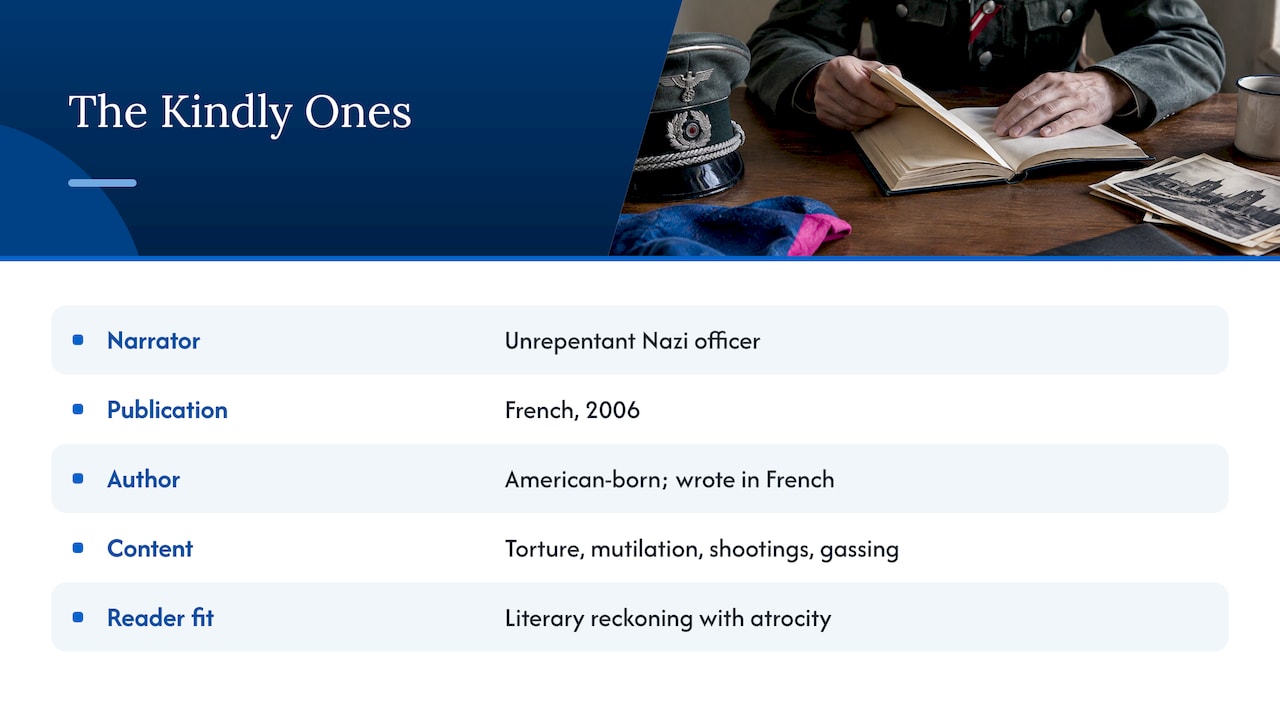
The New York Times review describes a novel narrated by an unrepentant Nazi officer, originally published in French in 2006 and written in French by the American-born Littell. The reviewer warns of extensive depictions of torture, mutilation, shootings and gassing, plus the narrator’s incestuous and sadomasochistic fantasies. It is long, historical and heavy. It suits readers who want a literary reckoning with atrocity rather than a thriller.
Vicious, V.E. Schwab
Vicious is the genre-blending option, a superpowers story built on ambition, jealousy and revenge, where the line between hero and villain keeps shifting. It is frequently recommended in reader lists of bad-guy narratives. It is a gentler door into the territory if the books above sound too bleak.
A Clockwork Orange, Anthony Burgess
A reader favorite in forum threads on this topic, and a natural bridge to dystopia: a violent young narrator in a society that answers brutality with its own kind of control. It matters here because it shows how a villain’s voice can carry a whole critique of the world around him.
Veniss Underground, Jeff VanderMeer
For the speculative end, Veniss Underground is a 2003 fantasy-horror novel set in a decadent, surreal city above an underground labyrinth ruled by the amoral crime lord Quin, with Orpheus and Dante’s Inferno echoes. It sits closer to dream logic than to realism. If that appeals, our guide to surreal horror books goes deeper.
How to choose: match the narrator to your appetite
The narrators differ a lot in style and in the kind of harm they do, so pick by what you want to feel.
| If you want… | Start with | What to expect |
|---|---|---|
| Satire and shock | American Psycho | Deadpan voice, graphic violence |
| Noir intimacy | The Killer Inside Me | Polite surface, brutal core, short read |
| Cool calculation | Ripley’s Game | Patient, tasteful, morally slippery |
| Obsession | You Love Me | Stalking told as romance |
| Superpowered revenge | Vicious | Rivalry and shifting loyalties |
| Historical weight | The Kindly Ones | Long, literary, extremely graphic |
| Dystopia and dread | A Clockwork Orange | Violent voice, society under the lens |
A quick rule: if you are new to the subgenre, begin with a narrator who is charming rather than explicit. The disturbing part of a good villain POV is the pull of the voice, and you can feel that without the harshest content.
Why the villain’s voice frightens us more than the monster
A monster at the door is simple fear. A narrator who explains, calmly, why the door should open is something else. Psychological horror lives in that gap, and it is also why these books so often sit between genres. If you are unsure which shelf a book belongs on, our comparison of psychological thriller vs horror sorts it out, and what psychological horror actually means shows how dread is built without gore.
The techniques are consistent:
- Self-justification. The narrator always has a reason, and the reason almost holds.
- Selective detail. We see what the villain notices, which tells us who they are.
- Withheld judgment. The prose never tells you how to feel, so you have to decide.
- Mundane texture. Dinner plans next to dread make the dread worse.
If you write, notice how many of these are choices of voice rather than plot. Our list of psychological thriller tropes is a useful companion.
Villain POV in a dystopian setting
Set a villain’s mind inside a broken society and the effect doubles: you cannot tell whether the person is the aberration or the system’s natural product. That question is central to the stories readers bring to us. In dystopian horror novels, the world itself becomes the antagonist, and our piece on what dystopian horror means explains when society becomes the monster. For moral weight specifically, see dystopian ethics books.
Where our books fit
Nathaniel Connors writes dark supernatural fiction and psychological thrillers built around revenge, guilt and redemption, and the psychological monsters inside us. The Nether, Stories of a Condemned Soul and Evolution A200: A Bubonic Apocalypse are available as ebooks and paperbacks on Amazon, and free to read for Kindle Unlimited subscribers.
If the villain-POV appeal for you is the moral murk, the question of what a person becomes after crossing a line, these are written for you. Start with The Nether for dystopian horror with emotional depth, or Evolution A200: A Bubonic Apocalypse for a plague-driven collapse. Browse both series on the books page.
If you prefer a guided path, our dark supernatural thrillers starter guide maps where to begin, and our list of slow burn non-supernatural horror on Kindle Unlimited helps if you want psychological dread without anything supernatural.
Our perspective
We think the most unsettling thing about a villain’s point of view is not what the character does. It is how reasonable it feels from the inside.
When we write guilt, revenge and redemption, we are interested in the moment a person decides the story they tell themselves is true. That moment is where the psychological monster lives, and it is why readers keep thinking about a book after the last page.
Dark fiction earns its place when it makes you look at the part of yourself that understands, even a little. That is the experience we want every reader to have with our books, and it is why we pair psychological depth with worlds that press on the characters from every side.
Nathaniel
FAQ
Are there books where the main character is the villain?
Yes. American Psycho, The Killer Inside Me, Ripley’s Game and You Love Me all put a harmful narrator at the center and let you watch from inside their head. The difference from an antihero is that the narrator is not redeemed by good intentions.
What is the difference between a villain protagonist and an antihero?
An antihero lacks conventional heroic traits but usually aims at something sympathetic. A villain protagonist pursues harm or selfish ends and the book follows them anyway. Our full comparison gives examples of both.
Which villain POV novel is best to start with?
For most readers, Ripley’s Game or Vicious is an easier entry because the tone is controlled rather than explicit. If you want satire, American Psycho is the classic, but expect graphic scenes.
Are Nathaniel Connors’s books on Kindle Unlimited?
Yes, his books are available free to read with a Kindle Unlimited subscription, and they are also sold as ebooks and paperbacks on Amazon. Browse the series on the books page.
Sources
- 7 Novels Narrated by Sociopaths, Electric Literature
- Unrepentant and Telling of Horrors Untellable: The Kindly Ones, The New York Times
- The Killer Inside Me: Read the Book Before You See the Film, HuffPost
- American Psycho, Wikipedia
- Veniss Underground, Wikipedia