
Psychological thrillers make the mind the battlefield; psychological horror makes the mind the instrument of dread. That single distinction separates two genres that share a neighborhood but operate on entirely different emotional engines. Thrillers keep you leaning forward, chasing a revelation. Horror keeps you looking over your shoulder, dreading what you already sense is true. The fear spectrum places them adjacent, but the primary emotion each targets, the source of the threat, and the payoff the reader walks away with are genuinely different.
Think of Silence of the Lambs versus The Shining. Both live inside a character’s psychology. But Clarice Starling is solving a puzzle, and the suspense comes from whether she’ll crack it in time. Jack Torrance is dissolving, and the dread comes from watching a mind become the weapon. That contrast is the whole argument.
Key Takeaways
Psychological thrillers and psychological horror share techniques but target different emotional engines: suspense and intellectual resolution versus dread and visceral catharsis.
| Point | Details |
|---|---|
| Primary emotion decides genre | Thrillers target suspense and intellectual uncertainty; horror targets dread and visceral fear. |
| Threat source is the first craft decision | Internal manipulation pulls toward thriller; external or existential danger pulls toward horror. |
| POV shapes the reader’s experience | Investigative or shifting POV signals thriller; locked, victim-centered POV signals horror. |
| Hybrids require a dominant engine | Works like The Silence of the Lambs and Midsommar blend both genres but commit to one payoff. |
| Nathanielconnors blends both | Titles like The Nether and Stories of a Condemned Soul use hybrid techniques across Kindle Unlimited and Amazon. |
Table of Contents
- What makes a psychological thriller its own genre?
- What makes psychological horror different?
- Where do the genres overlap, and what makes a hybrid?
- How do the two genres compare across key dimensions?
- Canonical examples: where does each film or novel actually land?
- What each genre actually does to the audience
- How to write a psychological thriller vs psychological horror
- How to choose the right genre direction for your project
- The line I keep returning to
- Explore Nathanielconnors’ dark fiction
- Sources
What makes a psychological thriller its own genre?
A psychological thriller centers on suspense generated by internal conflict, manipulation, and the instability of what a character believes to be true. The primary emotion is not fear of death but uncertainty: who is lying, what is real, and will the protagonist figure it out before it’s too late? Jericho Writers frames the genre around unreliable perception and manipulation as its core craft components, which is a useful anchor.
The hallmark traits to look for or build toward:
- Unreliable narrator or protagonist. The reader’s information is filtered through a compromised perspective, which makes every revelation feel earned.
- Slow-burn revelation structure. Plot turns replace jump scares. The climax resolves by exposing a truth, not by defeating a monster.
- Moral ambiguity. Characters operate in ethical gray zones. Villains have coherent motivations; heroes make questionable choices.
- Investigative or multiple POVs. Backstage notes that thrillers frequently shift perspective to the antagonist, building unpredictability rather than dread.
- Stakes tied to truth, reputation, or mental stability. Survival matters, but the deeper question is whether the protagonist can trust their own mind.
Gone Girl, Shutter Island, and The Girl on the Train all follow this template. The reader is essentially a detective, and the story rewards intellectual resolution. When you finish one of these, you feel the satisfaction of a puzzle snapping into place.
Pro Tip: If your climax works best as a conversation or a document reveal rather than a physical confrontation, you’re writing a psychological thriller.
What makes psychological horror different?
Wikipedia’s entry on psychological horror defines the subgenre as one that emphasizes perception, internal states, and ambiguity to produce dread, often relying more on atmosphere than on explicit gore. The distinction from thrillers is in the emotional target: horror wants you to feel dread, not solve a puzzle.
The threat in psychological horror is often existential. It may be supernatural, ambiguous, or entirely internal, but it operates on the body and the senses rather than on the intellect. You don’t decode it; you endure it. The hallmarks:
- Atmosphere and sustained dread. The feeling of wrongness accumulates before anything explicitly terrible happens.
- Victim-centered POV. The reader is locked inside a consciousness that is deteriorating or being overwhelmed, with no investigative distance.
- Confrontation structure. The climax is a reckoning, not a revelation. Something is faced, survived, or succumbed to.
- Sensory and body-focused imagery. Physical detail escalates the sense of threat in ways that bypass rational analysis.
- Existential or supernatural stakes. The threat is not just to reputation or truth but to sanity, identity, or survival itself.
The Shining, Hereditary, and The Exorcist sit here. The payoff is visceral and emotional: catharsis, terror, or a lingering disturbance that doesn’t resolve cleanly. When you finish a psychological horror, you don’t feel satisfied. You feel shaken.
Where do the genres overlap, and what makes a hybrid?
The Venn diagram between these two genres is substantial. One useful framing treats psychological horror as a hybrid category in its own right, where internal conflict and external threat collide. Modern storytelling increasingly blends thriller uncertainty with horror’s dread to create psychologically complex experiences that resist clean classification.
The most common crossover triggers:
- Unreliable narrator plus external threat. When a protagonist can’t trust their own perception AND faces a real physical danger, both genres activate simultaneously.
- Escalation from internal confusion to physical danger. A story that begins as a thriller (who is gaslighting me?) and ends as horror (I may not survive this) crosses the line mid-narrative.
- Moral ambiguity plus survival stakes. When the ethical puzzle and the physical threat reach the climax together, neither genre fully owns the story.
The Silence of the Lambs is the canonical example of a hybrid that leans thriller. The investigation structure and Clarice’s intellectual agency keep it in thriller territory, but Hannibal Lecter’s presence and the basement scenes with Buffalo Bill generate genuine horror. Get Out runs the same play: the first act is a thriller (something is wrong here, but what?), and the third act is survival horror. Black Swan uses the thriller’s unreliable narrator to build horror’s dread, with no clean resolution between the two.
Midsommar is worth examining separately. The threat is visible from early on, the atmosphere is horror, but the protagonist’s psychological disintegration and the film’s ambiguous ending give it a thriller’s intellectual residue. The Shining does something similar in the other direction: it’s structured as horror but the slow revelation of Jack’s deterioration borrows the thriller’s revelation engine.
Pro Tip: When blending genres, decide which emotional payoff you want the final scene to deliver. If it’s understanding, foreground thriller techniques. If it’s catharsis or dread, foreground horror. The ending tells the reader which genre won.
How do the two genres compare across key dimensions?
The table below maps the primary craft dimensions where psychological thriller and psychological horror diverge. These are the axes that actually change what a reader experiences.
| Dimension | Psychological Thriller | Psychological Horror |
|---|---|---|
| Primary emotion | Suspense, intellectual uncertainty | Dread, visceral fear |
| Antagonist visibility | Often hidden, revealed gradually | Present or ambiguous, felt before seen |
| Threat type | Manipulation, deception, internal collapse | Existential, supernatural, or bodily danger |
| Point of view | Investigative, multiple or shifting POVs | Victim-centered, locked perspective |
| Stakes | Truth, reputation, mental stability | Survival, sanity, identity |
| Pacing | Plot-driven, revelation-timed | Atmosphere-driven, dread accumulates |
| Core techniques | Unreliable narrator, clue planting, plot twists | Sensory imagery, ambiguity, confrontation |
| Audience payoff | Intellectual resolution, “I figured it out” | Emotional catharsis, “I survived that” |
A quick checklist for deciding which genre a project belongs to:
- Does the climax hinge on a truth being revealed or a threat being faced?
- Is the protagonist’s primary problem figuring something out or enduring something?
- Does the antagonist’s power come from knowledge and manipulation, or from force and dread?
- Would the story collapse if you removed the mystery, or if you removed the atmosphere?
Backstage and ThrillerGuide converge on these four axes as the most reliable for writers making genre decisions. If your answers split evenly, you’re writing a hybrid.
Canonical examples: where does each film or novel actually land?
These are the works that come up in every serious discussion of the genre boundary. Each one is worth examining for the specific craft choice that places it where it lands.
- The Shining (Kubrick/King, hybrid leaning horror). The revelation of Jack’s deterioration uses a thriller’s slow-burn structure, but the POV is victim-centered (Wendy and Danny), the atmosphere is pure dread, and the climax is survival. The Overlook Hotel’s ambiguity keeps it from being pure horror, but the emotional payoff is terror, not understanding.
- The Silence of the Lambs (hybrid leaning thriller). Clarice’s investigative POV and the procedural structure anchor it in thriller territory. The horror elements, Lecter’s intelligence as threat, the pit scenes, are real but subordinate to the revelation engine. StudioBinder’s canonical thriller lists consistently place it here.
- Jacob’s Ladder (psychological horror). Jacob Singer’s perception is so thoroughly compromised that no investigative framework can hold. The film’s payoff is not a solved mystery but an emotional confrontation with death. Atmosphere and bodily imagery dominate every scene.
- Midsommar (hybrid). The threat is visible and communal, which is horror. But Dani’s psychological arc, her grief, her dissociation, her ambiguous “liberation,” gives the film a thriller’s intellectual residue. The ending doesn’t resolve; it disturbs and provokes.
- American Psycho (hybrid leaning thriller). Patrick Bateman’s unreliable narration is the central mechanism. The violence may or may not be real, which means the reader is solving a puzzle about perception rather than simply enduring horror. The satire layer adds moral ambiguity that is distinctly thriller territory.
- Psycho (Hitchcock, horror/thriller hybrid). The film’s famous POV switch, killing the apparent protagonist early, is a thriller technique. But Norman Bates as a figure of dread and the film’s atmosphere of wrongness push it into horror. Hitchcock himself called it a fun film, which tells you something about how genre labels resist the work.
- Joker (psychological thriller case study). A clinical analysis published in PMC treats Joker as a psychological thriller because it centers Arthur Fleck’s deteriorating psychology and invites the audience to interpret his perception rather than simply fear him. The film provokes ethical and interpretive debate rather than visceral terror, which is a thriller’s job.
For novels specifically: Gone Girl (Gillian Flynn) is a pure thriller; House of Leaves (Mark Z. Danielewski) is psychological horror with experimental structure; We Need to Talk About Kevin (Lionel Shriver) sits in the hybrid space, using a thriller’s revelation structure to deliver horror’s emotional devastation.
What each genre actually does to the audience
The physiological and emotional responses these genres produce are genuinely different, and understanding that difference helps writers choose techniques with precision.
Psychological thrillers generate suspense, which is a forward-leaning state. Readers feel intellectually engaged, slightly anxious, and motivated to keep reading to resolve the uncertainty. The experience is pleasurable in the way a difficult puzzle is pleasurable. After finishing, the dominant feeling is satisfaction, sometimes admiration for the craft. The unease tends to fade.
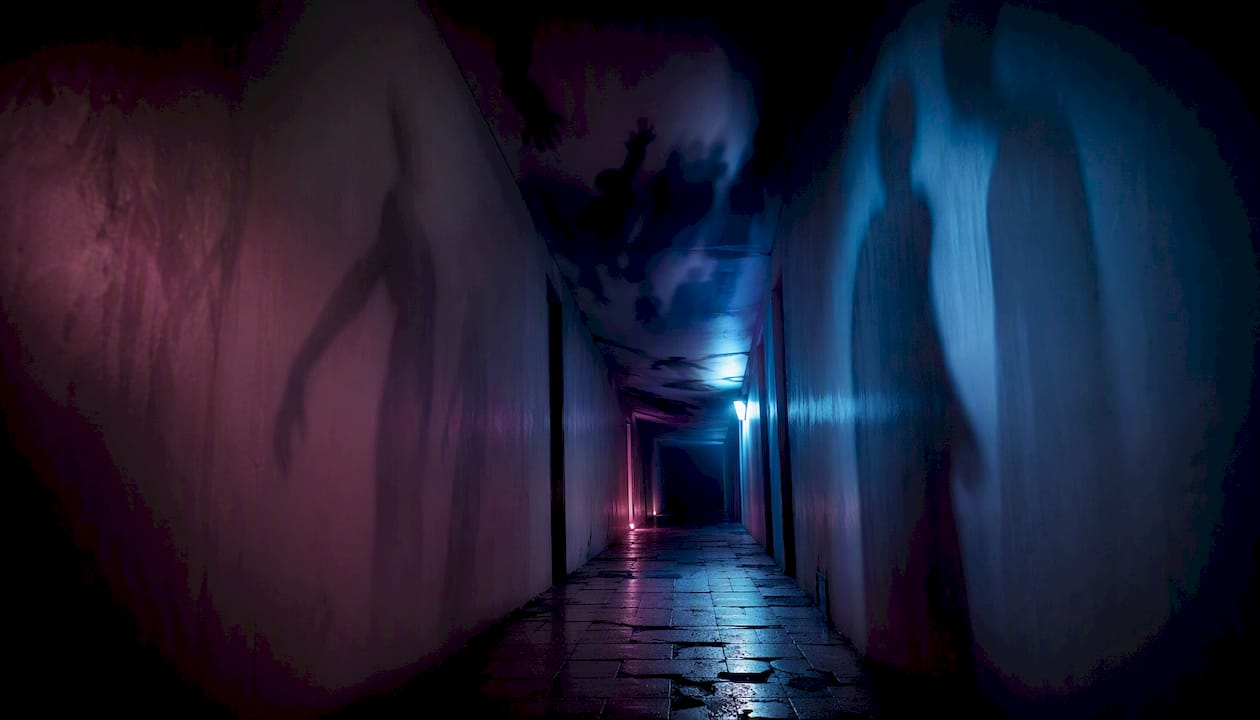
Psychological horror works differently. Dread is not forward-leaning; it’s a weight that accumulates. Readers feel a creeping wrongness that resists rational analysis, which is exactly the point. The visceral imagery and victim-centered POV bypass the intellect and hit the body directly. After finishing, the dominant feeling is disturbance. The images linger. Hereditary is still in your head three days later not because you’re still solving it but because you absorbed it.
The payoff difference matters for writers. Thriller readers want to feel smart. Horror readers want to feel something they can’t easily name. If your story’s most powerful moment is a character understanding something terrible, you’re writing a thriller. If it’s a character experiencing something terrible, you’re writing horror.
How to write a psychological thriller vs psychological horror
The single most important decision comes before page one: choose your primary threat source. Internal threats (manipulation, unreliable perception, gaslighting) pull toward thriller. External threats (physical danger, supernatural forces, bodily harm) pull toward horror. Most hybrid failures happen when writers haven’t committed to one dominant engine before drafting.
Numbered revision checklist:
- Identify the threat source. Is the primary danger coming from inside the protagonist’s mind, from another person’s manipulation, or from an external force? Name it explicitly before revising.
- Check the POV. A thriller’s investigative POV gives the reader analytical distance. A horror’s victim POV locks them inside the dread. Make sure your chosen POV matches your emotional target.
- Test the climax. Does it resolve by revelation (thriller) or confrontation (horror)? If it tries to do both equally, one will feel underdeveloped.
- Audit the unreliable elements. In a thriller, unreliable perception should generate clues the reader can retroactively decode. In horror, it should generate atmosphere and dread that resists decoding.
- Measure the emotional payoff. Read the final scene aloud. Does it produce intellectual satisfaction or visceral impact? That’s your genre signal.
Jericho Writers’ craft guidance on unreliable perception is worth reading before drafting either genre, because the technique works differently in each context.
Pro Tip: Plant micro-ambiguities in early scenes, small details that could be innocent or sinister, and let the reader’s genre expectations do the interpretive work. In a thriller, readers will assume manipulation. In horror, they’ll assume dread. The same sentence lands differently depending on the emotional frame you’ve established.
Three opening prompts to jump-start a draft:
- Pure thriller: “She’d read the email three times before she realized the timestamp was wrong by exactly one hour.”
- Pure psychological horror: “The smell came back every night at the same time, and every night she told herself it was the pipes.”
- Hybrid: “He knew the voice on the phone wasn’t his wife’s. He answered anyway.”
How to choose the right genre direction for your project
A few direct questions will tell you more than any genre taxonomy.
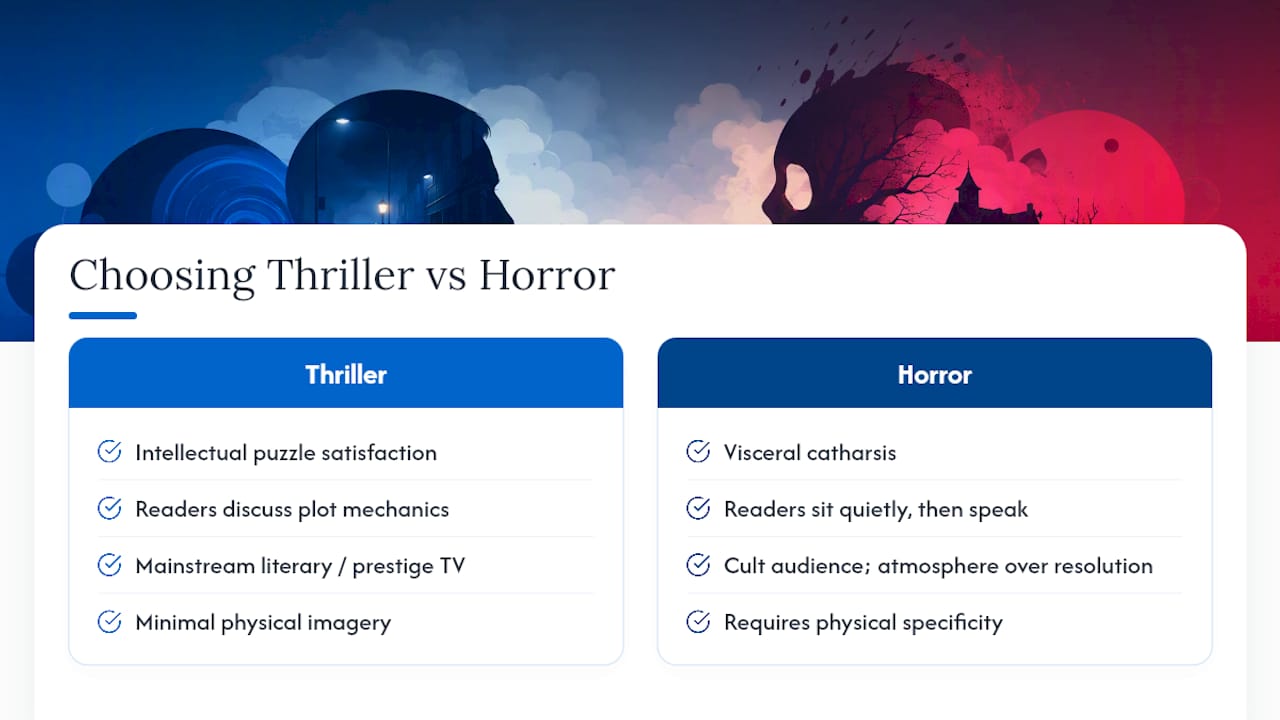
Do you want intellectual puzzle satisfaction or visceral catharsis? If your ideal reader finishes the book and immediately wants to discuss the plot mechanics, write a thriller. If you want them to sit quietly for a moment before they can speak, write horror.
Are you aiming for literary or festival attention, or for a genre-cult audience? Psychological thrillers have a stronger foothold in mainstream literary fiction and prestige television. Psychological horror has a devoted cult audience that rewards atmosphere and dread over plot resolution. Neither is a lesser goal, but they require different marketing approaches.
What’s your comfort level with violence and bodily imagery? Horror’s confrontation structure often demands physical specificity. Thrillers can operate almost entirely in the register of language, perception, and social dynamics. Be honest about where your writing is strongest.
For positioning a book or pitch: signal genre in the first page through POV choice and the nature of the first threat. A locked, victim-centered first-person voice signals horror. A questioning, investigative voice signals thriller. Cover copy should name the emotional experience directly: “a slow-burn thriller” versus “a deeply unsettling horror.” Readers in both genres are experienced enough to know when they’ve been mislabeled, and they’ll say so in reviews.
For writers interested in the grimdark vs dark fantasy space, the same logic applies: grimdark foregrounds moral ambiguity and survival, while dark fantasy foregrounds atmosphere and wonder corrupted. The dominant emotional engine is still the deciding factor.
The line I keep returning to
The question I find most useful when I’m drafting isn’t “is this a thriller or horror?” It’s “what do I want the reader to feel when they close the book?” Suspense and dread are not the same sensation, and the craft choices that produce one tend to undercut the other when mixed carelessly.
When I’m writing, I try to commit to one emotional engine early and let everything else serve it. Character truth and emotional honesty matter more to me than genre purity, but they’re easier to achieve when you know which register you’re working in. The boundary between thriller and horror is real, but it’s also a tool. Cross it deliberately, and the hybrid can be the most powerful thing you write. Cross it accidentally, and neither genre’s audience will feel fully served.
If you’re choosing a direction right now: pick the emotion you most want to produce, then build backward from the final scene. The genre will follow.
Explore Nathanielconnors’ dark fiction
If the craft questions in this article interest you, the best way to understand how these techniques work in practice is to read them in action. Nathanielconnors’ novels sit deliberately in the hybrid space this article describes. The Nether and Stories of a Condemned Soul use psychological thriller’s unreliable perception alongside horror’s dread to explore guilt, revenge, and the monsters people carry internally. Evolution A200: A Bubonic Apocalypse pushes into dystopian horror, where the external threat and the internal collapse happen simultaneously.
All three titles are available on Amazon in ebook and paperback, and free to read for Kindle Unlimited subscribers. For curated reading lists that map to the genres covered here, browse the dystopian horror novels guide or check the full Nathanielconnors book catalog for everything currently available.
Sources
- Psychological Thriller vs Horror: Where’s the Line? 2026 | ThrillerGuide
- Psychological horror — Wikipedia
- What’s the Difference Between Horror and Thriller? — Backstage
- Good Psychological Thriller vs. Horror Differences
- What Is A Psychological Thriller? A Full Guide – Jericho Writers
- Analysing Joker: an attempt to establish diagnosis for a film icon — PMC