
An open ending is a conclusion that deliberately leaves a key plot question unanswered while still resolving the story’s emotional or thematic core. Instead of tying up every loose thread, it hands the audience the last piece of the puzzle to place themselves. Think of Inception’s spinning top, the door left unopened in The Lady, or the Tiger?, or the sudden cut to black at the end of The Sopranos.
Key Takeaways
An open ending succeeds only when it pairs unresolved plot facts with a fully completed emotional or thematic arc.
| Point | Details |
|---|---|
| Definition anchor | An open ending leaves a plot question unresolved while closing the emotional or thematic arc. |
| Not a cliffhanger | Cliffhangers force continuation mechanically; open endings must feel earned and thematically complete. |
| Breadcrumbing is required | Plant clues early so the ambiguous ending supports a few plausible readings, not infinite ones. |
| Run the new-problem test | A genuinely open ending leaves the character facing a different, richer problem, not just no problem. |
| Reader response varies | Success shows up as reread value and debate, not universal agreement on one interpretation. |
Table of Contents
- What is open ending, really, and what are its defining traits?
- How is an open ending different from a closed ending or a cliffhanger?
- Why do writers choose to leave the ending open?
- What are some famous examples of open endings?
- How do you write an open ending that feels earned?
- What mistakes weaken an open ending?
- How do readers usually respond to an open ending?
- When does Nathaniel Connors choose to leave things open?
- Why the “just leave it vague” advice gets open endings wrong
- Where to read more on open endings
- Frequently Asked Questions
- Sources
What is open ending, really, and what are its defining traits?
An open ending isn’t a story that simply stops. It’s one that finishes its emotional business while leaving a factual outcome unresolved. A closed ending answers “then what happened?” An open ending answers “how did that change them?” and lets the plot question hang. The device leaves the story’s final moments in limbo, prioritizing unresolved threads and ambiguous imagery over a tidy wrap-up.
A few traits show up again and again in endings that critics label “open”:
- Ambiguous outcome: the reader can argue for at least two plausible futures.
- Unresolved plot threads: at least one concrete question (did they survive, did the deal happen, did she get on the train) stays unanswered.
- Thematic closure without practical closure: the character’s arc completes even though their circumstances don’t.
- Loaded final imagery or dialogue: the last line or shot carries symbolic weight instead of a plain statement of fact.
- A detached or restrained narrator stance: the storyteller stops guiding interpretation right when the reader wants it most.
Picture a final scene where a character closes a door, and the camera holds on the closed door for three extra seconds. Nothing else happens. That pause is doing all the work.
How is an open ending different from a closed ending or a cliffhanger?
Writers mix these up constantly, and the confusion causes real craft problems. Here’s the cleanest way to separate them:
- Closed ending: every major question gets answered. A courtroom drama that ends with a verdict read aloud is closed. The intent is resolution.
- Cliffhanger: the story stops mid-tension to force the audience into the next installment. A hero dangling off a cliff as the credits roll is a cliffhanger. The intent is mechanical suspense, a hook for a sequel, not meaning.
- Open ending: the emotional arc resolves, but a factual outcome does not. The Lady, or the Tiger? is the textbook case: the narrator refuses to say which door the princess pointed to.
The distinction matters because an open ending has to feel earned, offering real thematic payoff, while a cliffhanger survives purely on unresolved mechanics. Confuse the two in your own draft and readers will sense the difference even if they can’t name it.
Why do writers choose to leave the ending open?
Writers reach for open endings because tidy conclusions often flatten the exact uncertainty they’re trying to capture. Real life rarely closes its loops on cue, and fiction that mimics that feels truer for it.
The main reasons creators use the device:
- Invite interpretation. The audience becomes a participant instead of a passenger.
- Mirror real uncertainty. Big life events (a diagnosis, a breakup, a disappearance) rarely resolve neatly, and endings that acknowledge that read as honest.
- Deepen theme. Ambiguity keeps the story’s central question alive after the last page.
- Extend engagement. Readers reread, rewatch, and argue, which is exactly what drives long-running debate around films like Inceptionó.
- Provoke discussion. Book clubs and film forums thrive on endings that admit more than one reading.
Open endings also shift interpretive weight onto the audience. The writer stops explaining and starts trusting the reader to do part of the meaning-making, which is the whole point of the device.
Pro Tip: Resolve the emotional arc completely before you leave the plot arc open. If both are ambiguous, readers won’t feel invited, they’ll feel abandoned.
What are some famous examples of open endings?
- Inception: The top wobbles as the screen cuts to black. Notice the ring Cobb no longer wears. Takeaway: a single prop can carry an entire ambiguous question.
- Blade Runner: Deckard’s uncertain humanity and the unicorn origami close the film without confirming what he is. Takeaway: withhold one fact, and the whole story gets reread through that lens.
- The Lady, or the Tiger?: Stockton’s narrator stops at the moment of choice and never returns. Takeaway: sometimes the question is the story.
- The Sopranos finale: The screen cuts to black mid-scene in a diner. Notice the ordinary song playing, the man in the jacket. Takeaway: ordinariness right before the cut makes ambiguity feel dangerous.
- Hills Like White Elephants: Hemingway ends on a line of forced pleasantness with no decision confirmed. Takeaway: dialogue alone can carry an entire unresolved plot.
- Contemporary dark fiction: Novels in the psychological horror space often close on a character’s altered inner state rather than a resolved plot, trusting readers to sit with what that transformation implies.
How do you write an open ending that feels earned?
- Decide the thematic question first. Know what idea the ending needs to answer before you know what plot fact it will leave hanging.
- Finish the character’s transformation. The emotional or internal arc has to complete even when the external situation doesn’t.
- Plant breadcrumbs early. Drop small, deliberate clues throughout the story so the ambiguous ending supports more than one plausible reading, not an infinite number.
- Run the “new problem” test. Ask whether the character now faces a different, more interesting problem than the one they started with. If not, the ending is just unfinished.
- Skip the sequel-bait trick. An open ending built only to justify a sequel usually reads as a cliffhanger wearing a costume.
Pro Tip: If you can’t point to at least two earlier scenes that support your ambiguous final image, you haven’t earned it yet. Go back and plant more evidence.
Pro Tip: Read your last page aloud and stop before the final sentence. If the emotional temperature already feels complete, you’re close.
What mistakes weaken an open ending?
- The ending feels unfinished, not open. Fix: confirm the emotional arc is fully resolved before you submit the draft.
- No thematic or emotional closure. Fix: an ending that just stops without resolving the emotional arc is a failed ending, not an open one, so rewrite until the theme lands.
- No breadcrumbs planted earlier. Fix: revise earlier chapters to seed the clues your ending depends on.
- Using ambiguity as sequel bait. Fix: make the book stand alone; sell the sequel with new material, not a withheld answer.
- Mislabeling a cliffhanger as “open.” Fix: ask whether the tension is mechanical (a cliffhanger) or thematic (open) and be honest about which one you wrote.
How do readers usually respond to an open ending?
Reactions split hard. Some readers feel delighted, inspired to reread, or eager to debate; others feel cheated. Common responses include:
- Genuine delight at the ambiguity and a desire to reread for clues.
- Frustration when the ending feels like a dodge rather than a choice.
- Active debate in book clubs or film forums about “what really happened.”
- Divergent, equally defensible interpretations that never fully converge.
Judge success by emotional resonance, interpretive traction, and reread value rather than whether everyone agrees on one answer. Film forums tend to treat ambiguity as a feature to dissect; some book club readers treat it as a flaw to forgive.
When does Nathaniel Connors choose to leave things open?
I reach for an open ending when a character’s internal transformation matters more than their fate. If a protagonist has confronted the thing haunting them, I don’t always need to confirm whether they survive the night. What I need is for the reader to feel that confrontation land.

One rule I hold to: I never leave an ending open unless I’ve planted at least two moments earlier in the manuscript that make the ambiguity feel inevitable rather than convenient.
Pro Tip: If you can’t trace your ending’s ambiguity back to a specific earlier scene, it’s not open. It’s incomplete.
If you want to see that approach at work, Best Dystopian Horror Novels: 8 Haunting Reads for 2026 collects a set of dark, psychologically driven stories where the ending trusts you to finish the thought. Readers on Kindle Unlimited can dig into those titles at no added cost, and if you want something you can finish in one sitting, Short Dystopian Novels for One-Sitting Dread leans hard into that same unresolved unease.
Why the “just leave it vague” advice gets open endings wrong
Most craft advice treats ambiguity as the whole trick: leave something out, and you’ve written an open ending. That’s backward. The research on this device consistently ties its success to emotional completion, not omission. An ending only feels open, rather than broken, when the character’s internal arc has already resolved.
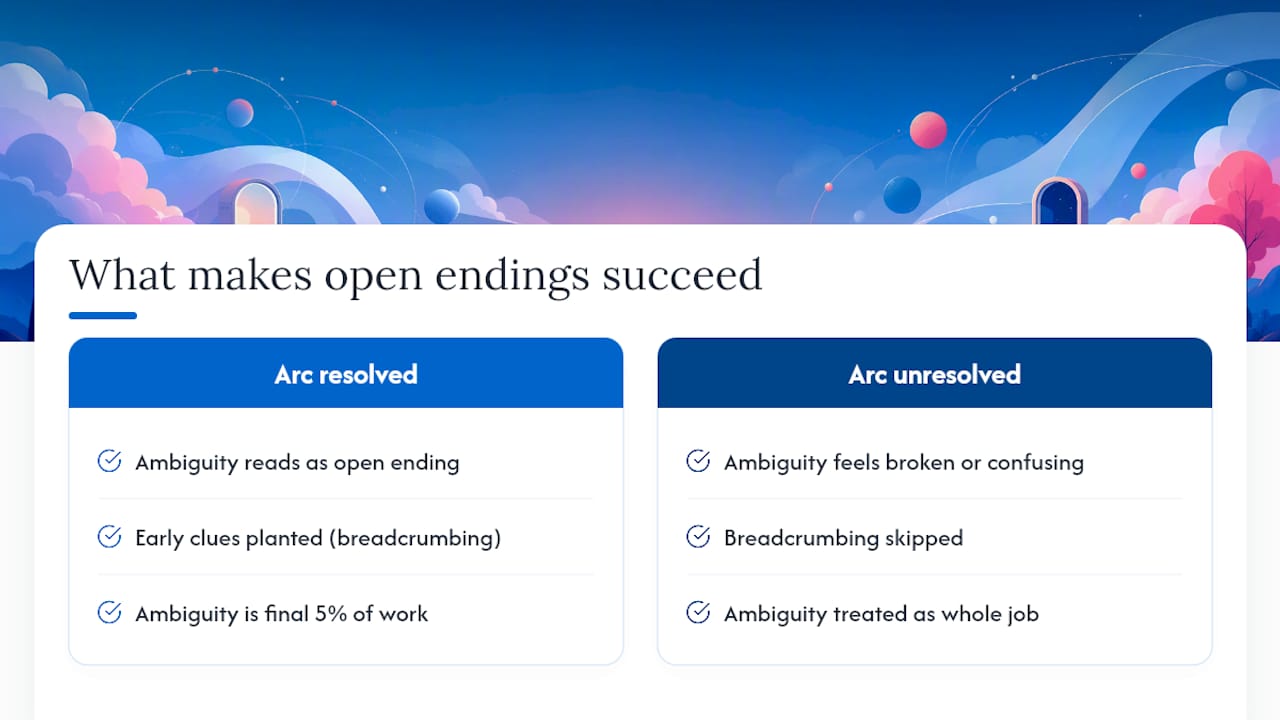
The conventional wisdom undersells breadcrumbing. Writers hear “leave it ambiguous” and skip the planting work that makes ambiguity readable instead of confusing. If you take one thing from this, prioritize the emotional closure and the earlier clues before you ever touch the final ambiguous image. The ambiguity is the last five percent of the work, not the whole job.
Where to read more on open endings
- What Is an Open Ending? How It Shapes Storytelling (clear craft definition)
- Writing Mistakes Writers Make: Confusing Open Endings and Cliffhangers (avoids the cliffhanger trap)
- How to Write an Open Ending: 3 Examples for Screenwriters (screenwriting-focused steps)
- Open ending – Fiveable (concise academic framing)
- Inception – Wikipedia (factual anchor for the film example)
- The Lady, or the Tiger? – Wikipedia (source text background)
Frequently Asked Questions
What is the simplest open ending definition?
An open ending is a story’s close that resolves the emotional or thematic arc but leaves at least one factual plot question unanswered on purpose.
Is an open ending the same as a cliffhanger?
No. A cliffhanger stops mid-tension to force a sequel; an open ending resolves the emotional arc first and leaves ambiguity as a deliberate thematic choice.
Can an open ending feel satisfying?
Yes, when the character’s transformation is complete and earlier scenes support the ambiguity. Readers tend to feel cheated only when that emotional groundwork is missing.
Why do some readers hate open endings?
Usually because the story stopped without finishing its emotional business, which reads as unfinished rather than intentionally open.
Do open endings work better in certain genres?
They show up often in psychological fiction, literary short stories, and dystopian narratives, where uncertainty mirrors the story’s themes about identity, guilt, or survival.
Sources
- What Is an Open Ending? How It Shapes Storytelling – Literary Devices
- Writing Mistakes Writers Make: Confusing Open Endings and Cliffhangers
- How to Write an Open Ending: 3 Examples for Screenwriters
- Open ending – Fiveable (Introduction to Creative Writing)