A curated list of 40-plus evocative psychological horror quotes, grouped by theme, with author context and original lines from Nathaniel Connors woven throughout. This isn’t a raw tag dump. It’s an organized read for anyone who wants the exact lines that capture how horror lives in the mind rather than in the monster under the bed.
Here’s what you’ll find below:
- Six theme groups: loss of self, blurred reality, cognitive fragmentation, inner monsters and guilt, sleep and dream terror, and obsession or surveillance.
- Short context for each quote, plus author notes on Shirley Jackson, Thomas Harris, Michael F. Simpson, and others whose work defines the genre.
- A handful of original quotes from Nathaniel Connors, clearly labeled, drawn from his own dark supernatural fiction.
- Practical guidance near the end on how to credit a quote correctly if you plan to share one.
Jump to any theme heading below if you already know the mood you’re chasing.
Key Takeaways
Psychological horror quotes work because they compress an internal collapse, identity loss, blurred reality, guilt, into a single sharp image rather than a description of an external threat.
| Point | Details |
|---|---|
| Six core themes | Loss of self, blurred reality, fragmentation, inner monsters, sleep terror, and obsession cover most of the genre. |
| Shirley Jackson’s key line | “To learn what we fear is to learn who we are” ties fear directly to identity. |
| Attribution matters | Credit author, title, and link the source instead of reposting long passages. |
| Original material available | Nathaniel Connors’s own quotes appear on the Dark Quotes landing page for further reading. |
| Short lines carry the most weight | A single compressed image tends to outlast a full paragraph of description. |
If these lines resonated, the full stories behind them are worth the trip. Start with The Best Dark Supernatural Books for Readers Who Want Real Dread for a reading path, or go straight to the Dark Quotes landing page for more original excerpts. All three of Nathaniel Connors’s novels, including The Nether and Evolution A200: A Bubonic Apocalypse, are free to read for Kindle Unlimited subscribers.
Table of Contents
- Psychological Horror Quotes Organized By Theme
- Who Wrote These Lines, and Why They Still Unsettle
- How to Use and Credit These Quotes
- Original Psychological Horror Quotes From Nathaniel Connors
- Why Short Lines Do the Heaviest Lifting
- Sources
Psychological Horror Quotes Organized By Theme
The best psychological horror quotes don’t describe a threat. They describe what a mind does to survive one, which is why the same six themes keep resurfacing across a century of dark fiction. Below, each theme groups together short, sourced lines with a note on why they land.
Loss of self and identity
Fear, in this genre, is rarely about dying. It’s about not recognizing yourself anymore.
- “To learn what we fear is to learn who we are,” from Shirley Jackson, is one of the most quoted lines in psychological horror because it reframes fear as a mirror rather than a threat.
- “I am not myself tonight” appears across dozens of psychological-horror adjacent texts as a stock line, precisely because it names the genre’s core anxiety in five words.
- “The house was not sane” (paraphrased sentiment from The Haunting of Hill House) treats a building as a psychological state rather than a location.
- Original, Nathaniel Connors: “He kept a list of who he used to be, and every year, the list got shorter.”
Blurred reality and unreliable perception
- Michael F. Simpson’s lines on control and fragmentation show how a narrator’s grip on reality can dissolve until distortion starts to feel like the only logical response to captivity.
- Mark Z. Danielewski’s House of Leaves is full of sentences that fold in on themselves, and its most frequently cited lines work precisely because the page itself seems to be lying to you.
- A recurring line from psychological-thriller collections warns that “the mind will build a room to hide in, and lock the door from the inside,” a compact image of self-deception.
- Original, Nathaniel Connors: “The mirror agreed with everything I said. That’s how I knew something was wrong.”
Cognitive fragmentation
- “Perfect sense” is the phrase Simpson uses to describe a controlled mind’s logic, a two-word line that does more work than a paragraph of exposition.
- Fragmented syntax, broken sentences, mid-thought cuts. These aren’t stylistic accidents in the genre; they’re the point, mimicking a psyche coming apart in real time.
- A Times Now roundup of psychological-thriller lines collects several examples where a character’s thoughts trail off mid-sentence, and the missing words carry more dread than finished ones would.
Inner monsters, guilt, and possession
Thomas Harris built an entire career on this theme. Hannibal Lecter’s most quoted lines rarely mention violence directly; they describe appetite, curiosity, and control as if they were virtues.
Sleep, dream, and insomnia horror
Some of the genre’s sharpest lines treat sleep as the least safe part of the day. A recurring device: the narrator can’t tell if they’re awake, and neither can the reader.
- Original, Nathaniel Connors: “I stopped trusting my dreams the night one of them left a mark.”
Obsession and creeping surveillance
- Watching, being watched, and not knowing which one is happening. That’s the engine behind most stalker-adjacent psychological horror, and it shows up constantly in Goodreads’ psychological horror tag collection, where dozens of user-verified quotes circle the same idea from different angles.
- Original, Nathaniel Connors: “He didn’t break into the house. He just started leaving things in it, so I’d know he could.”
Who Wrote These Lines, and Why They Still Unsettle
Every theme above traces back to a handful of writers who each solved the “make fear internal” problem differently.
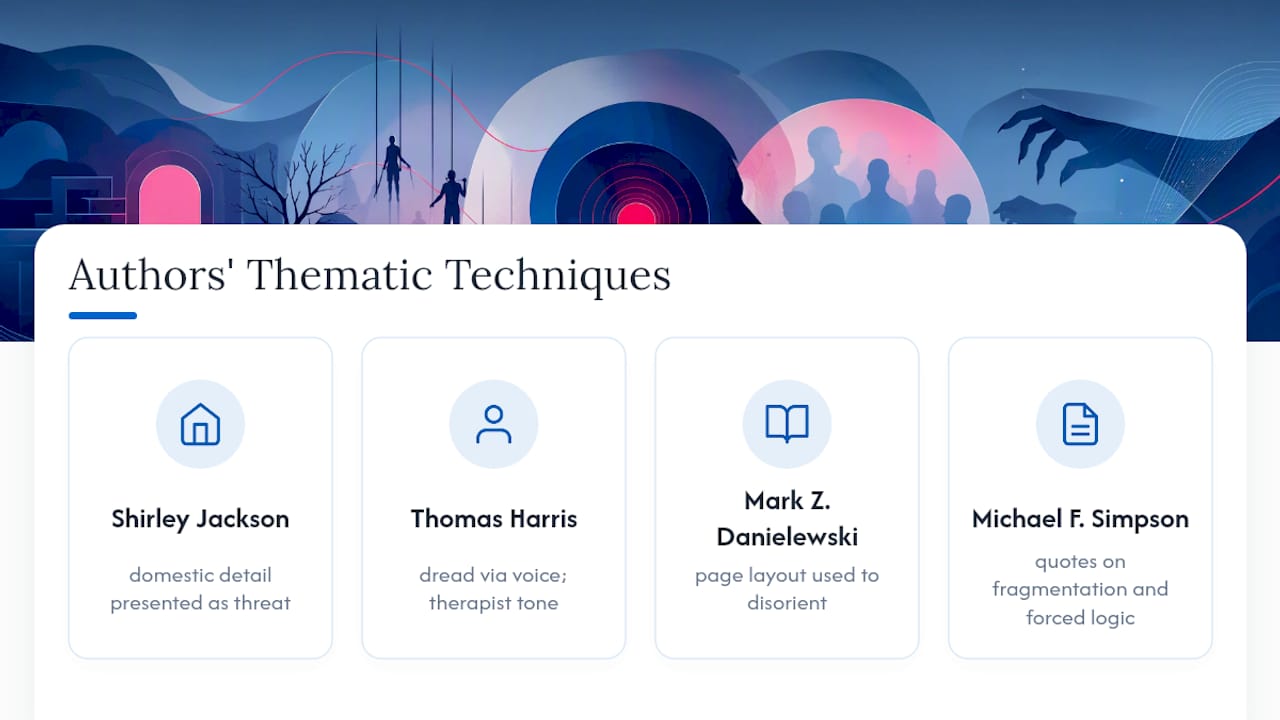
Shirley Jackson wrote horror almost entirely without monsters. Her genius was making ordinary domestic detail feel like a threat, which is why her single most quoted line does double duty as both horror and psychology:
Thomas Harris built dread through voice rather than violence. Hannibal Lecter talks like a therapist, not a killer, and that mismatch between tone and content is the technique worth studying.
Michael F. Simpson writes directly about the mechanics of a controlled mind, and his quotes on fragmentation and forced logic are some of the clearest examples of what psychological breakdown sounds like from the inside.
Mark Z. Danielewski used the physical layout of the page to disorient readers in House of Leaves, a formal trick that makes blurred reality a typographic experience, not just a narrative one.
Jonathan Harnisch writes from inside dissociation and identity disorder, producing lines that read less like fiction and more like a transcript of a mind losing its footing.
As novelist Andrew Pyper has put it, psychological horror is more interesting than physical horror because it deals with the “irrational, contradictory, mysterious” workings of the mind rather than an external monster. That’s the throughline connecting every author above. Fear, in this genre, is a symptom, not a cause. Fear itself has a long literary pedigree, too. The Folger Shakespeare Library points out how often the word shows up across Shakespeare’s plays, a reminder that mining dread from the mind rather than the sword is centuries older than the modern horror shelf.
How to Use and Credit These Quotes
Sharing a quote in a caption, blog post, or classroom discussion is usually fine under U.S. fair use, but the safety margin depends on length and purpose, not just intent. A short line used for commentary or illustration sits on solid ground. A full paragraph lifted for a commercial product does not. This isn’t legal advice, just the practical line most publishers draw.
- Keep excerpts short: a sentence or two, not a page.
- Credit the author and the work every time: “Shirley Jackson, The Haunting of Hill House.”
- Link to the original source (Goodreads, the publisher, or the author’s site) instead of reproducing a long passage.
- Request permission for anything beyond a short excerpt, especially for print, merchandise, or paid content.
Pro Tip: Screenshotting a quote card is convenient, but a text-based post with a link back to the original source protects you legally and gives the original author credit search engines can actually trace.
Original Psychological Horror Quotes From Nathaniel Connors
Nathaniel Connors writes dark supernatural fiction built around the same internal monsters covered above: guilt that outlives the act that caused it, and identity that erodes under pressure rather than snapping all at once. That’s the throughline across The Nether, Stories of a Condemned Soul, and Evolution A200: A Bubonic Apocalypse.
A few original lines, pulled from that body of work:
- “He kept a list of who he used to be, and every year, the list got shorter.”
- “The mirror agreed with everything I said. That’s how I knew something was wrong.”
- “I stopped trusting my dreams the night one of them left a mark.”
- “He didn’t break into the house. He just started leaving things in it, so I’d know he could.”
- “Guilt doesn’t visit. It moves in and pays rent.”
Readers who want the full context behind these lines, including craft notes on how they’re built, can browse more original material on the Dark Quotes landing page or read the craft guide to writing psychological horror for a breakdown of the techniques behind them.
| Point | Details |
|---|---|
| Source is Nathaniel Connors’s fiction | Original lines above are drawn directly from The Nether and Stories of a Condemned Soul. |
| Craft focus | The recurring device is guilt and identity erosion rather than external monsters. |
| Where to read more | The Dark Quotes landing page collects additional original excerpts by theme. |
Why Short Lines Do the Heaviest Lifting
The shortest lines in this collection are almost always the ones that stick, and that’s not an accident. A single image, done well, forces the reader’s own imagination to finish the horror. That’s harder to write than it looks: cutting a paragraph of dread down to one sentence means finding the exact image that carries the whole weight. I write toward that compression deliberately. If a line from Stories of a Condemned Soul or the Evolution A200 series stays with you after you close the page, that was the goal from the first draft.
— Nathaniel
Sources
- Quote by Shirley Jackson: ‘To learn what we fear is to learn who we are’ | Goodreads
- 15 dark and thought-provoking quotes from psychological thrillers | Times Now
- Andrew Pyper quote on psychological horror | AZQuotes