
This page gives you ready-to-use discussion question sets grouped by character, symbolism, ethics, and ending, plus a verdict map template and a copyable meeting agenda for Stories of a Condemned Soul. Use the sections below in order: they move from character motivation through symbolism and ethics to a structured ending debate, the same sequence discussion-guide practice recommends for analyzing dark fiction.
TL;DR:
- Most discussions should focus on whether Jon’s consent was impaired by grief and alcohol during the initial deal with the Salesman, rather than assuming full free will.
- The pub, whiskey, contract, and Salesman serve as key symbols representing liminal space, grief, temptation, and moral binding, which deepen the novel’s themes.
- Ethical debates should distinguish between Jon’s pre-deal guilt, manipulated wrongdoing, and his spiritual condemnation to clarify the moral implications.
- A structured verdict map improves clarity by listing concrete evidence supporting Jon’s redemption or condemnation, enabling focused group voting.
- A 60- to 90-minute meeting should follow a sequence from character and symbolism to ethics and finalize with the verdict map to maintain a purposeful discussion.
Table of Contents
- Character and motivation questions
- Symbolism and motifs: the pub, whiskey, the contract, and the Salesman
- Ethics, revenge, and types of guilt
- Ending interpretation and the verdict map
- Meeting agenda and facilitation tips
- Author perspective: Nathaniel Connors and availability notes
- What this guide gets right that most discussion templates miss
- Where to find the book and what to read next
- FAQ
- Sources
Character and motivation questions
Start where most strong discussions of morally complex fiction start: with the choice at the center of the plot. Jon drinks heavily, reaches a breaking point, and accepts a deal from a Salesman offering him a path to revenge, a sequence the book’s synopsis lays out directly. That sequence raises an immediate question: how much of what happens next is really his choice?
Grief and alcohol complicate consent in ways worth naming out loud rather than assuming. A group that treats Jon’s agreement as simple free will read the book very differently than a group that treats it as an impaired decision shaped by a manipulative outside party. Anchoring each answer to a specific scene, rather than a general impression, keeps the conversation evidence-based, a method reading-notes practice supports for fiction this morally loaded.
Bring these questions into the room:
- Was Jon capable of giving informed consent in the pub scene, or had grief and drink already narrowed his judgment?
- What does the Salesman say or withhold that nudges Jon toward the deal rather than away from it? This question echoes insights from escape room narrative design: crafting immersive stories about how narrative devices manipulate choices.
- Find one line from the handshake scene that reads differently once you assume Jon was being manipulated.
- Does the book ever let Jon reverse course, and if not, what does that tell you about his agency?
Symbolism and motifs: the pub, whiskey, the contract, and the Salesman
The objects and figures that recur throughout the novel are not decoration. Publisher and retail synopses point to the same four anchors: Jon in the pub, whiskey as a stand-in for grief, a Salesman who offers revenge, and a contract that binds the deal, a pattern confirmed by the publisher’s own synopsis. Reading each one symbolically changes what the plot means.
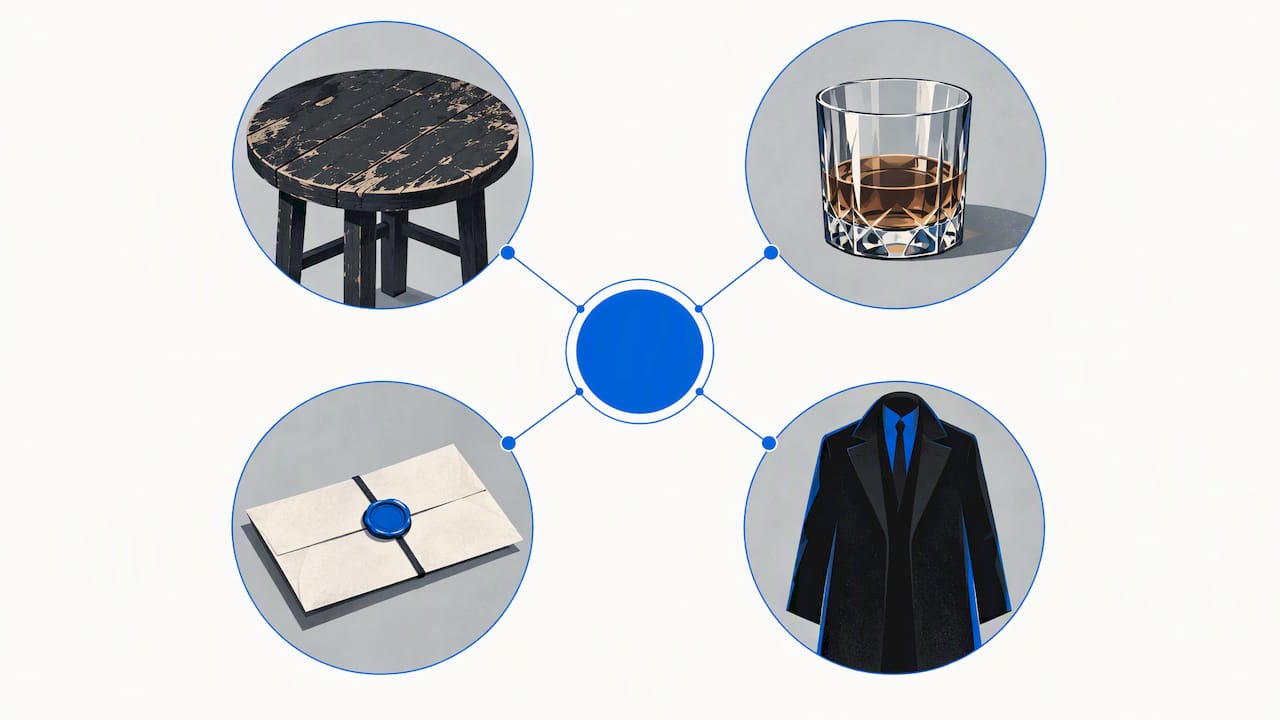
The pub works as a liminal space, a threshold where ordinary rules loosen and a bad bargain starts to look reasonable. Whiskey doubles as both numbing ritual and self-destruction, present at the exact moment judgment fails. The contract formalizes an exchange that should never be reduced to paperwork: a soul for a service. The Salesman himself belongs to a long literary tradition of tempter figures who offer exactly what a grieving person wants and nothing they actually need.
Use these prompts to open the motif conversation:
- What changes in the story the moment Jon signs the contract rather than simply agreeing verbally?
- Where else in literature have you seen a Salesman-like tempter, and how does this one compare?
- Split into pairs and find two scenes where whiskey appears: what shifts in Jon between them?
Ethics, revenge, and types of guilt
Once the group has named the key symbols, move the conversation from what happens to whether it was right. This is where plot summary gives way to values talk, and it works best when the facilitator distinguishes between different kinds of guilt rather than treating guilt as one single feeling. A redemption-focused facilitation method recommends naming the specific value a book tests, here most likely justice versus vengeance, and returning every question to that value.
Four categories are worth separating out loud: emotional guilt Jon carries before the deal, the wrongdoing he chooses once the contract is signed, the wrongdoing the Salesman arguably manipulates him into, and the broader spiritual condemnation the title points toward.
- Does revenge in this story actually redeem Jon, or does it just vindicate his pain without resolving it?
- At what point does Jon stop being a victim of circumstance and become someone who chooses harm?
- Can a person be condemned for an act they were manipulated into wanting?
- What would a version of this story look like if Jon had refused the Salesman’s offer?
Pro Tip: Keep a running list on a whiteboard titled “Chosen” and “Manipulated” and sort each major plot event into one column as the group debates it.
Ending interpretation and the verdict map
The ending of Stories of a Condemned Soul resists a single clean reading, which makes it the right place for a structured exercise rather than an open-ended argument. Building a verdict map, a short list of evidence for “redeemed” and evidence for “not redeemed,” gives the group something concrete to vote on instead of talking in circles. This sin-to-attempt-to-verdict structure comes directly from redemption-theme facilitation guides, which find that a short, focused verdict map produces a clearer closing activity than an unstructured debate.
Build the map with the group in real time:
- List two or three textual details that support reading Jon as redeemed by the end.
- List two or three details that support reading him as still condemned.
- Ask each member to vote and give one sentence of reasoning before moving on.
| Reading | Supporting evidence to cite |
|---|---|
| Redeemed | Jon’s final choice reflects remorse rather than continued hatred |
| Not redeemed | The contract’s consequences remain in effect regardless of Jon’s later regret |
| Ambiguous | The novel declines to state outright which reading the author intends |
Close the meeting by asking each member to write one sentence describing what justice would have looked like for Jon, separate from what the story actually gives him.
Meeting agenda and facilitation tips
A loose conversation about a book this morally dense tends to drift into plot recap. A timed agenda keeps the group moving from character to symbol to ethics to verdict, the same order library discussion guides use for morally dark fiction, with sample time budgets adaptable to shorter or longer meetings.
For a 60-minute meeting:
- Opening (10 minutes): one character question plus a round of initial reactions.
- Symbolism (15 minutes): small-group motif breakout, then share back.
- Ethics (20 minutes): guilt-type questions and the revenge debate.
- Ending and verdict map (15 minutes): build the map and vote.
A 90-minute meeting adds 15 minutes to the ethics block and 15 minutes to a closing round where members read their one-sentence justice statements aloud.
Pro Tip: When a quieter member hasn’t spoken, ask them to pick a side on the verdict map rather than answering an open question cold.
Author perspective: Nathaniel Connors and availability notes
Dark supernatural fiction often returns to themes of revenge, guilt, and redemption, and Stories of a Condemned Soul sits at the center of those concerns. Every question set above grew out of the same concerns that shape our work: what happens to a person’s moral standing once grief and manipulation enter the picture, and whether revenge ever actually settles anything.
The book is available on Stories of a Condemned Soul (Volume One), where groups can find purchase details, and it reads free for Kindle Unlimited subscribers, which makes it easy for every member to get a copy before the meeting.
- Our recurring themes across titles are revenge, guilt, and redemption rather than conventional scares.
- We built this guide’s structure around the same moral questions our fiction keeps returning to.
- Copies are available in ebook and paperback, and readers with Kindle Unlimited can read without additional cost.
What this guide gets right that most discussion templates miss
Most book club question lists for dark fiction default to plot-recap prompts: what happened, who did what, how did it end. That approach wastes a group’s time on a novel built around a single moral hinge, Jon’s choice in the pub, and everything that follows from it. The conventional advice to “ask open questions and see where the conversation goes” works for light fiction and fails here, because without a named value to argue about, groups circle the same ground for an hour without reaching anything.
What matters most is forcing the group to commit to a position early, ideally by the symbolism section, so the ethics conversation has something to push against. A verdict map is not a gimmick: it is the mechanism that turns a vague feeling (“that ending was dark”) into an actual argument with cited evidence. Facilitators should prioritize that structure over trying to cover every theme the book touches. One well-argued verdict beats five shallow observations.
— Nathaniel
Where to find the book and what to read next
If your club wants to start with Stories of a Condemned Soul, the full catalog, including The Nether Series and EA200 Series, is available on the books page, with Kindle Unlimited access included for subscribers.
For a second session built on the same themes, two of our posts pair well with this guide: a craft guide on psychological horror for groups curious about how dread gets built on the page, and a list of redemption arc books for clubs ready to compare Stories of a Condemned Soul against other earned-ending stories. Pick your next title from either list and carry the verdict map habit forward into your next meeting.
FAQ
What is the best order to run these discussion questions in?
Start with character and motivation, move through symbolism, then ethics, and close with the ending and verdict map. This sequence follows established discussion-guide practice for analyzing morally complex fiction and keeps the group building toward a final judgment rather than jumping around.
How long should a book club meeting on this novel run?
Both a 60-minute and a 90-minute agenda work, depending on how much time your group wants to spend on the ethics debate. The 90-minute version simply extends the ethics block and adds a closing round for members to share their final interpretations.
Was Jon manipulated or did he choose revenge freely?
The novel leaves this genuinely open, which is why it works well as a discussion topic rather than a settled fact. The synopsis shows Jon drinking heavily and in crisis before the Salesman’s offer arrives, which supports reading his consent as at least partly impaired.
How can we keep the discussion from turning into plot summary?
Anchor every question to a specific scene or line rather than a general impression, and use the verdict map to force the group toward an actual argument. Assigning small-group breakouts for the symbolism section also helps, since each pair returns with concrete evidence instead of vague reactions.
Where can our group get copies of the book before the meeting?
The book is listed on Stories of a Condemned Soul (Volume One), and it reads free for Kindle Unlimited subscribers. Members without a subscription can also buy the ebook or paperback directly.
Sources
- Stories of a Condemned Soul — Goodreads
- Purdue OWL — Writing prompts for analyzing fiction
- Redemption themes and reading notes — RainingBook
- A Lesson Before Dying — Durham County Library discussion guide