
Psychological horror makes readers fear what a character believes about reality, not what actually lurks in the dark. The fastest way to start: pick one relatable emotional wound, choose a single ordinary object or routine to corrupt, then write two scenes showing the character’s perception beginning to slip. That’s the engine. Everything else is craft.
Three-step quick start:
- Choose an emotional wound (grief, guilt, shame, fractured identity) that your protagonist hasn’t resolved.
- Select one “wrongness” — a detail in their daily environment that starts behaving slightly wrong (a door that was open is now closed; a smell that shouldn’t be there).
- Write Scene A showing the character’s normal relationship to that space, then Scene B showing the first moment they doubt their own perception of it.
Essential tools to use from the first draft:
- Close or first-person POV — limits what the reader can verify independently
- Sensory microdetail — concrete, specific, slightly misaligned with expectation
- Pacing by withholding — slow the reveal; let the reader sit in uncertainty longer than feels comfortable
Key Takeaways
Psychological horror is built from a character’s emotional wound outward: the wound determines what ordinary details become threatening, which POV choices create doubt, and how the escalation pattern maps onto the character’s collapse.
| Point | Details |
|---|---|
| Start with the wound | Choose one unresolved emotion (guilt, grief, shame) and build every uncanny detail from it. |
| Use close POV to limit trust | First-person or close-third narration restricts what the reader can verify, making unreliability feel organic. |
| Escalate in five stages | Move from Normal through Unease, Doubt, Distortion, and Collapse; place reveals at the stage transitions. |
| Revise by cutting explanations | Delete any sentence that tells the reader what a scene means; the implication is always more frightening. |
| Nathanielconnors as a model | The Nether and Stories of a Condemned Soul demonstrate wound-first structure and strategic omission at novel length. |
Table of Contents
- How psychological horror differs from other horror subgenres
- What every psychological-horror scene actually needs
- Building a believable interior life and emotional stakes
- How atmosphere and sensory detail corrupt the ordinary
- Voice and POV: how limited perspective creates doubt
- Plot structure and pacing for slow-burn dread
- Sentence- and line-level tactics that produce unease
- Common clichés to avoid and ethical handling of trauma
- Timeboxed writing exercises to practice psychological-horror techniques
- A revision checklist for making a draft more psychologically threatening
- Annotated examples and craft notes from published work
- What most writers get wrong about psychological horror
- Psychological horror novels that demonstrate these techniques
- Sources
How psychological horror differs from other horror subgenres
Psychological horror is a subgenre centered on mental and emotional states, where the terror comes from the erosion of perceived reality rather than from gore, monsters, or supernatural spectacle. The threat lives inside the protagonist’s mind, which means the reader can never fully trust what they’re being shown. That’s the defining mechanism: not danger, but doubt.
This distinction matters because it changes every craft decision you make, from POV to sentence rhythm to what you choose not to explain.
| Subgenre | Primary threat | Core technique | Reader experience |
|---|---|---|---|
| Psychological horror | Eroding perception and emotional truth | Unreliable narration, interiority, ambiguity | Doubt, dread, empathy |
| Gore/body horror | Physical destruction | Visceral description, shock imagery | Disgust, visceral fear |
| Supernatural horror | External entity or force | World-building, atmosphere, mythology | Awe, existential fear |
| Thriller | External antagonist with a plan | Plot mechanics, escalating stakes | Tension, urgency |
When to choose psychological horror for your story idea:
- The emotional core is more compelling than the plot mechanics (a character’s guilt is more interesting than the crime itself)
- You want readers to question what’s real alongside the protagonist
- The most frightening thing in your story is something the character believes, remembers, or fears about themselves
- You’re drawn to ambiguity and resist tidy resolutions
What every psychological-horror scene actually needs
Atmosphere, close POV, and slow-burn pacing are the load-bearing elements, but at the scene level, five specific components keep the unease building rather than flattening out. Think of these as a checklist you run before you move to the next scene.
Scene-level checklist:
- Interiority — the character’s internal commentary on what they perceive. Without it, the scene is just description. Example: “She told herself the window had always faced east.”
- Ambiguous sensory cue — something the reader perceives through the character that could be real or imagined. Example: “The milk smelled of dish soap and something metallic underneath.”
- Small contradiction — a detail that doesn’t match the established reality, planted without explanation. Example: “The chair was back at the table. She hadn’t moved it.”
- Denial or rationalization — the character’s attempt to explain the contradiction away. This is where readers start to distrust the narrator. Example: “She must have moved it without thinking. She did that sometimes.”
- Escalating consequence — each scene’s contradiction should carry a slightly higher cost than the last. The first anomaly is ignorable; the fifth is not.
Each element does a specific job. Interiority creates empathy. The ambiguous cue seeds doubt. The contradiction destabilizes the reader’s model of the story’s reality. Denial keeps the protagonist sympathetic rather than simply oblivious. And escalation is what separates psychological horror from a single eerie moment.
Building a believable interior life and emotional stakes
Character vulnerability is the engine of psychological horror. Without it, the uncanny details are just set dressing. The reader needs to care about what the protagonist stands to lose, and that caring has to be rooted in something specific and human, not generic.
Start with the wound. Grief, guilt, shame, and fractured identity are the most generative because they already distort perception in real life. A grieving person misidentifies strangers as the person they lost. Someone carrying guilt reads accusation into neutral expressions. Researching real psychological reactions — how trauma actually presents, how fear alters sensory processing, how the mind rationalizes what it can’t accept — produces character responses that feel earned rather than convenient.
Techniques for making interior life credible:
- Specificity of memory — don’t give the character a vague sad past; give them one specific image they return to (the particular blue of a hospital curtain, the sound of a name being called in a certain tone)
- Sensory triggers — link the wound to a physical sensation so the horror can activate it without explanation
- Physiological reactions — peer-reviewed research on fear responses shows that the body reacts before the conscious mind catches up; use that lag in your prose (the character’s hands are already shaking before they understand why)
- Cognitive distortion patterns — catastrophizing, dissociation, and hypervigilance are all real cognitive patterns that can drive a character’s unreliable perception without requiring a clinical diagnosis
Pro Tip: Before writing a character’s breakdown, spend 20 minutes reading clinical overviews of the specific psychological state you’re depicting — NCBI Bookshelf’s summaries are accessible and accurate. The goal isn’t clinical accuracy; it’s the specific, surprising detail that makes a reader think “yes, that’s exactly how it would feel.”
Psychological horror aims to make readers care about the character so the horror becomes personal. The author’s job is emotional manipulation for empathetic ends. That’s not cynical; it’s the craft.
How atmosphere and sensory detail corrupt the ordinary
Sensory detail is the primary lever for making the ordinary feel unsafe. Not dramatic description, not foreshadowing dialogue — the specific, slightly wrong physical detail that the character notices and then tries to un-notice.
The technique is what some writers call “corrupting the mundane.” You take a space the reader already trusts (a kitchen, a childhood bedroom, a familiar commute) and introduce microdetails that don’t quite fit. Making familiar things seem slightly “off” creates a sustained uncanny effect that accumulates across scenes rather than spiking and fading.
Microdetail examples that shift safe objects toward dread:
- “The kitchen was exactly as she’d left it. Too exactly.”
- “The hallway smelled of her mother’s perfume. Her mother had been dead for three years.”
- “The dog wouldn’t go past the doorway. It sat and watched the room instead.”
- “The clock read 3:14. It had read 3:14 when she left.”
Language tips for building sensory wrongness:
- Use concrete nouns over abstract ones — “the smell of wet wool and something burnt” lands harder than “an unpleasant odor”
- Selective omission — describe everything in a room except the one thing that should be there; the reader’s eye goes straight to the gap
- Negative capability — leave the wrongness unexplained; the reader’s imagination will fill it with something worse than you’d write
- Layer cues across a scene: one sensory wrongness per paragraph, building toward a moment where three or four converge
Pro Tip: The escalation pattern for sensory wrongness follows a rule of threes: the first anomaly is noticed and dismissed, the second is noticed and rationalized, the third cannot be rationalized. Building dread through small, patterned escalation rather than a single shock is what makes the horror linger after the book is closed.
Voice and POV: how limited perspective creates doubt
Close-limited POV and unreliable narrators magnify uncertainty because they restrict what the reader can verify. Choose a POV that naturally limits knowledge — a narrator who has reasons to lie to themselves, gaps in memory, or a compromised emotional state. Psychological horror works by destabilizing perception through unreliable narrators, subtle contradictions, and ambiguous timelines; the POV choice is what makes that destabilization feel organic rather than manipulative.
First person vs. close third: dos and don’ts
First person:
- Do use it when the narrator’s self-deception is the story’s central mechanism
- Do let the narrator’s language choices reveal what they’re avoiding
- Don’t have the narrator describe their own face or emotional state from the outside — it breaks the intimacy that makes the unreliability work
- Don’t make the narrator obviously unreliable from page one; the reader needs to trust them first
Close third:
- Do use it when you want a sliver of distance — the reader can sense the gap between what the character perceives and what the narration implies
- Do keep the narrative voice consistent with the character’s emotional state (a dissociating character narrates in flat, overly precise sentences)
- Don’t drift into omniscience; the moment you reveal something the character couldn’t know, the tension collapses
Planting reliable-looking detail that later reads as suspect: introduce two or three concrete, verifiable-seeming facts early (a specific date, a named location, a witnessed event). Later, contradict one of them quietly, without calling attention to the contradiction. The reader who catches it will distrust everything retroactively. The reader who doesn’t will feel the wrongness without being able to name it.
Plot structure and pacing for slow-burn dread
Psychological horror earns dread with incremental, patterned escalation rather than shocks. A single frightening scene followed by calm resets the reader’s nervous system; a series of small, compounding anomalies does not.
The escalation model that works most reliably moves through five stages:
| Stage | What happens | Pacing note |
|---|---|---|
| Normal | Establish the character’s baseline reality and wound | Spend real time here; readers need to trust the world |
| Unease | First anomaly appears; character notices but dismisses | Keep scenes short; let the dismissal feel reasonable |
| Doubt | Second and third anomalies; rationalization starts to strain | Increase interiority; the character’s explanations get longer |
| Distortion | The character’s perception of reality is visibly unreliable | Syntax can fragment here; time can compress or loop |
| Collapse | The wound and the horror converge; resolution or disintegration | Ambiguous or explicit — choose deliberately |
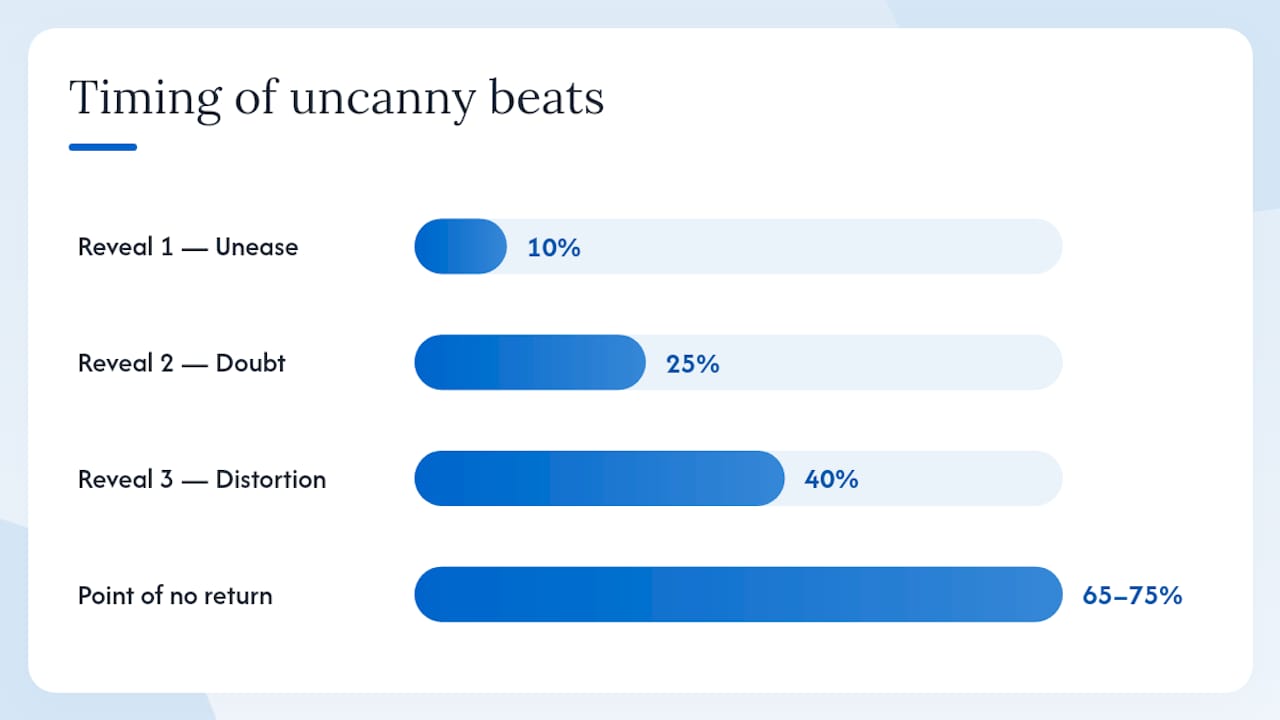
This escalation pattern maps directly onto where to place your reveals: the first reveal (something is wrong) belongs at the end of Unease; the second (the character may be causing it) belongs mid-Doubt; the third (the character cannot trust their own memory) belongs at the Distortion stage.
Ending tradeoffs:
- Ambiguous ending — leaves the horror unresolved; works when the story’s question is about the character’s inner state rather than external events. The reader carries the dread home. Risk: readers who want closure feel cheated.
- Explicit ending — names the truth, whether supernatural or psychological. Works when the revelation recontextualizes everything that came before. Risk: the explanation is rarely as frightening as the uncertainty was.
Checkpoints for placing key uncanny beats:
- First wrongness detail: within the first 10% of the manuscript
- First rationalization that strains credibility: by 25%
- First moment the reader suspects the narrator before the character does: by 40%
- Point of no return (the character can no longer maintain their version of reality): 65–75%
Sentence- and line-level tactics that produce unease
Small syntax choices control reader pacing and trust. The sentence is where psychological horror is either earned or lost, and most writers fix it in revision rather than drafting.
Before/after micro-snippets:
Before (tells the emotion):
“She was terrified as she walked down the hallway.”
After (implies through body and syntax):
“She walked. The hallway. Her hand found the wall.”
The fragmented syntax mimics dissociation. The reader’s body responds before their mind processes why.
Before (explains the wrongness):
“The room felt wrong, as if something had been moved.”
After (shows through specific detail):
“The lamp was on the left side of the desk. She kept it on the right.”
Syntax tips for building disquiet:
- Sentence length variation — long, winding sentences for the character’s rationalizations; short, declarative sentences for the moments of cold clarity. The contrast itself signals that something has shifted.
- Withhold the key noun — describe around the thing rather than naming it. “Something on the table” holds more dread than “the knife on the table” for exactly as long as you can sustain it.
- Sound devices — consonance (hard k and t sounds) creates a percussive, unsettling rhythm; assonance (long vowel repetition) slows the reader down and creates a dreamlike unease. Neither should be obvious.
- Punctuation as pacing — a period where a comma would be grammatically correct forces a pause the reader didn’t expect.
Quick revision checklist for a single line:
- Does the line tell the emotion or show the physical/cognitive response?
- Is there a concrete sensory detail that could replace an abstract descriptor?
- Does the sentence length match the character’s mental state in this moment?
- Is there anything the line explains that would be more unsettling left unexplained?
Common clichés to avoid and ethical handling of trauma
Avoid lazy tropes that reduce psychological horror to spectacle. The “it was all a dream” ending, the protagonist who is secretly dead, the twist that the haunting was a metaphor for grief but only stated in the final paragraph — these don’t fail because they’re overused. They fail because they let the writer off the hook. The horror evaporates the moment the reader realizes the story wasn’t playing fair.
Clichés to avoid and how to subvert them:
- “It was all a dream” — subvert by making the dream-state indistinguishable from waking throughout, so the reveal doesn’t erase the dread but deepens it
- The unreliable narrator who is simply lying — unreliability works when it’s self-deception, not deliberate deception; a narrator who knows the truth and hides it is a thriller, not psychological horror
- Mental illness as pure metaphor — using a character’s psychiatric condition as a plot device without depicting the actual experience is both a craft failure and an ethical one
- Trauma as backstory decoration — if the wound doesn’t actively distort the character’s present perception, it’s not doing its job
- The explained ending — a character who sits down and explains what was real and what wasn’t destroys the ambiguity that made the story work
Community resources cataloging psychological-horror tropes are useful precisely for this: knowing the pattern is the first step to subverting it.
Ethical guidelines for depicting trauma and mental illness:
- Research the specific condition or experience before writing it; clinical overviews and first-person accounts both matter
- Sensitivity readers with lived experience of the condition you’re depicting are not optional for published work
- Content warnings are a courtesy to readers, not a spoiler; include them
- Ask whether the suffering in your story serves the character’s arc or only the reader’s discomfort. If it’s only the latter, cut it.
Pro Tip: The test for ethical trauma depiction is simple: does the character experience the consequences of their suffering, or does the suffering exist only to generate atmosphere? A character whose trauma shapes their decisions, distorts their perception, and costs them something real is a character. A character whose trauma is a backdrop is a prop.
Timeboxed writing exercises to practice psychological-horror techniques
Short, iterative practice produces craft gains faster than theory alone. These drills isolate one technique at a time so you can feel the difference before combining them.
-
The corrupted kitchen (25 minutes) — Write a 250-word scene in which a kitchen becomes menacing without any external threat, no intruder, no supernatural element. The menace must come entirely from sensory microdetail and the character’s interiority. Variant: repeat with a different room and a different emotional wound.
-
The rationalization spiral (20 minutes) — Write a single paragraph in which a character discovers a small, unexplained anomaly and talks themselves out of being frightened by it. The rationalization should be almost convincing. Read it aloud; if it sounds fully convincing, make the anomaly stranger.
-
The unreliable memory (30 minutes) — Write two versions of the same scene: one from the character’s perspective in the present, one as a flashback to the same event. Contradict one specific detail between them. Don’t explain the contradiction. Share with a beta reader and ask: “At what point did you stop trusting the narrator?”
-
The sensory wrongness escalation (20 minutes) — Write three consecutive paragraphs, each containing one sensory anomaly. The first should be dismissible, the second harder to dismiss, the third impossible to rationalize. Use a different sense for each paragraph. Practical drills that isolate one technique are the fastest path from understanding a concept to owning it.
-
The syntax shift (15 minutes) — Take a paragraph you’ve already written that tells an emotion directly (“she was afraid”). Rewrite it three times using only physical sensation, fragmented syntax, and concrete objects. Compare the three versions for which produces the most unease.
Using beta readers for these drills:
- Ask targeted questions, not “did you like it?” Try: “Where did you first feel uncertain about what was real?” and “Was there a moment you stopped trusting the narrator?”
- Ask them to mark the sentence where the dread peaked and the sentence where it broke. Both are useful data.
- Story activity frameworks from workshop contexts can help structure feedback sessions if you’re working with a writing group.
A revision checklist for making a draft more psychologically threatening
Revision is where psychological horror is most reliably earned. The first draft establishes the bones; the revision is where you remove every sentence that explains too much, every scene that resolves too cleanly, and every moment where the prose trusts the reader less than it should.
Step-by-step manuscript revision:
- Read for interiority gaps — mark every scene where the character’s internal response to an event is absent or generic. Rewrite those responses with specificity.
- Audit your sensory details — for each scene, identify which sense is doing the most work. If it’s always sight, add sound, smell, or tactile cues to at least two scenes per chapter.
- Check your contradictions — list every anomaly you’ve planted. Does each one escalate from the last? Is any one of them resolved too quickly?
- Test the narrator’s reliability — read only the character’s rationalizations. Do they get progressively less convincing? If they stay at the same level of strain throughout, the escalation isn’t working.
- Cut explanations — search for any sentence that explains what a scene “means” or tells the reader how to feel. Delete it. The scene should do that work.
- Check the ending — does it resolve the character’s wound, leave it open, or deepen it? Whichever you choose, make sure the choice is deliberate and consistent with the story’s emotional logic.
- Read the last line of every scene — the last line is where the reader’s nervous system either settles or stays activated. If more than half your scenes end on a neutral or resolved note, the pacing is too comfortable.
Red flags that your draft leans on shock or lacks emotional truth:
- The scariest moments have no connection to the character’s wound
- The protagonist is passive — things happen to them rather than their perception distorting around them
- The horror is explained in dialogue
- The reader knows more than the character at every point (this is suspense, not psychological horror)
- The trauma is mentioned but never shown to cost the character anything
Annotated examples and craft notes from published work
Annotated before/after paragraphs show exactly how a single line-level choice shifts a scene toward psychological dread. The difference is almost always about what gets removed, not what gets added.
Example 1: Telling fear vs. implying it
Before:
“Marcus was terrified as he entered the house. Something felt wrong, and he couldn’t explain why. He was scared.”
After:
“Marcus stepped inside. The door swung shut behind him. He stood very still and listened to the house.”
The revision removes the emotion label entirely. “Listened to the house” implies the house has something to say. The reader supplies the fear.
Example 2: Explaining the wrongness vs. trusting the detail
Before:
“The photograph on the mantle had changed. Someone must have moved it, which meant someone had been in the house.”
After:
“The photograph on the mantle. She had been on the left. Now she was on the right. The glass was clean.”
The second version withholds the conclusion. “The glass was clean” is the detail that does the most work — it implies someone handled it without saying so.
Example 3: Escalating through syntax
Before:
“As the days passed, she became increasingly confused and frightened, unsure of what was real.”
After:
“Tuesday. She was sure it was Tuesday. She had written it down. The paper said Thursday.”
The fragmented syntax enacts the disorientation rather than describing it.
Craft notes: Nathaniel Connors’ fiction — particularly The Nether and Stories of a Condemned Soul — uses this principle of strategic omission throughout. The guilt and identity fractures in those narratives are never explained by the characters; they’re enacted through the specific objects the characters notice, the memories they return to, and the rationalizations that stop working. Readers who want to study longer passages of these techniques in action can find them on Nathanielconnors.
Adapting these examples to different subgenres:
- Contemporary psychological horror: keep the setting recognizable; the wrongness should feel like it could happen in the reader’s own home
- Dystopian horror: the distorted reality is partly external (the world is broken) and partly internal; the character’s unreliability compounds the world’s unreliability
- Supernatural horror with psychological depth: the supernatural element should mirror the character’s wound — the ghost is what the character can’t forgive, the entity is what they’ve buried
What most writers get wrong about psychological horror
The conventional wisdom says psychological horror is about subtlety. Write quietly, imply everything, never show the monster. That’s half right, and the half that’s wrong is what kills most first attempts at the genre.
Subtlety without specificity is just vagueness. A scene that implies something is wrong without grounding that wrongness in a concrete, specific detail isn’t subtle — it’s empty. The reader doesn’t feel dread; they feel confused and then bored. The writers who do this well aren’t being subtle about the detail. They’re being specific about the wrong detail, the one that shouldn’t be there, the one that doesn’t fit. That’s a completely different skill.
The other thing writers underestimate is how much work the character’s wound has to do. Anchoring horror in a single core emotion — guilt, shame, grief — and letting the plot and imagery spin out from that anchor is the structural principle that separates psychological horror that lingers from psychological horror that’s merely unpleasant. The wound isn’t backstory. It’s the lens through which every uncanny detail is filtered. Without it, the horror is atmospheric but not personal, and personal is what makes it stay with a reader.
One more thing: the ending. Writers agonize over whether to resolve the ambiguity. The answer is almost always to resist the urge to explain. Not because ambiguity is inherently superior, but because the explanation you write will be less frightening than the one the reader has already constructed. The reader’s version is tailored to their own fears. Yours is tailored to your story. Trust them.
Psychological horror novels that demonstrate these techniques
If you’ve worked through this guide and want to see these techniques in action at novel length, the most direct path is reading fiction that uses them deliberately. Nathaniel Connors’ The Nether and Stories of a Condemned Soul both demonstrate the wound-first structure, strategic omission, and escalating sensory wrongness covered here — and both are available on Kindle Unlimited, meaning Kindle Unlimited subscribers can read them without additional cost.
For readers drawn to dystopian settings where external and internal distortion compound each other, Evolution A200: A Bubonic Apocalypse applies the same psychological depth to a collapsing world. The best dystopian horror novels list on Nathanielconnors’s site includes these titles alongside curated recommendations that model the atmospheric and psychological techniques in this guide.
Readers who want shorter, one-sitting examples to study before committing to a full novel can find those on the Kindle Unlimited horror books page — a practical starting point for writers who want to read analytically without a long time investment.
Sources
- Storyville: Writing Psychological Horror
- Psychological Horror Writing That Haunts Forever | The Writer
- PubMed article 25041744