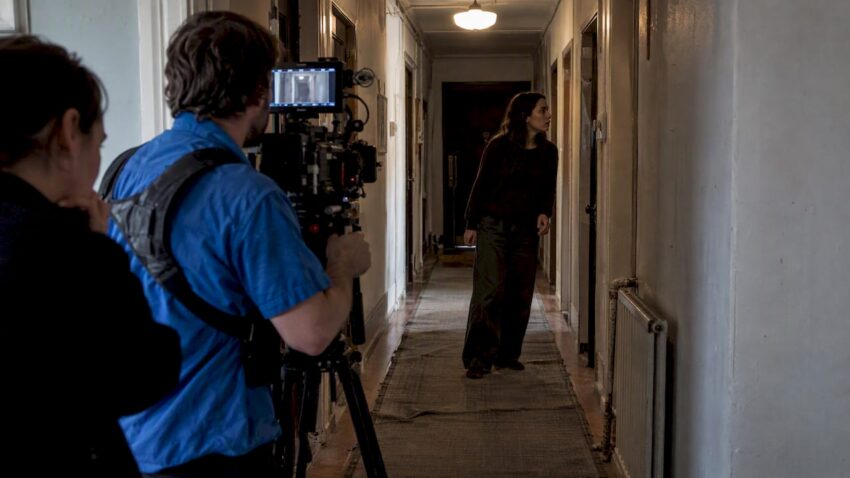
A great horror short picks one fear and structures every beat to deliver a single, unavoidable payoff. That means a compressed three-act spine, an inciting incident that arrives almost immediately, a clear point of no return, and a protagonist viewed from the inside out through subjective camera and sound choices.
TL;DR:
- Put the inciting incident within the first one to three pages, then cross the point of no return by roughly the script’s one third mark.
- Build dread with layered ambient sound, purposeful silence, and held point of view shots; a slow reveal often works better than a jump scare.
- Use one or two locations and repeat two or three visual or sound motifs, letting them change instead of adding threats or expensive effects.
- Test the hardest scare in a rough proof of concept after a table read, then prioritize the ending and midpoint commitment during revisions.
Table of Contents
- Core Components: Protagonist, Threat, Stakes, and Payoff
- Three-Act in Miniature: Where to Place Setup and the Point of No Return
- Tactics to Build Dread: Sound, Image, Rhythm, and Editing
- Character and Point of View: Making the Audience Live the Fear
- Writing Tight Scenes and Cutting Exposition
- Production-Minded Choices: Economy of Means for Horror Shorts
- Revision, Table Reads, and Testing: Iterate Until the Scare Lands
- Nathaniel Connors’ Micro-Techniques for Psychological Dread
- Author Perspective: Commit to One Fear and Finish the Film
- FAQ
- Sources
Core Components: Protagonist, Threat, Stakes, and Payoff
Four elements decide whether a horror short lands or collapses, and we treat them as a checklist before writing a single scene.
A protagonist needs a want that reads instantly on screen: find the exit, protect the child, hide the secret. Complicated backstory costs minutes a short doesn’t have. The threat needs a function, not just a look: what does it want, and how does it block the protagonist’s goal. A ghost that merely appears is décor; a ghost that wants the house empty is a plot engine.
Stakes should stay tethered to that one desire rather than ballooning into world-ending consequences the runtime can’t support. And the payoff, the final image or reveal, should exist before you write page one, because every earlier scene exists to earn it.
- Give the protagonist one concrete, visible want from the first scene.
- Define the threat by its function: what it wants and what it does when blocked.
- Keep stakes personal and specific, not cosmic.
- Write the ending first, then build backward toward it.
Our structure guide for horror shorts walks through examples of this reverse-engineering process in more detail.
Three-Act in Miniature: Where to Place Setup and the Point of No Return
A short horror script compresses the three-act shape into pages instead of chapters, and the timing of two beats determines whether the rest of the film has room to work.
- Open on the inciting incident within the first one to three pages: a locked door, a strange sound, a message that shouldn’t exist.
- Place the point of no return by roughly the one-third mark: the protagonist steps into the house, answers the call, or makes the choice that removes any easy exit.
- Spend the middle escalating a single idea rather than introducing new threats or subplots.
- Commit to the ending’s logic early enough that the final image feels inevitable, not tacked on.
A craft podcast episode on common structural mistakes in short films identifies over-ambition as the top killer of shorts: trying to fit feature-length plotting into ten minutes. Three templates tend to survive that trap: the contained slow-burn (one location, one escalating wrongness), the punchline or twist payoff (a short joke structure with a horror sting), and the escalating trap (each scene closes off an exit until none remain).
Tactics to Build Dread: Sound, Image, Rhythm, and Editing
Dread is mostly a sound and timing problem, not a budget problem. Editor Michael Block, discussing his work on the Sundance film Watcher, describes using different registers of quiet, a tense silence versus a lonely silence, to shape how an audience feels inside a scene rather than just what it sees, as described in a Filmmaker Magazine interview. That distinction between kinds of silence is worth testing in your own sound passes before you ever touch visual effects.
Camera choices should enforce subjectivity: point-of-view framing, close coverage on the protagonist’s face, and long takes that trap the viewer in real time rather than cutting away to relief. A slow reveal, where the frame holds a beat longer than feels comfortable, usually creates more dread than a jump scare, because the audience’s imagination does the work the effects budget can’t.
- Build a sound layer of ambient wrongness under dialogue scenes, not just stingers at the scare.
- Hold a shot past the point of comfort before cutting, rather than cutting on the scare itself.
- Stage everyday-object subversion (a blink that lasts too long, a chair that’s moved) in plain sight so the audience questions their own perception.
- Let silence do narrative work: cut dialogue or score entirely for a few seconds before the reveal.
Pro Tip: Record a silent pass of your rough cut and watch it with sound off first, then sound only with picture off, to isolate which element is actually carrying the tension.
A short works best as a single emotional experience rather than a miniature feature, according to a Filmmaker Magazine interview with Pepi Ginsberg about her Cannes short, The Pass. That framing explains why a short built around one sustained fear tends to outperform one juggling several.
Character and Point of View: Making the Audience Live the Fear
The fastest way to make an audience afraid is to make them inhabit one person’s body for the runtime. Pick a protagonist whose want creates an emotional spine strong enough to carry the whole film without a subplot propping it up.
Reveal character through behavior and sensory detail rather than dialogue-heavy backstory: how someone checks a lock twice, flinches at a sound, or avoids a room tells us more in two seconds than a line of expository dialogue does in twenty.
- Cast and direct for stillness: a performer who can hold a reaction shot without overacting reads stronger on camera than one who fills every beat with movement.
- Write physical behaviors (a held breath, a repeated gesture) instead of lines that explain what a character feels.
- Keep dialogue sparse and functional; let reactions carry the emotional information.
Our notes on writing characters and dialogue that build dread go deeper into directing performance for short, high-tension scenes.
Writing Tight Scenes and Cutting Exposition
Every scene in a short has to move the spine forward or reveal something new; if it does neither, cut it. Exposition should almost always be replaced with a visual substitute: a prop, a reaction shot, a sound cue that implies history without stating it.
- Ask what this scene reveals or advances; if the answer is “nothing new,” cut or merge it.
- Replace a line of explanation with an object or a glance wherever possible.
- Read the script aloud and flag any line that only exists to tell the audience something they could see instead.
Pro Tip: Highlight every line of dialogue that explains a feeling or a fact, then try deleting it and staging the same information as a visual beat before deciding it’s necessary.
Production-Minded Choices: Economy of Means for Horror Shorts
Structure and budget are the same problem viewed from different angles. Choosing one location that can be shot from multiple angles reduces coverage needs and forces the design team to make every object in frame count toward the spine.
A limited color and motif palette, two or three recurring visual or sound cues that evolve across the acts, keeps a low-budget short feeling intentional rather than cobbled together. That constraint-as-craft approach shaped Pepi Ginsberg’s economy of means on The Pass, where a limited cast and palette made the finished short feel more focused rather than cheaper.
- Choose one or two locations that can serve multiple scenes from different angles.
- Build a palette of two or three recurring colors or motifs instead of a new look per scene.
- Favor strong sound design and committed performance over visual effects, which cost more and often read as less frightening.
Revision, Table Reads, and Testing: Iterate Until the Scare Lands
A short script rarely survives contact with actors unchanged, and that’s the point of testing early. A workable loop runs: write a draft, hold a table read, shoot a quick proof-of-concept of the hardest beat, test it with a small audience, then refine.
- Run a table read specifically to check whether the inciting incident and point of no return land where you intended.
- Shoot a rough proof of the scariest beat before committing to a full shoot day, and watch for confusion in the emotional arc or muddled reveal timing.
- When time or budget is tight, prioritize fixes to the ending and the midpoint commitment first, since those decide whether the payoff works at all.
Table reads and small test screenings remain the most reliable way to check whether the spine and the timing of reveals actually land for a real audience rather than just on the page.
Nathaniel Connors’ Micro-Techniques for Psychological Dread
Three techniques translate from prose to film beats easily. Sensory inversion turns a comforting sense, like touch or a familiar smell, into a source of wrongness. Cost-reveals show what a character has already sacrificed through a single prop rather than dialogue. Motif escalation repeats one image with a small change each time it returns.
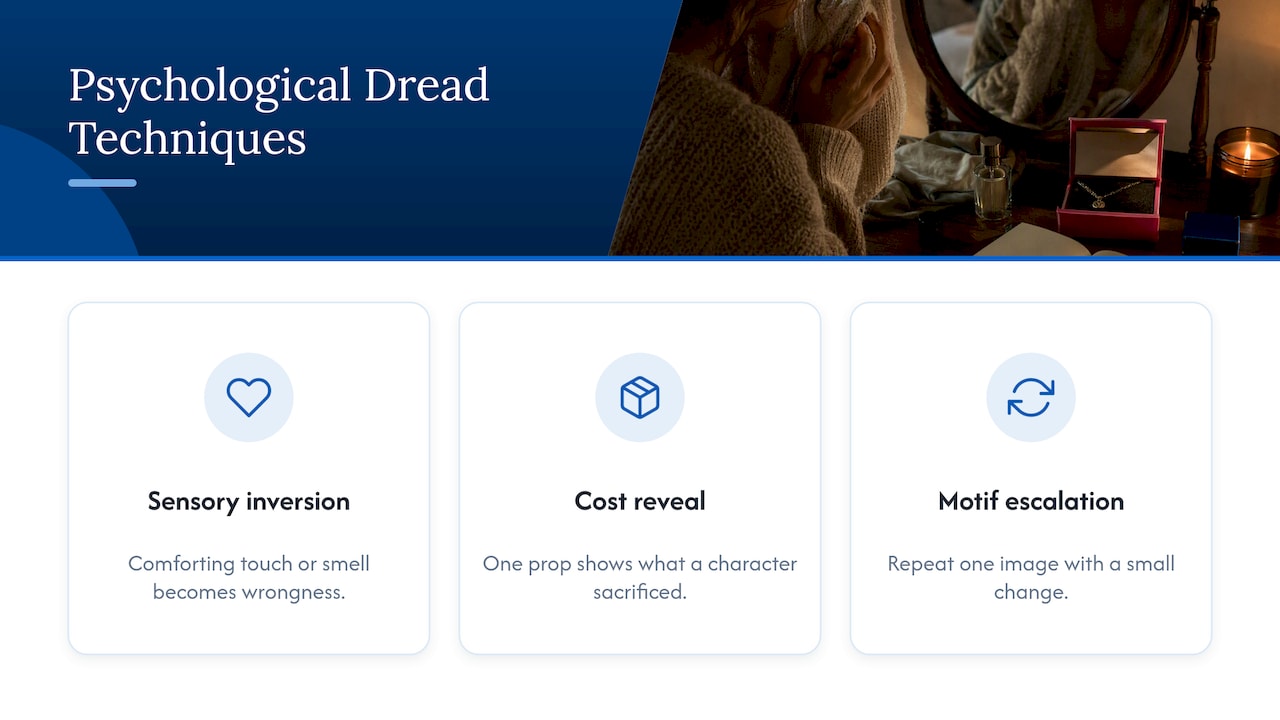
Try this: take a quiet moment from a journal entry or a short story draft and rewrite it as one shot with no dialogue, built entirely around a single prop.
Author Perspective: Commit to One Fear and Finish the Film
Most unfinished horror shorts die from indecision, not lack of skill. Emotional focus on a single fear beats a cleverer, more complicated premise almost every time, because a short only has minutes to earn a reaction.
Try a one-minute exercise: write the final image of your short first, then ask what single fear that image proves true. If you can’t answer in one sentence, the spine isn’t ready yet.
— Nathaniel
FAQ
What is the ideal length for a horror short film?
Most horror shorts run between five and fifteen minutes, with the inciting incident landing in the first one to three pages so the rest of the runtime can escalate a single fear. Longer running times tend to invite subplots that dilute the spine.
How do you build suspense without a big budget?
Suspense comes primarily from sound design, controlled silence, and camera choices that keep the audience locked into the protagonist’s point of view rather than from visual effects. A Filmmaker Magazine interview on the editing of Watcher describes using different kinds of quiet to shape dread with minimal visual complexity.
Should a horror short end on a twist or a slow reveal?
Either can work, but the choice should be decided before you write the first scene, since every earlier beat needs to earn that specific ending. Our guide to ambiguous horror endings explains how to test which ending logic fits your premise.
What is the biggest structural mistake in horror shorts?
The most common mistake is treating a short like a miniature feature, stacking multiple threats, subplots, or reveals into a runtime that can’t support them. A craft podcast episode identifies this over-ambition as the top cause of unfocused shorts and recommends containment instead.
How many drafts should a horror short script go through before shooting?
There’s no fixed number, but a workable loop is draft, table read, proof-of-concept shoot of the hardest beat, small test screening, then a focused revision pass. Prioritize fixing the ending and the point of no return first if time or budget runs short.
Sources
If this structural approach resonates with how we think about fear on the page, the longer fiction builds the same instincts at greater length. Readers who want to see sustained dread, cost-reveals, and motif escalation at work across a full narrative can start with our book collection, which includes The Nether Series and the EA200 Series, both free to read for Kindle Unlimited subscribers.
- “What does ‘quiet’ sound like when you’re trying to express the correct emotion?”: Editor Michael Block on Watcher – Filmmaker Magazine
- The number-one mistake that kills most short films (podcast episode)
Start with the first chapters free on Kindle Unlimited and see how the same structural discipline plays out across a full book.