To write a horror short film that lands, lock down one premise, one location, and one to three characters, then let sound and silence carry the fear instead of a monster budget. Draft your five-word tagline first. Something like “Babysitter hears herself upstairs” or “He answers his own knock.” If you can’t compress the idea that small, it’s not a short yet. It’s a feature pretending to be one.
Your immediate task: write that tagline, then expand it into a single logline sentence. Everything else, structure, dialogue, effects, gets built on top of those two lines.
- Verdict: one premise, one location, one to three characters, sound-driven scares
- Do this now: write a five-word tagline and a one-sentence logline
- Highest-leverage tools: atmosphere (sound and light) and pacing, not gore or cast size
Key Takeaways
A producible horror short depends on one tight premise, minimal cast and locations, sound-led scares, and page counts matched honestly to runtime.
| Point | Details |
|---|---|
| Compress before you draft | Reduce your idea to a five-word tagline and one-sentence logline before writing a scene. |
| Cast and locations stay small | Limit speaking roles to one to three and locations to one or two for producibility. |
| Sound carries the scares | Build a sound map into the script; silence and off-screen cues cost nothing to shoot. |
| Match pages to runtime | Target 4 to 6 pages for 5 minutes, 8 to 11 pages for 10 minutes. |
| Test before you shoot | Run a table read and a rough temp-sound mock-up to catch pacing problems early. |
Table of Contents
- How Do You Come Up with a Concept for a Horror Short Film?
- What’s the Best Structure for a Short Horror Script?
- How Do You Write Characters and Dialogue That Build Dread?
- How Do You Write a Horror Short for a Low Budget?
- How Long Should a Horror Short Film Script Be?
- How Do You Test a Horror Script Before You Shoot It?
- What Can Writers Learn from Nathaniel Connors About Psychological Dread?
- Ready to Write Your Own Dread-Soaked Short?
- Where to Study Horror Short Film Craft Further
- What Most Advice on Writing Horror Shorts Gets Wrong
- Frequently Asked Questions
- Sources
How Do You Come Up with a Concept for a Horror Short Film?
A single-idea premise is one unresolved question the audience can’t shake. Not “haunted house,” but “what if the thing in the house has always been you?” Short horror lives or dies on that kind of compression, and the strongest shorts succeed precisely because they commit to one atmosphere-driven idea instead of trying to cram in backstory and world-building the runtime can’t support.
Here’s the exercise. Do it in this order:
- Write the premise as one sentence with no character names (“A woman realizes the reflection in her mirror blinks a half-second late”).
- Cut it to a five-word tagline. If you can’t, the idea has two ideas hiding inside it. Split them.
- Write the logline: character, want, obstacle, and the twist of dread, in one sentence under 30 words.
- Run the producibility test below before you write a single scene.
The producibility test has four questions. Can you shoot this in one location, or two at most? Does it need more than a handful of props? Does the cast exceed three speaking roles? Can you tell the whole story in under 12 pages? If any answer breaks the short-film math, the premise needs trimming, not the script.
Pro Tip: Write your tagline on a sticky note and keep it visible while you draft. Every scene that doesn’t serve that five-word idea gets cut, no matter how clever it feels in isolation.
What’s the Best Structure for a Short Horror Script?
Two beat templates cover most of what works in short horror, and both are built to deliver dread fast rather than build a sprawling arc.
Template A: The Single-Scene Twist
- Hook (page 1): establish the ordinary, then plant one wrong detail
- Escalation (pages 2 to 4): the character investigates, and the wrongness compounds
- Reveal (pages 4 to 6): the audience learns what’s actually happening, slightly before or with the character
- Twist (final page): the last image or line recontextualizes everything before it
Template B: Escalating Containment
- Setup (pages 1 to 2): trap the character somewhere they can’t easily leave
- Slow reveal (pages 2 to 5): drip information about the threat through sound and environment, not dialogue
- Pressure (pages 5 to 8): the walls close, literally or psychologically
- Break (final 1 to 2 pages): the containment fails, violently or ambiguously
For a 3 to 5 minute short, aim for 3 to 5 pages total, using Template A almost exclusively since there’s no runway for slow escalation. For a 5 to 12 minute short, 5 to 12 pages fits Template B better, since it needs room to breathe before the pressure builds. StudioBinder’s beat-to-runtime guidance backs this up: study successful scripts and you’ll notice the scares almost always land at predictable page intervals, not randomly scattered through the runtime. Keeping cast and locations minimal isn’t just a budget move either. It’s what makes twist and open endings land, since there’s nowhere for the audience’s attention to drift.
How Do You Write Characters and Dialogue That Build Dread?
Short horror doesn’t have time for backstory monologues, so every character needs to function as want plus vulnerability, nothing more. A babysitter who’s afraid of being blamed for something. A man who can’t admit he’s lost. Give the audience that single fracture point in the first thirty seconds of screen time, and their reactions to the threat will read as earned instead of generic screaming.
Sensory detail beats explanation every time. Write in present tense, specific to what a camera and a microphone can actually capture: “The floorboard doesn’t creak. It exhales.” That’s a stage direction that tells your cinematographer and sound designer exactly what to build, and it leaves gaps the audience’s imagination fills in far more effectively than any explanation could. Fear of the unknown works because the audience’s brain generates something worse than anything you could film.
Formatting itself is a scare tool. Keep your action lines short and clipped through normal scenes, then let one paragraph go dense and slow right before a scare beat. That shift in white space physically primes the reader, and it translates directly to how an editor will pace the cut. Research on script structure confirms that white-space manipulation genuinely amplifies the moment when the scare lands, because the reader’s eye slows down exactly when you need their attention locked.
- Give each character one want and one crack in their armor
- Write sensory, present-tense action lines; leave interpretation to the audience
- Compress normal scenes; expand only the paragraph right before a scare
- Plant a recurring image early and let it return, altered, at the climax
Statistic Callout: Short horror scripts that keep their cast under four speaking roles and their locations to one or two consistently rank among the most produced festival entries, according to production breakdowns from Raindance, because tight scope leaves more craft budget for atmosphere instead of logistics.
Subtext does the heaviest lifting here. If your character says “I’m fine” while backing toward a door, that’s the whole scene. Don’t let anyone explain what they’re afraid of out loud. Horror dialogue that announces the threat kills tension instantly; horror dialogue that avoids naming it keeps the dread alive.
How Do You Write a Horror Short for a Low Budget?
Write toward what you can actually shoot. If you have access to one apartment, one basement, or one backyard at night, build the premise around that location before you write a single scene, because using what’s already available is the single biggest lever for controlling cost without sacrificing quality. Block your action on the page with the shoot in mind. If a scene can play in one continuous take instead of six coverage angles, write it that way. That choice saves an entire day of setup time.
Sound is your cheapest and most powerful effect. Write specific cues into the script itself, footsteps on a specific surface, a door that doesn’t fully latch, silence that cuts out mid-scene, because low-budget horror consistently earns its scares through pacing and sound design rather than visual spectacle. A practical trick worth stealing from production-focused writers: build a sound map alongside your script, a simple column noting which diegetic and non-diegetic sounds hit at each beat, so nothing gets left to chance on shoot day.
Practical effects almost always beat digital ones on a shoulder-season budget. A shape glimpsed through frosted glass, a shadow that moves wrong, makeup and lighting angle rather than a rendered creature. Camera placement does more work than any effect: shoot from behind an object, obscure the frame’s edges, let the audience’s peripheral vision do the panicking.
- Write scenes for locations you can actually access more than once
- Block for continuous takes to cut coverage time
- Build a sound map into the script before you shoot
- Use implied effects (shadows, sound, framing) over visible ones
Pro Tip: Schedule night-shoot pages in dedicated blocks and cap your daily page count at two to three pages for horror. Scares take longer to light and stage than dialogue scenes, and rushing them is the fastest way to lose the dread you wrote on the page.
How Long Should a Horror Short Film Script Be?
The one-page-per-minute rule holds roughly true for horror shorts, though horror often runs slightly under that because so much of the fear lives in silence rather than dialogue. A 5-minute short should land at 4 to 6 pages. A 10-minute short should land at 8 to 11 pages. If you’re consistently running long, the premise probably needs trimming, not the pacing.
- Draft in Final Draft, Arc Studio Pro, or another industry-standard format; sloppy formatting reads as amateur before anyone reaches the story.
- Keep sluglines precise and limit new locations. Every INT./EXT. change costs setup time on shoot day.
- Cut any paragraph over four lines outside of your one designated scare beat per scene.
- Trim dialogue ruthlessly. If a line explains what the image already shows, cut the line.
- Convert exposition into a visual beat wherever possible. A photo on a wall says more than a line of backstory.
How Do You Test a Horror Script Before You Shoot It?
A table read tells you things a solo read-through never will. Invite people who don’t know your ending, ideally a mix of writers and non-writers, and watch for where they laugh at the wrong moment, where they get confused about geography, and where the room goes quiet in a good way. That silence is data.
Before committing to a shoot day, build a rough mock-up using still frames or a rough animatic with temp sound layered in. This kind of cheap, early test validates whether your scare’s timing actually works before you’ve spent a single dollar on a location or crew.
Your final pre-shoot checklist should confirm: every practical effect has a clear, written execution note; every scare beat has an assigned sound cue; blocking is locked for continuous takes; and any physical effect involving actors has a documented safety plan reviewed by whoever’s running the effect.
- Invite fresh readers to a table read and track confusion, timing, and reactions
- Build a rough cut with temp sound before locking the shooting script
- Confirm every scare has a sound cue and every effect has a safety note
What Can Writers Learn from Nathaniel Connors About Psychological Dread?
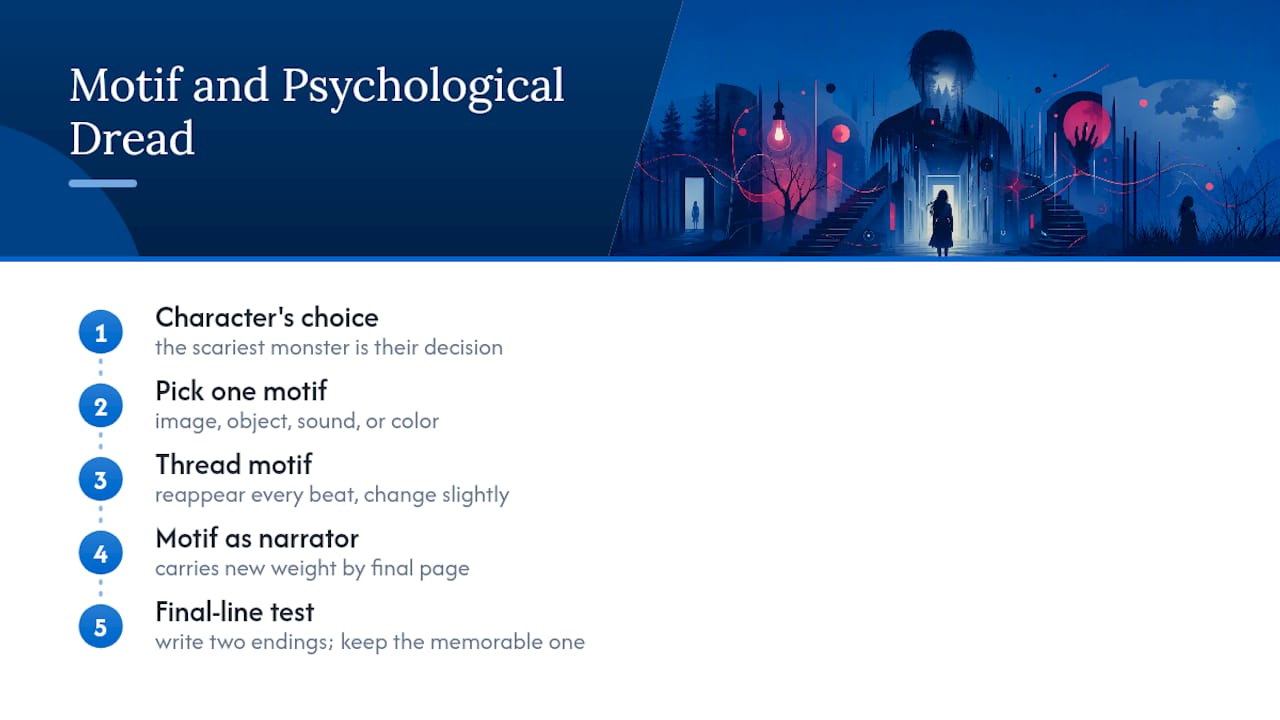
Nathaniel Connors builds his fiction, including The Nether and Stories of a Condemned Soul, around the idea that the scariest monster is usually a decision the character already made. That’s a useful prompt for short-form horror writers stuck on premise. Instead of asking “what’s the scary thing,” ask “what does my character feel guilty about, and what would happen if that guilt showed up wearing a face?” Guilt, revenge, and unfinished business compress well into short runtimes because the audience doesn’t need backstory. They recognize the feeling instantly.
Pick one image early, a specific object, a repeated sound, a particular color, and thread it through every beat, changing slightly each time it reappears. By the final page, that motif should carry weight it didn’t have on page one.
The recurring image is the story’s real narrator. If a door closing on page 1 means nothing different by page 8, you haven’t written a short. You’ve written a scene that repeats.
Pro Tip: After your first draft, write two versions of your final line, one that resolves the fear and one that leaves it open. Read both aloud to someone cold. Whichever version they bring up unprompted a day later is the one to keep. Studying your own personal fears for this exercise, rather than borrowed tropes, is what gives a five-minute script a voice.
If you want to see these choices carried through an actual finished script, Room 302 walks through one execution from page to screen.
Ready to Write Your Own Dread-Soaked Short?
Everything above works because horror short films succeed on constraint, not scale: one idea, one location, a handful of characters, and sound doing the heavy lifting a bigger budget would spend on visual effects.
If the psychology behind guilt, revenge, and lingering dread is what draws you to horror writing in the first place, Nathaniel Connors’ longer fiction digs into that same territory at full length. The Nether and Evolution A200: A Bubonic Apocalypse are both free to read for Kindle Unlimited subscribers, and they’re worth studying for how sustained dread gets built scene by scene rather than beat by beat. Start with the curated list of dystopian horror novels if you want a reading list built around exactly the atmosphere and pacing techniques this guide covers.
Where to Study Horror Short Film Craft Further
- Access Creative College: premise selection and atmosphere-first writing
- No Film School: low-budget production interviews
- StudioBinder: beat structure and personal-fear mining
- Arc Studio Pro: white-space scripting technique
- Iguanify’s runtime guide: pacing short-form content to a target length
What Most Advice on Writing Horror Shorts Gets Wrong
Most guides treat premise, structure, and production as three separate conversations. They aren’t. The moment you write “she hears footsteps upstairs,” you’ve already made a budget decision, a casting decision, and a sound design decision, whether you meant to or not. The strongest short horror writers I’ve studied treat every line as doing double duty: serving the story and serving the shoot.
The conventional wisdom oversells plot twists and undersells restraint. A clean, unresolved ending, the kind that leaves a single unanswered question, tends to outperform a clever reveal, because dread that lingers past the credits is worth more than a gasp that fades in the parking lot. Writers also underestimate how much a recurring image does. One thread, pulled through three or four beats, does more emotional work than a page of backstory ever will.
If you take one thing from this guide, let it be the tagline exercise. A short, precise tagline forces clarity in your concept. Write it before you write anything else, and let it discipline every choice that follows.
Frequently Asked Questions
How long should a horror short film be?
Most festival-friendly horror shorts run 5 to 12 minutes, translating to roughly 5 to 12 script pages using the one-page-per-minute standard, though horror often runs slightly shorter per page due to sound-driven silence.
What makes a good horror short film idea?
A good idea is a single, specific fear compressed into one unresolved question, expressed in a location and cast size you can actually shoot. If you can’t state it in five words, it likely needs to be split into two ideas.
Should a horror short have a twist ending?
Not necessarily. Twist endings work, but an unresolved or lingering ending often lands harder in short form because it keeps the dread alive after the credits instead of resolving it neatly.
How many characters should a horror short film have?
One to three speaking roles is a practical limit to keep production manageable. Fewer characters means faster scheduling, tighter dialogue, and more budget left for sound and lighting.
Do I need special effects to write a scary short film?
No. Sound design, negative space, and implied threats often create more effective scares than visible monster effects in short horror, both creatively and financially, since they cost almost nothing to execute well.