
Revenge in literature is the motive and structural engine that pits personal retribution against public justice, usually at moral cost to whoever pulls the trigger. It drives plot, tests character, and almost always asks the same question: does getting even actually settle anything? LitCharts has tracked this tension across classic texts for years, and Nathaniel Connors builds entire novels around the same collision between vengeance and conscience.
- Revenge is a private act; justice is a public, sanctioned one, and literature loves to blur that line.
- The best revenge stories cost the avenger something, even when they “win.”
- The theme shows up everywhere from Jacobean tragedy to modern horror and psychological thrillers.
Key Takeaways
Revenge in literature functions as a moral pressure test that exposes the difference between personal retribution and public justice, almost always at a cost to the avenger.
| Point | Details |
|---|---|
| Revenge and justice differ | Revenge is personal and unsanctioned; justice is public and rule-bound, and literature exploits that gap. |
| Classic texts model the cost | Monte Cristo, Hamlet, and Wuthering Heights each show vengeance corroding the avenger. |
| Modern genres reframe the theme | Thrillers, fantasy, and horror update revenge with feminist and psychological angles. |
| Structure follows a pattern | Flashback plants the wound, plotting escalates the moral cost, ending delivers catharsis or reversal. |
| Endings rarely stay clean | Most serious revenge narratives end in ambiguity, ruin, or moral reckoning rather than a tidy win. |
Table of Contents
- What Revenge in Literature Actually Does to a Story
- Classic Examples: What Monte Cristo, Hamlet, and Wuthering Heights Teach Us
- Modern and Cross-Genre Revenge Novels Worth Reading
- The Toolbox Authors Use to Build a Revenge Plot
- How to Write a Strong Essay on Revenge as a Literary Theme
- Nathaniel Connors and the Weight of Vengeance
- Why Characters Actually Choose Vengeance
- Revenge Looks Different Across Cultures and Eras
- Is Revenge Ever Morally Justified in Fiction?
- How Revenge Plots Usually End
- An Editorial Take on Studying Revenge in Fiction
- Sources
What Revenge in Literature Actually Does to a Story
Justice is supposed to be impersonal, weighed by a court or a code, applied evenly. Revenge is personal. It’s one person deciding they, not the law, get to settle the score. Novels and plays exploit that gap constantly, staging what happens when a wronged character stops waiting for the system and starts acting alone.
That distinction splits into two flavors worth knowing for any close reading:
- Private revenge — an individual act, usually secret, driven by grief or humiliation (Edmond Dantès plotting for years in disguise).
- Public revenge — vengeance dressed up as justice, sanctioned by a state, a mob, or a code of honor, which lets authors ask whether “legal” and “moral” are the same thing at all.
Revenge works so well as a story engine because it gives a character a goal sharp enough to organize an entire plot around, while quietly corroding them along the way. DIY MFA calls revenge one of literature’s classic masterplots precisely because it fuses external action (the plan) with internal decay (the obsession). A protagonist chasing revenge rarely ends the book as the person who started it.
Revenge rarely restores what was lost. Across the canon, the pattern repeats: the avenger gets their moment, and it costs more than they expected.
Classic Examples: What Monte Cristo, Hamlet, and Wuthering Heights Teach Us
Three texts do most of the heavy lifting in any serious study of this theme, and each teaches a different lesson.
- The Count of Monte Cristo shows revenge’s collateral damage. Edmond Dantès spends fourteen years engineering an elaborate payback against the men who destroyed his life, and it works, mostly. But LitCharts’s analysis points out that his schemes hurt people who never wronged him, forcing Dantès into a moral recalculation by the novel’s end. Getting even and getting justice turn out to be different projects entirely.
- Hamlet is the textbook revenge tragedy: a ghost demands blood, a prince stalls, and the delay itself becomes the drama. Hamlet’s hesitation raises the genre’s central question, whether revenge belongs to men or to providence, and the play answers it with a stage littered with bodies. Nobody, including the avenger, survives clean.
- Wuthering Heights turns revenge generational. Heathcliff’s fury at his mistreatment doesn’t die with him. It gets passed to the next generation like an inheritance, warping relationships that had nothing to do with the original injury.
The ghost’s demand in Hamlet sets the terms for the entire revenge-tragedy genre: personal grievance dressed as sacred duty, with the avenger’s own destruction baked into the bargain.
Each of these texts treats vengeance as a structural device with its own arithmetic: a wrong committed, a debt calculated, and a payment that always runs over budget.
Modern and Cross-Genre Revenge Novels Worth Reading
The theme didn’t stay in the nineteenth century. It migrated into thrillers, fantasy, horror, and feminist fiction, each genre bending the mechanics differently.
- Gone Girl by Gillian Flynn — a marriage weaponized into an elaborate, ice-cold act of retribution.
- Vicious by V.E. Schwab — two former friends turned superpowered rivals, each convinced the other deserves ruin.
- The Count of Monte Cristo remains the genre’s founding blueprint and still tops most curated lists, including The Guardian’s roundup of top revenge reads.
- Ninth House by Leigh Bardugo — a dark academia mystery where past violence demands a reckoning; confirmed as widely available for U.S. readers.
- My Sister, the Serial Killer by Oyinkan Braithwaite — a pitch-black feminist thriller where loyalty and payback tangle together.
- The Silent Patient by Alex Michaelides — a psychological thriller built around a wife’s silence and a slow-burning motive.
- The Talented Mr. Ripley by Patricia Highsmith — revenge reframed as pure opportunism and self-preservation.
- Sharp Objects by Gillian Flynn — small-town secrets and inherited cruelty, revenge simmering under domestic surface.
- Contemporary horror lists compiled by sites like Dark Distractions point to why these stories satisfy: readers want to watch wrongs finally get answered, even fictionally.
Whatever the genre, the same question survives the jump: does the payback actually settle anything, or just multiply the damage?
The Toolbox Authors Use to Build a Revenge Plot
Revenge plots aren’t improvised. They lean on a small set of recurring devices that experienced readers learn to spot fast.
- Revenge cycles — one act of vengeance triggers another, spiraling across families or generations, a pattern documented in revenge-tragedy criticism going back centuries.
- The avenging angel — a character positioned as righteous punisher, blurring hero and villain until the reader isn’t sure which one they’re rooting for.
- Collateral damage — innocent characters caught in the blast radius, the device that turns triumph into tragedy.
- The unreliable narrator — a voice that hides its own motive, letting the reader discover the vengeance plot alongside (or after) the other characters.
Structurally, most revenge plots share a shape: a flashback plants the original wound, a middle section tracks the plan and the toll it takes, and the ending delivers either catharsis (the wrong is answered) or reversal (the avenger becomes what they hated). Genre changes the flavor more than the skeleton. Horror leans into visceral, physical punishment; realist fiction lingers on the moral wreckage instead. DIY MFA’s breakdown of technique versus genre convention is worth reading if you want the mechanics spelled out further, and Mark Watson’s guide to story themes is a solid primer if you’re building a plot from scratch rather than just analyzing one.
Pro Tip: When you’re stuck identifying a revenge motif in a text, ask who the collateral damage is. That character usually reveals the author’s actual verdict on whether the revenge was worth it.
How to Write a Strong Essay on Revenge as a Literary Theme
Treat revenge as a thematic argument, not a plot summary. Here’s a working set of prompts and a structure that holds up under grading.
- Thesis prompt A: Argue that a chosen text presents revenge and justice as fundamentally incompatible (use Hamlet or Monte Cristo).
- Thesis prompt B: Trace the specific cost of revenge to the avenger across one novel, chapter by chapter.
- Thesis prompt C: Compare cyclical revenge in Wuthering Heights to a modern example like Vicious.
- Close-reading prompt: Quote the moment a character chooses vengeance over mercy. What imagery surrounds that choice?
- Structure advice: Anchor every paragraph to technique (point of view, imagery, pacing) rather than “what happens next.” Instructors reward the device to effect to meaning chain, not recap.
Nathaniel Connors and the Weight of Vengeance
Guilt, revenge, and redemption sit at the center of Nathaniel Connors’s fiction, where characters rarely get a clean payoff for the wrongs they avenge. His novella Stories of a Condemned Soul asks how far a person will go for personal justice and what’s left of them afterward, the exact question this article keeps circling back to.
Readers drawn to this theme have a few places to go next:
- The Best Dark Supernatural Books for Readers Who Want Real Dread — a curated list heavy on moral horror and reckoning.
- Books Like The Silent Patient — for readers who want the psychological-thriller angle on vengeance.
- Connors’s titles, including The Nether and Evolution A200: A Bubonic Apocalypse, are free to read on Kindle Unlimited, so there’s no added cost to testing whether his take on guilt and payback fits your shelf.
| Point | Details |
|---|---|
| Revenge fiction pairs with dark fantasy | Fans of vengeance plots often enjoy the moral horror in Connors’s catalog. |
| Free access lowers the barrier | Kindle Unlimited subscribers can read Connors’s novels at no added cost. |
| Related reading extends the theme | Curated lists on dark supernatural fiction connect readers to more revenge-adjacent stories. |
Why Characters Actually Choose Vengeance
Most literary avengers aren’t chasing abstract justice. They’re chasing relief from a specific wound: humiliation, grief, betrayal, or the sense that no one else will ever answer for what happened. That’s why revenge plots read as psychologically dense rather than simply violent. Dantès isn’t driven by principle; he’s driven by fourteen years of rehearsing his own destruction in a prison cell. Heathcliff isn’t righting a cosmic wrong; he’s punishing everyone near him for a childhood of contempt.
Shame and helplessness show up constantly as the actual engine under the surface plot. A character who felt powerless once often becomes obsessed with proving they’ll never feel that way again, and revenge offers a script for that. Grief does similar work: when the legal system offers no adequate answer to a death or a betrayal, fiction lets characters write their own verdict.
The unsettling part, and the part good authors exploit, is how good revenge feels in the moment inside the story. It’s rarely framed as pure madness. It’s framed as relief, even triumph, right up until the cost becomes visible. That gap between the emotional payoff and the eventual price is where most revenge narratives find their tension, and it’s why flat “villain wants payback” writing falls short of the genre’s real potential.
Revenge Looks Different Across Cultures and Eras
Jacobean revenge tragedy, the genre that gave us Hamlet and its bloodier cousins, treated vengeance as a matter of honor bound up with family and social rank. A wrong against your bloodline demanded an answer, and failing to answer it was itself shameful. That’s a very different frame from, say, contemporary feminist revenge fiction, where the “wrong” is often systemic (abuse, dismissal, silencing) and the payback reads as reclamation rather than honor-debt.
Historical revenge plots often folded in religious or providential frameworks: was the avenger an instrument of divine justice, or a sinner usurping God’s role? Analysis of the revenge-tragedy genre traces this tension straight through English Renaissance drama, where the avenger frequently dies alongside their target, punished by the same moral order they invoked.
Modern and cross-cultural revenge stories tend to secularize that question without eliminating it. The debt still exists; it just gets weighed against psychology, trauma, or social justice instead of divine law. Horror fiction, in particular, often externalizes the moral question into something supernatural: a curse, a haunting, a monster that embodies the original crime and metes out its own brand of payback outside any human court.
Is Revenge Ever Morally Justified in Fiction?
Literature almost never lets revenge stay simple. The satisfying version, where a clear villain gets exactly what they deserve, exists, but the more memorable revenge stories complicate it on purpose. The Guardian’s curated list of revenge novels leans toward exactly this kind of moral ambiguity rather than tidy comeuppance.
The core ethical question a revenge plot poses is whether personal retribution can ever substitute for justice, and most serious texts answer no, even while making the revenge feel earned. Dantès gets his vengeance and loses his innocence in the trade. Hamlet gets his and loses his life, his mother, and most of the Danish court. The moral arithmetic rarely balances clean.
Writers use this imbalance deliberately. It lets a story explore whether the avenger has become the thing they set out to destroy, a question that hits harder than a simple morality tale about villains getting punished. Readers stay invested because the ambiguity feels true to how grievance actually works outside of fiction, messy, escalating, and rarely resolved by a single act.
How Revenge Plots Usually End
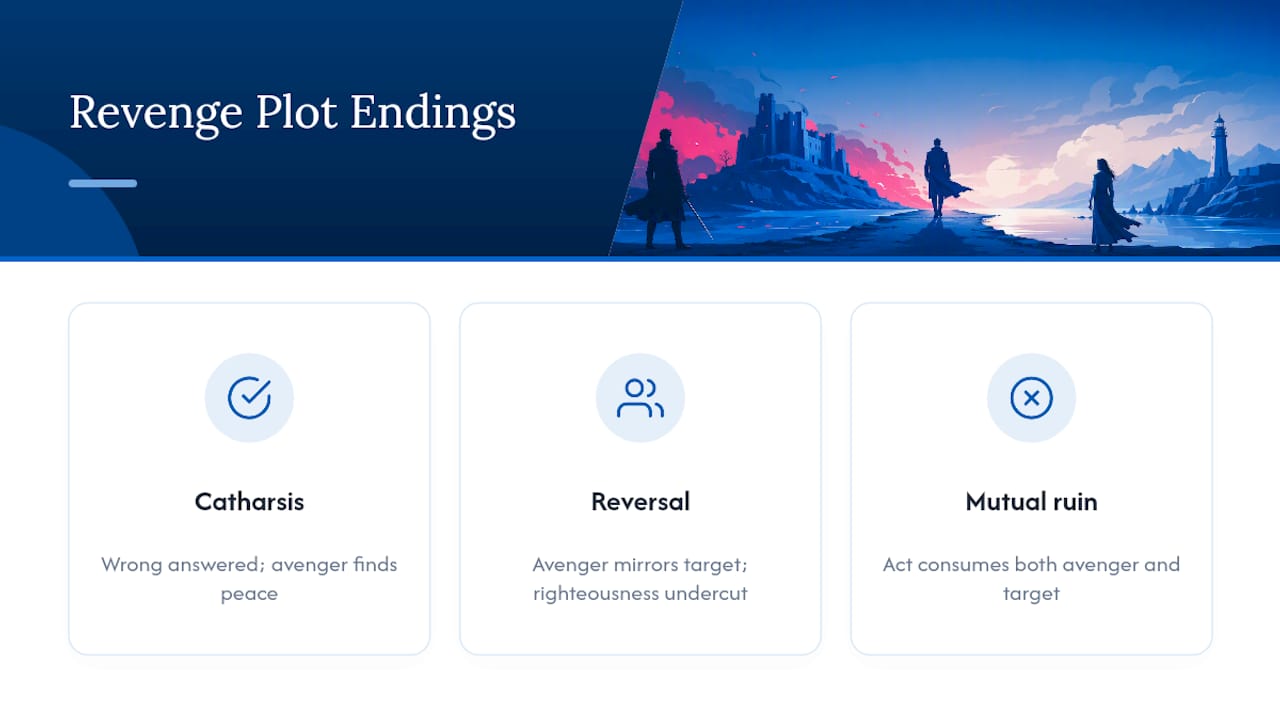
Three endings dominate the genre. The first is catharsis: the wrong gets answered, the avenger finds some peace, and the moral ledger closes, even if imperfectly. The second is reversal: the avenger becomes indistinguishable from their target, undercutting whatever righteousness fueled the original plan. The third is mutual destruction, the ending Hamlet chooses, where the act of vengeance consumes avenger and target alike.
Very few major revenge narratives end with a clean, uncomplicated win. Even The Count of Monte Cristo, often read as a revenge fantasy with a satisfying payoff, ends with Dantès questioning whether he had the right to play judge, jury, and executioner at all. That hesitation at the finish line is almost a genre signature.
What determines which ending a story reaches usually comes down to whether the author treats revenge as a plot device or a thematic argument. Stories that use it as pure motive tend toward the catharsis ending. Stories that use it to interrogate the character’s soul tend toward reversal or mutual ruin, the darker, more literary register where Connors’s own fiction tends to live.
An Editorial Take on Studying Revenge in Fiction
Most study guides treat revenge as a synonym for motive, a box to check before moving on to “real” themes like identity or power. That undersells it badly. Revenge is one of the few themes that forces a character’s morality and a story’s structure to move in lockstep. Every scheme, every delay, every reversal is doing double duty: advancing plot and revealing exactly what a character is willing to sacrifice for the feeling of being made whole again.
Where conventional analysis falls short is treating the “satisfying” ending, the villain getting what’s coming, as the interesting part. It isn’t. The interesting part is the moment right before, when the avenger still has a choice and takes the darker road anyway. That’s where a text tells you what it actually believes about justice, and it’s the passage worth quoting in an essay, not the final confrontation everyone already remembers.
If you’re studying this theme, read backward from the ending. Ask what it cost the character to get there before asking whether they deserved to win.