
We recommend Evolution A200: A Bubonic Apocalypse to readers who want their apocalypse fiction anchored in guilt and consequence rather than gunfire and sprint sequences. The novel’s strongest asset is its focus on one scientist’s culpability as the world unravels. Reception data is thin but positive: a solid Amazon rating exists, though professional critical coverage remains limited.
TL;DR:
- Dr. Katherine Nelson’s decisions during the expedition release the plague, and her attempts to repair the damage, rather than military action, drive the story.
- The novel favors introspection and slow burn dread over constant action, then ends ambiguously, so readers seeking fast pacing or tidy closure may be disappointed.
- Amazon lists a 4.4 out of 5 rating from 33 reviews, but the small sample and limited professional coverage do not establish broad critical consensus.
- The early expedition chapters establish the guilt that drives the novel, so reading them carefully helps preserve the force of Nelson’s later choices.
- Kindle Unlimited subscribers can read the book at no added cost, while Amazon also lists paperback and ebook formats for purchase.
Table of Contents
- What happens in Evolution A200: a spoiler-light synopsis
- Guilt, responsibility, and redemption drive the tension
- How readers and critics have responded so far
- Who will enjoy Evolution A200
- Where to find it: formats and access
- Why Nathaniel Connors’ catalog matters here
- A closer look at the plot without spoiling the ending
- The voice behind the apocalypse
- How it stacks up against other outbreak fiction
- Strengths and weaknesses worth weighing
- Who should pick this book up
- Where this book fits in our catalog
- Ready to start reading Evolution A200
- FAQ
- Sources
What happens in Evolution A200: a spoiler-light synopsis
The story opens with an expedition that goes wrong: a dormant strain of plague escapes containment and begins spreading with the speed and reach of a global emergency. Governments and military units scramble to contain it, but the outbreak outpaces every official response. At the center of the chaos sits Dr. Katherine Nelson, the scientist whose actions during the expedition set the catastrophe in motion.
Rather than following a straightforward survival-horror template, the narrative keeps returning to Nelson’s internal reckoning with what she caused and what, if anything, she can still fix.
The setup delivers familiar apocalypse-genre scaffolding alongside a distinct emotional core:
- A plague escapes during a research expedition and quickly outstrips containment efforts.
- Military and government responses form the backdrop rather than the main event.
- Dr. Nelson’s remorse and attempted corrections drive the plot forward.
- The tone balances large-scale collapse with a tightly focused personal story.
Guilt, responsibility, and redemption drive the tension
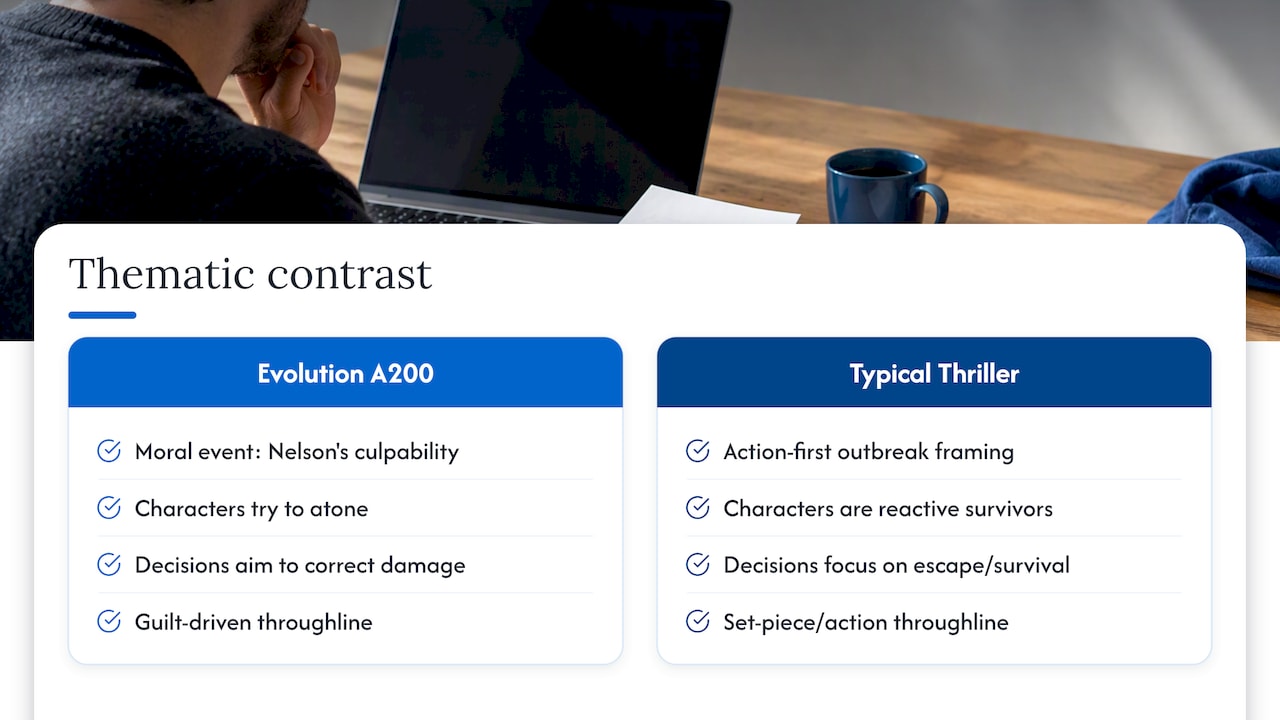
Evolution A200 treats its outbreak as a moral event as much as a biological one. The author’s own framing centers the plague’s release on Dr. Nelson’s culpability, and that choice shapes everything downstream: her decisions are not purely tactical, they are attempts to answer for what she started.
This is where the book diverges from action-first zombie fiction. A typical outbreak thriller treats its survivors as reactive, people dodging threats and improvising weapons. Evolution A200 keeps circling back to responsibility: who caused this, what does atonement look like when the damage is already planetary, and can a single person’s remorse mean anything against a collapsing world.
Readers watching for thematic cues should notice how often Nelson’s choices are framed as attempts to correct rather than simply survive. The novel rewards attention to small decisions, the moments when a character could cut losses and run but instead tries to fix what broke. That pattern is the throughline, more than any specific set piece.
Pro Tip: Read the early expedition chapters slowly. The guilt that fuels the rest of the book is planted there, and skimming it will flatten everything that follows.
How readers and critics have responded so far
Evidence of reception is mixed in source but not in tone. On the retailer side, Amazon lists a 4.4 out of 5 rating from 33 reviews, which signals that people who bought and finished the book tend to rate it favorably.
A 4.4 out of 5 average across 33 Amazon reviews points to a positive but small sample: enough to suggest satisfaction among purchasers, not enough to stand in for broad critical consensus.
A few things worth keeping separate when you weigh this evidence:
- Retailer ratings reflect buyers who chose to review, which skews toward engaged readers.
- Community discussion threads show active reader interest but are not the same as edited criticism.
- No wide body of professional reviews turned up in available coverage, so treat the rating as reader sentiment, not critical consensus.
- A 33-review sample is honest data but still small enough that a handful of reviews can move the average noticeably.
Who will enjoy Evolution A200
This book fits readers who want their horror psychological rather than kinetic. If you finish zombie novels wishing the characters had spent more time wrestling with what they’d done, this is built for you.
- You prefer character studies over body counts and action sequences.
- You enjoy moral ambiguity and slow-burn dread rather than constant immediate threat.
- You don’t mind a protagonist whose guilt is the engine of the plot.
- You’re comfortable with pandemic and outbreak material, since the premise leans into global collapse and its human cost.
Pacing runs closer to introspective than propulsive, so go in expecting a slower burn than typical outbreak fiction.
Where to find it: formats and access
Evolution A200 is available as an ebook and in paperback through its Amazon product listing, with a separate Kindle edition listing for digital readers.
- Ebook and paperback formats are both listed on Amazon.
- Kindle Unlimited subscribers can read the book at no added cost.
- The author’s book page offers a fuller synopsis before you commit to a purchase.
- Readers who like sampling chapters first can also check preview resources from curated horror sites before buying.
Why Nathaniel Connors’ catalog matters here
Dark supernatural fiction often explores what happens inside a person after they’ve caused real harm. That focus runs through The Nether and Stories of a Condemned Soul as much as it does here, which is part of why the thematic weight in this novel feels consistent rather than incidental.
These titles share a commitment to psychological consequence over spectacle, and are accessible to Kindle Unlimited subscribers, which lowers the barrier for readers testing whether this register of horror works.
A closer look at the plot without spoiling the ending
The expedition that triggers the outbreak is deliberately detailed early on, giving readers enough context to understand how a contained research effort turns into a global crisis. From there, the novel splits its attention between the macro scale (governments and military units trying to slow a plague that won’t be slowed) and the micro scale (Dr. Nelson’s attempts to make sense of her role in starting it).
The structure avoids a tidy redemption arc. Instead, it tracks a series of choices Nelson makes under worsening conditions, each one testing whether atonement is even a coherent goal once the damage has gone global. Supporting characters orbit her story less as a cast of equals and more as pressure points: people whose survival or loss sharpens what her guilt actually costs.
Nothing here resolves as cleanly as genre convention might suggest, and the ending leans into ambiguity rather than closure. That choice will frustrate readers who want a clean wrap-up and satisfy readers who came for the moral weight rather than a tidy finish.
The voice behind the apocalypse
The narrative voice stays close to Dr. Nelson’s interiority, favoring reflection over rapid-fire action beats. Sentences tend toward the deliberate, giving guilt and dread room to accumulate rather than rushing past them for the next crisis.
This is a stylistic choice that marks the book as psychological horror first and outbreak thriller second. Readers used to fast-cut, plot-driven pandemic fiction may notice the slower rhythm immediately. Those who enjoy spending time inside a character’s conscience will find the pacing suits the material.
How it stacks up against other outbreak fiction
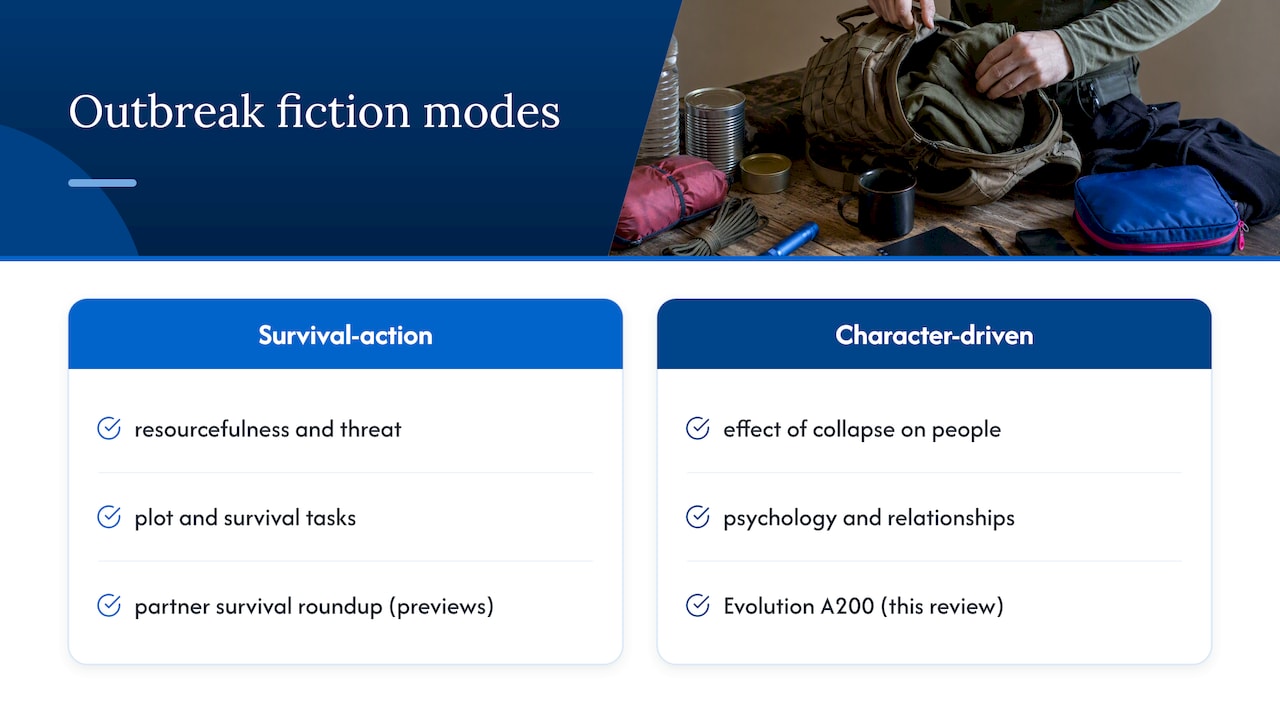
Pandemic and apocalypse fiction tends to split into two camps: survival-action stories focused on resourcefulness and threat, and character-driven stories focused on what collapse does to the people inside it. Evolution A200 sits firmly in the second camp.
Readers who want a wider map of the subgenre can browse our roundup of pandemic apocalypse novels or our look at bubonic plague tropes in fiction for context on how this book’s approach compares to others using similar plague premises. If you’d rather sample a few outbreak titles before committing, this partner roundup of survival horror books offers chapter previews worth checking.
Strengths and weaknesses worth weighing
The book’s clearest strength is its refusal to let the apocalypse overshadow the person who caused it. That choice gives the novel staying power that pure spectacle often lacks.
Its clearest limitation is pacing: readers expecting constant forward motion may find the introspective stretches slow. The small review sample on retailer platforms also means reception data, while positive, is not yet broad enough to call definitive.
Who should pick this book up
Evolution A200 suits adult readers comfortable with dark themes, moral ambiguity, and a protagonist defined by fault rather than heroism. The reading level sits at a standard adult fiction register: no specialized vocabulary, but emotionally dense material that rewards patience over speed-reading.
It is not aimed at readers looking for young-adult-friendly pacing or lighter horror. If graphic consequence and sustained guilt as a narrative engine sound appealing, this book was built for you.
Where this book fits in our catalog
Evolution A200 extends a thread we return to across our work: what a person owes once their actions cause irreversible harm. We wanted the emotional experience here to sit closer to quiet dread than jump-scare horror. Readers who connect with Dr. Nelson’s arc may also want to start The Nether next.
— Nathaniel
Ready to start reading Evolution A200
We keep our catalog built around one idea: horror works best when the monster is partly the person telling the story. Evolution A200 is available in full on our book page, where you can read the complete synopsis before buying, and it’s included at no added cost if you subscribe to Kindle Unlimited.

- Browse our full book catalog if you want to see everything we’ve published.
- Check our dystopian horror roundup for similar reads once you finish.
| If you want | Start here |
|---|---|
| The book itself | Evolution A200 book page |
| More from our catalog | Browse all books |
| A similar psychological read | The Nether |
FAQ
Is Evolution A200 worth reading for horror fans?
It’s worth reading if you prefer psychological and moral horror over action-driven zombie fiction. The 4.4 out of 5 rating from 33 Amazon reviews suggests buyers who finished it responded well, though that sample is still small.
Is Evolution A200 available on Kindle Unlimited?
Yes, Evolution A200 is accessible to Kindle Unlimited subscribers at no added cost, alongside a separate Kindle ebook listing for individual purchase. Paperback and standard ebook formats are also available through its Amazon listing.
Who is the author of Evolution A200?
Evolution A200 was written by Nathaniel Connors, who specializes in dark supernatural fiction exploring guilt, revenge, and redemption. Other titles in the same thematic vein include The Nether and Stories of a Condemned Soul.
Does Evolution A200 have professional critical reviews?
Professional critical coverage for Evolution A200 appears limited based on available searches, with most visible feedback coming from retailer ratings and reader discussion rather than edited review outlets. The Amazon aggregate rating offers the clearest available reader-sentiment signal.
What kind of horror reader will enjoy this book most?
Readers who enjoy character-driven horror with moral ambiguity and slow-burn dread will connect with this book most, since it centers on a scientist’s guilt rather than nonstop survival action. If you want constant action over introspection, the pacing may feel slower than expected.