
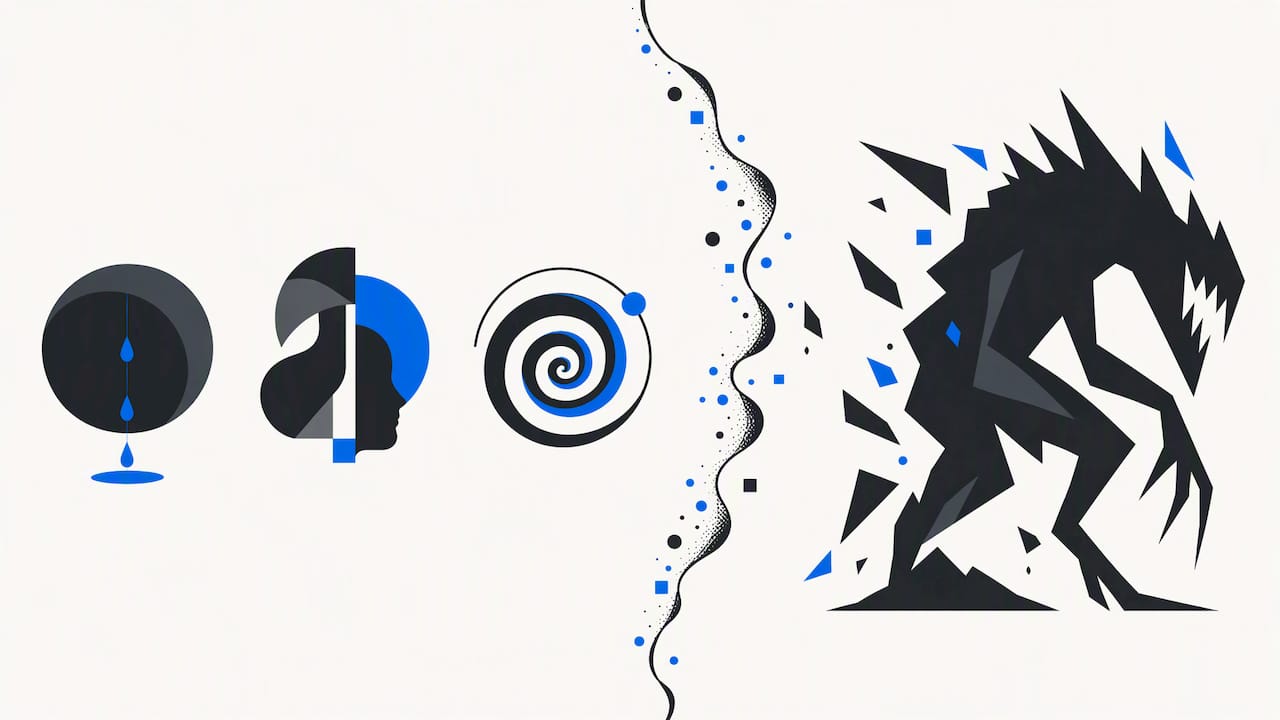
Internal monsters are psychological forces: guilt, trauma, compulsion, and the quiet logic of a mind turning against itself. External monsters are physical or visible threats: the creature in the house, the virus in the blood, the villain at the door. The most memorable horror rarely picks one. It fuses both, letting a visible threat carry the weight of an invisible one.
TL;DR:
- Cohort research linked external locus of control to later depressive symptoms and experiences resembling psychosis across different cohorts, although beliefs about control shift with context.
- Four studies found monsters with mismatched cognition and emotion elicited higher fear ratings, partly because people perceived them as less controllable.
- Draft the monster’s mind before its body, echo the character’s wound through sensory traits, and delay the reveal until that wound is clear.
- Stories can cast society and institutions as monsters, while Frankenstein and Sweet Home make physical forms embody abandonment, shame, desire, and trauma.
Table of Contents
- What Counts as an Internal Monster and What Counts as an External One
- Locus of Control, Trauma, and How Internal Monsters Form
- Monster Theory and Classic Literary Cases
- Why Some Monsters Feel Scarier: the Imbalanced Mind
- Practical Techniques for Writing Internal and External Monsters
- An Author’s Take on Internal and External Monsters
- Where to Start Reading This Fusion of Fear
- FAQ
- Sources
What Counts as an Internal Monster and What Counts as an External One
An internal monster lives in the mind. It can be guilt that resurfaces as hallucination, a compulsion the character cannot name, or a trauma response that distorts how they read the world. An external monster lives in the world. It has a body, a location, and a set of rules a character can theoretically fight, flee, or negotiate with.
A rough taxonomy helps when reading or writing:
- Psychological monsters: repressed memory, addiction, dissociation, or moral corrosion that the character carries internally.
- Symbolic or social monsters: a community, institution, or ideology that behaves monstrously toward individuals.
- Physical monsters: creatures, infections, or supernatural entities with a tangible presence in the story’s world.
- Villains: human antagonists whose menace is external but whose motives often trace back to internal wounds.
Mary Shelley’s creature in Frankenstein is the classic case that supports both readings at once: a physically monstrous being whose menace is inseparable from Victor Frankenstein’s parental abandonment. Some contemporary stories update this pairing, turning trauma and desire into literal monstrous transformation, so that each creature design mirrors a specific psychological wound. The telltale signal for readers and writers alike: ask whether removing the physical threat would still leave a story, or whether the fear collapses without it.
Locus of Control, Trauma, and How Internal Monsters Form
Internal monsters are built from recognizable psychological mechanics, and locus of control is one of the clearest. Psychology Today defines locus of control as the degree to which people believe outcomes stem from their own actions (internal locus) versus chance, fate, or other people (external locus), noting that internal locus tends to track with greater well-being while external locus tracks with higher stress.
This is not just a feel-good distinction. Cohort research published in Frontiers in Psychology found that an externalized locus of control is prospectively associated with later reports of psychotic-like experiences and depressive symptoms, and that this association held across different cohorts and ages.
An externalized locus of control predicts later depressive symptoms and psychotic-like experiences across multiple cohorts, according to Frontiers in Psychology, which gives writers a grounded reason to make a character’s sense of agency, or lack of it, central to how their internal monster takes shape.
A few things to keep in mind when applying this to character work:
- Locus of control sits on a continuum, not a binary; most people shift position depending on the situation.
- Cultural context and immediate circumstance can modulate how externality expresses itself.
- A character who believes they have no control over their fate is narratively primed for an internal monster to take root.
Monster Theory and Classic Literary Cases
Literary scholarship gives this pattern a name. Jeffrey Jerome Cohen’s monster theory frames monsters as boundary objects: figures that mark the edge of what a culture considers human and absorb whatever a society needs to exclude to define itself. Analysis building on this framing treats monsters as abjected fragments that mediate between consciousness and the unconscious, a kind of psychopomp that carries repressed material across the line into visible form.
Frankenstein remains the case study scholars return to most. A thesis examining monster construction in horror and slave narratives reads the creature as a figure that exposes Victor’s failure as a parent and society’s failure to extend compassion to what it finds unfamiliar. The physical monstrosity is the vehicle; the psychological and social failure is the cargo.
A short map of how this plays out across texts:
- In Frankenstein, the creature’s body externalizes Victor’s abandonment and shame.
- In Sweet Home, each character’s monstrous transformation literalizes a specific desire or trauma they could not face while human.
- In dystopian fiction more broadly, a society can itself become the monster, with institutions standing in for the internal corruption of the individuals who run them.
Reading for this pattern changes how a story lands. Once you notice that the monster is doing double duty, the plot stops being only about survival and starts being about what the character, or the culture, refuses to look at directly.
Why Some Monsters Feel Scarier: the Imbalanced Mind
Empirical psychology backs up what writers have long sensed by instinct. Research from Preston et al. proposes the imbalanced-mind hypothesis: agents perceived as having mismatched cognition and emotion are rated as scarier, because they seem less predictable and harder to control.
Fictional monsters, animals, and infected humans perceived as imbalanced on cognition and emotion elicited higher fear ratings across four studies, with controllability partly explaining the effect.
Reduced perceived controllability is one of the mechanisms linking an imbalanced mind to higher fear ratings, according to the Warwick-hosted study, which means a monster that thinks clearly but feels nothing, or feels intensely but reasons unpredictably, reads as more dangerous than one that is simply strong or fast.
This connects directly back to internal versus external monsters. An internal pathology, untreated grief, dissociation, an unresolved compulsion, can produce exactly this kind of imbalance in a character’s mind. When that imbalance gets externalized into a visible threat, the result is a monster whose unpredictability feels earned rather than arbitrary, because the reader has already seen the psychological seams where the imbalance began.
Practical Techniques for Writing Internal and External Monsters
Craft follows directly from the theory above. A few techniques show up again and again in horror fiction that successfully fuses psychological and physical threat:
- Interior unreliability: let the narrator’s perception drift just enough that readers question whether the external threat is real, amplified, or partly imagined.
- Sensory mirroring: design the external monster’s traits (a smell, a sound, a texture) to echo a specific trauma the character is avoiding.
- Delayed reveal: withhold the monster’s full form until the psychological wound driving the story is already visible, so the reveal lands as confirmation rather than surprise.
- Doubling: give the external monster a clear parallel to the protagonist, so defeating or failing to defeat it reads as a verdict on the character’s internal struggle.
- Sentiment mismatch: have the monster express calm where fear is expected, or distress where calm is expected, to manufacture the imbalance that research ties to higher fear.
Each of these works best when shown through behavior and consequence rather than stated outright. A character does not need to announce their guilt; the story can stage its results and let the reader draw the line.
For deeper craft breakdowns, our guide on how to write psychological horror walks through pacing and reveal structure, and our comparison of psychological thriller versus horror is useful for deciding how much of the monster should stay internal versus externalized on the page.
Pro Tip: Draft your monster’s “mind” before you draft its body: decide what it thinks and feels first, then design its physical traits to make that imbalance visible.
An Author’s Take on Internal and External Monsters
The writing aims toward the moment where a character’s private wound becomes impossible to hide, because that collision is where horror earns its weight. A story about a creature is rarely only about the creature. The collapse witnessed in some stories is inseparable from what the characters have buried long before the external threat arrives. Further craft notes and fiction illustrating this fusion can be found on related sites.
— Nathaniel
Where to Start Reading This Fusion of Fear
If you want to see internal and external monsters working together on the page, The Nether follows characters whose private guilt shapes how they read, and survive, a collapsing world. Evolution A200: A Bubonic Apocalypse pushes the same idea further, turning a literal outbreak into a mirror for the breakdown already happening inside its characters.
Both titles, along with the rest of our books, are free to read for Kindle Unlimited subscribers. If you want more curated psychological horror while you wait for your next read, our partners at Lorraine Cunningham’s horror and thriller previews let you browse by mood and preview chapters before you commit.
FAQ
What is internalism vs externalism?
In philosophy and psychology, internalism holds that the justification or cause of a belief or behavior comes from within the mind, while externalism holds that factors outside the mind, environment, other people, or events, play a determining role. In horror fiction, this maps loosely onto internal monsters (psychological causes) versus external monsters (environmental or physical causes).
Can you give me an example of externalism?
A clear example is locus of control: a person with an external locus attributes their outcomes to chance, fate, or other people rather than their own choices. In fiction, an external monster such as a creature or a hostile institution embodies this same idea by placing the source of danger outside the character entirely.
What is the difference between internal and external beliefs?
Internal beliefs are grounded in a person’s own reasoning, values, or self-assessment, while external beliefs are shaped by outside authority, circumstance, or social pressure. This distinction echoes the internal versus external locus of control described by Psychology Today, where internal belief in one’s own agency tends to track with better well-being.
What is active externalism?
Active externalism is a philosophical position suggesting that external tools, objects, or environmental features can function as part of a person’s cognitive process, not just as influences on it. It is a distinct philosophical concept from narrative “external monsters,” though both share the idea that something outside the self can shape or extend internal experience.
Sources
- Locus of Control | Psychology Today
- Minds of monsters: scary imbalances between cognition and emotion (Preston et al., 2023)
- The association between locus of control and psychopathology
- The monster within and without: identity assignment and construction in slave narratives and horror fiction