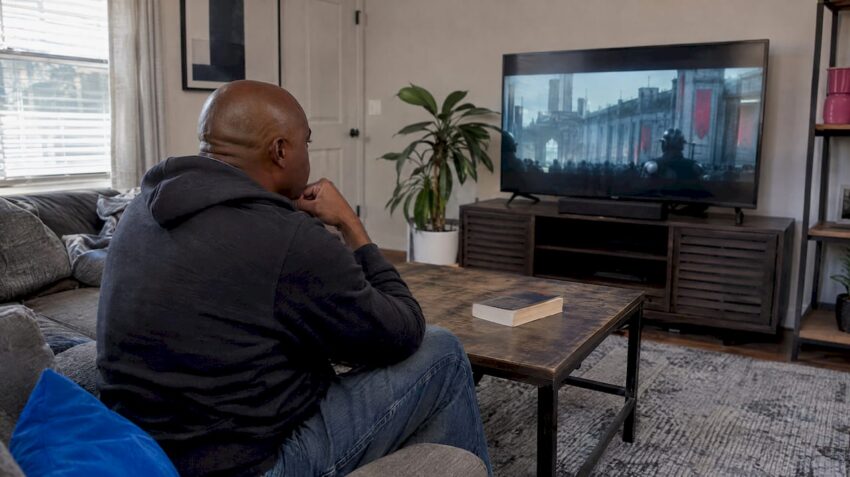
The best dystopian adaptations send you back to the page, because film shows a broken society while a novel puts you inside the mind living in it. If you came for the movies, this guide covers which dystopian novels have been filmed, how the films differ from the books, and which ones capture the psychological weight. If you like that weight, the dark dystopian fiction in Nathaniel Connors’s books is free to read with Kindle Unlimited.
TL;DR
- Orwell, Golding, Matheson and Boulle top the list of most-adapted dystopian novels, and some have been filmed many times over.
- Close adaptations keep the plot. Psychological depth is what usually gets trimmed, because interior thought is hard to film.
- Films such as the later Hunger Games installments and Never Let Me Go earn praise for how they show trauma and quiet cruelty on screen.
- Dystopian stories sort by theme: government control, class, technology, conformity, the environment.
- If the book is where you want to live, start with the novels built around guilt, revenge and the psychological monsters in us.
Table of Contents
- Dystopian novels that became movies
- What the screen keeps and what it loses
- Adaptations that capture psychological depth
- Themes: which society is the nightmare?
- Dystopian novels still heading to the screen
- How to pick between reading and watching
- Where to read dystopian horror with the same depth
- Our view: the book is where dystopia gets personal
- FAQ
- Sources
Dystopian novels that became movies
Dystopia has been a screen staple for decades. Word & Film ranks 16 dystopian novels with two or more screen adaptations. At the top is Pierre Boulle’s Planet of the Apes (1963) with nine adaptations, followed by Orwell’s Nineteen Eighty-Four (1949) with five. Lord of the Flies (1954) and I Am Legend (1954) each have four. The rest of that list includes:
- The Time Machine
- Atlas Shrugged
- Animal Farm
- Brave New World
- The Handmaid’s Tale
- A Clockwork Orange
- Altered Carbon
- Fahrenheit 451
- The Prize of Peril
- The Running Man
- The Stand
- We
That is only the count of the repeat offenders. A wider catalog at Movies vs Books tracks 48 dystopian films and series drawn from novels and comics. Some entries you may know:
| Film | Source | What the story sets up |
|---|---|---|
| V for Vendetta (2005) | Graphic novel by Alan Moore and David Lloyd | A 2027 where the US has fractured in a second civil war |
| The Hunger Games (2012) | Suzanne Collins, 2008 | Twelve districts each send two tributes, aged 12 to 18, to fight to the death |
| A Clockwork Orange (1971) | Anthony Burgess, 1962 | A violent youth leader is offered a state procedure that strips his agency |
| Blade Runner (1982) | Philip K. Dick’s Do Androids Dream of Electric Sheep? | A retired cop is pulled back in, in a 2019 Los Angeles |
| Never Let Me Go (2010) | Kazuo Ishiguro | Children raised at a boarding school with a hidden purpose |
| The Giver | Lois Lowry | A community that has given up memory and feeling |
If you want more titles in the same vein, dystopian books recommended on podcasts shows what listeners and hosts keep returning to.
What the screen keeps and what it loses
The question behind most book-to-film arguments is fidelity. How close is close enough, and what disappears when a novel gets a camera?
Some adaptations stay faithful until the final minutes. The Mist closely follows Stephen King’s novella, but Collider notes that the film ends in devastation where the novella leaves a glimpse of hope. The same guide says Bird Box keeps the broad plot of Josh Malerman’s novel but changes characters, plot devices and the ending. On screen the sanctuary is a school for the blind. In the book it houses people who gouged out their own eyes, which is a darker place to end up. The Giver is described as accurate to Lowry’s book with small shifts: Jonas is younger in the novel, and the book leaves it ambiguous whether he restores memory to his community.
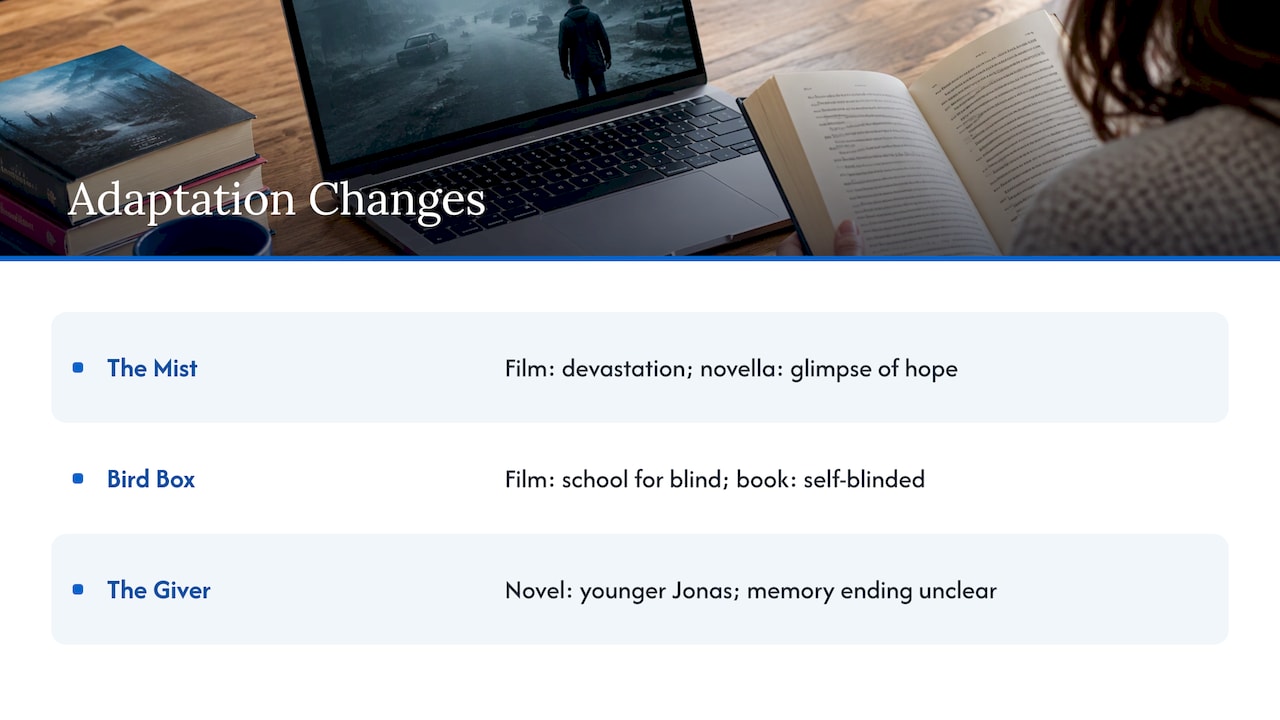
The pattern is consistent. Plot survives. Ambiguity gets resolved, endings get adjusted, and the narrator’s private thoughts become dialogue or voiceover.
The oldest case is Orwell. A Lancaster University article on adapting 1984 records that Michael Anderson’s 1956 film was dismissed as Cold War propaganda without the novel’s intricacy, and that Michael Radford’s later film was called a “museum piece.” It also relays one critic’s argument that satire suits cinema poorly, since film is sensory and invites quick identification while satire is cerebral and indirect. The same article applies a useful idea from adaptation studies: an adaptation is repetition without replication. Judge the film as its own reading of the book, not as a photocopy.
For a reader who loves a novel for its inner life, that is the whole case for reading the book as well as watching the film. The adaptation gives you the world. The page gives you the person trapped in it.
Adaptations that capture psychological depth
Some films do manage the interior. They are worth knowing if what you want from dystopia is character, not spectacle.
The Hunger Games finale
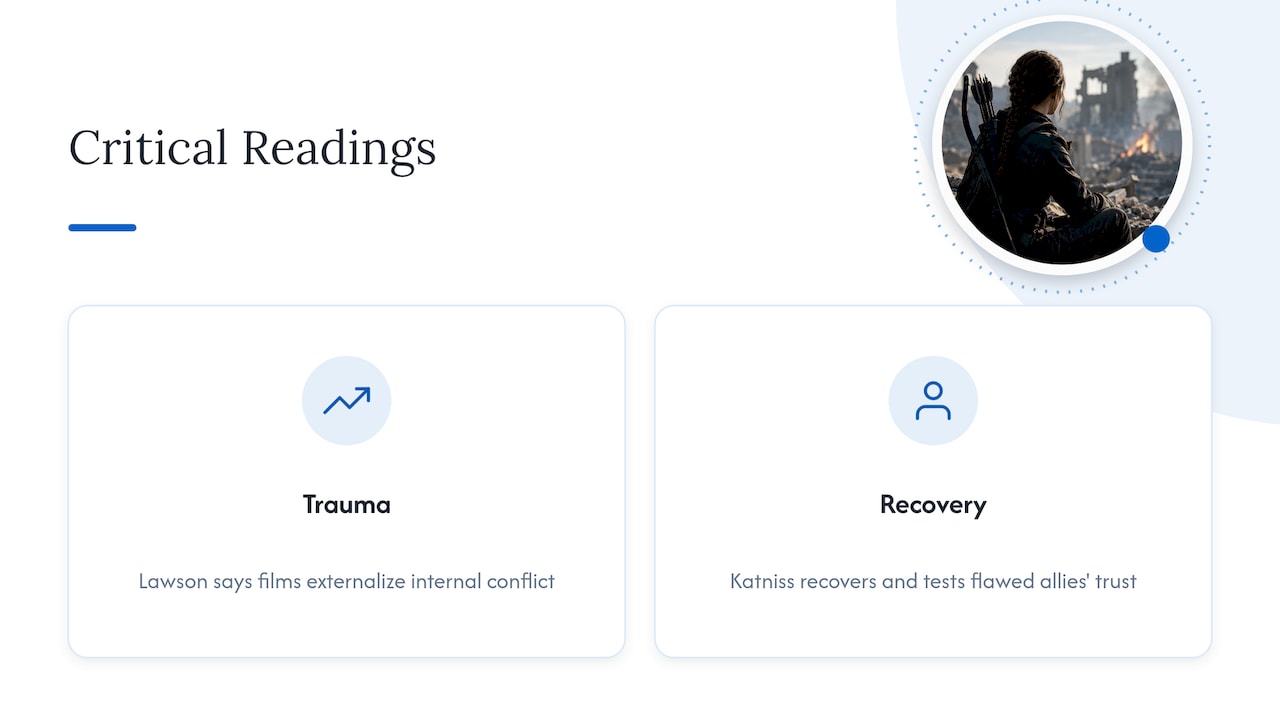
Few expect a blockbuster franchise to be an exploration of trauma, but critics have argued exactly that. Vanity Fair’s Richard Lawson called Mockingjay: Part 2 a rare adaptation that improves on its source. In his reading, the films deal with youth in war, PTSD and the habit of giving autonomy up for comfort and spectacle, and they say it more clearly than the book. He credits screenwriters Peter Craig and Danny Strong with externalizing the book’s internal-monologue conflict.
Film Comment’s Michael Sragow describes Mockingjay, Part 1 as an epic of inaction. Its power, he writes, comes from Jennifer Lawrence embodying “heroic confusion” as Katniss recovers from what she lived through and learns how far she can trust her flawed allies. That is a psychological portrait dressed as a franchise film.
Never Let Me Go
Mark Romanek’s adaptation of Ishiguro’s novel is quiet to the point of dread. The New York Times review notes that the film reveals its secrets slowly and scatters hints with care, much as Ishiguro does. The film follows Kathy, a “carer,” as she remembers growing up at Hailsham with Tommy and Ruth, children given peculiar instruction about their future as organ donors. The review points to young adults casually swiping metal bracelets like electronic leashes, a nonchalance that gives the viewer pause. The horror is in how calm everyone is.
Divergent
A Lancaster University piece on young adult dystopian cinema explains Divergent’s setup: a walled future Chicago where citizens choose at 16 among five virtue-based factions after an aptitude test. It argues the film leaves the audience feeling loss rather than freedom as the faction system collapses.
Themes: which society is the nightmare?
A good way to choose what to watch or read is by the fear underneath. WIRED’s “Dystopia 101” groups important dystopian books and films by theme:
- Environmental collapse: Atwood’s MaddAddam trilogy.
- Class inequality: Elysium, Octavia E. Butler’s Parable of the Talents, Metropolis.
- Corrupt government: The Hunger Games, V for Vendetta, Battle Royale.
- Capitalism and complacency: The Machine Stops, Soylent Green (from Make Room! Make Room!), The Giver, Divergent.
- Gender and age inequality: Children of Men, Logan’s Run.
Those labels are a helpful map, and the same book can sit under several. If you are sorting out where dystopia ends and the apocalypse begins, our guide to dystopian versus post-apocalyptic fiction draws the line, and six dystopian subgenres explained goes further. For stories that press on conscience, see our list of dystopian ethics books.
Dystopian novels still heading to the screen
The pipeline never stops. Variety reported that Lionsgate announced a film of Suzanne Collins’s Sunrise on the Reaping at the same time as the book’s 2025 release. It follows a young Haymitch Abernathy in the 50th Hunger Games. Producer Nina Jacobson said the team already had a draft and locations established before the book came out, which she called a very different process from earlier films. Lionsgate’s official Hunger Games page is the place to check where the franchise stands.
Screen Rant’s roundup of upcoming sci-fi book adaptations mentions three more:
- William R. Forstchen’s One Second After, about an electromagnetic pulse attack on America, is moving back toward a feature film.
- Neill Blomkamp is set to write and direct a new Starship Troopers closer to Heinlein’s novel.
- Bradley Cooper is spearheading a Hyperion adaptation.
Release windows shift, so confirm current dates on the studios’ own pages.
The lesson for readers is practical: when a dystopian novel is announced for the screen, the book is the only version you can read before the film changes it.
How to pick between reading and watching
A simple rule works well.
- Watch first when the book’s strength is its world and plot. The visuals add something, and you lose little.
- Read first when the book’s strength is a voice, a guilty conscience or an unreliable mind. The film will have to guess at what the page said outright.
- Do both when the ending differs. The mismatches between The Mist or Bird Box and their sources make the pair more interesting than either alone.
If you want the page to hit harder, start with shorter reads. Our list of short dystopian novels for one-sitting dread and best dystopian horror novels are built for exactly that. If you prefer to see a story first, our dystopian short films for classrooms are a quick way to feel the genre.
Where to read dystopian horror with the same depth
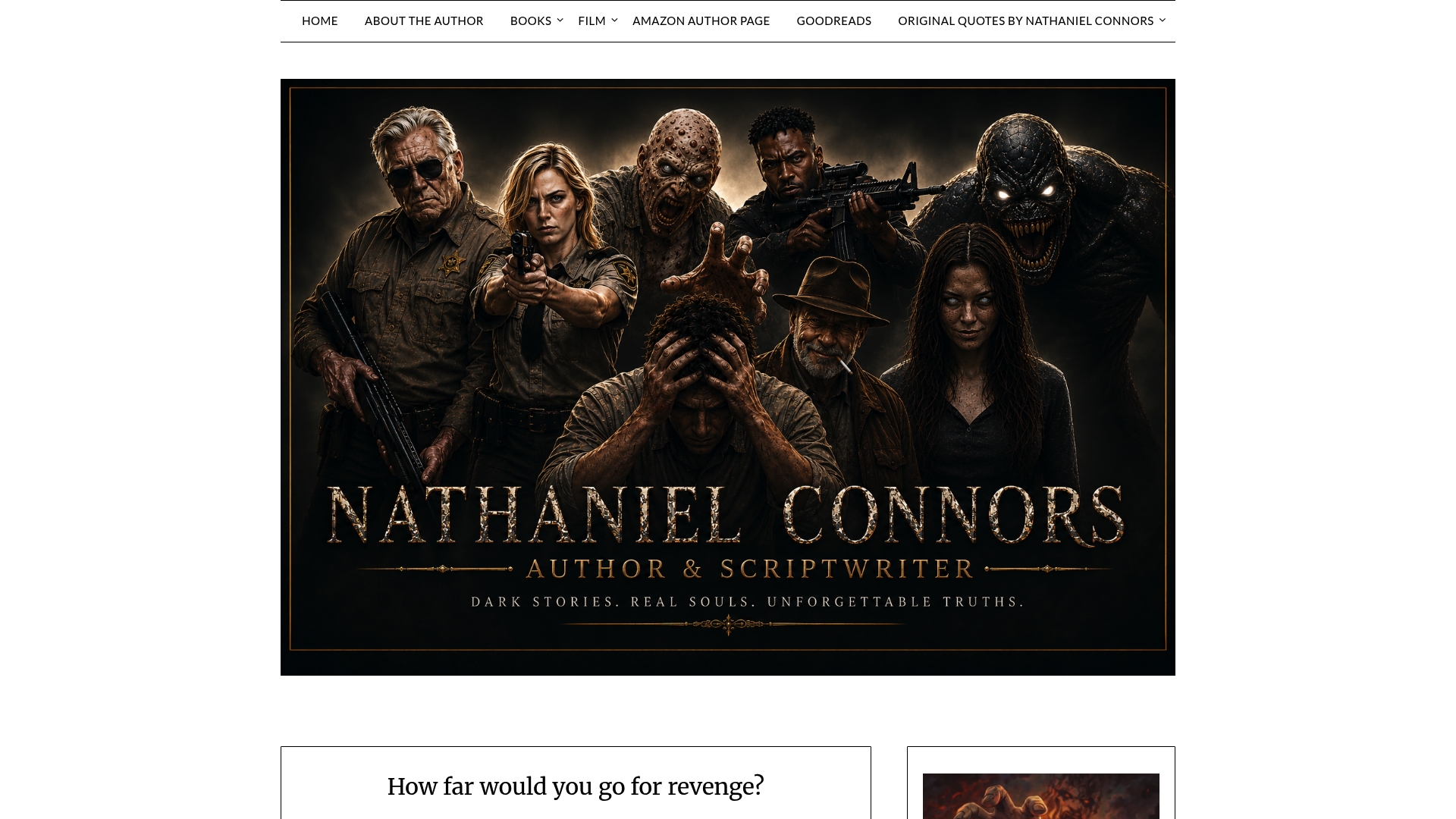
Nathaniel Connors writes dark supernatural fiction and dystopian horror about revenge, guilt and redemption, with the psychological monsters inside us at the center. The Nether and the Evolution A200 books, including Evolution A200: A Bubonic Apocalypse, are available in ebook and paperback on Amazon and free to read for Kindle Unlimited subscribers. Browse The Nether series and the EA200 series, or start with The Nether.
If you already subscribe, our Kindle Unlimited tips show how to get more from the membership.
Our view: the book is where dystopia gets personal
We love a good adaptation. A film can make a collapsing society visible in a way no paragraph can, and the ones that earn praise, like the later Hunger Games films, do it by finding a human face for the damage.
But the stories that stay with us are the ones where the monster is in the narrator. Revenge that curdles, guilt that will not leave, a chance at redemption that costs more than anyone expected. That is the territory of our books, and it is why we write them as novels first. A page can hold a thought a camera cannot.
That is also why we pay attention to how films handle interior life. When an adaptation gets trauma right, it is borrowing the novelist’s tools. When it cannot, the book is waiting. Our work is written for the reader who wants to stay in that dark room a little longer, and Kindle Unlimited makes it easy to step inside.
Nathaniel
FAQ
What dystopian books have been turned into movies?
Many. The most adapted include Planet of the Apes, Nineteen Eighty-Four, Lord of the Flies and I Am Legend, according to Word & Film’s ranking. Others include The Hunger Games, A Clockwork Orange, Fahrenheit 451, The Giver, Divergent and Never Let Me Go.
Which dystopian adaptation is the most psychological?
Critics single out Never Let Me Go for its quiet, slowly revealed cruelty, and the later Hunger Games films for their treatment of trauma. Both are discussed above, with links to the reviews.
Are the movies faithful to the books?
Usually on plot and often not on endings. The Mist and Bird Box change their conclusions, and The Giver shifts small details such as Jonas’s age. Adaptation scholars generally treat a film as its own reading of the book, not a copy.
What dystopian novels are being adapted next?
Lionsgate announced a film of Sunrise on the Reaping, and projects such as One Second After, Starship Troopers and Hyperion have been reported in development. Check the studios’ official pages for current status.
Where can I read dystopian horror on Kindle Unlimited?
Nathaniel Connors’s books, including The Nether and Evolution A200: A Bubonic Apocalypse, are free to read with a Kindle Unlimited subscription. Start on the books page.
Sources
- Most Adapted Dystopian Fiction Books, Word & Film
- Dystopian movies and TV series based on books and comics, Movies vs Books
- The Hunger Games and 9 Other Dystopian Films Based on Books, Collider
- Adapting George Orwell’s 1984, Lancaster University
- Mockingjay: Part 2 Review, Vanity Fair
- Deep Focus: The Hunger Games: Mockingjay, Part 1, Film Comment
- Growing Up in a Hush, With the Ultimate Identity Crisis, The New York Times
- Young Adult Dystopian Cinema, Lancaster University
- The 10 Most Important Dystopian Books and Films of All Time, WIRED
- Sunrise on the Reaping movie producer interview, Variety
- The Hunger Games, Lionsgate
- 8 Most Exciting Upcoming Sci-Fi Movies Based on Books, Screen Rant
- Dystopian fiction recommended on podcasts, podshelf