Dystopian horror means a story where the social system itself is the source of dread, not a masked killer or a haunted house. It differs from plain dystopia, which critiques oppressive systems through the lens of politics and loss of freedom, and from pure horror, which usually locates the threat in a body, a ghost, or a monster. Dystopian horror fuses both: the government, the corporation, or the machine becomes the monster, and the terror is visceral because it’s administered like policy. Margaret Atwood’s The Handmaid’s Tale works this way. The theocracy isn’t background noise. It’s the thing that reaches into your body and controls it.
- A regime, algorithm, or institution replaces the traditional monster
- The dread is bodily and immediate, not just intellectual or political
- Escape is blocked by law, surveillance, or bureaucracy rather than geography
Key Takeaways
Dystopian horror works because it converts systemic critique into bodily dread, making institutional harm feel as immediate as a monster’s attack.
| Point | Details |
|---|---|
| Core definition | Dystopian horror turns oppressive systems into the source of visceral, bodily fear. |
| Dystopia’s focus | Society-level control, surveillance, censorship, and scarcity drive the critique. |
| Horror’s focus | Immediate, sensory dread through body horror, psychological terror, or cosmic fear. |
| The crossover mechanic | Policy and procedure get routed through the body until abstraction becomes unbearable. |
| Quick identification test | Check whether the source of fear has a job title and whether refuge is blocked by law. |
Table of Contents
- Defining Dystopian Fiction and Its Core Motifs
- What Horror Actually Means as a Genre
- Dystopia vs. Horror: Systemic Critique vs. Visceral Threat
- How the System Becomes the Monster
- Dystopian Horror in Literature, Film, and TV
- Why the Crossover Matters
- A Quick Checklist for Spotting Dystopian Horror
- Nathaniel Connors on Why This Subgenre Sticks
- Explore More Dystopian Horror to Read Next
- Where the Genre-Blend Argument Actually Lands
- Sources
Defining Dystopian Fiction and Its Core Motifs
A dystopian novel, according to Britannica, depicts a society defined by oppressive control, a false promise of perfection, and the erosion of individual freedom, usually as a pointed critique of real political or cultural patterns. Merriam-Webster narrows the definition further: a dystopian world or society is one where people live dehumanized, fearful lives. Neither definition requires monsters or gore. Dystopia can be entirely bloodless and still be devastating, because the horror is structural.
What separates a compelling dystopia from a lazy one is how specifically it commits to its motifs. Wikipedia’s overview of the genre catalogs the recurring building blocks, and most great dystopian fiction leans on several at once:
- Totalitarian control — a single party or leader dictates behavior, as in George Orwell’s Nineteen Eighty-Four.
- Surveillance — constant monitoring erodes privacy, the engine behind 1984’s telescreens.
- Censorship — information gets erased or rewritten, the entire premise of Ray Bradbury’s Fahrenheit 451.
- Loss of individuality — citizens are stripped of names, choices, or identity, as in Lois Lowry’s The Giver.
- Environmental degradation — a ruined ecology forces desperate social arrangements, seen in Paolo Bacigalupi’s The Water Knife.
- Scarcity — resource shortages justify brutal rationing systems, central to Suzanne Collins’s The Hunger Games.
- Propaganda — the state manufactures consent through slogans and manipulated narrative, a hallmark of Orwell’s Ministry of Truth.
These motifs alone don’t produce horror. They produce critique. Horror needs something else layered on top, and that’s where the second genre enters the conversation.
What Horror Actually Means as a Genre
Horror is built to produce fear in the reader’s body, not just in their head. Where dystopia argues a point about power, horror wants your pulse to spike. That distinction shows up in three overlapping registers writers and critics use to describe the genre:
- Body horror targets the physical: mutation, disfigurement, loss of bodily control, the stuff that makes skin crawl.
- Psychological horror works through dread, paranoia, and the slow collapse of a character’s sense of reality.
- Cosmic or existential horror exploits the fear of insignificance, of forces too vast or alien to reason with.
Horror prioritizes the immediate. A dystopia can spend a hundred pages building a bureaucratic case against a regime. Horror doesn’t have that patience. It wants a hand on the back of your neck in the first chapter, sensory and specific: the sound in the walls, the thing under the skin, the smell of something wrong.
Endings matter too. Horror rarely resolves clean. Characters survive, but they’re marked. Trauma lingers past the last page, and the shock of the final scene often matters more than any neat resolution. That’s a different emotional contract than dystopian fiction typically makes, which brings the two genres into direct contrast.
Dystopia vs. Horror: Systemic Critique vs. Visceral Threat
The cleanest way to separate the two genres is by asking where the camera points. Dystopia points at the system. Horror points at the body. Both genres map catastrophe, just from different altitudes: dystopia sketches the architecture of oppression, while horror delivers the immediate cost of standing inside it.
Three axes make the split concrete:
- Scale. Dystopia operates at the level of society, laws, and institutions. Horror usually narrows to an individual or a small group facing a threat that doesn’t care about policy.
- Source of the threat. In dystopia, the antagonist is a structure: a party, a corporation, an algorithm. In horror, it’s a monster, a haunting, a disease, or a body turning against itself.
- Narrative payoff. Dystopian fiction tends to end on revelation or critique. It wants you to see the machine clearly. Horror tends to end on catharsis or unresolved terror. It wants you to feel the machine’s teeth.
A quick example of each axis in action: Brave New World critiques a society engineered around comfort and control, which is scale and structure without much bodily terror. The Texas Chain Saw Massacre is almost pure horror, all threat and no system commentary. The Handmaid’s Tale sits in between, using the state’s legal machinery to inflict direct bodily harm on its narrator, which is where dystopian horror actually lives.
Pro Tip: Check the point-of-view and the pacing of dread. If the tension builds through paperwork, checkpoints, and rules, you’re reading dystopia. If it builds through sensory detail and physical vulnerability, you’re reading horror. If both are happening at once, on the same page, you’ve found dystopian horror.
How the System Becomes the Monster
Analytic writing on the subgenre describes this crossover as societal horror: a mode where bureaucracy, surveillance, and institutional violence generate the same kind of dread usually reserved for monsters. The mechanism is specific. A writer takes a policy, a procedure, or a law, and routes it through a human body until the abstraction becomes unbearable to read.
Several devices recur across the subgenre:
- Institutionalized body horror — medical or legal procedures performed on citizens as a matter of routine, not violence, which makes them worse.
- Medicalized violence — harm delivered through clinics, treatments, or “corrective” programs rather than weapons.
- Administered transformation — a character changed, sterilized, or reprogrammed by official process rather than a curse or a virus.
- Deceptive utopia — a society that looks peaceful on the surface, with the horror hidden in what happens to anyone who steps out of line.
The most unsettling image in dystopian horror is rarely a creature. It’s a waiting room, a form to sign, a procedure scheduled for Tuesday. The horror comes from how ordinary the violence is allowed to look.
That’s the trick writers in this space use again and again: put policy inside the body, and the reader can’t look away from the paperwork anymore. Atwood does this with the Ceremony in The Handmaid’s Tale, where state-sanctioned assault is dressed in ritual language. The horror isn’t hidden. It’s scheduled.
Dystopian Horror in Literature, Film, and TV
- The Handmaid’s Tale (Margaret Atwood) pairs totalitarian religious control with direct bodily violation, making the state’s laws the actual monster.
- Nineteen Eighty-Four (George Orwell) uses surveillance and psychological torment (Room 101) to turn state control into something felt in the body, not just observed from outside.
- Black Mirror (various episodes), especially “White Bear” and “White Christmas,” turns social punishment and technology into instruments of prolonged bodily and psychological suffering.
- The Platform (2019 film) confines characters in a vertical prison where scarcity and institutional rules produce cannibalism and physical desperation, a direct fusion of dystopian scarcity and body horror.
- Annihilation (Jeff VanderMeer) blends environmental collapse with cosmic body horror, as an unexplained zone rewrites human biology from the inside out.
- Severance (Apple TV+) uses a corporate procedure that splits a worker’s consciousness in two, turning workplace policy into a form of psychological horror about identity and consent.
Each example earns its place because the system and the body are inseparable. Remove either half and the horror collapses into something else entirely, a straight thriller or a clean political allegory.
Why the Crossover Matters
Making a system feel bodily is what gives dystopian horror its urgency. Readers can nod along with an essay about surveillance overreach and forget it by dinner. It’s much harder to forget a scene where surveillance results in a specific character losing something physical and irreversible. That’s the emotional leverage the subgenre exploits, and it’s why it tends to outlast pure political allegory in a reader’s memory.
The subgenre also asks something specific of its audience:
- Sustained discomfort rather than a quick scare and release
- Ethical reflection on how ordinary people participate in harmful systems
- Recognition that institutional violence rarely announces itself as violence
That demand comes with responsibility on the writer’s side. Depicting systemic violence for shock value alone, without the structural logic that makes it dystopian, just becomes exploitative horror wearing a political costume. The best work in this space treats the system’s cruelty as something to be understood, not just survived.
A Quick Checklist for Spotting Dystopian Horror
- Is the source of fear institutional? A law, a company, or a government agency, not a lone creature.
- Is bodily harm tied to policy? The violence follows procedure, paperwork, or protocol.
- Is refuge denied by law rather than geography? Characters can’t simply run; the system follows them.
- Does the tone shift between clinical and visceral? Bureaucratic language sits next to sensory, physical dread.
Applied example: a story where a government “resettlement program” turns out to be a covert medical experiment checks every box above.
Pro Tip: If you can’t tell whether a scene is dystopian or horror, check who’s holding the clipboard. If the monster has a job title, you’re likely in dystopian horror territory.
Nathaniel Connors on Why This Subgenre Sticks
What draws me to dystopian horror is the moment a reader realizes the villain has an org chart. There’s no monster to defeat, only a system that keeps functioning whether you fight it or not, and that’s a harder kind of fear to shake. My own work leans into that same territory, where guilt and institutional harm get tangled together in a body that can’t escape either.
- Start with Best Dystopian Horror Novels: 8 Haunting Reads for 2026 for a curated entry point
- Compare related subgenres in Dystopian vs Post-Apocalyptic: How to Tell the Difference
- Learn more about the author at Nathaniel Connors’ author page
Explore More Dystopian Horror to Read Next
If the fusion of policy and body horror is what pulls you into a story, Best Dystopian Horror Novels: 8 Haunting Reads for 2026 collects titles built on exactly that tension, several of them available to read at no added cost through Kindle Unlimited. Nathaniel Connors’ own novels, including The Nether and Stories of a Condemned Soul, sit in that same tradition: institutions, guilt, and bodily consequence tangled together until the line between system and monster disappears. Readers who want a broader shelf of dread beyond dystopia specifically can also check The Best Dark Supernatural Books for Readers Who Want Real Dread for adjacent reading.
Where the Genre-Blend Argument Actually Lands
The conventional take treats dystopia and horror as neighbors that occasionally borrow from each other. That undersells what’s happening in the strongest work. The system doesn’t just create the conditions for horror. It performs the horror, scene by scene, with the calm of routine paperwork.
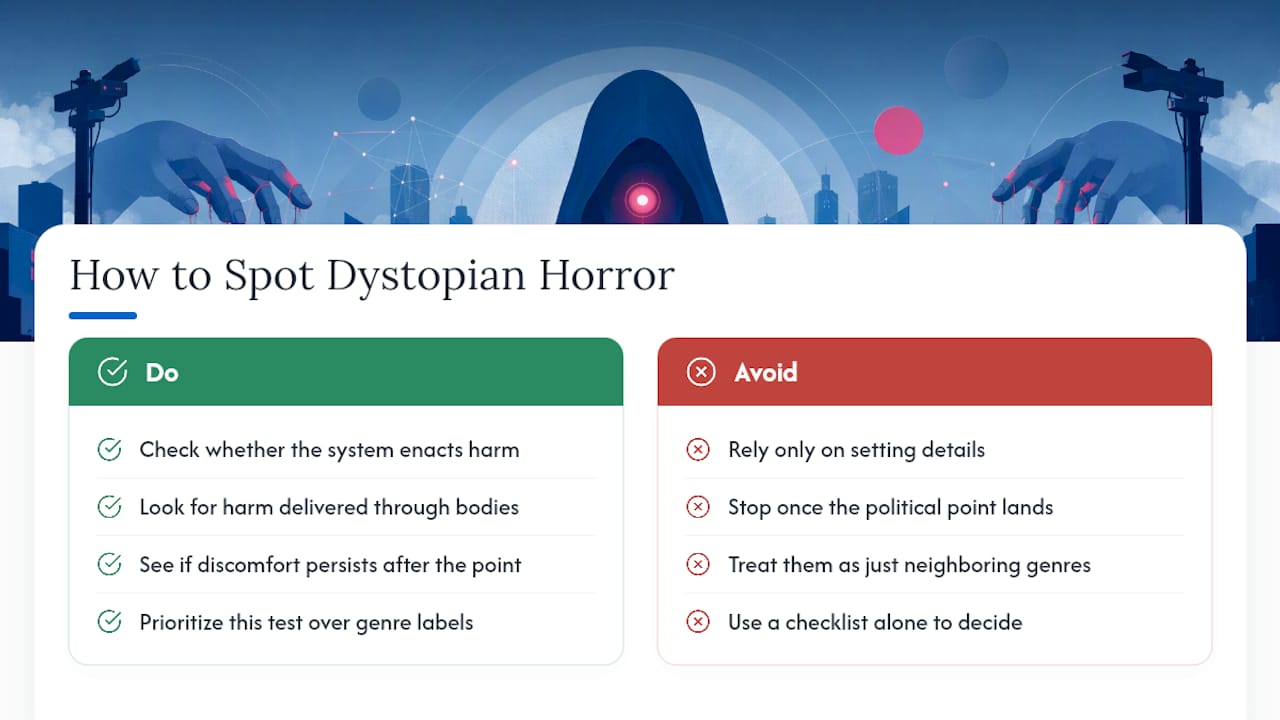
Most readers new to the subgenre focus on setting: the surveillance state, the ration cards, the propaganda posters. Those are dressing. The real test is whether harm gets delivered through the body and whether the story keeps you uncomfortable rather than satisfied once the political point lands. Prioritize that test over genre labels, and you’ll spot dystopian horror faster than any checklist alone can manage.
— Nathaniel
Sources
- Dystopian novel | literary genre | Britannica
- Dystopian Definition — Merriam-Webster
- Dystopia — Wikipedia
- What is dystopian horror, and what makes it its own subgenre? — Mark Andrew Watson (Substack)