
Unreliable narrator horror books are first-person or tightly framed stories whose narrator cannot be fully trusted, and that distrust is the engine of their dread. Readers come looking for titles that use this device well and for help spotting it before they commit to a book. The fastest tell is a confessional voice, a memory gap, or a blurb that mentions a “twist,” an “ambiguous” ending, or a “confession.”
TL;DR:
- Unreliable narrators in horror often use confessional voices, memory gaps, or mention twists and ambiguous endings to signal their untrustworthiness.
- The most effective horror stories rely on sustained, consistent narrator flaws that are crucial to the plot, not just last-minute misdirection.
- Different subgenres offer varied pacing: psychological horror favors slow dread through trauma, while twist-driven titles build suspense around sudden revelations.
- Detecting unreliability requires noticing contradictions, overinsistence, and disproportionate reactions, especially during close reading or re-reads.
- It is best to avoid detailed plot summaries beforehand, as the genre’s greatest payoff depends on sharing the narrator’s blind spots until the final pages.
Table of Contents
- 1. What makes a narrator unreliable in horror fiction
- 2. Why unreliable narration deepens horror’s psychological grip
- 3. Reading categories: how different horror subgenres bend unreliability
- 4. How do you choose and read an unreliable narrator horror book?
- 5. Nathaniel Connors on writing from a broken point of view
- 6. Contemporary authors who use unreliable narrators well
- 7. Recurring motifs that define unreliable narrator horror
- 8. How unreliable narrators reshape plot twists and suspense
- 10. What this guide gets right that most lists miss
- 11. Find more psychologically driven fiction with Nathaniel Connors
- Sources
- FAQ
1. What makes a narrator unreliable in horror fiction
An unreliable narrator is a storyteller whose credibility is compromised by delusion, bias, limited knowledge, or deliberate deception, which forces the reader to question the account and piece together what actually happened, according to Britannica’s entry on narrators. That single definition covers a wide range of voices, and horror writers tend to reach for a handful of recognizable types.
- The naive narrator lacks the sophistication to understand their own situation, which tends to generate pity rather than betrayal.
- The deceptive narrator knows the truth and hides it from the reader on purpose, often for a late reveal.
- The delusional or psychotic narrator believes their own distorted account, so the horror comes from watching their grip on reality slip.
- The limited-knowledge narrator simply does not have access to the full picture, which creates suspense through withheld information rather than malice.
- The fragmented or multi-voice narrator splits the story across several accounts that do not fully agree, leaving the reader to reconcile them.
On the page, unreliability shows up through small, consistent signals: first-person “I” framing, gaps where memory should be, a confessional tone, or an outright disclaimer like “I shouldn’t be telling you this.” Those signals are not new. Nineteenth-century horror leaned on them long before the term “unreliable narrator” existed, and Britannica’s discussion of “The Tell-Tale Heart” treats Poe’s confessing killer as a founding example of the type, alongside the sanity-versus-haunting ambiguity of Henry James’s “The Turn of the Screw.” Our breakdown of unreliable narrator meaning goes deeper into how these subtypes function across genres.
2. Why unreliable narration deepens horror’s psychological grip
The device works because it turns reading into detective work. When a narrator’s account and the objective truth diverge, the reader has to weigh every claim against the available clues instead of absorbing the story passively, a dynamic that Britannica’s narrator entry describes as the core purpose of the unreliable narrator in fiction.
That active participation matters because horror, as a genre, already asks readers to sit with intense negative emotion on purpose. Scholarly work on the genre argues that horror fiction lets readers experience fear, disgust, and dread through mechanisms that evolved to process real threat, but in a context where the reader stays safe, according to Oxford Academic’s analysis of horror’s appeal.
Unreliable narration is one of the few devices that makes readers experience horror’s uncertainty from the inside, not just observe it. That framing matters because an unreliable narrator does not just withhold information the way a mystery does. It corrupts the instrument the reader depends on to receive that information in the first place, which is why the genre’s most memorable narrators (the confessing killer, the haunted governess, the patient who insists they are sane) tend to outlast their plots in a reader’s memory.
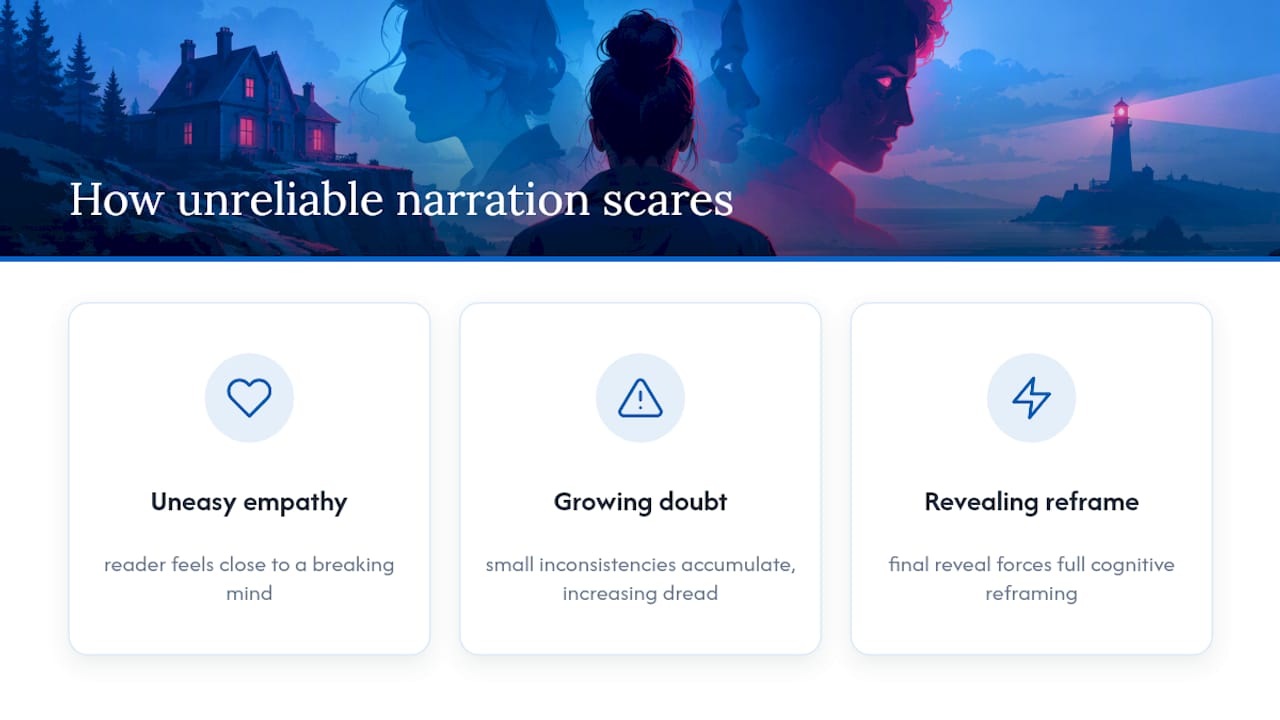
Three mechanisms drive the effect. First, readers often extend empathy to a distorted narrator even while doubting them, which creates an uncomfortable closeness to a mind that may be dangerous or breaking down. Second, doubt escalates gradually rather than arriving all at once, so dread builds scene by scene as small inconsistencies accumulate. Third, the reveal, when it comes, forces a full cognitive reframing of everything the reader thought they understood, which is a sharper jolt than a plot twist alone can deliver.
3. Reading categories: how different horror subgenres bend unreliability
Not every unreliable-narrator book delivers the same reading experience. The category tends to predict the pace and the payoff.
- Domestic and psychological horror leans on trauma, memory gaps, and gaslighting, and blurbs in this category often name those terms directly; expect a slow accumulation of dread rather than a single scare.
- Gothic and ambiguous supernatural horror keeps the reader guessing between a haunted house and a haunted mind, favoring atmosphere over resolution and often refusing to confirm which explanation is true.
- Epistolary and multi-voice horror tells the story through diaries, letters, or several short first-person accounts that contradict each other, rewarding readers who enjoy cross-referencing details.
- Metafictional and twist-driven horror uses a self-aware or confessional narrator who plays with the reader’s trust on purpose, building toward a final reversal that recontextualizes the whole book.
Domestic and psychological titles tend to reward patience: the horror is cumulative, and the biggest scares are quiet realizations rather than jump moments. Gothic and supernatural-adjacent books ask readers to enjoy the not-knowing itself, since many never resolve whether the haunting was real. Epistolary structures give readers the most active role, since spotting the contradictions between voices is part of the fun. Metafictional and twist-driven books are the most plot-forward of the four, built around a single moment where the floor drops out.
Pro Tip: If you want the reveal to land hardest, avoid reading detailed plot summaries beforehand; the genre’s biggest payoffs depend on you sharing the narrator’s blind spot until the last possible page.
Our list of mind-bending horror books sorts further titles by exactly these categories, which is a useful next stop once you know which flavor of unreliability you’re chasing.
4. How do you choose and read an unreliable narrator horror book?
Finding the right title starts with reading the blurb like a detective would read a case file. Look for specific language cues before you buy.
- A first-person “I” narrator, especially one who addresses the reader directly.
- Mentions of memory loss, blackouts, or a character who “isn’t sure what really happened.”
- Review or blurb language using words like “twist,” “ambiguous,” “confession,” or “unreliable narrator” itself.
- A synopsis that withholds the ending or motive rather than spelling it out.
- Comparisons to canonical unreliable-narrator works, which usually signal the publisher knows what shelf the book belongs on.
Once you’re reading, a different set of habits pays off. Annotate contradictions as you spot them: a detail the narrator states early that a later scene quietly undercuts is usually intentional, not sloppy writing. Flag moments where the narrator’s emotional reaction seems disproportionate to what they’re describing, since that gap is often where the unreliability lives. Many of these books reward a full reread once the reveal is known, since a second pass exposes exactly how the narrator’s language was steering you, a pattern that recurs across curated lists of unreliable-narrator horror.
Pro Tip: Keep a running note of anything the narrator insists on too strongly (“I would never lie to you,” “you have to believe me”); overinsistence is one of the most reliable tells in the genre.
One more practical step: check reviews and content notes before committing, since this category frequently deals with mental health crises, suicide, and abuse as central plot material. That information is usually easy to find in reader reviews on the retailer page, and it’s worth a few minutes before you start a book that may need a content warning you didn’t expect.
5. Nathaniel Connors on writing from a broken point of view
An author writes dark supernatural fiction built around revenge, guilt, and redemption, with novels including “The Nether,” “Stories of a Condemned Soul,” and “Evolution A200: A Bubonic Apocalypse.” His work centers on the psychological monsters characters carry with them, which makes limited perspective a natural tool rather than a gimmick.
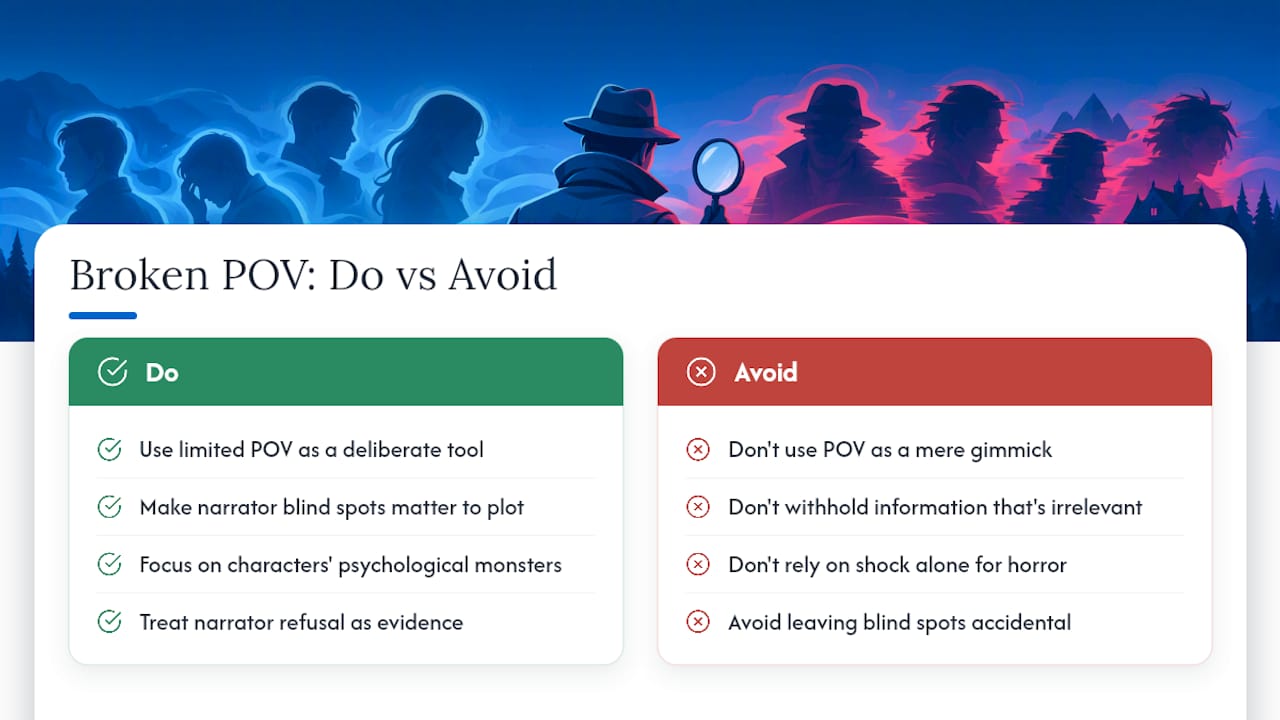
The craft logic is straightforward: when a reader only has access to what one damaged narrator perceives, every detail the narrator dismisses or misreads becomes a source of tension. The reader starts noticing what the narrator refuses to look at directly, and that refusal becomes its own kind of evidence. Connors’s approach, outlined further in his notes on unreliable narrator meaning, treats a narrator’s blind spots as structural, not accidental: the withheld information has to matter to the plot, or the device is just a trick.
Readers drawn to this guide because they want dark supernatural fiction with a strong psychological core, rather than horror that relies on shock alone, will find that focus consistent across his catalog. The interest is less in what’s hiding in the dark and more in what a character has convinced themselves is true to survive it.
— Nathaniel
6. Contemporary authors who use unreliable narrators well
Modern horror has kept the device central rather than retiring it. Curated reading lists built specifically around this trope, including BookRiot’s roundup of horror novels with unreliable narrators, point to a consistent pattern across contemporary titles: authors working in domestic horror and psychological suspense frequently build entire novels around a single narrator whose account slowly reveals its own cracks. These lists tend to group books by the specific flavor of unreliability, whether that’s memory loss, self-deception, or a narrator with something to hide, which mirrors the reading categories covered earlier in this guide.
What separates the stronger examples from weaker ones is consistency: the narrator’s blind spots have to track logically across the whole book rather than existing only to enable a last-page swerve. Readers hunting for new titles in this space will generally have the best luck searching lists organized by subtype (gaslighting narratives, epistolary horror, confessional killers) rather than a single “best of” ranking, since the emotional experience varies so much by category.
7. Recurring motifs that define unreliable narrator horror
A handful of techniques show up again and again across this category. Memory itself becomes a plot device, with gaps, blackouts, or contradictory recollections standing in for what a straightforward mystery would call clues. Confession is another recurring frame: narrators who address the reader directly, sometimes apologizing in advance, use that intimacy to make the reader complicit before the full picture is clear.
Doubling is common too, where a narrator’s account of another character quietly reveals more about the narrator than the person being described. Ambiguous endings, especially in gothic-leaning titles, refuse to confirm whether a haunting was supernatural or psychological, letting both readings stay valid. And disproportionate reactions, a narrator who is oddly calm about something horrifying or unusually panicked about something small, are used as quiet signals that something in the account doesn’t add up. None of these motifs work in isolation; they’re most effective layered together, which is part of why rereading tends to surface details a first pass misses.
8. How unreliable narrators reshape plot twists and suspense
An unreliable narrator changes what a plot twist actually does to a reader. In a conventional thriller, a twist reveals new information. In unreliable-narrator horror, a twist usually reveals that information you already had was wrong, or that the person delivering it was compromised the entire time. That distinction is why these books tend to reward rereading more than most other horror subgenres: once you know the narrator was lying, minimizing, or delusional, earlier scenes read completely differently.
Suspense builds differently too. Instead of escalating through external threat alone, the tension comes from watching the gap between the narrator’s account and the truth slowly widen, with the reader aware something is off well before the narrator admits it. That’s the “reader as detective” dynamic in action, and it’s the reason unreliable-narrator horror tends to produce some of the genre’s most discussed twist endings rather than its loudest jump scares.
10. What this guide gets right that most lists miss
Most roundups of unreliable-narrator horror treat the device as a marketing hook, a “twist” to be spoiled in a headline. That undersells the craft. The books that hold up are the ones where the narrator’s blind spot is load-bearing, meaning the story falls apart if you remove it, not the ones where the unreliability exists purely to ambush the reader on the last page.
The advice worth prioritizing is simple: read for the gap, not the reveal. Notice what the narrator avoids saying, not just what they eventually confess. That habit will serve you better across the whole genre than hunting for the “best twist ending” lists tend to promise, because the strongest books in this category earn their reveals through patient, consistent misdirection rather than a single trick.
— Nathaniel
11. Find more psychologically driven fiction with Nathaniel Connors
If the pull of a narrator you can’t quite trust is what draws you to this genre, Nathaniel Connors’s fiction works from that same instinct. These novels favor psychological monsters over external ones, built through rich character development and plots that stay with readers well after the story ends.
What to expect across his catalog:
- Themes centered on revenge, guilt, and redemption rather than shock for its own sake.
- A series of dystopian horror and thriller fiction built around dark supernatural elements.
- Another series including an apocalyptic horror title with a psychological core.
- Titles available through Kindle Unlimited subscriptions.
Readers who finish this guide wanting more than a list of other authors’ books can start with Nathaniel Connors’s full catalog, where both series are available now.
Sources
This guide draws on three kinds of sources: reference material, academic analysis, and contemporary reading lists. Britannica’s narrator entry and its entry on “The Tell-Tale Heart” supply the definitions and historical grounding. Oxford Academic’s work on why horror seduces explains the psychological appeal of the genre more broadly. BookRiot’s list of horror novels with unreliable narrators shows how the device gets marketed and discussed today. Together they cover the craft, the history, and the current reading landscape.
- Narrator | Character, Voice, Perspective | Britannica
- Why horror seduces (Oxford Academic)
- Don’t Trust Anyone: 8 Horror Novels with Unreliable Narrators
FAQ
What are some famous examples of unreliable narrators in horror?
Edgar Allan Poe’s confessing killer in “The Tell-Tale Heart” and the governess in Henry James’s “The Turn of the Screw” are among the most cited canonical examples, according to Britannica. Both narrators leave readers uncertain whether to trust their account of events, sanity, or motive.
What book does Stephen King regret writing?
This guide’s sources don’t cover Stephen King’s personal statements about his own bibliography, so an accurate answer isn’t available here. Readers looking for that specific claim should check King’s own interviews or an outlet that has documented his remarks directly.
What is the most terrifying book ever written?
There’s no single agreed-upon answer, since “most terrifying” depends heavily on individual readers and eras. What the sources here do support is that unreliable narration is one of the recurring techniques behind horror fiction’s most enduring, frequently cited scares.
Which is the best example of an unreliable narrator?
Rather than a single best example, reference sources point to a range of strong cases depending on the subtype: Poe’s narrator in “The Tell-Tale Heart” for the deceptive, confessing type, and James’s governess in “The Turn of the Screw” for the ambiguous, possibly delusional type, per Britannica. The right example depends on whether you want a narrator who lies on purpose or one who may not know they’re wrong.
How do I know if a horror book uses an unreliable narrator before I buy it?
Look for first-person “I” narration, blurb language mentioning a “twist,” “confession,” or “ambiguous” ending, and any hint of memory loss or trauma in the synopsis, patterns that contemporary reading lists consistently flag. Reader reviews often name the device outright, so a quick scan of the top few reviews usually confirms it.