Horror book content warnings tell you what a story contains before you start it, so you can decide whether to read it, when to read it, or whether to skip a particular book entirely. There is no universal standard for them, which means you have to know where to look and how to read what you find. This guide covers both: where warnings live, what a useful one says, how to spot a vague one, and how to get the most out of a genre that is built to unsettle you.
TL;DR
- Check three places before you buy: the retailer’s book description, the front matter (via the sample), and reader-compiled warning lists.
- A good warning is specific. “Contains graphic animal cruelty” helps you. “Contains dark themes” does not.
- Warnings are framed by researchers as informed consent, not as a way to tell you to stop reading.
- Missing warnings do not mean missing content. Cross-check, and sample the first chapter when you can.
- Subgenre matters: psychological dread, dystopian horror and splatterpunk cross very different lines.
Table of Contents
- Why horror readers want warnings
- Where to find content warnings before you read
- What a good horror content warning looks like
- Reading the genre signals when there is no warning
- Do warnings change the reading experience?
- Our perspective
- Using warnings to choose your next read
- Where to start with our books
- FAQ
- Sources
Why horror readers want warnings
Horror promises discomfort. That is the contract. But discomfort you chose is different from a scene that hits a nerve you did not know the book would press. A reader who lost a child, survived abuse or lives with PTSD is not asking horror to be gentler. They are asking to know where the specific lines are.
Editors who work in dark fiction put it plainly: content warnings are an accessibility tool, not censorship. The ability to choose whether to engage with specific material matters for readers with trauma-related anxiety, and an author who gives that choice shows respect for the audience.
The same editors argue the fear that warnings spoil a book or scare readers away usually runs backward. A cautious reader who knows what is coming is often more willing to try something dark, not less.
The debate in the genre is real. You will find horror writers who think warnings dilute the experience and others who treat them as basic courtesy. As a reader you do not need to settle that argument. You need information, and you can collect it yourself.
Where to find content warnings before you read
Coverage varies wildly from book to book, so use more than one source. A practical order:
- The retail description. On Amazon, the product page is where you decide to buy or borrow. Careful authors put warnings here because it is the first place a purchase decision happens. Scroll to the end of the description, since notes often sit below the blurb.
- The sample. Download the free sample and read the front matter. Many authors place a note before chapter one. If a book has chapter-level notes, you will see how it handles them early.
- The author’s website or social accounts. Authors often post fuller lists than a description allows.
- Reader-run lists and communities. For newer or independently published books, a practical approach is to search the title plus “content warnings”, look for flags repeated across readers, then confirm against the author’s note. Horror communities and individual reviewers also maintain databases focused on the genre, and some reviewers publish warning lists for every book they read.
- Reviews. Search within a book’s reviews for specific words: “child”, “suicide”, “animal”, “assault”. Reader reviews can clarify how intense a scene is, but tags and mentions are inconsistent, so treat a clean review page as weak evidence.
One caution: a missing warning does not mean absent content. Nobody is required to provide one.
What retailers do and do not require
Amazon’s Kindle Direct Publishing rules deal with a different problem. The KDP content guidelines set out what Amazon will and will not sell, and the platform says it values access to the written word, including content some consider objectionable. Those rules screen out illegal material, not material that might upset you. A book can be fully compliant and still contain scenes you want to avoid. Warnings are the author’s voluntary extra, which is why checking them yourself matters.
What a good horror content warning looks like
Research reviewing how warnings are written across health, education, social media and entertainment found no single standard taxonomy, and that granular, specific descriptions are the most helpful. Here is how that plays out on a page.
| Weak warning | Useful warning |
|---|---|
| Contains violence | Contains graphic depictions of animal cruelty and a scene of on-page torture |
| Dark themes | Includes suicide of a major character and a long sequence about grief after a child’s death |
| Not for the faint of heart | Features sexual assault (non-explicit, in a flashback) and domestic abuse |
| Mature content | Includes body horror, medical gore and a pandemic with mass death |
A strong warning does four things:
- Names the subject, not the mood.
- Says how it is shown. On the page or implied, brief or extended, explicit or off-screen. This is what separates a psychological thriller from splatterpunk.
- Says roughly where it appears, if the content arrives suddenly or sporadically. Chapter-level notes serve this purpose, and marking where a warned section ends lets you rejoin the story safely.
- Avoids spoilers. You need the category and the intensity, not the plot twist.
Publishing guidance for authors often lists the categories that merit a note. One university press guide to content warnings lists mental illness, abuse, substance abuse and graphic violence or sex that the genre would not lead you to expect. Notice that last category: the surprise factor is what counts. A reader of a high-intensity subgenre can infer much from the genre itself, but a specific warning clarifies exactly which lines the book crosses and keeps readers from mistaking it for a milder psychological thriller.
Reading the genre signals when there is no warning
Sometimes you will have only the cover, the blurb and a few reviews. Use these cues.
Subgenre labels
The label tells you a lot about intensity:
- Psychological horror works through dread, unreliable minds and moral collapse. Violence is often implied. Content to check: suicide, abuse, self-harm, mental illness. Our guide to writing psychological horror explains why this subgenre hits so close to home.
- Quiet or slow-burn horror keeps graphic detail low. If you want chills without gore, see our piece on quiet horror and our list of slow-burn non-supernatural horror.
- Splatterpunk and extreme horror are about explicit transgression. Readers expect everything on the page. If you are curious but cautious, sampling a chapter before committing is sensible, because sample text shows you the register fast.
- Dystopian and apocalyptic horror often carries mass death, disease, loss of children and cruelty between survivors, even when it is not gory.
- Grimdark and dark fantasy can be as brutal as horror without being scary. We separate them in grimdark vs horror and dark fantasy vs horror.
For a wider map, see horror subgenres explained.
Review patterns
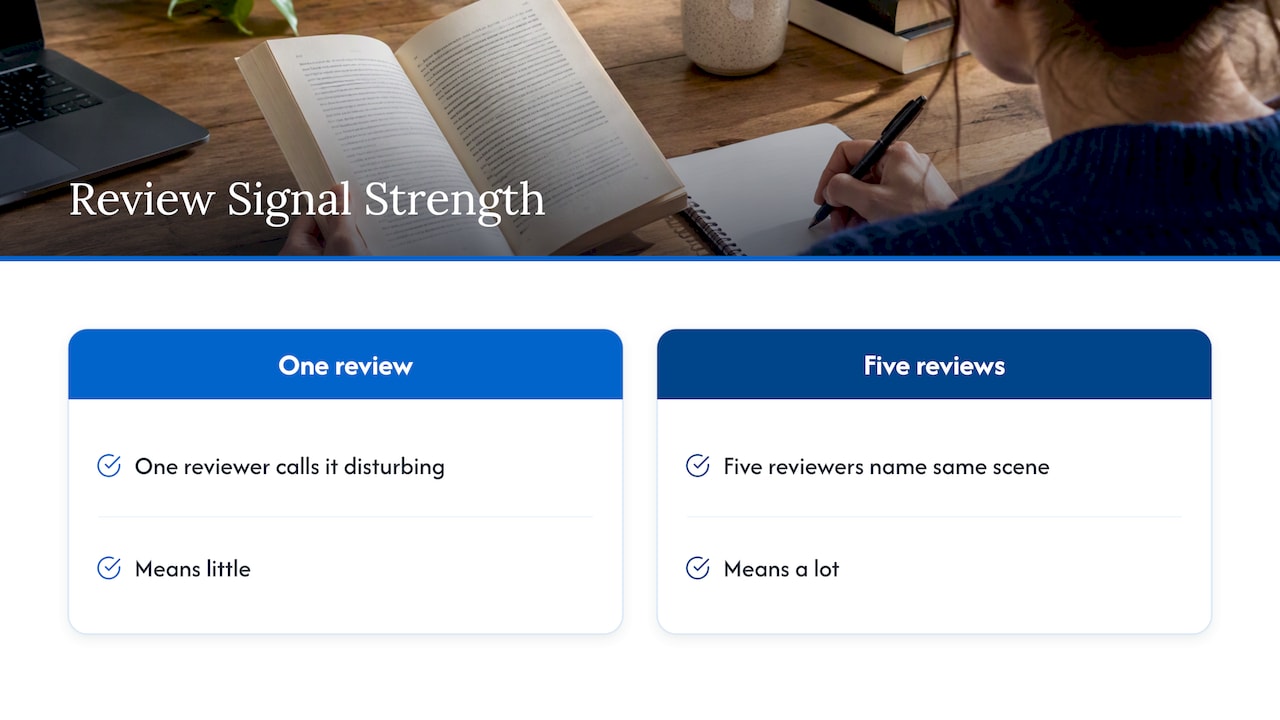
One reviewer saying a book was disturbing means little. Five reviewers independently naming the same scene means a lot. Look for repeated nouns.
Your own list
Keep a short note of your personal hard lines and softer “depends on how it’s handled” lines. Searching reviews for two or three words is faster than reading dozens of them.
Do warnings change the reading experience?
The research summarized by one reading resource links warnings to higher anticipatory anxiety, but not consistently to greater distress during reading, and notes that specific labels help readers judge personal relevance. In plain terms: a warning is information, not a cure and not a harm. Use it to decide, then read.
If you have a trauma history and a book’s warning lists something close to it, a licensed mental health professional is the right person to talk to about whether and how to read it. A warning list cannot tell you how a particular scene will land for you.
Our perspective
We write dark supernatural and psychological horror, and we have thought about this from the writing side. Our books deal with revenge, guilt, redemption and the psychological monsters people carry. That is heavy ground, and the people who like it most are often the people who take it seriously.
Here is where we stand. A reader’s trust is the real asset in this genre. If you pick up a book expecting an unsettling mystery and meet a scene you were never prepared for, you do not remember the craft. You remember being blindsided. We would rather you arrive ready.
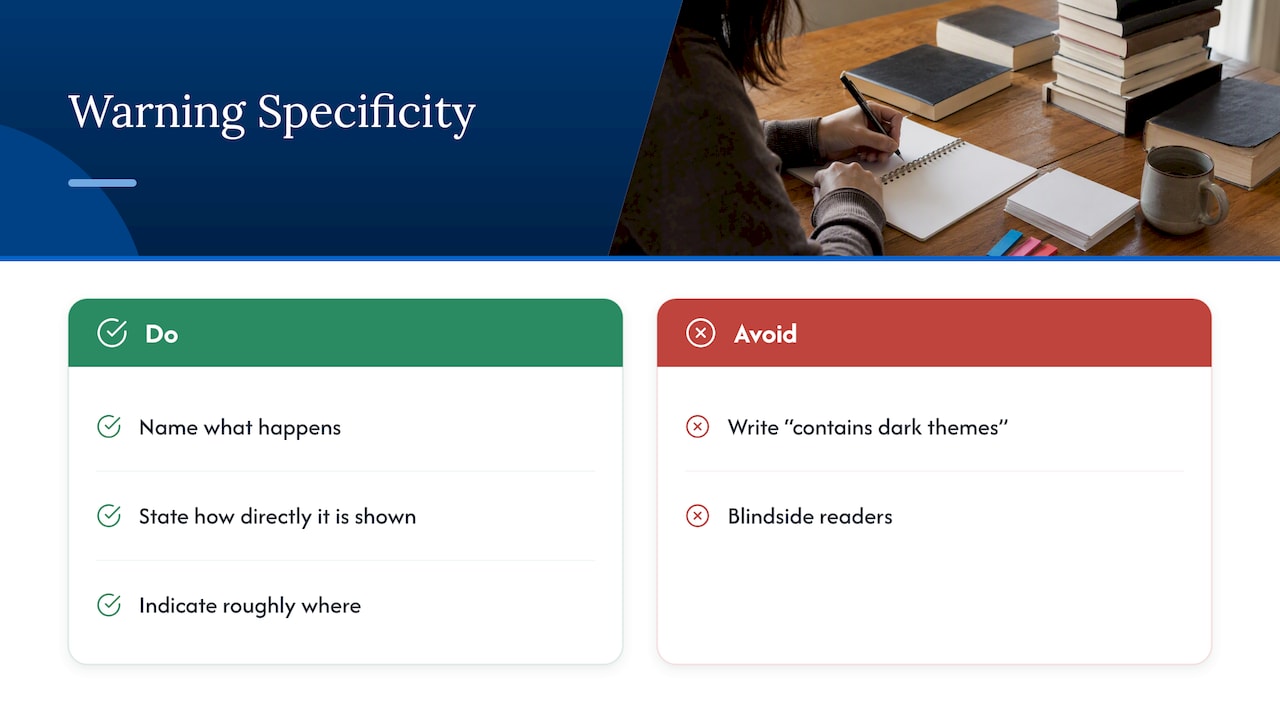
We also think vagueness is the failure. “Contains dark themes” is a shrug. A reader deserves nouns: what happens, how directly it is shown, roughly where. That is also what we ask of other writers and what we look for as readers.
And we think warnings and dread coexist. Fear in a good horror story comes from anticipation, character and what the mind fills in, not from ambush. Knowing a book contains grief, guilt or a pandemic does not drain the book of power. It lets you step in on your own terms.
To see how we approach intensity, read our notes on psychological horror without gore and supernatural thrillers without gore.
— Nathaniel
Using warnings to choose your next read
A workable routine for a new horror title:
- Read the full description, including the bottom.
- Search the title plus “content warnings”.
- Scan reviews for your two or three hard-line words.
- Download the sample and read the front matter.
- Decide: read now, save for a different mood, or skip.
If a book has no warnings and you are unsure, borrowing helps. A Kindle Unlimited subscription lets you start a title and put it down without a separate purchase, which makes experimenting cheaper. We looked at that tradeoff in whether Kindle Unlimited is worth it for horror.
If your hard line is something specific, such as claustrophobia, our claustrophobic horror list with trigger notes shows what this kind of annotation looks like in practice.
Where to start with our books
If you like psychological depth, dystopian dread and stories about guilt and consequence, our books page lists The Nether Series and the EA200 Series. Titles include The Nether and Evolution A200: A Bubonic Apocalypse, available in ebook and paperback on Amazon and free to read with Kindle Unlimited. Check each book’s Amazon page and sample before you read, as you would with any horror title.
FAQ
Do books need content warnings?
No law or retailer rule requires them for fiction. Amazon’s guidelines focus on prohibited material, not on warning readers about upsetting scenes. Warnings are a voluntary courtesy from authors and publishers, which is why reader-side checking matters.
Does all horror need a content warning?
Most horror readers already expect fear and some violence, so a generic note adds little. What helps is a warning about material beyond what the genre would lead you to expect, such as graphic sexual violence or harm to children, and about specific subjects that cause lasting distress.
Are content warnings the same as trigger warnings?
They overlap. “Trigger warning” suggests a response in the reader, while “content warning” simply describes what is in the book. Researchers have suggested “content notification” as a framing that emphasizes informed consent over avoidance.
How do I know if a horror book is too intense for me?
Check the subgenre, search reviews for your own hard-line words and read the sample. Splatterpunk and extreme horror are explicit by design, while psychological and quiet horror usually rely on dread. If a warning is vague, assume you have incomplete information and look for a second source.
Sources
- Typology of content warnings and trigger warnings: Systematic review (PMC)
- When (And How) To Use Content Warnings In Your Book, Phantom Pen Editorial
- Educating Your Author About Content Warnings, Ooligan Press
- Amazon KDP Content Guidelines
- Trigger Warnings in Books: 5 Places to Check Before Reading
- Splatterpunk eBooks: Look Beyond Big Stores, Sample a Chapter