If you want horror that crawls under your skin instead of jumping out at you, start here. These picks exemplify patience, mood, and dread that outlasts the last page.
- The Haunting of Hill House by Shirley Jackson: a masterclass in unreliable narration and a house that never has to raise its voice.
- House of Leaves by Mark Z. Danielewski: the payoff arrives in fragments, and the format itself becomes the threat.
- The Little Stranger by Sarah Waters: postwar decay disguised as a ghost story, with dread that seeps in through class anxiety.
- A Head Full of Ghosts by Paul Tremblay: possession horror filtered through media obsession, withheld until the ending forces a reckoning.
- The Woman in Black by Susan Hill: a short, controlled slow burn that proves atmosphere doesn’t need three hundred pages to work.
- Let the Right One In by John Ajvide Lindqvist: isolation and adolescence turned into something genuinely unsettling, one quiet scene at a time.
- The Changeling by Victor LaValle: grief transformed into a modern fairy tale that takes its time before it turns monstrous.
Key Takeaways
Slow burn horror succeeds by withholding payoff, building atmosphere through sensory detail and unreliable narration, and rewarding readers who stay patient through the buildup.
| Point | Details |
|---|---|
| Definition matters | Slow burn horror prioritizes dread and atmosphere over jump scares, unlike fast-paced horror. |
| Craft techniques drive tension | Isolation, unreliable narrators, and withheld payoff are the core tools authors rely on. |
| Match mood to book | Choose gothic, domestic, or experimental slow burns based on tone and available reading time. |
| Endings decide success | A weak final act is the most common failure mode, so payoff quality matters most. |
| Nathaniel Connors fits the mold | The Nether and Stories of a Condemned Soul apply the same slow-building dread found in these picks. |
Table of Contents
- What Makes a Book a Slow Burn Horror Novel?
- How Do Authors Build Dread Slowly?
- Which Slow Burn Horror Books Should You Read First?
- How Do You Pick the Right Slow Burn Horror Book?
- What’s the Best Reading Order for Slow Burn Horror?
- Why These Books Made the Slow Burn Horror List
- A Curator’s Note on Slow Burn Horror
- Want More Slow Burn Horror? Try These Next
- Frequently Asked Questions
- Sources
What Makes a Book a Slow Burn Horror Novel?
Slow burn horror prioritizes long-form psychological dread and atmosphere over immediate jolts. It’s a subgenre that withholds overt supernatural or violent payoff until late in the story, letting silence and suggestion do the work that jump scares usually handle in fast horror.
Fast-paced horror wants a reaction in seconds. Slow burn horror wants a reaction that lingers for days. A slasher novel spikes your pulse on page ten; a slow burn like House of Leaves spends chapters destabilizing your sense of what’s real before anything overtly frightening happens.
This overlaps heavily with what’s often called literary horror, a category that leans on prose craft and philosophical weight rather than shock value. Shirley Jackson’s work and Danielewski’s experimental structure are the standard reference points for readers chasing that immersive, unsettled feeling rather than a quick scare.
How Do Authors Build Dread Slowly?
Slow burn craft depends on a specific toolkit, and once you notice it, you’ll spot it in every book on this list.
- Patient escalation: small wrongness compounds into something larger, never all at once.
- Unreliable narrators: the reader questions the story right alongside the protagonist.
- Isolation: physical or social confinement removes escape routes and outside perspective.
- Sensory detail: sound, smell, and texture do more work than explicit description.
- Suggestive prose: what’s implied outweighs what’s stated.
- Withheld payoff: the real horror surfaces only in the last act.
This mirrors what genre analysts call the art of tension building, where silence and incremental stakes replace quick scares, and it’s the same mechanism driving cinematic slow burns like Hereditary or The Witch. The psychological payoff comes from anticipation itself. You lean into the story because you’re piecing together a threat before the characters do, and that gap between reader knowledge and character knowledge is where the dread actually lives.
Pro Tip: Keep a mental (or literal) note of small details that repeat, a recurring smell, a phrase, a room mentioned twice. Slow burns plant micro-escalations early that only make sense once you’re fifty pages further in.
Which Slow Burn Horror Books Should You Read First?
Classics that defined the subgenre. The Haunting of Hill House by Shirley Jackson remains the benchmark for psychological haunted house fiction, built almost entirely on perception and loneliness. Beloved by Toni Morrison uses haunting as a vehicle for generational trauma, and it belongs on any literary horror shortlist precisely because it never treats its ghost as a gimmick. Best for readers who want prose that rewards rereading.
Modern essentials. House of Leaves remains the reference point for experimental slow burn, a novel that turns its own footnotes into a maze. A Head Full of Ghosts by Paul Tremblay updates possession horror for the reality-TV era, and its structure keeps the truth ambiguous until the final pages. Mexican Gothic by Silvia Moreno-Garcia builds atmosphere across its opening third before shifting into an unnerving, intense payoff that critics consistently single out.
Psychological and clinical dread. The Changeling by Victor LaValle wraps grief and fatherhood around a fairy tale structure that turns genuinely disturbing by its midpoint. Best for readers who want emotional stakes as high as the horror stakes.
Gothic and house-focused horror. The Little Stranger by Sarah Waters uses a decaying manor and postwar class tension to build dread that’s more social than supernatural. The Woman in Black by Susan Hill proves a haunted house story can be short, controlled, and still devastating.
Short, quick slow burns. Let the Right One In by John Ajvide Lindqvist pairs isolation and adolescence with a vampire story that earns its horror through patience, not spectacle. If you want something newer with a similarly measured buildup, Home Sick by Rhiannon Grist tests a reader’s patience early but rewards it with a haunting final act.
Author works worth adding. Nathaniel Connors’ The Nether, Stories of a Condemned Soul, and Evolution A200: A Bubonic Apocalypse each lean into slow-building psychological horror rooted in guilt, revenge, and dystopian dread, and they sit comfortably alongside the classics above for readers drawn to character-first horror.
How Do You Pick the Right Slow Burn Horror Book?
Match the book to your mood before you match it to the hype. Gothic settings (The Little Stranger, The Woman in Black) suit readers who want decay and class tension; domestic settings (A Head Full of Ghosts) suit readers who want horror inside ordinary family life.
- Short reads (The Woman in Black, Let the Right One In) work for a weekend; immersive novels (House of Leaves, Beloved) need weeks.
- If you want ambiguity, pick Jackson or Tremblay. If you want a hard, explicit payoff, pick Mexican Gothic.
- Read in focused sessions rather than scattered five-minute bursts. Slow burns lose their power when interrupted.
Pro Tip: If a slow burn hasn’t shifted its atmosphere by the halfway mark, that’s often a structural signal the payoff will be thin. Keep reading if small details are compounding; consider setting it aside if nothing has changed since chapter one.
What’s the Best Reading Order for Slow Burn Horror?
If you’re new, start here:
- The Woman in Black — short, controlled, low commitment.
- The Haunting of Hill House — the genre’s clearest blueprint.
- Let the Right One In — accessible prose with real emotional stakes.
If you already love slow burn, try these next:
- House of Leaves — demands patience and a willingness to get lost.
- A Head Full of Ghosts — rewards readers who track unreliable narration closely.
- Beloved — literary weight paired with genuine haunting.
Starting simple builds tolerance for ambiguity before you tackle books that actively resist a clean resolution.
Why These Books Made the Slow Burn Horror List
Every title here had to deliver atmosphere, patient pacing, character-driven tension, and a late-stage payoff that actually lands. Prose craft mattered as much as plot; a weak ending is the most common failure mode in slow burn fiction, so books that stick the landing got priority.
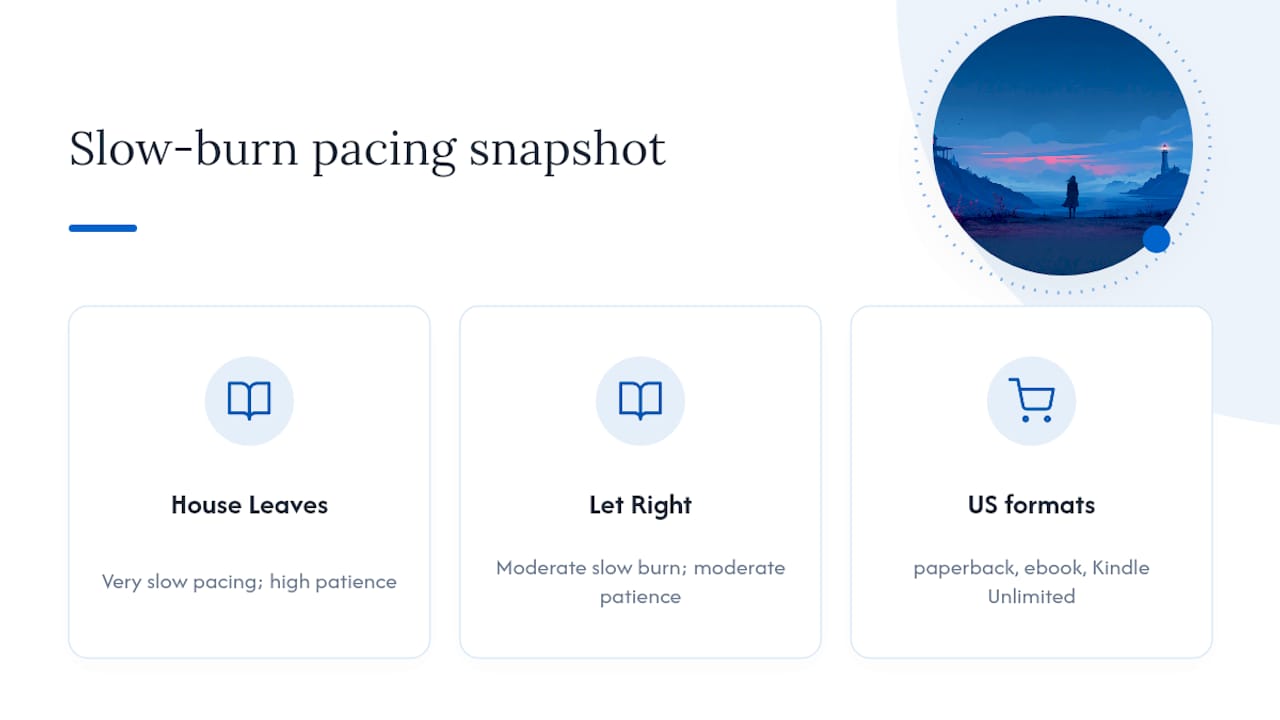
Intensity note: annotations flag pacing from very slow (House of Leaves) to moderate slow burn (Let the Right One In) so you can gauge patience required before committing.
All titles listed are currently available in the US market in paperback, ebook, or Kindle Unlimited formats.
A Curator’s Note on Slow Burn Horror
I’ve spent years writing dark supernatural fiction that leans on dread instead of shock, and that’s exactly why these books matter to me. The Nether and Stories of a Condemned Soul grew out of the same patience these authors practice: let guilt and consequence build until the reader can’t look away.
Want More Slow Burn Horror? Try These Next
If Jackson’s patient dread or Tremblay’s unreliable narration hooked you, my own books lean into that same territory of psychological horror and dystopian unease.
- The Nether: guilt and revenge told through a slow, unraveling structure similar to The Changeling.
- Stories of a Condemned Soul: character-focused dread that builds toward a late, heavy payoff.
- Evolution A200: A Bubonic Apocalypse: dystopian horror for readers who liked the isolation and creeping wrongness of Let the Right One In.
All three are available in ebook and paperback on Amazon, and Kindle Unlimited subscribers can read them at no added cost. If you want a broader entry point first, dystopian horror novels that share this pacing make a solid next stop, and readers pressed for time can start with short dystopian reads built for one sitting. Ready to sample the author directly? Head to the Kindle Unlimited psychological thrillers page and start reading today.
Frequently Asked Questions
What are the best slow burn horror books for beginners?
The Woman in Black, The Haunting of Hill House, and Let the Right One In offer strong entry points because they build dread without demanding the reader tolerate heavy ambiguity or experimental structure.
How is slow burn horror different from psychological horror novels?
Slow burn horror is a pacing style; psychological horror is a thematic focus on mental unraveling. Many books, like A Head Full of Ghosts, are both at once, but a slow burn can also be gothic or supernatural without being psychological.
Are slow burn horror books good for readers who dislike jump scares?
Yes. These books earn their scares through atmosphere and suggestion rather than sudden shocks, which makes them a better fit for readers who find jump scares cheap or exhausting.
Do slow burn horror novels always have a strong ending?
Not always. A weak payoff is the most common complaint against slow burns, which is why the titles on this list were chosen partly for how well their endings land.
Can short books still qualify as slow burn horror?
Absolutely. The Woman in Black proves a slow burn can work in under two hundred pages if the atmosphere is controlled and the payoff is earned rather than rushed.
Sources
- House of Leaves — Wikipedia
- Skulls in the Stars — Mexican Gothic by Silvia Moreno-Garcia
- Writing Tension: The Art of Slow-Burn Horror — Sinister Film Fest
- Mexican Gothic by Silvia Moreno-Garcia — Penguin Random House