Cosmic horror is a specific strain of the broader weird mode: every cosmic horror story is weird fiction, but not every weird story qualifies as cosmic horror. The dividing line comes down to scale. Weird fiction chases a sense of the numinous through any rupture in the natural order, while cosmic horror insists specifically on humanity’s insignificance against a vast, indifferent universe.
TL;DR:
- Cosmic horror involves threats on a universe-wide scale that leave characters feeling insignificant and often cause mental collapse, unlike human-scaled weird fiction.
- Weird fiction incorporates a broader range of unsettling themes, including supernatural, biological, or strange imagery, without necessarily implying cosmic indifference.
- Modern writers have critically inherited Lovecraft’s work by updating or questioning its prejudices, especially around race and ideology, while maintaining cosmic dread.
- Effective cosmic horror relies on fragmentary revelation, sensory detail, and a narrative perspective that emphasizes the collapse of understanding over explanation.
- Stories with themes of cosmic indifference, incomprehensible forces, and scale as a threat are classified as cosmic horror, while those with local, personal strangeness remain within weird fiction.
Table of Contents
- Weird Fiction vs Cosmic Horror: Definitions and a Quick Comparison
- Core Themes and Tropes That Define Each Mode
- How Weird Fiction and Cosmic Horror Evolved Over Time
- Representative Works: Weird Fiction and Cosmic Horror Examples
- When a Story Sits Between Weird Fiction and Cosmic Horror
- How to Write Weird Fiction and Cosmic Horror
- Lovecraft’s Racism and How Modern Writers Have Responded
- What Weird and Cosmic Elements Actually Do in Fiction
- Where to Start if You Want Both Modes in One Book
- Sources
- FAQ
Weird Fiction vs Cosmic Horror: Definitions and a Quick Comparison
Weird fiction is a mode, not a strict genre. It blends horror, fantasy, and science fiction to produce a mixture of awe and unease, and it usually skips the traditional Gothic cast of ghosts, vampires, and werewolves in favor of something stranger and harder to name. The Wikipedia overview of weird fiction describes it as emphasizing the numinous and violating the assumed laws of nature, often through nontraditional monsters and imagery like the now-famous tentacle. That flexibility is exactly why weird fiction has survived a century of reinvention. It can hold a haunted house story, a body-horror tale, or a story about a god sleeping under the ocean, as long as the story reaches for that unsettled, wondering feeling rather than a jump scare.
Cosmic horror narrows that focus considerably. It’s the subgenre built entirely around what H. P. Lovecraft called cosmic fear: the horror of the unknowable, paired with the terror of realizing humanity barely registers on the universe’s scale. According to the Wikipedia entry on Lovecraftian horror, the mode centers on incomprehensible, nonhuman forces and the psychological toll of encountering them, rather than gore or physical threat. An academic honors thesis from the University of Tennessee at Chattanooga makes the subset relationship explicit: every cosmic horror tale fits inside the weird mode, but the weird mode covers plenty of ground cosmic horror never touches.
So how do you actually tell them apart on the page? Run a story through this checklist:
- Scale: Does the threat operate on a cosmic, universe-spanning level, or is it localized and personal, even if it’s strange?
- Agency: Are human choices basically irrelevant to the outcome, or do characters retain meaningful control?
- Explainability: Does the story withhold explanation entirely, or does it eventually rationalize the phenomenon, even loosely?
- Emotion: Is the dominant feeling dread and insignificance, or a broader mix of awe, wonder, and unease?
- Descriptive signals: Does the prose lean on cosmic imagery (stars, void, ancient geological time), or on more intimate strangeness (a wrong-shaped room, an object that shouldn’t exist)?
If a story scores cosmic on most of those, you’re looking at cosmic horror. If it’s strange and unsettling but stays human-scaled, you’re looking at weird fiction that never crosses into cosmic territory. A haunted painting that slowly drives its owner mad is weird. A haunted painting that reveals the owner’s entire species is an afterthought to something ancient and unnamable, is cosmic.
Core Themes and Tropes That Define Each Mode
Weird fiction’s toolbox is broader and stranger than most readers expect. A few recurring motifs show up again and again:
- The numinous: A sense that something sacred, terrible, or beyond category has brushed against ordinary life.
- Violation of natural law: Physics, biology, or geometry stop behaving the way they should, without a tidy scientific fix.
- Uncanny artifacts: Objects, texts, or relics that carry wrongness with them, independent of any villain wielding them.
- The tentacle motif: A shorthand for nonhuman biology so alien it resists ordinary description, a device weird fiction leans on so often it’s become a genre signature in its own right.
Cosmic horror inherits all of that but adds its own, tighter set of obsessions:
- Cosmic indifference: The universe doesn’t hate you. It doesn’t notice you. That absence of malice is often more disturbing than a monster that wants something.
- Mind-breaking knowledge: Understanding too much about reality costs the protagonist their sanity, their faith, or their sense of self.
- Scale as threat: The horror isn’t a creature. It’s the size of the thing the creature is a symptom of.
Both modes share devices like unreliable narrators, fragmentary documents, and academics or investigators who dig too deep. The divergence shows up in payoff. Weird fiction can end on wonder as easily as horror. Cosmic horror almost never lets the reader off that easy. The Cleveland Review of Books makes a similar point: the weird tradition’s effect is often awe mixed with dread, not one fixed emotional target, which is precisely what separates it from cosmic horror’s narrower, colder register.
Pro Tip: If you’re not sure which mode a scene belongs to, ask what happens to the character’s understanding of the world by the final page. If they gain awe and wonder alongside the fear, you’re writing weird fiction. If they gain only the crushing certainty that nothing they do matters, you’re writing cosmic horror.
How Weird Fiction and Cosmic Horror Evolved Over Time
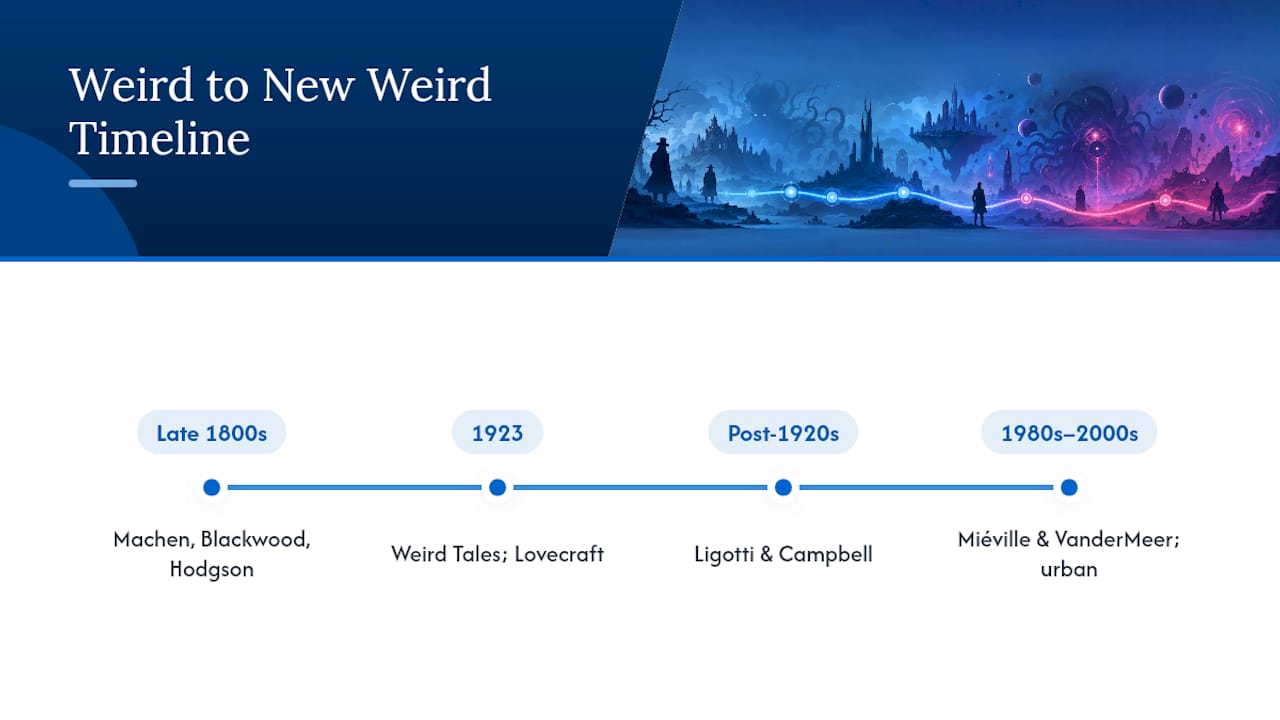
The weird mode has roots stretching back to late 19th and early 20th century writers experimenting with fiction that didn’t fit neatly into Gothic romance or straight fantasy. Arthur Machen, Algernon Blackwood, and William Hope Hodgson wrote stories about forces and presences that resisted explanation, laying groundwork before anyone had coined the term “weird fiction” as a category.
The pulp magazine Weird Tales, launched in 1923, gave the mode a home and a readership, and this period is often called the Old Weird. It’s also where H. P. Lovecraft did his defining work. Lovecraft wasn’t just writing weird stories. He was theorizing what the weird tale should accomplish. His essay “Supernatural Horror in Literature” lays out his craft philosophy directly, arguing that the strongest weird fiction produces what he termed cosmic fear, an atmosphere of dread tied to the suspension of natural law rather than jump-scare mechanics. That essay, combined with stories like “The Call of Cthulhu,” effectively crystallized cosmic horror as its own recognizable strain within the wider weird tradition.
Cosmic horror didn’t stay frozen in the 1920s. Writers who came after Lovecraft, including Thomas Ligotti and Ramsey Campbell, kept pushing the cosmic strain forward, often stripping out Lovecraft’s more dated baggage while keeping the existential scale intact.
Starting around 1980 and accelerating through the 2000s, the New Weird movement reshaped the broader mode entirely. Writers like China Miéville, along with Ann and Jeff VanderMeer, pushed the weird toward political engagement, urban settings, and a willingness to critique the tradition’s older assumptions rather than simply repeat them. A Duke University Press introduction to the Old and New Weird frames this generation as both inheriting and correcting what came before, using the weird’s flexibility to carry social and ideological weight the pulp era rarely attempted. That periodization, Old Weird to Weird Transition to New Weird, is why so many contemporary novels feel weird without ever touching cosmic horror’s specific dread.
Representative Works: Weird Fiction and Cosmic Horror Examples
Reading the actual texts makes the distinction click faster than any definition. Here’s a working reading path across both modes:
- “The Call of Cthulhu” by H. P. Lovecraft — The foundational cosmic horror text. A sleeping god, a scale of time that dwarfs human history, and a narrator whose sanity cracks under the weight of what he learns.
- “The Colour Out of Space” by H. P. Lovecraft — Cosmic horror without a monster at all. The threat is a force so alien it doesn’t fit any earthly category, which is the purest version of cosmic indifference in Lovecraft’s catalog.
- “The Willows” by Algernon Blackwood — Often cited as a precursor to cosmic horror, but it stays closer to pure weird fiction: dread and wonder tangled together, with no explanation offered or needed.
- “The Great God Pan” by Arthur Machen — Weird fiction built on transgression and the numinous rather than cosmic scale, proving the mode existed before Lovecraft gave it a philosophy.
- “House of Leaves” by Mark Z. Danielewski — A modern weird text about a house that’s larger inside than outside. Deeply strange, deeply unsettling, but human-scaled rather than cosmic.
- “Annihilation” by Jeff VanderMeer — New Weird cosmic horror in a biological register. The threat isn’t a god from beyond the stars; it’s an ecosystem rewriting the rules of biology itself, which keeps the dread cosmic without the pulp trappings. Readers who want more titles in this vein can check a curated list of books like Annihilation.
- “The City & the City” by China Miéville — Weird fiction that uses a fantastical premise, two cities occupying the same physical space, to explore politics and perception rather than cosmic dread. It shows how far the weird mode stretches beyond horror entirely.
- “Perdido Street Station” by China Miéville — A New Weird cornerstone blending fantasy, body horror, and industrial gothic imagery, demonstrating that weird fiction can build entire secondary worlds rather than intrude on our own.
The Weird Fiction Review’s introduction to the weird groups titles like these together deliberately, annotating how similar devices, strange biology, forbidden knowledge, uncanny architecture, produce very different emotional effects depending on whether cosmic scale enters the picture.
When a Story Sits Between Weird Fiction and Cosmic Horror
Plenty of stories resist a clean label, and that’s not a failure of the categories. It’s a sign the modes were always meant to overlap. A few questions help sort out the genuinely borderline cases:
- Does the story’s threat operate on a scale beyond any single character’s comprehension, or is the strangeness contained to one house, one object, one bloodline?
- Would removing the cosmic element (the ancient god, the incomprehensible force) collapse the plot, or would the story survive as a smaller, still-effective weird tale?
- Is the emotional target dread specifically, or a broader mix that includes fascination and even beauty?
- Does the marketing copy call it “Lovecraftian” as a genre signal, even when the actual scale of the threat stays personal?
Stories like Shirley Jackson’s “The Haunting of Hill House” get miscategorized in both directions. It’s frequently filed as straight horror, sometimes even as cosmic horror because of its atmosphere, but the threat never escapes the scale of one house and one fragile mind. That makes it weird fiction through and through, not cosmic horror. The reverse mistake happens too: cosmic horror stories get softened into generic “supernatural thriller” marketing because publishers worry cosmic horror sounds niche.
For anyone doing academic or marketing labeling, the safest rule is to lead with the broader term when scale is ambiguous and reserve “cosmic horror” for stories that actually commit to human insignificance as a theme, not just as set dressing. A monster from space isn’t automatically cosmic horror if the story still treats human choices as decisive. If you want a wider map of where horror’s subgenres split and blend, the horror subgenres guide breaks down more of these boundary cases.
How to Write Weird Fiction and Cosmic Horror
Writing convincingly in either mode comes down to a handful of deliberate choices, not just borrowing imagery from Lovecraft.
- Choose a point of view that matches your target emotion. Weird fiction often works well in close third or first person because it lets wonder and horror sit side by side in the narrator’s reaction. Cosmic horror tends to favor detached, formal, or retrospective narration, the classic “I am writing this account before my sanity fails” structure, because that distance makes the eventual collapse hit harder.
- Control the pace of revelation. The incomprehensible has to stay incomprehensible. Writer’s Digest’s guide to the mode recommends implying scale and forbidden knowledge rather than explaining it outright, since a fully rationalized threat stops being cosmic the moment it’s explained. Show fragments: a partial equation, a single sentence from a forbidden text, a glimpse that the character can’t fully process.
- Ground the impossible in specific, sensory detail. The wrongness lands harder when everything around it feels ordinary. A character’s coffee going cold, the exact smell of a basement, the particular creak of a floorboard, these details buy credibility for the one impossible thing you’re asking the reader to accept.
- Let epistemic collapse be felt, not summarized. Craft guidance on this point is consistent: the reader should experience the character’s understanding breaking down in real time rather than being told afterward that it happened. A character who calmly narrates “and then I understood everything, and it destroyed me” has told the reader the ending instead of delivering it.
Common pitfalls include over-explaining the cosmic threat until it becomes a garden-variety monster, and leaning so hard on Lovecraft’s original vocabulary that the prose reads like pastiche instead of a fresh story. Pro Tip: If you’re drawing on Lovecraft’s original mythology, treat it as raw material to update, not a rulebook to copy. New Weird writers have spent decades proving you can keep the cosmic dread while cutting the source material’s dated and often bigoted framing. For a deeper look at tone control in this territory, the guide on psychological thriller vs. horror craft covers related pacing techniques.
Lovecraft’s Racism and How Modern Writers Have Responded
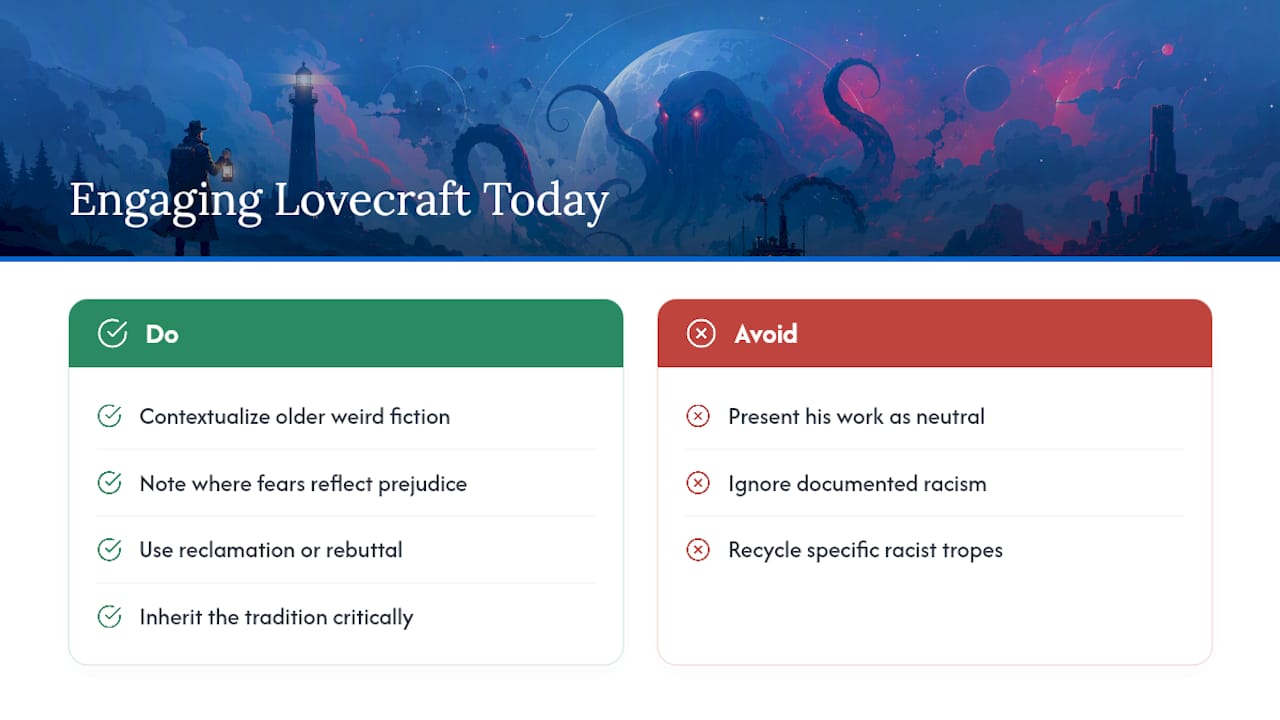
Any honest discussion of cosmic horror has to address where the mode’s most influential figure went wrong. H. P. Lovecraft’s letters and fiction contain documented, explicit racism and xenophobia, views that shaped some of his monsters and plots directly, not just his private correspondence. That’s not a minor footnote. It matters to readers because Lovecraft’s fear of “the unknowable other” was, in several of his own works, tangled up with genuine bigotry toward real people, not just cosmic entities.
Contemporary writers have responded in different ways rather than pretending the problem doesn’t exist. Some have written direct rebuttals and reclamations that use Lovecraft’s own settings against his politics. The New Weird movement broadly, through writers like the VanderMeers and Miéville, treats the older weird tradition as something to inherit critically, keeping the cosmic dread while correcting or interrogating its ideological baggage instead of reproducing it uncritically.
For readers and writers engaging with this material now, the practical guidance is straightforward: contextualize older weird fiction rather than presenting it as neutral, note where a text’s fears reflect its author’s prejudices, and avoid recycling those specific tropes without examination. Cosmic horror’s central insight, that the universe doesn’t revolve around us, doesn’t require carrying forward the specific fears of the man who first wrote it down.
What Weird and Cosmic Elements Actually Do in Fiction
The most useful thing weird and cosmic elements do in fiction isn’t scare readers. It’s disorient them just enough that ordinary moral and emotional stakes suddenly feel fragile. In my own work, that disorientation usually starts small: a character in The Nether trusting a system that was never built to reward trust, or a scientific process in Evolution A200: A Bubonic Apocalypse that keeps behaving exactly according to its own logic while wrecking everything human beings care about. Neither book leans on tentacled gods. Both lean hard on the cosmic horror principle that indifference, not malice, is the scarier force.
That’s the real value of understanding this genre boundary as a writer. You don’t need Lovecraft’s specific mythology to use his central insight. You need a world that keeps operating by its own rules regardless of what your characters want. If that idea interests you, it’s worth spending some time with the fuller catalog on the books landing page.
— Nathaniel
Where to Start if You Want Both Modes in One Book
If the distinctions above have you wanting to see weird and cosmic elements in practice rather than just on the page as theory, two titles cover most of that ground. The Nether Series leans into psychological dread and a dystopian system that treats its characters as expendable, closer to weird fiction’s rupture-of-normal-life register than pure cosmic scale.
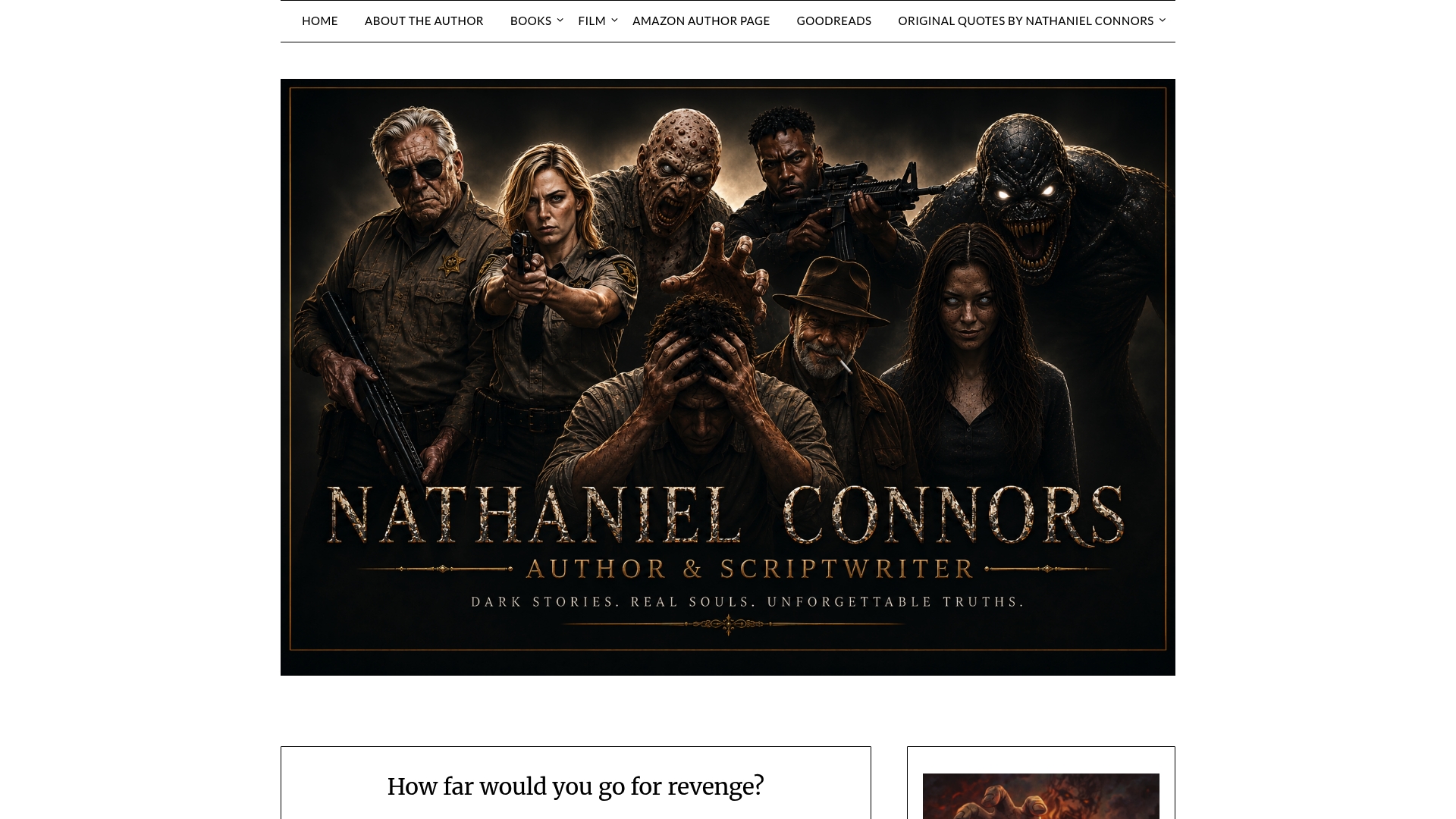
Both series are available in ebook and paperback on Amazon, and Kindle Unlimited subscribers can read them. If you want a low-commitment way to test whether this is your kind of dread, start with The Nether and sample the first chapter before deciding whether to keep going. From there, the full books catalog has the complete lineup if either series pulls you in.
Sources
- Weird fiction — Wikipedia
- What Is Cosmic Horror in Fiction? — Writer’s Digest
- Weird and cosmic short horror fiction and the illustration of existential fears — UTC honors thesis
FAQ
What Made H. P. Lovecraft’s Work Controversial?
Lovecraft’s fiction and personal letters contain documented racism and xenophobia that shaped several of his stories and characters. Modern writers and critics address this directly rather than ignoring it, often through reclamation projects or by critically inheriting his weird tradition while rejecting its prejudices.
What Are the Four Types of Fiction?
Fiction is commonly grouped into realistic, historical, fantasy, and science fiction, though these categories overlap constantly and don’t capture hybrid modes like weird fiction. Weird fiction itself deliberately mixes horror, fantasy, and science fiction rather than sitting in one lane, which is part of why the Wikipedia definition treats it as a mode rather than a fixed genre.
What Counts as Weird Fiction?
A story counts as weird fiction when it produces a mixture of awe and unease through a rupture in natural law, typically without relying on traditional Gothic monsters like vampires or werewolves. Cosmic horror is one strain of the weird mode, but weird fiction also covers stories that never touch cosmic scale, like Shirley Jackson’s haunted-house work or Mark Z. Danielewski’s House of Leaves.
Is Stranger Things Lovecraftian Horror?
Stranger Things borrows visual and atmospheric elements from Lovecraftian horror, particularly its otherworldly Upside Down and tentacled Mind Flayer, but it stays closer to adventure horror than true cosmic horror. The show’s characters retain real agency and consistently affect the outcome, which runs against cosmic horror’s core premise of human insignificance against indifferent, incomprehensible forces.