
Dark speculative fiction is any story that uses a nonrealist frame (science fiction, fantasy, horror, alternate history) to explore existential dread, social collapse, or psychological breakdown rather than comfort or escapism. This guide defines the term, maps its major branches, and hands you a curated reading list, including work from Nathaniel Connors, sorted by the mood or question you’re chasing.
TL;DR:
- Dark speculative fiction often explores systemic collapse, psychological breakdown, or existential dread through subgenres like dystopian, horror, weird, gothic, and Black speculative fiction.
- Its narratives use tools such as unreliable narration, moral inversion, ambiguous endings, and settings built on scarcity to heighten psychological and societal unease.
- Different subgenres emphasize threats from systems, minds, unknown forces, or moral bargains, which helps identify a book’s primary source of dread.
- The genre’s style frequently features nonlinear structures, claustrophobic perspectives, slow pacing, and environmental symbolism to evoke disorientation and decay.
- Readers should focus on mood and thematic intent rather than classic titles, choosing works that match their desired emotional experience or mood.
Table of Contents
- What Dark Speculative Fiction Actually Means
- The Subgenres That Feed Into Dark Speculative Fiction
- The Craft Behind the Dread
- Where to Start, Based on What You Want
- How Different Voices Expand the Genre
- Author Spotlight: Nathaniel Connors
- Where Dark Speculative Fiction Came From
- The Authors Who Shaped the Genre
- Dark Speculative Fiction vs. Horror and Traditional Speculative Fiction
- Techniques That Define the Genre’s Style
- An Editorial Take on Reading Dark Speculative Fiction
- Start Reading Dark Speculative Fiction Tonight
- Sources
What Dark Speculative Fiction Actually Means
Speculative fiction is the umbrella term literary scholars use to cover fantasy, science fiction, horror, and any story that asks “what if reality worked differently?” It’s the parent category, and Wikipedia’s overview of the genre treats it as a container rather than a single tradition. Dark speculative fiction is what happens when that container gets pointed at the worst possibilities inside a premise instead of the most wondrous ones.
That distinction matters because “speculative” alone tells you nothing about tone. A story about a colony on Mars can be a triumphant adventure or a slow suffocation of hope, depending on what the author does with isolation, resource scarcity, and human fallibility. Dark speculative fiction leans into the second version. It uses the “what if” not to marvel at possibility but to press on where a society, a mind, or a body might break.
Some practitioners argue the term works best as a tone rather than a fixed shelf category. That framing, as House of Gamut’s curated list of dark speculative titles suggests, lets a single writer move between science fiction, fantasy, and literary fiction while still contributing to a coherent dark field. A few quick comparisons show the shift in practice:
- A first-contact story that ends in wonder is speculative fiction. One that ends in the slow realization that humanity was never in control is dark speculative fiction.
- A fantasy quest where the hero saves the kingdom is speculative fiction. One where the hero becomes the thing they set out to destroy leans dark.
- A near-future tech thriller about a helpful new device is speculative fiction. One where that device quietly erodes free will is dark speculative fiction.
The word “dark” isn’t decoration. It signals that dread, moral compromise, or systemic collapse are doing real narrative work.
The Subgenres That Feed Into Dark Speculative Fiction
No single tradition owns this space. Dark speculative fiction pulls from at least five distinct branches, each contributing its own flavor of unease.
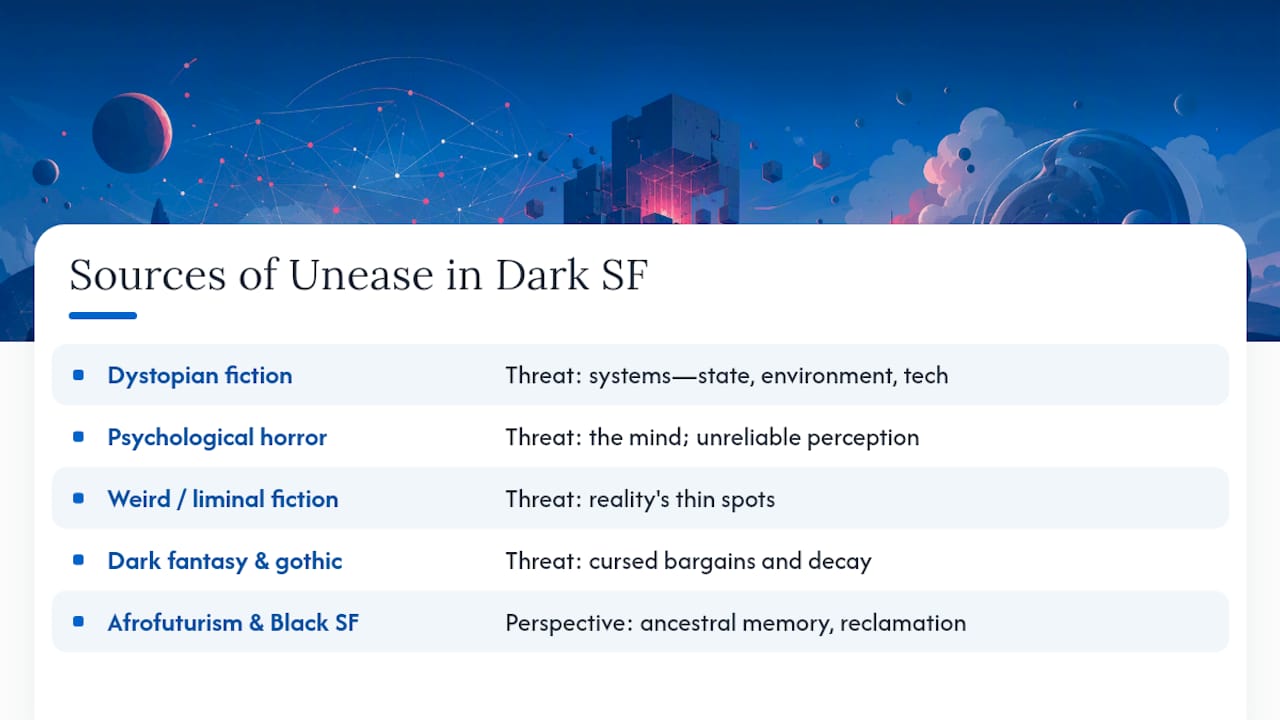
Dystopian fiction works through near-future allegory. It takes a real anxiety, authoritarian creep, environmental collapse, unchecked technology, and pushes it a few decades forward until the warning becomes impossible to ignore. StudioBinder’s breakdown of dystopian characteristics notes that the genre’s near-future setting is what creates its urgency; a dystopia set a thousand years out reads more like fantasy than warning. Utopian and dystopian fiction have long functioned as political commentary on contemporary social trends, which is why so many dystopias age into accidental prophecy.
Psychological horror turns the camera inward. Instead of a monster in the basement, you get an unreliable narrator, a slipping grip on reality, or paranoia that the reader can’t fully distinguish from fact. Psychological horror’s defining feature is that dread, not gore, drives the story, and it overlaps heavily with dark speculative fiction whenever a speculative twist (a curse, a haunting, an altered mind) amplifies that internal collapse.
Weird and liminal fiction sits closer to cosmic horror. It’s less interested in explainable monsters than in the sense that reality itself has thin spots, moments where logic stops applying and something vast and indifferent presses through.
Dark fantasy and gothic fiction borrow the trappings of traditional fantasy (magic systems, secondary worlds, inherited curses) but refuse the genre’s usual optimism. Decaying estates, moral rot passed through bloodlines, and bargains that always cost more than promised are gothic staples that dark fantasy keeps alive.
Afrofuturism and Black speculative fiction reframe the entire conversation. Rather than treating darkness only as threat, these traditions often carry ancestral memory, alternate histories, and political reclamation alongside dread, a broadening documented by Emory Libraries’ research guide on the tradition’s scope.
Pro Tip: If you’re not sure which subgenre a book belongs to, ask what’s actually threatening the protagonist: a system (dystopian), their own mind (psychological horror), an unknowable force (weird fiction), or a moral bargain (dark fantasy). That question sorts most dark speculative books faster than any back-cover blurb.
The Craft Behind the Dread
Dark speculative fiction doesn’t scare or unsettle readers by accident. Writers reach for specific tools, and once you notice them, you’ll spot them everywhere.
Unreliable narration is probably the most common. When you can’t fully trust the person telling the story, every scene carries a second layer of tension: not just what’s happening, but whether what’s happening is even real. Moral inversion does similar work at the plot level, forcing a sympathetic character into a choice that corrupts them, or revealing that the “hero” was compromised from page one. Ambiguous endings deny the reader closure on purpose, leaving the dread to linger past the last page. And worldbuilding built on scarcity (of resources, of freedom, of trust) turns the setting itself into a source of pressure rather than backdrop.
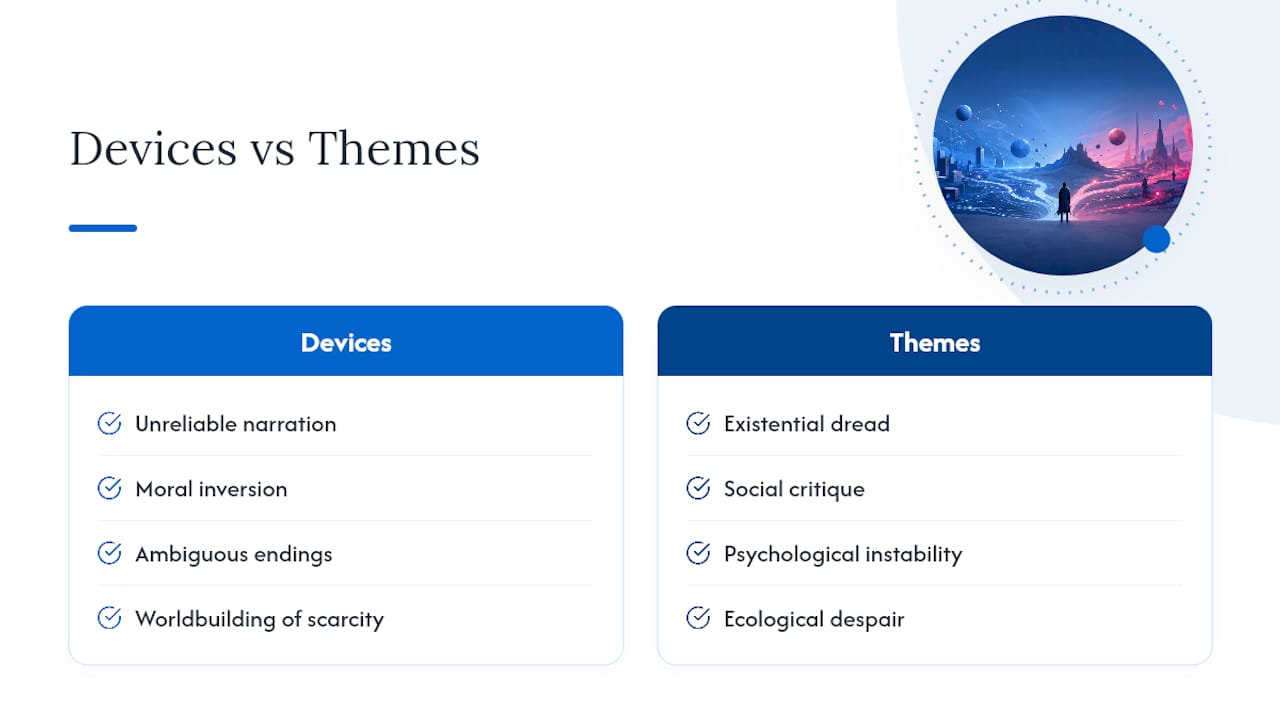
These devices serve a handful of recurring themes: existential dread (the sense that meaning itself is unstable), social critique (systems failing the people inside them), psychological instability (minds that can’t be trusted, including the reader’s own read on events), and increasingly, ecological despair, the fear that the natural world itself has turned hostile or indifferent.
You can see all four themes stacked in a single passage from Butler’s work, where climate collapse, social breakdown, and one protagonist’s fragile grip on safety compound into something closer to dread than adventure:
The speculative premise isn’t the point. It’s the delivery mechanism. A plague, a haunting, a ravaged coastline: these are vehicles for asking what happens to a person, or a society, once the usual guardrails disappear.
That’s the throughline across every subgenre on this list. The monster, the collapse, the curse, none of it matters without a character whose interior state gives the darkness weight.
Where to Start, Based on What You Want
Different readers come to dark speculative fiction chasing different feelings. Pick the mood, not just the subgenre.
- Atmospheric dread: Start with “Annihilation” or “Piranesi.” Both trade plot momentum for a slow, creeping sense that something’s fundamentally wrong with the world’s rules.
- Political allegory: “The Handmaid’s Tale” and “Parable of the Sower” hit hardest here. Both use speculative premises to sharpen real anxieties about control and collapse. Readers who want more in this vein should check out this roundup of dystopian horror novels.
- Psychological mindbender: “We Need to Talk About Kevin” and “House of Leaves” strip away the supernatural and make the reader’s own uncertainty the source of horror. For a primer on where psychological horror ends and thriller begins, see this genre comparison.
- Culturally rooted speculative vision: “Kindred” and “Beloved” use speculative or ghost story frameworks to process historical trauma in ways realist fiction often can’t reach.
- Existential unease: If you want the “why does any of this matter” flavor of dread, this collection on existential horror digs into books built specifically around that question.
How Different Voices Expand the Genre
Afrofuturism and Black speculative fiction don’t just add representation to dark speculative fiction. They change what darkness is allowed to mean. In much of the Western horror and dystopian canon, dread points forward, toward an imagined collapse. In Black speculative traditions, dread often points backward too, carrying the weight of historical violence, alongside speculative elements like ancestral memory and alternate histories that let darkness coexist with reclamation, a dynamic Emory’s research guide on the tradition traces in detail.
That shift changes the emotional register. Octavia Butler’s collapse narratives never feel purely nihilistic, because survival and lineage matter as much as danger. Toni Morrison’s ghosts aren’t there to frighten so much as to insist on being remembered. Readers who want more names in this space should look for N.K. Jemisin, Nnedi Okorafor, and Tananarive Due, each of whom bends speculative dread toward questions of memory, power, and inheritance rather than jump scares.
Author Spotlight: Nathaniel Connors
Nathaniel Connors writes dark supernatural fiction centered on revenge, guilt, and redemption, the psychological wreckage left behind once a haunting or curse forces a character to confront what they’ve buried. Titles like “The Nether,” “Stories of a Condemned Soul,” and “Evolution A200: A Bubonic Apocalypse” span gothic horror, dark fantasy, and dystopian plague fiction, but they share a fixation on the internal cost of guilt, which is what makes them dark speculative fiction rather than straightforward horror.
That range matters. Connors doesn’t stay inside one subgenre lane; he moves between supernatural dread and societal collapse depending on which frame best serves the emotional wound at the center of the story. Readers can sample the full catalog through Nathaniel Connors’s dark supernatural thrillers, with every title free to read for Kindle Unlimited subscribers.
Where Dark Speculative Fiction Came From
The instinct to use imagined worlds for warning or reckoning goes back centuries, but the modern shape of dark speculative fiction owes the most to three overlapping waves. Gothic fiction in the 18th and 19th centuries (think decaying estates, inherited curses, and moral rot) established the idea that atmosphere and dread could carry as much weight as plot. Mary Shelley’s “Frankenstein” pushed that gothic sensibility into speculative territory, using scientific overreach as the source of horror rather than a haunted house.
The 20th century added political urgency. Orwell and Huxley wrote dystopias as direct responses to totalitarianism and industrial control, cementing near-future allegory as a dark speculative staple. Mid-century weird fiction, running through H.P. Lovecraft’s cosmic horror despite the racism embedded in his work, introduced the idea that some threats are too vast for human minds to fully process, a thread that runs straight through to contemporary weird fiction like VanderMeer’s.
The later 20th century brought a crucial expansion: writers like Octavia Butler began using speculative frameworks to process historical trauma and social collapse from perspectives the earlier canon had largely ignored. That expansion, from warning fiction into memory and reclamation, is arguably the most significant shift the genre has seen, and it’s still reshaping what “dark” gets to mean today.
The Authors Who Shaped the Genre
A handful of writers didn’t just contribute books to dark speculative fiction, they redefined what the category could do. George Orwell proved that dystopian allegory could double as urgent political argument, a template every dystopian writer since has worked from or against. Shirley Jackson demonstrated that psychological horror didn’t need a monster; “The Haunting of Hill House” made a building’s ambiguity scarier than any explained threat.
Octavia Butler expanded the genre’s emotional range entirely, using speculative premises (time travel, empathic ability, ecological collapse) to explore slavery’s legacy and climate anxiety with equal weight. N.K. Jemisin carried that expansion into contemporary fantasy, building magic systems explicitly tied to systemic oppression rather than treating fantasy worldbuilding as neutral. Jeff VanderMeer kept weird fiction’s cosmic-dread tradition alive for a new generation, trading Lovecraft’s explicit threats for something closer to ecological unease.
Each of these writers solved a different problem: how to make political critique feel urgent, how to make an unreliable mind terrifying, how to make historical trauma legible through speculative distance, how to make oppression structural rather than incidental, and how to make nature itself feel unknowable again. Dark speculative fiction today draws on all five solutions at once.
Dark Speculative Fiction vs. Horror and Traditional Speculative Fiction
The overlap with horror is real, but the emphasis differs. Horror’s primary goal is usually to produce fear, often through immediate physical threat or supernatural danger. Dark speculative fiction can produce fear too, but its central concern is usually existential or psychological: what does this threat reveal about the character, the society, or the nature of reality itself? A slasher story wants you afraid of the killer. A dark speculative story wants you unsettled by what the killer’s existence implies about the world.
The line against traditional (non dark) speculative fiction is about tone and intent rather than subject matter. A first-contact story, a magic school, a climate-adaptation narrative: any of these can go either direction. What tips a story into dark speculative territory is whether it uses its premise to explore dread, moral collapse, or systemic failure rather than wonder, adventure, or hope. Same ingredients, opposite destination.
Techniques That Define the Genre’s Style
Beyond the devices already covered (unreliable narration, moral inversion, ambiguous endings), a few stylistic habits show up again and again. Fragmented or nonlinear structure mirrors psychological breakdown on the page itself, forcing readers to reconstruct events the way a traumatized narrator might. Close, claustrophobic point of view keeps readers locked inside one character’s limited, often compromised, perception rather than granting the safety of an omniscient narrator.
Slow-burn pacing is another signature. Dark speculative fiction rarely front-loads its threat; it lets dread accumulate through small, unsettling details before the full scope of the horror becomes clear. And environmental symbolism, decaying houses, poisoned landscapes, collapsing infrastructure, does double duty as both setting and metaphor for internal or societal decay. Writers reach for these techniques because straightforward exposition can’t replicate the disorientation that makes dark speculative fiction feel dangerous rather than merely described.
An Editorial Take on Reading Dark Speculative Fiction
The biggest mistake readers make with this genre is treating “dark” as a content warning instead of a craft choice. Darkness here isn’t decoration bolted onto a plot to make it edgier. It’s the mechanism that lets a story ask harder questions than a hopeful narrative usually can. That’s why Butler’s plague-ravaged California and Connors’s guilt-haunted characters belong on the same reading list despite looking nothing alike on the surface.
The conventional advice to “start with the classics” undersells how much the genre has expanded. Orwell and Shelley built the foundation, but Afrofuturism and Black speculative fiction have done more to reshape what darkness can mean in the last fifty years than any single dystopian classic. If you’re serious about understanding this space, don’t treat diverse voices as a side quest after the “real” canon.
Start with mood, not chronology. Figure out whether you want dread, reckoning, or disorientation, then let that choice, not a syllabus, decide your next book.
— Nathaniel
Start Reading Dark Speculative Fiction Tonight
Most curated lists point you toward a dozen authors and leave you to hunt down each book separately, comparing prices across a dozen tabs. This guide highlights a few distinct entry points into the genre corresponding to supernatural guilt, gothic reckoning, and dystopian collapse, with several titles available for Kindle Unlimited subscribers.
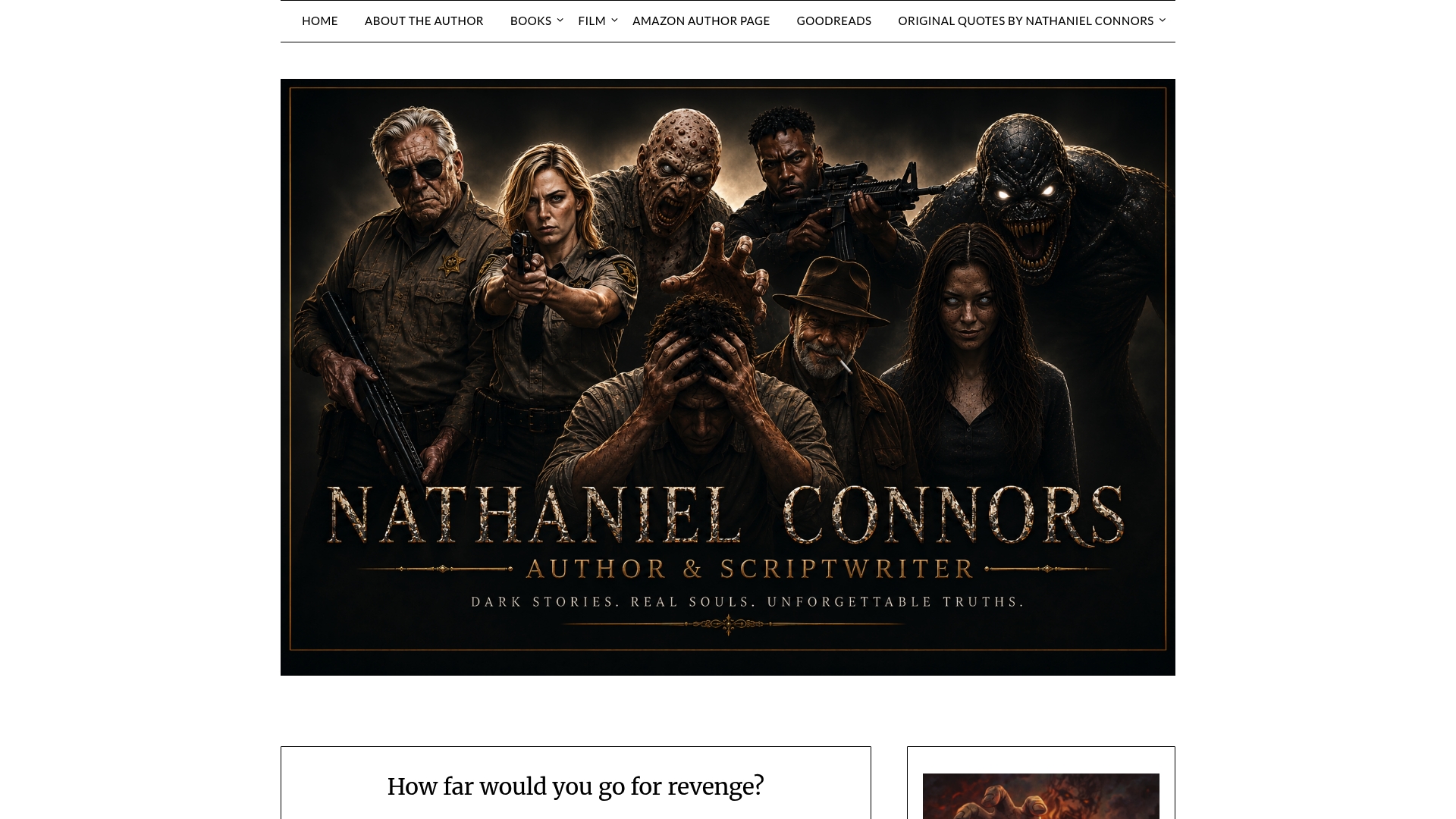
That range means you don’t have to guess which subgenre fits your mood before committing. If tonight calls for a haunting built on buried guilt, or a plague narrative that reads closer to Butler’s societal breakdowns than a zombie thriller, both live in the same catalog rather than scattered across different authors’ backlists. Start with Nathaniel Connors’s dark supernatural thrillers and pick the title that matches the dread you’re actually looking for tonight.
Sources
A few resources go deeper into specific pieces of this genre map:
- Speculative fiction – Wikipedia
- What is Dystopian Fiction? Definition and Characteristics – StudioBinder
- My Top 20 Dark Speculative Fiction Books of 2023 – House of Gamut