Character driven horror is horror that runs on interiority and emotional stakes: the dread comes from who the person is, what they carry, and what they cannot face, not from what jumps out of the dark. Below you will find curated film and book picks, each tied to a specific character trait, plus a checklist for choosing more.
TL;DR:
- Look for reviews that mention psychological intimacy, unreliable narration, an ambiguous threat, and aftermath rather than body counts before choosing a title.
- For empathy and heartbreak, choose Presence or Pet Sematary; for existential doubt, try The Witch or The Turn of the Screw.
- Readers new to the genre can start with Hereditary on screen or The Haunting of Hill House in print; slow pacing rewards patience.
- Horror draws 91% Gen Z engagement, and 17% of North American ticket purchases went to scary movies as of 2026.
Table of Contents
- What makes horror character-driven instead of plot-driven?
- The core elements and techniques behind character-first dread
- Character-driven horror films, and what each one shows you
- Character-driven horror books and collections worth reading
- Why character-driven horror resonates right now
- How to choose a character-driven horror book or film
- How character-driven horror grew into its own tradition
- Techniques authors use to deepen character psychology
- Guilt, redemption and revenge as character engines
- Setting and atmosphere as an extension of the mind
- How flaws and growth arcs shape tension and resolution
- Why the monster should always be a person: an author’s view
- Start your character-driven horror reading with our books
- FAQ
- Sources
What makes horror character-driven instead of plot-driven?
A horror story is character-driven when the central question is “what is happening inside this person?” and not “what will happen next?” The monster, the house or the curse matters because of what it does to someone’s sense of self. Remove the supernatural element and a human drama still stands.
Plot-driven horror works the other way around. It wants to know who survives, how the killer is stopped, what the rules of the threat are. Characters serve the machinery.
Here is what you will usually find in the character-first version:
- Interiority: we spend real time inside a mind, through narration, close point of view or long, quiet scenes.
- Arcs with consequences: choices change people, and the damage lingers after the credits or the last chapter.
- Emotional stakes before physical ones: losing a child, a marriage or a grip on reality hurts more than a chase.
- Familiar forms: domestic and household horror, grief-driven hauntings, and unreliable narrators.
Readers who prefer the psychological label will recognize the overlap. Psychological horror is the closest cousin, and our own guide to psychological horror without gore covers how that dread is built. If you are unsure where the thriller ends and horror begins, our breakdown of psychological thriller versus horror draws the line.
The core elements and techniques behind character-first dread
Strip away the genre trappings and the same handful of tools show up again and again.
A believable normal comes first. Effective character-driven horror establishes normalcy and relatable human tension before anything supernatural arrives, so that when the distortion comes, the stakes feel emotional or existential, not merely a matter of survival. If you do not care about the kitchen table, you will not care when it shakes.
Ambiguity does the heavy lifting. When a threat stays unexplained, you project your own anxieties onto it. Critics describe how this kind of horror often activates archetypal structures such as the shadow self, the devouring mother and inherited trauma, while keeping the threat open enough that you fill in the rest.
The supernatural becomes a symbol. One reviewer reads the supernatural elements in Hereditary as devices that literalize inner states, such as inherited family trauma. The ghost is the grief.
A few craft markers to watch for:
- Unreliable narrators and tightly restricted points of view that trap you in one head.
- Slow-burn pacing that lets a scene sit long enough to become uncomfortable.
- Ensemble character studies, where several people each hold a different piece of the same wound.
- Endings that resolve the person, not necessarily the plot. If a finale leaves you puzzling, our method for decoding ambiguous horror endings can help.
Pro Tip: Genuine interiority changes how a character perceives things, not just what happened to them. A dead sibling in the backstory is surface. A character who flinches at a sound, rewrites a memory or cannot look at a doorway is interiority.
Character-driven horror films, and what each one shows you
Pick by the emotional experience you want. Each entry names the trait on display and the kind of dread it produces.
- Hereditary: family trauma made literal. Its dread is the slow suffocation of a household that cannot stop hurting itself.
- Resurrection: a study in psychological abuse, where ambiguity puts you inside the protagonist’s confusion and isolation. Expect claustrophobic, paranoid unease.
- Presence: a ghost story built on a restrictive point of view that turns the audience into the haunting presence. The dread is quiet, intimate and sorrowful.
- Weapons: an ensemble told in fractured, diary-like episodes. Reviewers praise how it builds suspense through multiple characters’ perspectives, so the unease accumulates piece by piece.
- The Babadook: grief and exhaustion given a body. Its dread is a parent running out of patience and strength.
- Midsommar: a breakup and a bereavement drifting into a cult setting. The dread is emotional dependency in broad daylight.
- The Witch: a devout family fracturing under suspicion and fear. The dread comes from belief eating relationships alive.
- Rosemary’s Baby: a woman gaslit by the people closest to her. Paranoia and isolation do the work.
- A Dark Song: two damaged people locked in a house for a ritual, each driven by loss. The dread is grief with a deadline.
- Black Swan: perfectionism as a self-inflicted haunting. You watch a mind come apart in real time.
Several of these are slow, and that is the point. Give them the patience they ask for. You can also browse community-curated collections such as the Character Study Horror/Drama list on IMDb to keep going once this watchlist runs out.
Character-driven horror books and collections worth reading
Prose has an advantage film cannot match: it can sit inside a head for hundreds of pages. Where a movie shows a character’s face, a novel gives you the unspoken thought, the rationalization, the memory they keep editing. That makes books a natural home for this kind of horror.
- The Haunting of Hill House, Shirley Jackson: Eleanor’s loneliness and longing are the real haunting. The house simply reflects them back.
- We Have Always Lived in the Castle, Shirley Jackson: a sealed-off narrator whose cheerful voice hides something terrible.
- Beloved, Toni Morrison: a ghost story where memory and guilt are the haunting.
- The Shining, Stephen King: a hotel works on a father’s resentments, addictions and failures until they become a weapon.
- Pet Sematary, Stephen King: grief and the bargain it tempts a decent man to make.
- Rebecca, Daphne du Maurier: a nameless narrator undone by insecurity and a dead woman’s reputation.
- The Turn of the Screw, Henry James: the textbook unreliable narrator, where you can never settle whether the threat is real.
- Mexican Gothic, Silvia Moreno-Garcia: family control and decay told through a heroine’s slowly shifting perception.
- Stories of a Condemned Soul, Nathaniel Connors: a collection of dark supernatural tales about revenge, guilt and redemption.
- The Nether, Nathaniel Connors: a dystopian horror novel that follows its characters’ psychological fallout, not just the apocalypse around them.
Notice how many of these use a first-person or tightly limited narrator. In prose, interiority is built through voice: what a narrator notices, what they avoid saying and where their story stops adding up. If you want sample chapters before you commit, a psychological horror reading list sorted by mood offers previews. Reading in a group? Our horror book club questions work well for character-first titles.
Why character-driven horror resonates right now
Part of the appeal is simple demand. Gen Z is the generation most likely to consume horror media, with 91% engagement, and the same source reports that scary movies account for 17% of North American ticket purchases as of 2026.
Gen Z engages with horror at a 91% rate, and scary movies make up 17% of North American ticket sales as of 2026. That is a large, loyal audience, and it is not only chasing jump scares.
Reporting connects that audience’s taste to darker, socially aware stories. Coverage of the trend notes that the generation enjoys the honesty and analytical side of character-driven horror, and that viral, curiosity-piquing films pull people in. A story that mirrors real anxiety invites you to think, not only flinch.
Ambiguity is a big part of why this lands. When a film refuses to explain itself, you stay inside the protagonist’s uncertainty, and the unease lingers well after the screen goes dark. One therapist quoted in coverage of Resurrection’s ending says the shift toward psychological, character-driven horror reflects audiences wanting honest responses to real-world trauma and a place to sit with complicated feelings.
Television is part of the picture too. Analysis of The Terror: Devil in Silver argues it builds slow-burn dread through institutional confinement and ambiguity, with consequences for characters standing in for spectacle.
How to choose a character-driven horror book or film
You can screen almost any title in a minute. Look for these signals in the synopsis, the reviews and the first few pages or scenes:
- Interiority language: reviewers mention “psychological,” “intimate,” “slow burn,” “character study” or “unreliable.”
- An ambiguous threat: if critics argue about what was real, that is usually a good sign.
- Consequence over spectacle: the story lingers on aftermath, not the body count.
- A normal world established early: you get to know the people before things go wrong.
- Quiet openings: a first act that earns trust instead of rushing to a scare.
A few pairings help. Pick Presence or Pet Sematary if you want empathy and heartbreak. Pick The Witch or The Turn of the Screw if you want existential dread and doubt. Pick Rosemary’s Baby if paranoia is your flavor.
First-timers should start with Hereditary on screen or The Haunting of Hill House on the page. If you prefer your dread in a dystopian setting, our list of dystopian horror novels is a good next stop.
How character-driven horror grew into its own tradition
The roots go back to the gothic novel, where haunted houses always doubled as haunted minds. Henry James and Shirley Jackson sharpened the idea: put an uncertain narrator in a charged space and let the reader wonder how much of the horror lives outside her head.
Mid-century paperbacks and films pushed the form toward domestic life. Rosemary’s Baby made paranoia a household matter, and later writers made grief, addiction and family damage the engine of dread. By the time modern prestige horror arrived, audiences were already trained to read monsters as metaphors.
Genre conventions have also been reexamined from the inside. Carol J. Clover’s concept of the Final Girl is a case in point: later critical work, as one analysis of the Final Girl growing up shows, notes how franchises revisiting survivors retroactively fill them with trauma and interiority. The stock survivor becomes a person with a past.
The pattern across all these eras is the same. Whenever horror gets stale, it turns inward again, and the most durable work asks what fear does to a particular human being.
Techniques authors use to deepen character psychology
Writers have a surprisingly practical toolkit for building a mind the reader can fall into.
Control the point of view. Close third or first person limits what you can know. If the narrator avoids a topic, you feel the avoidance.
Let small habits carry the weight. A character who repeatedly checks the locks, or never says a name aloud, tells you more than a page of backstory.
Shrink the scope. Creator Ian McCulloch explained that adapting a story for the series Teacup meant narrowing an epic to a small group of characters so the audience cares about how they react. Fewer people means more room for each of them.
Make the flaw load-bearing. The trait that makes someone sympathetic should also be the one the horror exploits.
Let the reader doubt. Contradictions between what a narrator says and what the scene shows build unease without a single monster. Our full craft walkthrough on how to write psychological horror goes step by step through these moves, and a companion piece on building a supernatural thriller without gore applies them to the supernatural.
Guilt, redemption and revenge as character engines
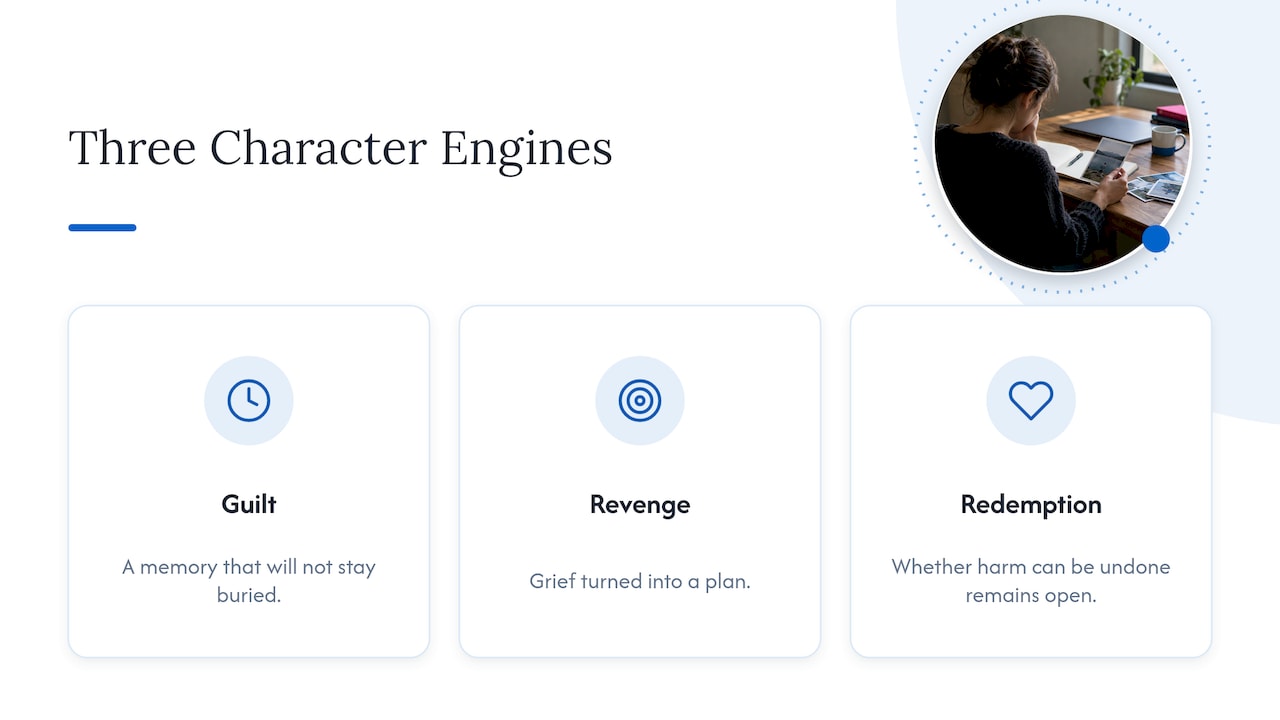
These three themes show up so often because they are internal pressures that a story can make external. Guilt is a memory that will not stay buried. Revenge is grief with a plan. Redemption is the question of whether any of it can be undone.
Grief is the entry point for many of the best examples. Writing on how horror helps us confront loss argues that the genre gives grief a shape you can look at directly, so a haunting becomes a way to feel something that is otherwise hard to name.
Guilt works especially well because it needs no villain. A character who did something unforgivable will see the consequences in every shadow, and the reader keeps asking whether the haunting is punishment or conscience. Revenge stories turn the same pressure outward, then show the cost to the avenger. A good one asks what a person becomes while pursuing it.
Redemption is the hardest to land. The strongest endings do not hand it out. They leave the question open, because certainty would be cheaper than the truth.
Setting and atmosphere as an extension of the mind
In character-first horror, the place is rarely just a backdrop. A house, a hospital or a small town works like a second narrator, reflecting whatever the protagonist cannot say aloud.
Confinement is the classic version. When a story keeps people in one location, the walls start to feel like the character’s own limits. The analysis of The Terror: Devil in Silver mentioned earlier points to this: institutional confinement feeds slow-burn dread because characters cannot escape the consequences of their choices.
Atmosphere also controls rhythm. Long, still shots or long, unhurried paragraphs force you to sit with discomfort. Soderbergh’s Presence goes further and commits to realism and a restrictive viewpoint so the house itself is the lens, a choice critics praise for its intimate character focus.
The most effective settings are ordinary: a kitchen, a nursery, a hallway you have walked a thousand times. Ordinary places carry memory, and memory is what character-driven horror feeds on.
How flaws and growth arcs shape tension and resolution
Flaws are the fuel. A character who is stubborn, proud, avoidant or secretive gives the story somewhere to apply pressure, and the tension comes from watching that trait collide with the threat.
Think of any strong example. The mother who cannot admit she is losing control. The narrator who will not look at the thing in the corner. The husband who rationalizes every warning. The horror escalates because the flaw prevents the one sensible action.
Arcs are where resolution lives. Some stories let a character change and pay for it. Others show someone refusing to change and being destroyed by it. Both can satisfy, as long as the ending follows from who the person was all along.
Beware of arcs that feel bolted on. If a character suddenly finds courage near the end with no groundwork, the dread evaporates. The best finales feel inevitable in hindsight: the flaw, the choice and the consequence line up so cleanly that you realize the ending was waiting from the first scene.
Why the monster should always be a person: an author’s view
I write dark supernatural fiction because I care less about what is in the room than about who is standing in it. Every horror I have written started with a person carrying something heavy: a debt, a death, an act they cannot take back. The creature, the curse or the collapse of the world arrives to make that weight visible.
When I build a story, I ask one question before I plan a single scare: what does this character most need to avoid looking at? Then I put it in the next room. A scene that works on the page usually works because the reader sees the avoidance before the character does.
That is why the books I publish keep returning to revenge, guilt and redemption. Scares fade by the next morning. A character you understood, and maybe feared you resembled, stays with you much longer.
— Nathaniel
Start your character-driven horror reading with our books
If this article leaves you wanting more of the same, we write exactly this: dark supernatural and dystopian fiction where the psychology is the plot’s engine. Stories of a Condemned Soul and our Nathaniel Connors Dark Supernatural Thrillers guide are good first stops if you want interior, guilt-soaked dread.
Want a dystopian character study with slow-burn tension? The Nether follows its people through the aftermath, and our Evolution A200 books, starting with A Bubonic Apocalypse, carry that same emotional focus into a larger collapse. Our books are available on Kindle Unlimited, so subscribers can read them at no added cost. Browse the whole book catalog, sample a title and see which one you want to sit with first.
FAQ
What are the top character-driven horror movies?
Strong starting points include Hereditary, Resurrection, Presence, The Babadook, The Witch and Rosemary’s Baby. Each puts a character’s inner state at the center and uses the horror to reveal it. Pick by the kind of dread you want, from grief to paranoia to isolation.
What is an example of a character-driven story?
Shirley Jackson’s The Haunting of Hill House is a classic: the house matters because of what it does to Eleanor’s loneliness and longing. On screen, Hereditary works the same way, since the supernatural elements literalize inherited family trauma. In both, the human drama would still stand without the ghost.
Why does Gen Z like horror?
Reporting links the generation’s appetite to a preference for stories that reflect social anxieties and invite analysis. Critics note that Gen Z enjoys the honesty and analytical aspects of character-driven horror, and viral, curiosity-piquing releases pull new viewers in.
What makes a horror story character-driven?
It centers on interiority, emotional stakes and consequences instead of a chain of scares. The threat is usually ambiguous, and it reveals who the characters are. If the story still works with the monster removed, it is probably character-driven.
Sources
- Tim Roth and Rebecca Hall’s Unsettling Psychological Horror Movie Features Two of Their Best Performances Ever
- Lithub