
A dystopian ethics book is one where the plot hangs on a moral choice, not on the machinery of the future. Who gets sacrificed? Who looks away? What does a person owe a community that is quietly rotten? The best starting points are Orwell, Huxley and Zamyatin for power and control, Le Guin and Lowry for the cost of a perfect society, and Ishiguro for the ethics of using people. Below we sort them by the question each one asks, then show you how to read them.
TL;DR
- Ethics-first dystopias put a hard moral dilemma at the center, and the setting exists to make that dilemma unavoidable.
- Start with the “big three” (Zamyatin, Huxley, Orwell) for control and agency, then move to Le Guin and Lowry for sacrifice.
- Modern picks such as Ishiguro’s clone novel ask who a society treats as expendable.
- Read with a few fixed questions in mind: who benefits, who pays, who knows, and what would you do?
- Our own dystopian horror, The Nether and the Evolution A200 books, is on Kindle Unlimited if you want the ethics with real dread.
Table of Contents
- What makes a dystopian book an ethics book
- The foundations: power, control and the individual
- Sacrifice stories: when the perfect society has a price
- Modern dystopias about who counts as expendable
- Where horror and ethics meet
- Questions to ask while you read
- A reading order that works
- Our perspective: ethics is what scares us most
- Dystopian horror with an ethical core, free on Kindle Unlimited
- FAQ
- Sources
What makes a dystopian book an ethics book
Most dystopias have a bleak society. Fewer make you argue with yourself afterward. The difference is whether the story treats the world as scenery or as a moral experiment.
Critics have long described the genre as an exercise in moral imagination: it does more than predict the future, it gives readers a way to see and resist oppressive power in their own lives by exploring the limits of agency and sacrifice. That framing is useful when you are choosing what to read. You are not looking for the grimmest world. You are looking for the book that corners a character, and through the character you, into a decision with no clean exit.
Three signs you have found one:
- The villain is a system, and the system has reasons. The rules make sense to the people enforcing them.
- The protagonist’s choice costs someone else. Survival and conscience pull in different directions.
- The ending refuses to settle the question. You close the book still arguing.
If you want the genre’s boundaries first, our guide to what dystopian horror means covers how a society itself becomes the monster. And if you are unsure whether a book you have in mind is dystopian at all, see how dystopian and post-apocalyptic fiction differ.
The foundations: power, control and the individual
The canonical “big three” are Yevgeny Zamyatin’s We (1920), Aldous Huxley’s Brave New World (1932) and George Orwell’s Nineteen Eighty-Four (1949). Scholars cite them as the works that established the genre’s core tropes: totalitarian control, technocratic dehumanization and the suppression of individual agency. Each one attacks a different moral comfort.
| Book | The ethical pressure point | Question it leaves you with |
|---|---|---|
| We | A state that has turned happiness into arithmetic | Is a life without choice still a life? |
| Brave New World | Comfort and pleasure as tools of control | Would you give up truth for contentment? |
| Nineteen Eighty-Four | Power that wants to rewrite what people can think | What do you owe the truth when it is dangerous? |
A caution about reading Orwell as prophecy
It is tempting to treat these books as predictions that either came true or did not. A Cambridge Companion chapter argues that Nineteen Eighty-Four is misread when it is separated from its time, around 1948, a postwar world divided into spheres of influence after the atomic bomb. Read it as a moral warning about the abuse of power and it keeps its edge. Read it as a forecast and you will spend your time scoring it.
That shift in approach is the whole trick with ethics-driven dystopias. Ask what the book wants you to feel responsible for, not whether it was right.
Sacrifice stories: when the perfect society has a price
If you want the purest moral dilemmas, go to the shorter, sharper works that are built around a single sacrifice. Scholars of the genre point to Ursula K. Le Guin’s “The Ones Who Walk Away from Omelas” and Lois Lowry’s The Giver as seminal texts on sacrificial ethics, because both make the reader face the moral cost of keeping a seemingly perfect society running.
“The Ones Who Walk Away from Omelas”
Le Guin’s story dates from 1973 and works as an allegory. One analysis reads it as a commentary on American culture in the Vietnam era, and notes that it offers no easy answers. It takes twenty minutes to read and a week to shake off. Its power comes from the fact that it implicates you: you enjoy the city before you learn what holds it up.
The Giver
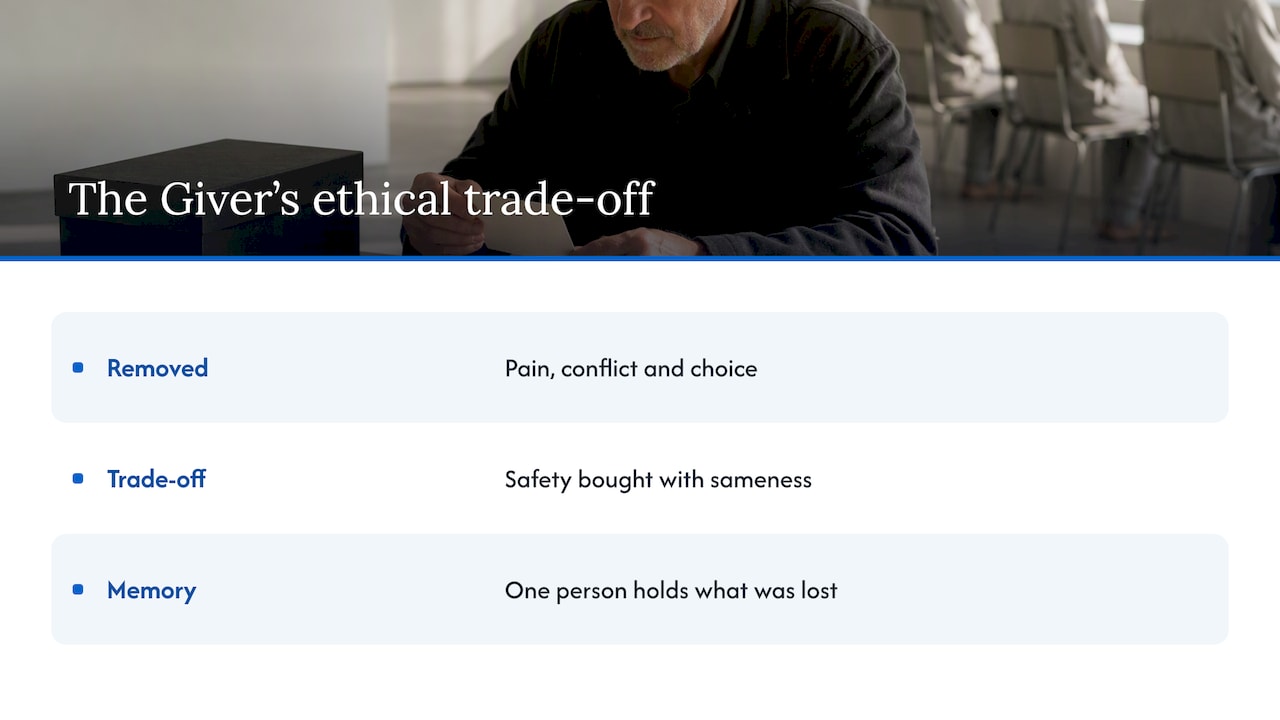
Lowry’s novel asks a younger-sounding version of the same question. A community has removed pain, conflict and choice, and a single person holds the memory of what was lost. The ethical weight is in the trade: safety bought with sameness. It reads quickly, so it is a good entry for readers new to the genre or for anyone sharing the conversation with a teenager.
For more in this compact format, our list of dystopian short stories, classic and modern is a good next stop, and short dystopian novels for one-sitting dread covers the book-length options.
Modern dystopias about who counts as expendable
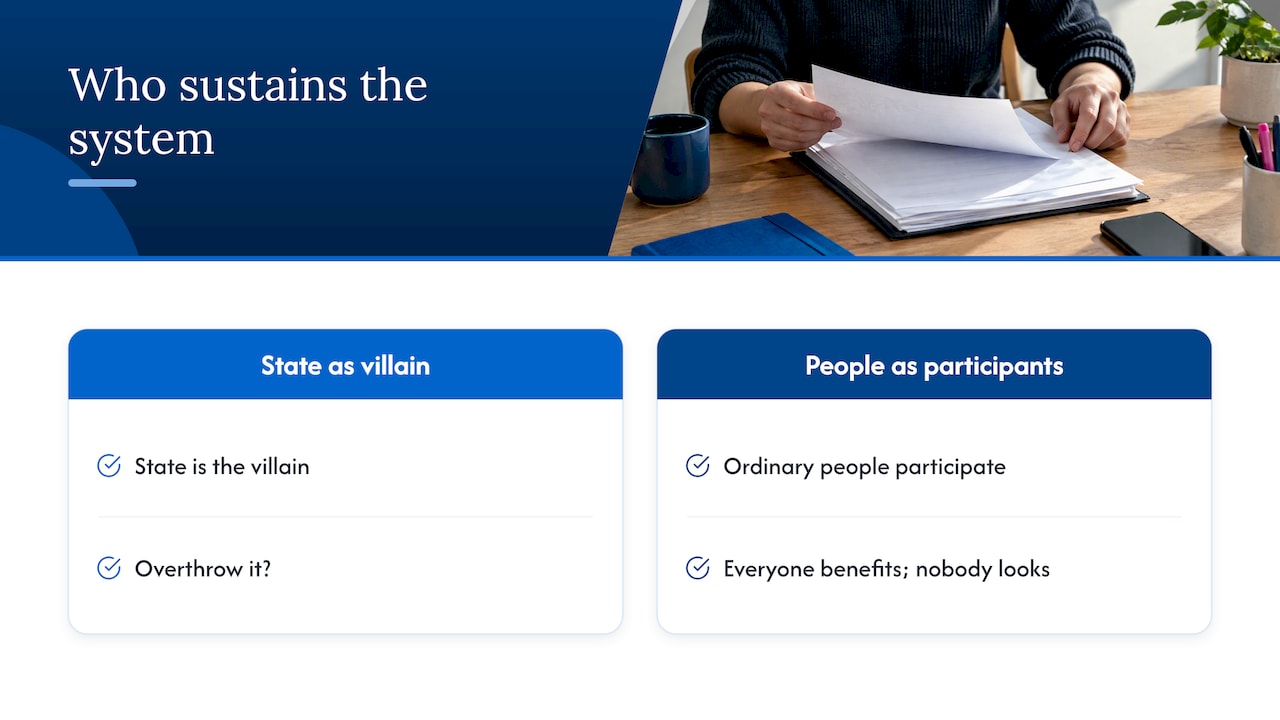
Newer dystopian fiction tends to move from the state as villain to ordinary people as participants. Ishiguro’s Never Let Me Go (2005) is the clearest example. It is a science fiction novel about clones who confront mortality, love and the ethics of their own existence. Nothing in it looks like a regime. The horror is how calm everyone is.
That quiet tone is a hallmark of the modern ethics dystopia. Instead of a dictator, you get a system that everyone benefits from and nobody wants to look at. Readers who want similar books often search for fiction on class division, capitalism and bodily exploitation, and the pattern holds across all of them: the question is no longer “how do we overthrow it?” but “why are we all fine with it?”
Where horror and ethics meet
Horror readers sometimes assume ethics-heavy dystopias are dry. They are not, when the fear comes from the choice itself. Guilt, revenge and the wish to be forgiven are very effective engines for dread, because the monster is partly inside the person who made the choice.
That is the territory we work in. If you want curated reading in this overlap, see our picks for the best dystopian horror novels, and for survival dilemmas in particular, five questions on apocalyptic survival ethics, tested by four novels. Post-collapse settings strip away institutions and leave only people deciding, which is why our list of post-apocalyptic survival books belongs on any ethics reading list.
Questions to ask while you read
A short checklist turns a good read into a real discussion, whether you are alone, in a book club or in a classroom.
- Who benefits? List the people the system serves. Be specific.
- Who pays? Find the person or group absorbing the cost. Do the characters name them?
- Who knows? Separate those who understand the price from those who have chosen not to.
- What is the smallest refusal? Note the least dramatic act of resistance the book allows. It is often more revealing than the big revolt.
- What would you have done on page one? Decide before the protagonist does, then see where you diverge.
A useful habit: write your answer to the fifth question before you read the second half. Rereading it afterward is humbling, and that is the point of the genre.
A reading order that works
You do not have to read forty books. A sequence of five covers most of the ground:
- Start short: “The Ones Who Walk Away from Omelas” for the core dilemma in a single sitting.
- Add a gentle gateway: The Giver for the trade between safety and freedom.
- Go to the canon: Nineteen Eighty-Four or Brave New World, depending on whether you fear coercion or comfort more.
- Read the origin: We, to see where both of the others came from.
- Finish modern: Never Let Me Go for the quietest and arguably cruelest version of the question.
Then move to horror, where the same questions come with a pulse.
Our perspective: ethics is what scares us most
We write dark supernatural and dystopian fiction, and the thing we keep returning to is that readers do not remember the monster. They remember the decision. In our books the themes are revenge, guilt and redemption, and the deeper psychological monsters people carry, because a threat you can shoot is less frightening than a choice you cannot undo.
That is why we think the best dystopian ethics books share a trait with good horror: they do not let the reader off. Rich characters matter more than rich worldbuilding, since you only feel the ethical weight when you care who is paying. And a plot has to be intricate enough that the easy answer is tempting before it fails. We want you thinking about a story days after it ends, and we judge our own work by that standard first.
If you read dystopias for ideas, read them also for the people inside the ideas. The system is the setting. The conscience is the story.
— Nathaniel
Dystopian horror with an ethical core, free on Kindle Unlimited
If you want these questions wrapped in dread, our Nathaniel Connors books are a natural next step. The Nether is a dystopian horror and thriller, and Evolution A200: A Bubonic Apocalypse takes survival ethics into plague territory. They are available as ebooks and paperbacks on Amazon, and Kindle Unlimited subscribers can read them without paying extra. For a gentler on-ramp, our dark supernatural thrillers starting guide will point you to the right title.
FAQ
What are the big three dystopian books?
The three most often named are We by Yevgeny Zamyatin, Brave New World by Aldous Huxley and Nineteen Eighty-Four by George Orwell. Academic writing treats them as the pillars of twentieth-century dystopia. Together they cover coercion, engineered comfort and the loss of individual agency.
What is the most famous book about ethics in a dystopia?
There is no single answer, but Nineteen Eighty-Four is the most widely discussed on the abuse of power, and Le Guin’s “The Ones Who Walk Away from Omelas” is the most cited short work on sacrifice. Which one suits you depends on whether you care more about political power or personal complicity.
What is the darkest dystopian book?
It depends on what you find dark. For quiet, moral horror, many readers point to Never Let Me Go, where nobody rebels. For visceral dread, dystopian horror is the better shelf, and our list of dystopian horror novels is a place to begin.
Are dystopian novels predictions?
Mostly no. Critics argue that Nineteen Eighty-Four, for example, is better read as a protest against abuse of power tied to its postwar moment than as a forecast. Their value is in the moral questions they raise, not in what they got right.
Which dystopian books suit a classroom?
Short works travel best: “Omelas” and The Giver are both widely used because they get to the dilemma fast. If you teach with film, our guide to dystopian short films for classrooms lists ten options that open the same discussion in minutes.
Sources
- The origins of dystopia: Wells, Huxley and Orwell (Cambridge Companion to Utopian Literature)
- Nineteen Eighty-Four: context and controversy (Cambridge Companion to George Orwell)
- Marginalization and Agency in Feminist Dystopian Narratives (Michigan Technological University)
- Before Utopia: The Function of Sacrifice in Dystopian Narratives (Maria Varsamopoulou)
- The Ones Who Walk Away from Omelas by Ursula Le Guin (1973), literary analysis
- Never Let Me Go by Kazuo Ishiguro, summary and analysis