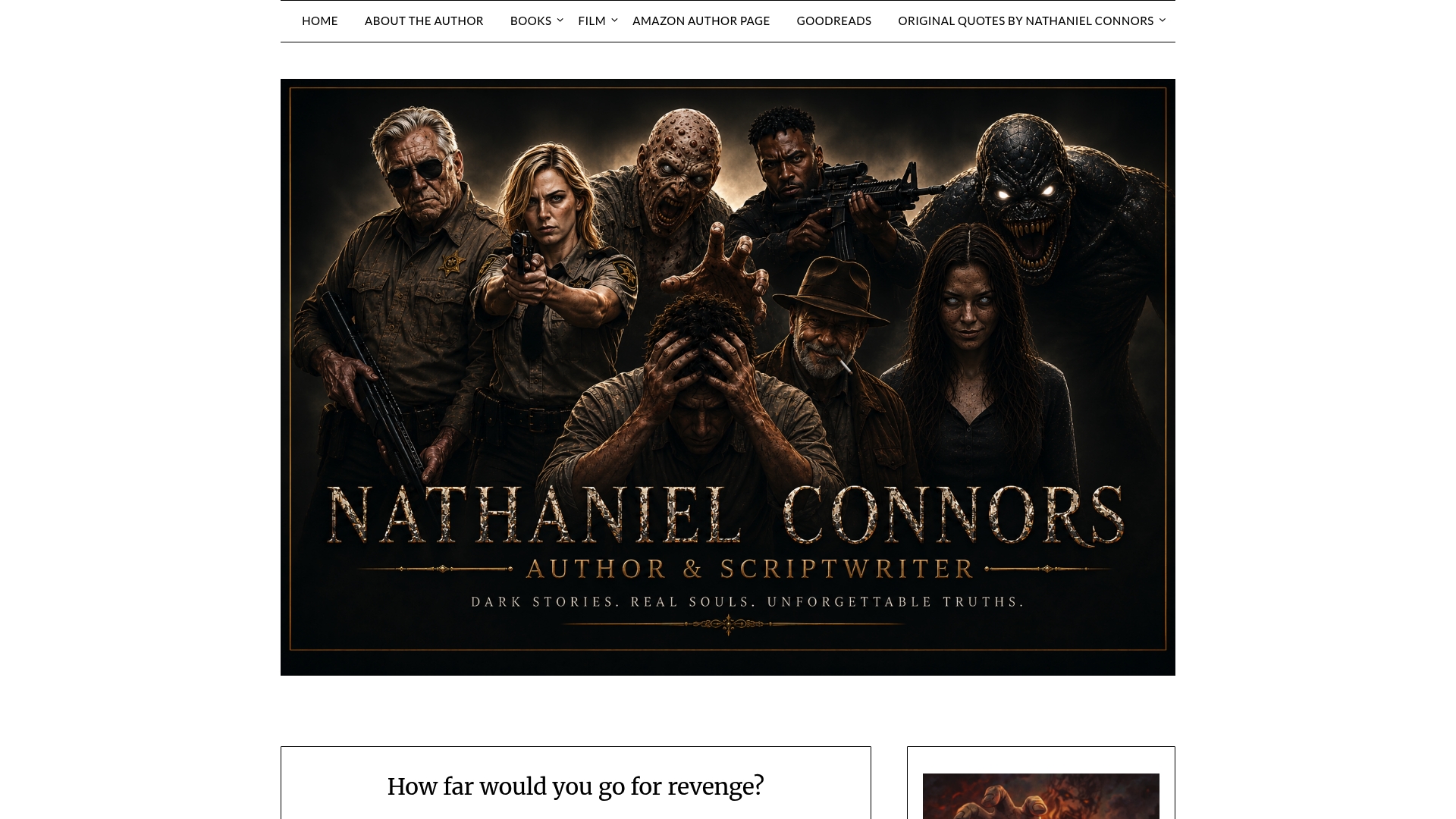
Nathaniel Connors | Dystopian Horror & Thriller Fiction

Where every story begins in the dark.

Menu
  • Home
  • About the Author
  • Books
    • The Nether
    • Evolution A200: A Bubonic Apocalypse
    • Stories of a Condemned Soul (Volume One)
  • Film
    • Room 302 (Short Film)
  • Amazon Author Page
  • Goodreads
  • Original Quotes by Nathaniel Connors
    • Dark Quotes
    • What Remains
    • Where Stories Settle
Menu

Month: August 2026

Woman reading post-apocalyptic book indoors

Best Post Apocalyptic Survival Books: 10 Picks Worth Reading

Posted on August 4, 2026August 4, 2026 by NConnors

The best post apocalyptic survival books on this list were chosen for one reason: they make survival feel real, focusing on the human experience beyond mere survival tactics. Not real as in a prepper manual with chapter headings like “Water Purification,” but real as in you feel the weight of every decision a character makes when the world has stopped cooperating. Here are ten picks that deliver that, ranked by how well they combine tactical plausibility with genuine psychological depth.

Quick picks for readers in a hurry:

  • The Road by Cormac McCarthy — bleakest psychological survival on record; father-son first-person intimacy
  • One Second After by William R. Forstchen — EMP collapse through a small-town family’s eyes; tactically detailed
  • The Dog Stars by Peter Heller — post-pandemic survival told in a lyrical, fractured first-person voice
  • Life As We Knew It by Susan Beth Pfeffer — asteroid impact seen through a teenager’s diary; family-unit realism
  • Earth Abides by George R. Stewart — slow civilizational collapse; one man watching society dissolve
  • Alas, Babylon by Pat Frank — nuclear aftermath in a Florida town; community-formation under pressure
  • Parable of the Sower by Octavia E. Butler — near-future social collapse with a moral framework for rebuilding
  • Evolution A200: A Bubonic Apocalypse by Nathaniel Connors — pandemic-driven collapse with psychological horror at its core; available on Kindle Unlimited
  • The Nether by Nathaniel Connors — dark supernatural survival with deep character interiority; Kindle Unlimited
  • Stories of a Condemned Soul by Nathaniel Connors — short-form psychological horror set against collapse; Kindle Unlimited

Community consensus from Goodreads and Reddit’s r/suggestmeabook threads consistently surfaces The Road, One Second After, and Earth Abides as the benchmarks for realistic survival fiction. Nathaniel Connors’ titles appear on the list because they share the same editorial priority: psychological survival over tactical spectacle.


Table of Contents

  • 1. The best post apocalyptic survival books, reviewed in depth
  • How these books were chosen
  • Why psychological realism matters more than tactics
  • Key Takeaways
  • A note on recommending my own books
  • Nathanielconnors’ titles are worth your next Kindle Unlimited slot
  • Where these picks came from

1. The best post apocalyptic survival books, reviewed in depth

The Road by Cormac McCarthy

A father and son walk south through an ash-gray America after an unnamed catastrophe. McCarthy uses a tight third-person perspective that reads like first-person — you are inside the father’s head for almost every page. The survival realism here is not about gear lists; it’s about caloric math, the ethics of the last bullet, and what it costs to keep a child believing the world is worth surviving. Literary Hub’s survey of apocalypse fiction consistently places it among the benchmarks for psychological survival storytelling. Standalone. Paperback and ebook widely available.

Father and son trekking through post-apocalyptic forest

One Second After by William R. Forstchen

An EMP attack wipes out the power grid, and a small North Carolina college town has roughly six months before starvation becomes the primary cause of death. Forstchen’s protagonist is a military historian, which gives the book its tactical edge: insulin dependency, medication scarcity, and community defense are handled with specificity that most survival novels skip. The viewpoint is tight third-person family, which keeps the stakes personal even when the logistics get granular. Standalone (with sequels available). Paperback and ebook; find it at Bookshop.org.

Group planning survival in small town community hall

The Dog Stars by Peter Heller

A flu pandemic has killed most of humanity, and a pilot named Hig lives at a small Colorado airport with his dog and an armed, paranoid neighbor. Heller writes in a compressed, almost breathless first-person style — sentence fragments, white space, grief folded into every paragraph. The survival mechanics (foraging, fuel management, aerial reconnaissance) feel grounded, but the book’s real subject is what loneliness does to a person over years. Reader communities frequently cite it alongside The Road for lyrical, introspective survival fiction. Standalone. Paperback and ebook.

Life As We Knew It by Susan Beth Pfeffer

An asteroid knocks the moon closer to Earth, triggering volcanic eruptions, tsunamis, and a nuclear winter. Pfeffer tells it through a sixteen-year-old’s diary, which is a smart choice: the family-unit viewpoint captures both the mundane (rationing canned goods, losing heat) and the emotional (watching a parent make impossible decisions). It’s one of the few end of the world novels that handles parental anxiety and adolescent fear simultaneously without either feeling false. First in a series, but reads as standalone. Paperback and ebook; available at Bookshop.org.

Earth Abides by George R. Stewart

A disease kills nearly everyone. Isherwood Williams survives by accident, and the novel follows him across decades as he watches the last remnants of civilization fade. Stewart is less interested in survival tactics than in the sociology of collapse: how skills are lost, how children raised post-collapse relate differently to the old world, and what, if anything, is worth preserving. The Guardian’s list of end-of-the-world novels treats it as a foundational text for exactly this reason. Standalone. Paperback and ebook.

Alas, Babylon by Pat Frank

Nuclear war leaves a small Florida town as one of the few functioning communities in the eastern United States. Pat Frank’s 1959 novel holds up because the survival problems are specific: salt, insulin, radiation contamination of fish, and the social dynamics of a town that suddenly has to govern itself. The viewpoint is ensemble but anchored to one protagonist, which keeps the community-formation arc from feeling abstract. Standalone. Paperback and ebook; find it at Bookshop.org.

Parable of the Sower by Octavia E. Butler

Set in a near-future California where climate collapse and economic failure have shredded social infrastructure, Butler’s novel follows a young Black woman named Lauren Olamina who develops a new belief system as she travels north with a small group of survivors. The survival here is social and moral as much as physical: Butler’s publisher frames it as a parable about which social structures are worth carrying forward. First-person diary format. First in a duology. Paperback and ebook.

Evolution A200: A Bubonic Apocalypse by Nathaniel Connors

A mutated plague reshapes civilization, but Connors is less interested in the logistics of outbreak than in what the collapse does to the people caught inside it. The novel foregrounds internal conflict, guilt, and moral compromise in ways that feel closer to The Road than to a medical thriller. It’s the kind of survival horror novel where the real threat is what the characters are becoming, not just what’s killing them. Available in ebook, paperback, and on Kindle Unlimited. Standalone.

The Nether by Nathaniel Connors

Dark supernatural elements frame a survival scenario that pushes characters toward their psychological limits. Connors’ signature is character interiority: the reader spends more time inside a character’s fractured reasoning than watching external action. For readers who want survival horror novels that treat the mind as the primary battleground, this delivers. Available on Kindle Unlimited.

Stories of a Condemned Soul by Nathaniel Connors

Short-form psychological horror set against collapse scenarios. If you want to sample Connors’ voice before committing to a novel-length read, this is the entry point. The stories share a preoccupation with guilt and consequence that runs through all his work. Available on Kindle Unlimited, which makes it a low-friction first read.


Comparison at a glance:

Title Realism type Viewpoint Tone Standalone? Availability
The Road Psychological Father-son close third Bleak, literary Yes Paperback/ebook
One Second After Tactical + social Family third-person Action, grounded Yes (series) Paperback/ebook
The Dog Stars Psychological + logistical First-person Lyrical, introspective Yes Paperback/ebook
Life As We Knew It Social + family First-person diary Emotional, YA-adjacent Yes (series) Paperback/ebook
Earth Abides Sociological Close third Slow, meditative Yes Paperback/ebook
Alas, Babylon Tactical + community Ensemble/third Grounded, classic Yes Paperback/ebook
Parable of the Sower Social + moral First-person diary Hopeful, urgent No (duology) Paperback/ebook
Evolution A200 Psychological + pandemic Close third Dark, horror Yes KU/ebook/paperback
The Nether Psychological Close third Dark, supernatural Yes KU/ebook
Stories of a Condemned Soul Psychological Varied Horror, introspective Yes KU/ebook

Pro Tip: If you want relational stakes and family tension, start with Life As We Knew It or One Second After. If you want scavenging, mobility, and a lone-survivor perspective, go straight to The Dog Stars.


How these books were chosen

The selection rests on four criteria, applied in order.

Tactical plausibility means the book handles resource scarcity honestly: food, water, shelter, and energy are treated as real constraints, not background noise. One Second After and Alas, Babylon score highest here.

Social plausibility means communities form and fracture in ways that track with how actual groups behave under stress. Earth Abides and Parable of the Sower are the strongest examples.

Psychological authenticity means characters experience isolation, grief, and moral compromise in ways that feel earned rather than decorative. The Road, The Dog Stars, and Connors’ work prioritize this above everything else.

Narrative viewpoint matters because whose eyes you use to interpret survival changes everything. A first-person diary (Life As We Knew It) creates claustrophobic intimacy. A small-group third-person (Alas, Babylon) lets you see community dynamics. A lone-survivor first-person (The Dog Stars) makes loneliness the subject.

The list deliberately favors grounded threats over zombie-heavy narratives. Pandemics, EMP events, asteroid impacts, and climate collapse pose different moral and logistical challenges than undead hordes, and reader taste has been shifting in that direction for years. Zombie-first books were deprioritized not because they lack merit but because they tend to push action ahead of the survival psychology this list is built around.

Content notes: The Road contains graphic violence and child endangerment themes. One Second After includes mass death and medical crisis. Connors’ titles carry psychological horror and dark supernatural content. Life As We Knew It handles parental anxiety and teen depression.

Reading-goal matrix:

Your goal Start here
Tactical survival detail One Second After, Alas, Babylon
Psychological depth and literary prose The Road, The Dog Stars
Hopeful rebuilding and moral framework Parable of the Sower
Psychological horror and dark interiority Evolution A200, The Nether

Why psychological realism matters more than tactics

Post-apocalyptic fiction has earned serious literary attention precisely because it strips modern infrastructure away and asks which moral codes and empathetic practices survive the stripping. Booker Prize juries have recognized this repeatedly.

Nathaniel Connors writes from that same premise. His work on nathanielconnors.com positions psychological intensity as the core of collapse fiction: what guilt does to a person when the social structures that normally manage it are gone, what revenge costs when there is no law to outsource it to, what redemption looks like when there is no institution to grant it.

The most honest survival stories are not about whether you can start a fire or find clean water. They are about whether you can live with the version of yourself that the collapse creates. That is the question I keep returning to in my own work, and it is the question I look for in every book on this list.

Evolution A200 sits alongside The Road on this list because both novels treat the inner collapse as the real catastrophe. The plague in Evolution A200 is the inciting event; the psychological unraveling is the story.

Pro Tip: Before committing to a full novel, check Goodreads reviews filtered to three stars. Three-star reviewers tend to be honest about pacing and realism failures in ways that five-star fans and one-star detractors rarely are.

Goodreads and Reddit’s r/suggestmeabook community lists have been used throughout this curation as a check on editorial bias. When a title appears on multiple independent community lists alongside critical coverage, that convergence is treated as a trust signal.


Key Takeaways

The most effective post-apocalyptic survival novels combine tactical plausibility with psychological authenticity, and the best ones are available across formats including Kindle Unlimited.

Point Details
Psychological vs. tactical realism The strongest picks treat inner collapse as the real story, not just resource scarcity.
Match viewpoint to preference First-person diary for intimacy; small-group third-person for community dynamics.
Check community consensus Goodreads and Reddit lists help verify whether a book’s realism holds up beyond marketing claims.
Standalone vs. series Most picks here read as standalone; Parable of the Sower requires the duology for full resolution.
Nathanielconnors on Kindle Unlimited Evolution A200, The Nether, and Stories of a Condemned Soul are all available to KU subscribers at no added cost.

A note on recommending my own books

Recommending your own work in a curated list requires a disclosure, so here it is: Evolution A200, The Nether, and Stories of a Condemned Soul appear on this list because they fit the selection criteria, not because I wrote them. The editorial standard applied to them is the same one applied to McCarthy and Forstchen. If psychological realism and dark interiority are what you are looking for in survival fiction, they belong here. If you want tactical detail above all else, start with One Second After and come back to Connors after.

You can find all three titles, along with purchase and Kindle Unlimited borrow options, at nathanielconnors.com.


Nathanielconnors’ titles are worth your next Kindle Unlimited slot

Nathanielconnors offers something the mainstream survival canon mostly does not: dystopian horror novels built around psychological collapse rather than logistical survival. Evolution A200: A Bubonic Apocalypse puts a mutated plague at the center but keeps its focus on what the characters are becoming. The Nether runs darker and stranger, with supernatural elements that push character psychology to its limit. Stories of a Condemned Soul is the shortest entry point, ideal if you want to test the voice before committing to a full novel.

Nathanielconnors

All three are available on Kindle Unlimited, meaning if you already subscribe, the cost to read all of them is zero. Paperback and ebook editions are also available on Amazon. Head to nathanielconnors.com to read the book descriptions and find your next read.


Where these picks came from

The curation draws on the following sources. Each is worth bookmarking if you want to keep exploring the genre.

  • The Booker Prizes: post-apocalyptic nominations — used to establish literary credibility for canonical picks and to frame the genre’s thematic ambitions
  • Literary Hub: The 50 Greatest Apocalypse Novels — the broadest cross-era survey; useful for checking which titles have lasting critical consensus
  • The Guardian: Top 10 end-of-the-world novels — classic and contemporary picks across subgenres
  • The Booker Prizes: The End of Everything — 2026 longlisted title showing the genre’s continued critical relevance

Recommended

  • Best Dystopian Horror Novels: 8 Haunting Reads for 2026
  • post apocalyptic monster book Archives – Nathaniel Connors | Dystopian Horror & Thriller Fiction
Woman reading science fiction horror book at home

Best Science Fiction Horror Books by Nathaniel Connors

Posted on August 3, 2026August 3, 2026 by NConnors

Start with The Nether, then move to Stories of a Condemned Soul, and finish with Evolution A200: A Bubonic Apocalypse. These three science fiction horror books by Nathaniel Connors are the fastest way into his world of dark supernatural dread, psychological guilt, and body horror that lingers well past the last page. All three are available for fans of slow-burn psychological terror and dark supernatural revenge arcs.

  • Read free on Kindle Unlimited — all three titles are included in the subscription
  • Buy ebook or paperback on Amazon — available in both formats
  • Browse the full backlist at nathanielconnors.com

Best for: readers who prefer slow-burning dread, character-driven guilt arcs, and body-horror elements over cheap jump scares.


Table of Contents

  • What makes science fiction horror books work?
  • What Nathaniel Connors brings to the genre
  • Which Connors books should you read first?
  • How do you pick the right book for your mood?
  • Where and how to read these books in the United States
  • What order should you read Connors’ books?
  • Key Takeaways
  • Why these books belong on your shelf
  • Read Nathaniel Connors’ sci-fi horror today
  • Useful sources and further reading

What makes science fiction horror books work?

Sci-fi horror earns its dread by combining high-concept speculation with a threat that feels visceral and personal. The genre does not rely on the supernatural alone. Instead, it uses speculative premises — invasive technology, ecological collapse, parasitic organisms, cosmic indifference — to strip characters of safety, identity, and certainty. That combination is what separates the best sci-fi horror novels from standard thriller fare.

Settings do a lot of the heavy lifting. The most effective ones create pressure-cooker conditions where escape is structurally impossible:

  • Generation ships — confined, self-contained, with no outside help (Ness Brown’s The Scourge Between Stars is a recent standout for claustrophobic pacing)
  • Isolated outposts — Antarctic stations, deep-sea research vessels, abandoned colonies
  • Parasitic or invasive technology — systems that turn the body or mind against itself
  • Ecological collapse — environments that become actively hostile to human biology

“The best sci-fi horror often mirrors real-world anxieties, using body horror and social themes to interrogate human choices — and what it means to be human at all.”

— Aliya Whiteley, FiveBooks

The genre’s emotional payoff comes from slow escalation, not jump scares. Collider’s retrospective on John Carpenter’s The Thing makes the case plainly: slow-building dread and body horror create lasting terror in a way that cheap shocks simply cannot. Identity erosion — the fear that you are no longer yourself — is the genre’s sharpest tool.


Infographic of science fiction horror key elements steps

What Nathaniel Connors brings to the genre

Connors writes dark supernatural fiction and psychological thrillers where guilt, revenge, and redemption do the real work. His books are not about monsters chasing people through corridors. The horror comes from inside the characters, from choices made and debts unpaid, which is exactly what genre analyst Brandon Cornett identifies as the hybrid’s core strength: high-concept ideas grounded by character arcs that make speculative threats feel personal.

His backlist proof points:

  • The Nether — dark supernatural fiction with a guilt-driven psychological core
  • Stories of a Condemned Soul — psychological horror exploring moral reckoning
  • Evolution A200: A Bubonic Apocalypse — dystopian techno-horror with body-horror sequences

All three are available on Kindle Unlimited, plus ebook and paperback on Amazon. Nathanielconnors also appears on the curated list Best Dystopian Horror Novels: 8 Haunting Reads for 2026, which positions his work alongside the genre’s strongest contemporary entries.


Which Connors books should you read first?

Three titles, three distinct entry points. Here is what each one delivers and who it suits best.

1. The Nether
A dark supernatural thriller built around guilt and the psychological weight of choices that cannot be undone. The dread is slow and internal — less about what is hunting the protagonist and more about what the protagonist cannot escape within themselves. Dominant fright mode: psychological. Ideal for readers who want character-driven horror that stays with them. Available on Kindle Unlimited, ebook, and paperback.

Man holding book in eerie urban night street

2. Stories of a Condemned Soul
A collection of horror narratives that sit at the intersection of the supernatural and the morally complex. Each story functions as a reckoning, a character forced to confront what they have done or what they have become. Dominant fright mode: psychological and supernatural. Best for readers who enjoy anthology-style horror with consistent thematic weight. Available on Kindle Unlimited, ebook, and paperback.

3. Evolution A200: A Bubonic Apocalypse
The most overtly science fictional of the three. A dystopian techno-plague scenario where the horror is biological, systemic, and deeply unsettling. Body horror runs through the narrative alongside questions about survival, identity, and what humanity looks like after catastrophic disease. Dominant fright mode: body horror and dystopian dread. Best for fans of post-apocalyptic monster fiction and techno horror books. Available on Kindle Unlimited, ebook, and paperback.


How do you pick the right book for your mood?

The single decision rule: match the dominant dread mode to your current reading appetite. Pacing and emotional center matter more than plot summary.

Three criteria worth checking before you commit:

  • Pacing — want slow-burn dread that builds over chapters? Start with The Nether. Want something that escalates faster with visceral set pieces? Go to Evolution A200.
  • Focal threat — supernatural and psychological guilt (The Nether, Stories of a Condemned Soul) versus biological and technological collapse (Evolution A200)
  • Emotional center — guilt and redemption arcs versus pure survival instinct

Red flags to avoid in any sci-fi horror title, Connors or otherwise:

  • Thin character work where the threat exists but no one feels real enough to care about
  • Gratuitous gore with no payoff — shock without consequence
  • Inconsistent world-building that breaks the internal logic and kills the dread

Pro Tip: Use the Kindle Unlimited preview or the free sample on Amazon to read the first chapter before buying. Tone is everything in this genre, and the opening pages will tell you whether the pacing matches what you are in the mood for.


Where and how to read these books in the United States

The fastest path: open Amazon or the Kindle app right now.

  1. Kindle Unlimited — if you already subscribe, search Nathaniel Connors and start reading immediately at no extra cost. New subscribers get a free trial period before the monthly fee kicks in.
  2. Amazon ebook — buy any title outright for your Kindle device or the free Kindle app on iOS, Android, or desktop.
  3. Amazon paperback — order a physical copy; standard shipping applies, or Prime members get faster delivery.
  4. Local bookstore — most independent stores can order paperback editions through their distributor. Bring the ISBN or the exact title.
  5. Library request — check OverDrive or Libby (your library’s digital lending apps) to see if a copy is available or requestable through interlibrary loan.

Format notes worth knowing:

  • Ebook wins for uninterrupted late-night reading and instant access
  • Paperback suits collectors or readers who prefer physical books for longer sessions
  • The author landing page lists the full backlist with direct purchase links

What order should you read Connors’ books?

Start with The Nether. It establishes Connors’ voice most clearly: the slow build, the guilt architecture, the way dread accumulates through character rather than event. It is the most accessible entry point for readers new to his work.

Suggested reading order:

  1. The Nether — sets the tone; psychological and supernatural, deliberately paced
  2. Stories of a Condemned Soul — deepens the thematic world; each story adds a new angle on moral reckoning
  3. Evolution A200: A Bubonic Apocalypse — the most intense and visceral; best read after you are already inside Connors’ sensibility

The Nether and Stories of a Condemned Soul work well as multi-night slow-burn reads. Evolution A200 can be consumed in longer, more urgent sessions once the body horror takes hold.


Key Takeaways

Nathaniel Connors’ best sci-fi horror books work because guilt, redemption, and slow-burn dread replace cheap shocks with psychological weight that stays with you.

Point Details
Start with The Nether The clearest entry into Connors’ voice; psychological dread, slow pacing, guilt-driven arc.
Match mood to dread mode Psychological/supernatural for The Nether and Stories of a Condemned Soul; body horror for Evolution A200.
Kindle Unlimited access All three titles are readable free with a Kindle Unlimited subscription.
Red flag to avoid Skip titles with thin characters — stakes only land when you care about who is suffering.
Nathanielconnors The full backlist, purchase links, and curated lists live at nathanielconnors.com.

Why these books belong on your shelf

The conventional wisdom in horror recommendation circles is to lead with the scariest book first — shock the reader into the catalog. That approach misses what makes Connors’ work worth your time. The horror here is not in the opening pages. It builds. The guilt accumulates. The world narrows. By the time the real dread arrives, you are already too far in to look away.

What most readers underestimate about psychological sci-fi horror is how much the genre depends on the reader’s willingness to sit with discomfort rather than demand resolution. Evolution A200 does not offer clean answers about what the plague means or who deserves to survive. The Nether does not resolve its protagonist’s guilt with a tidy arc. That refusal to comfort is the point. The best creepy sci-fi books leave you with a question you cannot shake, not a monster you can forget by morning.

If you have been reading horror that relies on atmosphere alone, or science fiction that keeps its stakes safely abstract, Connors’ books are the correction.


Read Nathaniel Connors’ sci-fi horror today

Nathanielconnors

The Best Dystopian Horror Novels: 8 Haunting Reads for 2026 is the place to start if you want a curated path through Nathanielconnors’ darkest work. It collects the strongest titles, including The Nether, Stories of a Condemned Soul, and Evolution A200: A Bubonic Apocalypse, with context for each.

Two ways to get reading right now:

  • Kindle Unlimited subscribers — search Nathaniel Connors in the app and start reading free
  • Amazon — buy the ebook for instant delivery or order the paperback

Subscribe to the author mailing list at nathanielconnors.com for new releases, reading recommendations, and updates on upcoming titles.


Useful sources and further reading

The sources below informed this article’s genre analysis and comparative context. Use them to explore the wider sci-fi horror category or to find additional titles beyond Connors’ backlist.

  • The Best Sci-Fi Horror Books — Aliya Whiteley’s expert recommendations on FiveBooks, with commentary on body horror and social themes
  • Forget ‘Alien,’ John Carpenter’s ‘The Thing’ Is the Most Terrifying Sci-Fi Horror Film Ever — Collider’s case for slow-burn dread and body horror as the genre’s most effective tools
  • Nathaniel Connors author landing page — full backlist, purchase links, and Kindle Unlimited access for all titles

Recommended

  • Nathaniel Connors | Dystopian Horror & Thriller Fiction – Where every story begins in the dark.
  • Free Read With Kindle Unlimited: Enter the Worlds of Nathaniel Connors – Nathaniel Connors | Dystopian Horror & Thriller Fiction
  • Kindle Unlimited Psychological Thrillers by Nathaniel Connors
  • Original Quotes by Nathaniel Connors – Nathaniel Connors | Dystopian Horror & Thriller Fiction
Woman reading Kindle Unlimited on tablet in living room

How Kindle Unlimited Works for Nathaniel Connors Readers

Posted on August 2, 2026August 2, 2026 by NConnors

Kindle Unlimited is a paid monthly membership that gives you instant access to millions of eligible ebooks and audiobooks, including Nathaniel Connors titles that carry the KU badge, readable on any Kindle device, the free Kindle app, or a browser; a Kindle device is not required to use Kindle Unlimited. No wait-lists, no library holds. You sign up, you read.

Here’s what that means in practice:

  • Device access: Works on Android, iOS, Mac, PC, Amazon Kindle e-readers, and Fire tablets, or read in a browser without any app download; you do not need a Kindle device.
  • Borrowing limit: Up to 20 titles at once; magazines don’t count toward that cap.
  • No wait-lists: KU titles are instant downloads — unlike public-library apps, nothing sits in a queue.
  • Account requirement: You need an Amazon account with a valid payment method to subscribe.

KU is also a separate service from Prime Reading. Prime gives you a small curated selection; KU unlocks millions of titles, including the full Nathanielconnors catalog on the service.


Table of Contents

  • What does a Kindle Unlimited membership actually include?
  • How do you sign up and start reading right now?
  • How do payments, free trials, and cancellations work?
  • How do you find and read Nathaniel Connors’s KU books?
  • How does Kindle Unlimited pay authors like Nathaniel Connors?
  • What should you watch out for with KU availability?
  • Key Takeaways
  • Why Nathaniel Connors puts his books on Kindle Unlimited
  • Read Nathaniel Connors on Kindle Unlimited today
  • Useful sources for KU policies and updates

What does a Kindle Unlimited membership actually include?

The catalog covers millions of ebooks, thousands of audiobooks, comics, manga, and magazine subscriptions. The KU badge on a book’s Amazon page is the definitive confirmation a title is included. If you don’t see it, the title isn’t part of the subscription, regardless of what any third-party list says.

Borrowing rules are straightforward:

  • Hold up to 20 ebooks at once with no due dates while your membership is active.
  • Magazines don’t count toward the 20-book limit, so you can stack genre-adjacent reads alongside your ebook slots.
  • Audiobook availability varies; many KU ebooks include a paired audiobook, but some audiobooks are sold separately.

For dark-fiction readers, this means you can keep a rotating shelf of Nathanielconnors titles alongside other horror and psychological thriller reads without buying each one outright. Third-party coverage from Mashable consistently frames KU as the better-value option for readers who finish multiple books a month, and that tracks for anyone working through a backlist.

Pro Tip: Always check for the Kindle Unlimited badge on the book’s Amazon page before assuming a title is included. Catalog membership isn’t permanent.

Man reading horror thriller e-reader in cozy library nook


How do you sign up and start reading right now?

You can be reading a Nathanielconnors title within five minutes. Here’s the exact path:

  1. Go to Amazon.com and search “Kindle Unlimited” or navigate to Membership & Subscriptions.
  2. Click “Try Kindle Unlimited Free” (or the current trial offer) and confirm with your Amazon account credentials.
  3. Add a valid payment method if one isn’t already on file. The free trial auto-converts to the paid monthly plan unless you cancel before the trial ends.
  4. Download the free Kindle app on your device (iOS, Android, Mac, or PC) or open Kindle Cloud Reader in any browser.
  5. Search for “Nathaniel Connors” on Amazon, look for the KU badge, and hit “Read for Free.”
  6. The title downloads instantly to your app or device.

To return a book and free up a slot:

  • In the Kindle app: long-press the title and select “Return to Kindle Unlimited.”
  • On desktop: go to Account & Lists > Content Library, filter for Kindle Unlimited, and return from there without needing a device.

Pro Tip: The desktop Content Library method is faster when you’re at your 20-book limit and want to grab a new title immediately.


Infographic illustrating steps to use Kindle Unlimited

How do payments, free trials, and cancellations work?

KU charges a monthly fee to the payment method on your Amazon account. The free trial converts automatically to a paid subscription on the last day of the trial period, so the timing matters.

Key billing details:

  • Trial end: Cancel before the trial ends to avoid being charged. Amazon sends no automatic reminder.
  • Cancellation: Manage everything under Membership & Subscriptions in your Amazon account. You can pause or cancel at any time.
  • Access after cancellation: You keep full access through the end of the current billing period. No prorated refunds for prior months.
  • Mid-cycle cancellation: Your books stay accessible until the billing date passes, then borrowed titles become unavailable.

Pro Tip: Set a calendar reminder for the day before your trial ends. Auto-conversion is easy to miss, and Amazon’s cancellation process takes only a minute once you’re in Membership & Subscriptions.


How do you find and read Nathaniel Connors’s KU books?

Nathanielconnors has confirmed that titles from his catalog are available on Kindle Unlimited. The three featured titles you can look for right now:

  • The Nether — dark supernatural fiction exploring guilt and psychological horror
  • Stories of a Condemned Soul — a collection of haunting narratives built around revenge and redemption
  • Evolution A200: A Bubonic Apocalypse — dystopian horror with a visceral, high-stakes premise

To find them:

  • Search “Nathaniel Connors” directly on Amazon and filter results by Kindle Unlimited.
  • Visit the author’s KU landing page on NathanielConnors.com for a curated list of available titles and direct links.
  • On any book page, confirm the KU badge before borrowing.

For fans who read across subgenres, borrow Connors titles into your 20-slot library and use the remaining slots for related psychological thrillers. Magazines covering horror culture or dark fiction don’t eat into that limit at all.

Nathanielconnors on KU: “Making my books available on Kindle Unlimited means readers can pick up The Nether or Evolution A200 without committing to a purchase first. For dark fiction, that first read is everything — it’s how readers decide whether a voice is worth following.”

Pro Tip: Check the psychological thrillers page on NathanielConnors.com for a curated KU reading list that pairs well with the Connors catalog.


How does Kindle Unlimited pay authors like Nathaniel Connors?

Authors enrolled in KU earn royalties through Amazon’s read-based model. Each month, Amazon distributes a global fund among enrolled authors based on pages read (or equivalent metrics for audiobooks and other formats). There’s no fixed per-page rate published publicly; the payout per page fluctuates with the size of the fund and total pages read across the platform.

What this means practically:

  • Pages read matter. An author earns more from a reader who finishes the book than from one who samples the first chapter.
  • Audiobook listens contribute differently to author revenue than ebook page reads; the exact split follows Amazon’s internal metrics.
  • Discovery is real. KU gives authors like Nathanielconnors access to readers who prefer subscription reading over individual purchases, expanding reach beyond buyers.

Pro Tip: Finishing a Connors title — or reading a substantial portion — contributes more to his royalties than a quick sample. If you’re enjoying it, keep going.


What should you watch out for with KU availability?

The KU catalog is regional and dynamic. A title available on Amazon.com’s KU catalog may not appear in another country’s KU catalog, and titles rotate in and out over time.

Practical things to know:

  • Catalog rotation: Titles enter and leave KU as author enrollment changes. Always verify the KU badge before planning to read a specific title.
  • Regional limits: Your U.S. KU subscription applies to the Amazon.com catalog only. Accessing another marketplace’s KU catalog requires that marketplace’s subscription.
  • Offline reading: Downloaded KU titles are available offline on the Kindle app or a Kindle device, but USB transfer to other devices isn’t supported.
  • Hitting the 20-book cap: Amazon prompts you to return a title before a new download proceeds. Use the desktop Content Library filter to handle returns quickly.

Add titles to your library while they’re available. Catalog changes happen without notice.

Pro Tip: If you hit the 20-book limit mid-download, go straight to Content Library on desktop, filter for Kindle Unlimited, and return the title you’ve already finished. It takes about 30 seconds and you’re back in business.


Key Takeaways

Kindle Unlimited gives instant, device-flexible access to KU-badged titles across a 20-book borrowing limit, with no wait-lists and a catalog that rotates, making it a practical choice for readers who want immediate access to Nathanielconnors’s dark fiction.

Point Details
Instant access, no queues KU titles download immediately; no hold lists like public-library apps.
20-book borrowing limit Hold up to 20 ebooks at once; magazines don’t count toward this cap.
Check the KU badge Confirm the badge on each Amazon book page — catalog membership can change.
Manage returns from desktop Use Content Library to filter and return KU titles without a device.
Nathanielconnors on KU The Nether, Stories of a Condemned Soul, and Evolution A200 are available; verify via the KU subscribers page.

Why Nathaniel Connors puts his books on Kindle Unlimited

KU gets his work in front of readers who would never have found it through a straight Amazon search. Subscription readers browse differently — they take chances on unfamiliar authors because the cost of a wrong pick is zero. That’s exactly the kind of reader dark supernatural fiction needs: someone willing to follow a story into uncomfortable territory without the friction of a purchase decision.

The read-based royalty model also creates a direct feedback loop. When readers finish The Nether or push through Evolution A200, those pages register. It’s a more honest signal of engagement than a sale that sits unread on a device. For an author whose work is built around psychological tension and slow-burn dread, that matters.

The KU comparison guides on the site — including the KU vs. buying ebooks breakdown — exist because readers deserve a clear-eyed answer, not a sales pitch. If buying outright makes more sense for your reading habits, that guide says so. But for readers who want to explore a full backlist without committing upfront, KU is the right call.


Read Nathaniel Connors on Kindle Unlimited today

If you’re already a KU subscriber, you can borrow a Nathanielconnors title right now. If you’re not, the free trial gets you in the door with no upfront cost.

Nathanielconnors

The three titles currently available on KU:

  • The Nether — psychological horror with a supernatural core
  • Stories of a Condemned Soul — dark short fiction built around guilt and consequence
  • Evolution A200: A Bubonic Apocalypse — dystopian horror at its most visceral

Confirm availability via the KU badge on each book’s Amazon page, then head to the Kindle Unlimited subscribers page on NathanielConnors.com for direct links and the full list of available titles. For readers who want to go deeper into the genre, the dystopian horror novels guide is a strong next stop.

This article is general information about Kindle Unlimited’s membership features. For current pricing, trial terms, and policy details, confirm directly with Amazon.


Useful sources for KU policies and updates

These are the authoritative pages for verifying current Kindle Unlimited terms, catalog details, and account management:

  • What is Kindle Unlimited? — About Amazon: Amazon’s official explainer covering catalog size, device compatibility, and membership basics.
  • Kindle Unlimited landing page — Amazon.com: Start a free trial and review current pricing and included benefits.
  • Learn About Kindle — Amazon Help: Official help documentation for borrowing limits, returns, Content Library management, and offline reading.
  • Kindle Content FAQ — Amazon Help: Regional catalog rules and marketplace-specific subscription details.
  • How Does Kindle Unlimited Work? — BookBub: Reliable third-party overview of catalog dynamics, instant downloads, and KU vs. library apps.
  • Everything to Know About Kindle Unlimited — Mashable: Independent coverage of KU’s subscription model and catalog scope.

For the most current KU badge status on any Nathanielconnors title, check the book’s Amazon page directly.

Recommended

  • Free Read With Kindle Unlimited: Enter the Worlds of Nathaniel Connors – Nathaniel Connors | Dystopian Horror & Thriller Fiction
  • Kindle Unlimited vs Scribd: Best Pick for Dark Fiction Fans
  • Kindle Unlimited Psychological Thrillers by Nathaniel Connors
  • Kindle Unlimited vs Kobo Plus: Best Pick for Dark Fiction
Woman reading short dystopian novella in cozy apartment

Short Dystopian Novels for One-Sitting Dread

Posted on August 1, 2026August 1, 2026 by NConnors

If you want dark, psychological, supernatural dystopian fiction you can finish in a single evening, start with Nathaniel Connors. His titles are available as ebooks, paperbacks, and free to read on Kindle Unlimited.

Top picks to read next:

  • Stories of a Condemned Soul
  • The Nether
  • Evolution A200: A Bubonic Apocalypse

Each runs novella-length, meaning a focused two-to-three hour read. All three are on Amazon in ebook and paperback, and Kindle Unlimited subscribers can read them at no extra cost.


Table of Contents

  • Why short dystopian novels hit harder than you expect
  • Nathaniel Connors titles to read right now
  • How do you pick the right short dystopian novella for your mood?
  • Where can you find short dystopian novels in the U.S.?
  • Suggested reading orders and evening pairings
  • Key Takeaways
  • The case for short, dark, and unresolved
  • Read Nathaniel Connors’ dark dystopian collection tonight
  • Primary sources and further reading

Why short dystopian novels hit harder than you expect

Short-form dystopian fiction concentrates atmosphere and psychological tension into a single, unbroken arc. There is no room for subplot sprawl. Every scene presses on the same wound.

The genre features that matter most for dark, psychological, and supernatural readers:

  • Near-future urgency. Dystopian narratives use close-horizon settings to make social and political dread feel immediate, not abstract.
  • Concentrated protagonist arcs. A short work lives or dies on one character’s psychological unraveling. There is nowhere to hide.
  • Ethos clash. The world’s values actively oppose the protagonist’s, forcing a moral confrontation the reader feels personally.
  • Supernatural amplification. When the horror is internal, a supernatural element makes the psychological stakes visceral and undeniable.

Short dystopias also function as cultural stress tests. By pushing social anxieties to extremes, they let readers process existential dread in a controlled, atmospheric space. That is a different experience from a 400-page novel, and for many readers it is a more intense one. Project Gutenberg’s early dystopian shorts prove the short form has carried this weight since the genre’s beginnings.

Pro Tip: For maximum psychological impact in a single sitting, pick a piece with a domestic or confined setting and a close first-person POV. The claustrophobia does half the work.

Overhead view of hands holding coffee next to dystopian notes


Nathaniel Connors titles to read right now

These three works form the core of Nathanielconnors’s short dystopian catalog. Each one is built around the psychological monsters inside the protagonist, not just the collapsed world outside.

  1. Stories of a Condemned Soul — The collection that defines Nathanielconnors’s voice. Guilt and redemption collide in a series of interconnected dark narratives where the condemned are as much the architects of their own suffering as the society around them. The tone is psychological and relentless, with supernatural undercurrents that surface at the worst possible moments. Novella-length; plan for a two-to-three hour read. Available in ebook and paperback on Amazon, and free on Kindle Unlimited. Best for: readers who want moral weight with their dread.

  2. The Nether — This one opens on revenge and never lets go. The protagonist’s descent into a supernatural underworld mirrors an internal collapse that feels more real than the external horror. Rich character development keeps the pacing tight; the plot’s intricate turns reward close reading. Ebook and paperback on Amazon, included in Kindle Unlimited. Best for: readers who want supernatural escalation with a psychological core.

  3. Evolution A200: A Bubonic Apocalypse — A post-apocalyptic short that blends biological catastrophe with the kind of character-level dread that lingers. The bubonic premise is a vehicle for examining how people fracture under existential pressure. Darker and more outward-facing than the other two, but still character-driven. Available in ebook and paperback; Kindle Unlimited subscribers can read it free. Best for: readers who want post-apocalyptic monster fiction with a hard edge.


How do you pick the right short dystopian novella for your mood?

The single most useful criterion is tone: psychological versus supernatural. Decide that first, and the rest follows quickly.

  1. Tone first. Do you want dread that comes from inside the character, or dread that arrives from outside as something inhuman?
  2. Pacing. Short works move fast. If you want to breathe between revelations, look for a novella with chapter breaks rather than a single-arc short story.
  3. Protagonist focus. Is the story about one person’s unraveling, or a community’s collapse? The former hits harder in a short format.
  4. Supernatural presence. Decide whether you want a realist dystopia (social collapse, authoritarian control) or one where the horror has a supernatural dimension.
  5. Intimacy vs. worldbuilding. Short dystopias rarely build sprawling worlds. If you need extensive lore, a novel-length work serves you better.
  6. Ending type. Ambiguous endings are common in dark short fiction. If you need resolution, check reader reviews before you start.
  7. Trigger content. Themes of guilt, punishment, bodily horror, and psychological breakdown are common in this subgenre. Check content warnings on the Amazon product page or author site before reading.
  8. Narrator reliability. An unreliable narrator in a short work can reframe everything in the final pages. Decide if you find that satisfying or frustrating.

Quick self-check before you pick: Do I want to feel unsettled or terrified? Do I want the horror to make sense by the end? Am I in the mood for a character study or a plot-driven sprint? Three honest answers narrow the field fast.


Infographic displaying steps to pick dystopian novella mood

Where can you find short dystopian novels in the U.S.?

The fastest access is ebook or Kindle Unlimited. You can start reading in under a minute with no shipping wait.

Key channels for short dystopian fiction in the U.S.:

  • Amazon (ebook/paperback). The primary channel for Nathanielconnors titles and most indie short dystopian works. Ebooks typically price in a moderate range for short-form works; paperbacks vary.
  • Kindle Unlimited. A subscription service that includes thousands of short dystopian titles at no per-book cost. Nathanielconnors titles are included.
  • OverDrive/Libby. Library-linked apps that carry popular dystopian fiction. Availability for indie short works is inconsistent but worth checking.
  • Author direct and literary magazines. Some indie authors distribute free samples or complete short stories directly. Dystopian fiction appears across formats including literary magazines and direct-to-reader platforms.
  • Audible. Audiobook availability for short dystopian novellas varies by title; check individual listings.
Channel Typical price range Formats Kindle Unlimited
Amazon moderate price range (ebook) Ebook, paperback Yes (KU titles)
Kindle Unlimited Subscription included Ebook Yes
OverDrive/Libby Free (library card) Ebook, audiobook No
Author direct Free to paid Ebook, PDF No
Audible Credit or purchase Audiobook No

To check Kindle Unlimited availability: open the Amazon product page, look for the “Read for Free” button or the “Kindle Unlimited” badge near the price. If it shows, your subscription covers it.


Suggested reading orders and evening pairings

Two or three short dystopian works in one evening is entirely doable if you sequence them by intensity.

Pairing suggestions:

  • Single-sitting opener: Start with Stories of a Condemned Soul for psychological weight, then follow with The Nether for supernatural escalation. The tonal shift between them feels deliberate, not jarring.
  • Double-feature contrast: Pair a close-quarters psychological piece with Evolution A200 for outward-collapse scale. The contrast sharpens both reads.
  • Mood descent: Begin with a realist short from a literary magazine or free indie sample, then move to a Nathanielconnors title for the supernatural turn. The grounded opening makes the horror land harder.
  • Palate reset: Between two intense reads, take twenty minutes away from the screen. Short dystopian fiction is designed to linger. Spacing reads preserves the impact of each one.

Short-form dystopian fiction yields higher intensity per page precisely because it focuses on one ethical conflict. Back-to-back reads can flatten that effect if you rush them.


Key Takeaways

Short dystopian novellas deliver concentrated psychological and supernatural horror that longer works often dilute across hundreds of pages.

Point Details
Start with tone Decide psychological vs. supernatural before picking a title — it narrows the field instantly.
Short = intense Novella-length dystopias focus on one ethical conflict, making each page hit harder than in a full novel.
Fastest access Kindle Unlimited and ebook give you immediate one-sitting access to short dystopian works.
Check warnings first Review content warnings on Amazon or the author site before reading dark psychological fiction.
Nathanielconnors Stories of a Condemned Soul, The Nether, and Evolution A200 are the core short dystopian picks, all on Kindle Unlimited.

The case for short, dark, and unresolved

The conventional wisdom says dystopian fiction needs scale: collapsed governments, sprawling wastelands, armies of survivors. That framing misses what actually makes the genre disturbing. The most unsettling dystopian works are the ones where the horror is personal and the world just provides the conditions for it.

Short fiction forces that focus. There is no room for a subplot to absorb the tension. The protagonist carries everything, and the reader feels that weight directly. Revenge, guilt, redemption — these are not themes that need a thousand pages. They need precision and pressure, which is exactly what a novella delivers.

The shift toward quieter, character-centric dystopian stories is real, and it favors short-form work. Readers who come to this genre for psychological depth rather than spectacle are better served by a two-hour novella than a trilogy. That is the ethos behind every Nathanielconnors title.


Read Nathaniel Connors’ dark dystopian collection tonight

Nathanielconnors offers something specific: short, character-driven dystopian horror where the psychological and supernatural are inseparable. No bloated worldbuilding, no filler arcs.

Nathanielconnors

  • Stories of a Condemned Soul — guilt and redemption, psychological and supernatural, Kindle Unlimited included
  • The Nether — revenge-driven supernatural descent, tight pacing, Kindle Unlimited included
  • Evolution A200 — post-apocalyptic dread, character-level horror, Kindle Unlimited included

Kindle Unlimited subscribers read all three at no extra cost. Everyone else can pick up ebook or paperback on Amazon. Start with Stories of a Condemned Soul and read the full collection at nathanielconnors.com.


Primary sources and further reading

  • EBSCO Research Starters: Utopian and Dystopian Fiction — genre definition, near-future urgency, and subgenre overview.
  • Project Gutenberg: “There Will Be School Tomorrow” — early public-domain short dystopian fiction demonstrating the form’s concentrated horror impact.
  • Wikipedia: Utopian and Dystopian Fiction — format and distribution overview, including literary magazines and multi-format availability.

Recommended

  • Nathaniel Connors | Dystopian Horror & Thriller Fiction – Where every story begins in the dark.
  • Facebook
  • Twitter
  • Instagram
  • TikTok
  • Linkedin

Recent Posts

  • Best Post Apocalyptic Survival Books: 10 Picks Worth Reading
  • Best Science Fiction Horror Books by Nathaniel Connors
  • How Kindle Unlimited Works for Nathaniel Connors Readers
  • Short Dystopian Novels for One-Sitting Dread
  • Best Kindle Unlimited Horror Books for Subscribers

Recent Comments

No comments to show.

Categories

  • Books
  • Film
  • Kindle Unlimited
  • Uncategorized
  • August 2026
  • July 2026
  • May 2026
  • April 2026
  • December 2021

Share Our Blog

©2026 Nathaniel Connors | Dystopian Horror & Thriller Fiction