Nathaniel Connors | Dystopian Horror & Thriller Fiction

Where every story begins in the dark.

Menu
  • Home
  • About the Author
  • Books
    • The Nether
    • Evolution A200: A Bubonic Apocalypse
    • Stories of a Condemned Soul (Volume One)
  • Film
    • Room 302 (Short Film)
  • Amazon Author Page
  • Goodreads
  • Original Quotes by Nathaniel Connors
    • Dark Quotes
    • What Remains
    • Where Stories Settle
Menu

Month: August 2026

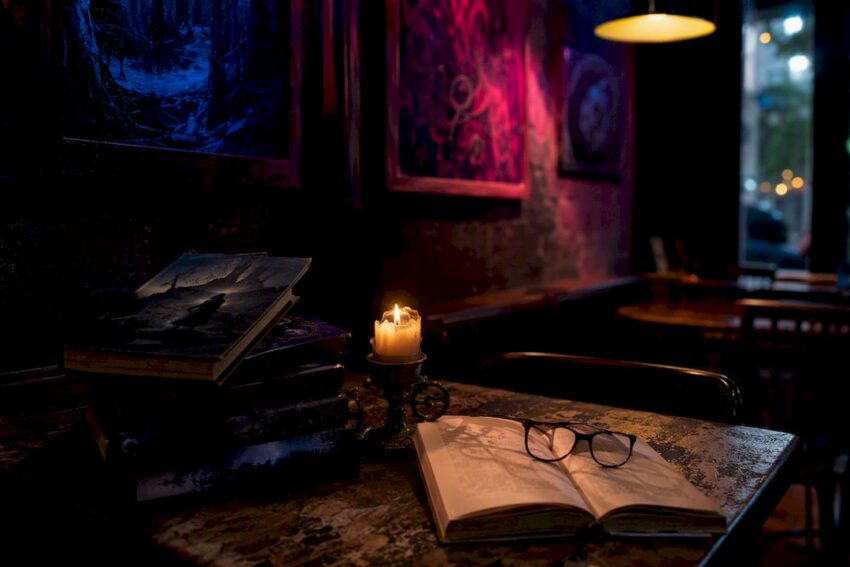
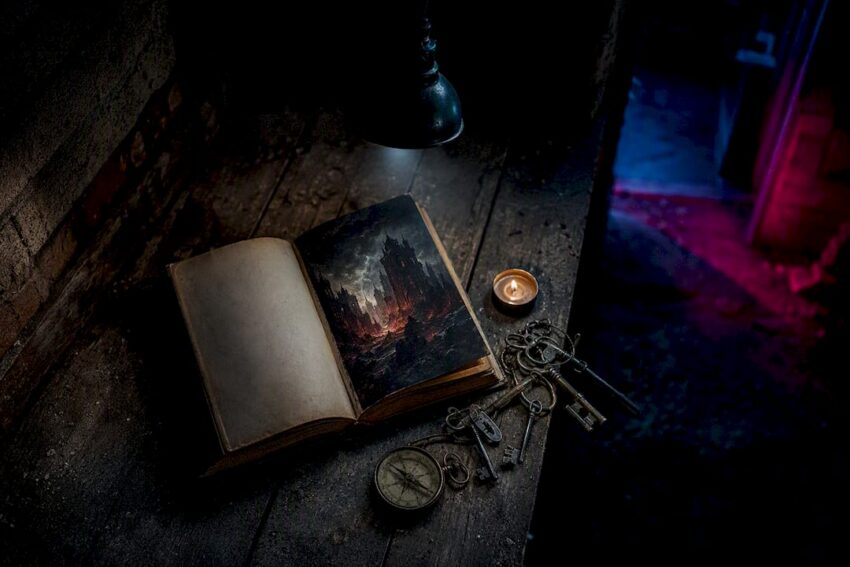
Open horror novel with candlelight in dim library

Slow Burn Horror Books: Top Picks for Atmosphere and Dread

Posted on August 20, 2026August 20, 2026 by NConnors

If you want horror that crawls under your skin instead of jumping out at you, start here. These picks exemplify patience, mood, and dread that outlasts the last page.

  • The Haunting of Hill House by Shirley Jackson: a masterclass in unreliable narration and a house that never has to raise its voice.
  • House of Leaves by Mark Z. Danielewski: the payoff arrives in fragments, and the format itself becomes the threat.
  • The Little Stranger by Sarah Waters: postwar decay disguised as a ghost story, with dread that seeps in through class anxiety.
  • A Head Full of Ghosts by Paul Tremblay: possession horror filtered through media obsession, withheld until the ending forces a reckoning.
  • The Woman in Black by Susan Hill: a short, controlled slow burn that proves atmosphere doesn’t need three hundred pages to work.
  • Let the Right One In by John Ajvide Lindqvist: isolation and adolescence turned into something genuinely unsettling, one quiet scene at a time.
  • The Changeling by Victor LaValle: grief transformed into a modern fairy tale that takes its time before it turns monstrous.

Key Takeaways

Slow burn horror succeeds by withholding payoff, building atmosphere through sensory detail and unreliable narration, and rewarding readers who stay patient through the buildup.

Point Details
Definition matters Slow burn horror prioritizes dread and atmosphere over jump scares, unlike fast-paced horror.
Craft techniques drive tension Isolation, unreliable narrators, and withheld payoff are the core tools authors rely on.
Match mood to book Choose gothic, domestic, or experimental slow burns based on tone and available reading time.
Endings decide success A weak final act is the most common failure mode, so payoff quality matters most.
Nathaniel Connors fits the mold The Nether and Stories of a Condemned Soul apply the same slow-building dread found in these picks.

Table of Contents

  • What Makes a Book a Slow Burn Horror Novel?
  • How Do Authors Build Dread Slowly?
  • Which Slow Burn Horror Books Should You Read First?
  • How Do You Pick the Right Slow Burn Horror Book?
  • What’s the Best Reading Order for Slow Burn Horror?
  • Why These Books Made the Slow Burn Horror List
  • A Curator’s Note on Slow Burn Horror
  • Want More Slow Burn Horror? Try These Next
  • Frequently Asked Questions
  • Sources

What Makes a Book a Slow Burn Horror Novel?

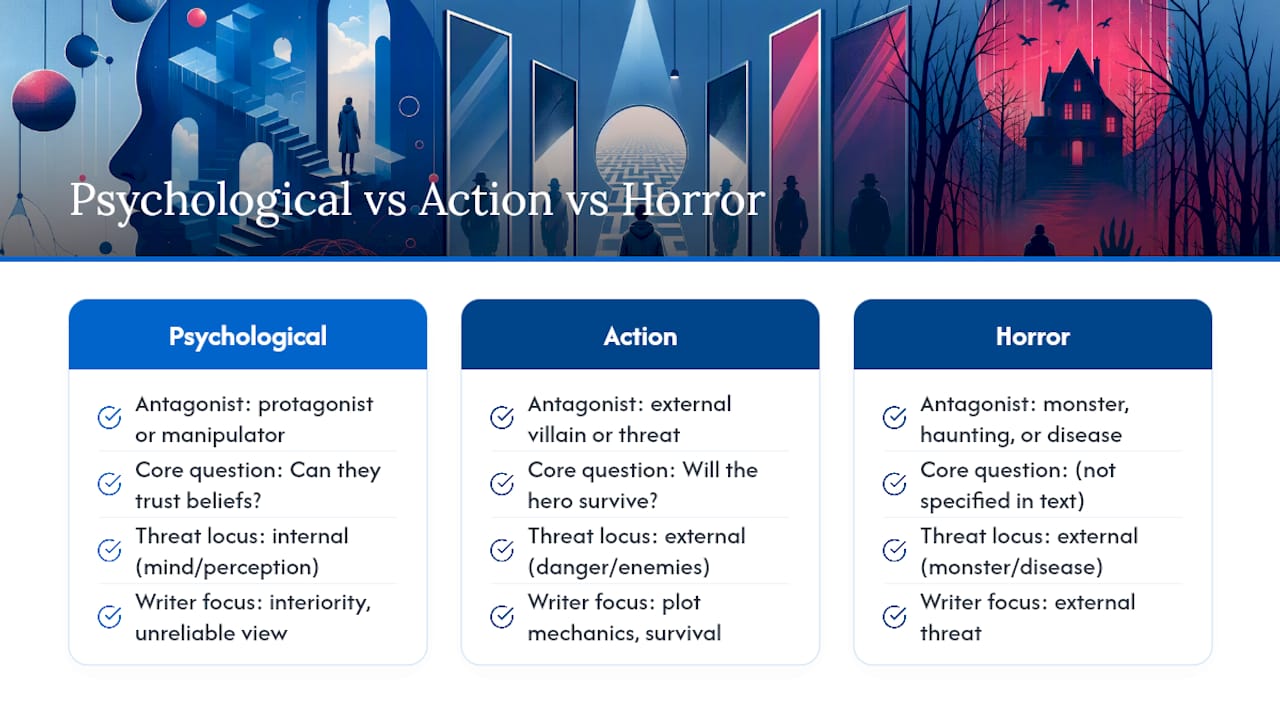
Slow burn horror prioritizes long-form psychological dread and atmosphere over immediate jolts. It’s a subgenre that withholds overt supernatural or violent payoff until late in the story, letting silence and suggestion do the work that jump scares usually handle in fast horror.

Fast-paced horror wants a reaction in seconds. Slow burn horror wants a reaction that lingers for days. A slasher novel spikes your pulse on page ten; a slow burn like House of Leaves spends chapters destabilizing your sense of what’s real before anything overtly frightening happens.

This overlaps heavily with what’s often called literary horror, a category that leans on prose craft and philosophical weight rather than shock value. Shirley Jackson’s work and Danielewski’s experimental structure are the standard reference points for readers chasing that immersive, unsettled feeling rather than a quick scare.

How Do Authors Build Dread Slowly?

Slow burn craft depends on a specific toolkit, and once you notice it, you’ll spot it in every book on this list.

  • Patient escalation: small wrongness compounds into something larger, never all at once.
  • Unreliable narrators: the reader questions the story right alongside the protagonist.
  • Isolation: physical or social confinement removes escape routes and outside perspective.
  • Sensory detail: sound, smell, and texture do more work than explicit description.
  • Suggestive prose: what’s implied outweighs what’s stated.
  • Withheld payoff: the real horror surfaces only in the last act.

This mirrors what genre analysts call the art of tension building, where silence and incremental stakes replace quick scares, and it’s the same mechanism driving cinematic slow burns like Hereditary or The Witch. The psychological payoff comes from anticipation itself. You lean into the story because you’re piecing together a threat before the characters do, and that gap between reader knowledge and character knowledge is where the dread actually lives.

Pro Tip: Keep a mental (or literal) note of small details that repeat, a recurring smell, a phrase, a room mentioned twice. Slow burns plant micro-escalations early that only make sense once you’re fifty pages further in.

Close-up of small symbolic details on desk

Which Slow Burn Horror Books Should You Read First?

Classics that defined the subgenre. The Haunting of Hill House by Shirley Jackson remains the benchmark for psychological haunted house fiction, built almost entirely on perception and loneliness. Beloved by Toni Morrison uses haunting as a vehicle for generational trauma, and it belongs on any literary horror shortlist precisely because it never treats its ghost as a gimmick. Best for readers who want prose that rewards rereading.

Modern essentials. House of Leaves remains the reference point for experimental slow burn, a novel that turns its own footnotes into a maze. A Head Full of Ghosts by Paul Tremblay updates possession horror for the reality-TV era, and its structure keeps the truth ambiguous until the final pages. Mexican Gothic by Silvia Moreno-Garcia builds atmosphere across its opening third before shifting into an unnerving, intense payoff that critics consistently single out.

Psychological and clinical dread. The Changeling by Victor LaValle wraps grief and fatherhood around a fairy tale structure that turns genuinely disturbing by its midpoint. Best for readers who want emotional stakes as high as the horror stakes.

Gothic and house-focused horror. The Little Stranger by Sarah Waters uses a decaying manor and postwar class tension to build dread that’s more social than supernatural. The Woman in Black by Susan Hill proves a haunted house story can be short, controlled, and still devastating.

Dusk view of gothic manor with wrought iron gate

Short, quick slow burns. Let the Right One In by John Ajvide Lindqvist pairs isolation and adolescence with a vampire story that earns its horror through patience, not spectacle. If you want something newer with a similarly measured buildup, Home Sick by Rhiannon Grist tests a reader’s patience early but rewards it with a haunting final act.

Author works worth adding. Nathaniel Connors’ The Nether, Stories of a Condemned Soul, and Evolution A200: A Bubonic Apocalypse each lean into slow-building psychological horror rooted in guilt, revenge, and dystopian dread, and they sit comfortably alongside the classics above for readers drawn to character-first horror.

How Do You Pick the Right Slow Burn Horror Book?

Match the book to your mood before you match it to the hype. Gothic settings (The Little Stranger, The Woman in Black) suit readers who want decay and class tension; domestic settings (A Head Full of Ghosts) suit readers who want horror inside ordinary family life.

  • Short reads (The Woman in Black, Let the Right One In) work for a weekend; immersive novels (House of Leaves, Beloved) need weeks.
  • If you want ambiguity, pick Jackson or Tremblay. If you want a hard, explicit payoff, pick Mexican Gothic.
  • Read in focused sessions rather than scattered five-minute bursts. Slow burns lose their power when interrupted.

Pro Tip: If a slow burn hasn’t shifted its atmosphere by the halfway mark, that’s often a structural signal the payoff will be thin. Keep reading if small details are compounding; consider setting it aside if nothing has changed since chapter one.

What’s the Best Reading Order for Slow Burn Horror?

If you’re new, start here:

  1. The Woman in Black — short, controlled, low commitment.
  2. The Haunting of Hill House — the genre’s clearest blueprint.
  3. Let the Right One In — accessible prose with real emotional stakes.

If you already love slow burn, try these next:

  1. House of Leaves — demands patience and a willingness to get lost.
  2. A Head Full of Ghosts — rewards readers who track unreliable narration closely.
  3. Beloved — literary weight paired with genuine haunting.

Starting simple builds tolerance for ambiguity before you tackle books that actively resist a clean resolution.

Why These Books Made the Slow Burn Horror List

Every title here had to deliver atmosphere, patient pacing, character-driven tension, and a late-stage payoff that actually lands. Prose craft mattered as much as plot; a weak ending is the most common failure mode in slow burn fiction, so books that stick the landing got priority.

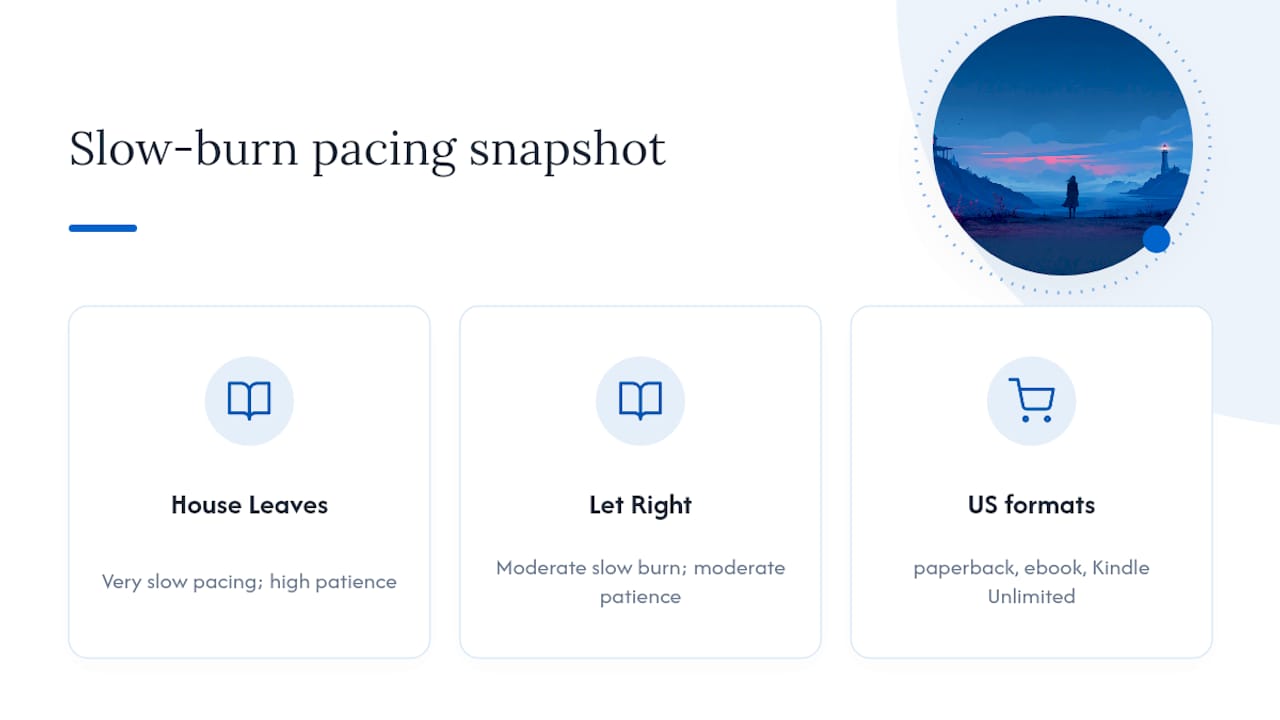
Intensity note: annotations flag pacing from very slow (House of Leaves) to moderate slow burn (Let the Right One In) so you can gauge patience required before committing.

Diagram comparing pacing intensity of slow burn horror books

All titles listed are currently available in the US market in paperback, ebook, or Kindle Unlimited formats.

A Curator’s Note on Slow Burn Horror

I’ve spent years writing dark supernatural fiction that leans on dread instead of shock, and that’s exactly why these books matter to me. The Nether and Stories of a Condemned Soul grew out of the same patience these authors practice: let guilt and consequence build until the reader can’t look away.

Want More Slow Burn Horror? Try These Next

If Jackson’s patient dread or Tremblay’s unreliable narration hooked you, my own books lean into that same territory of psychological horror and dystopian unease.

Nathanielconnors

  • The Nether: guilt and revenge told through a slow, unraveling structure similar to The Changeling.
  • Stories of a Condemned Soul: character-focused dread that builds toward a late, heavy payoff.
  • Evolution A200: A Bubonic Apocalypse: dystopian horror for readers who liked the isolation and creeping wrongness of Let the Right One In.

All three are available in ebook and paperback on Amazon, and Kindle Unlimited subscribers can read them at no added cost. If you want a broader entry point first, dystopian horror novels that share this pacing make a solid next stop, and readers pressed for time can start with short dystopian reads built for one sitting. Ready to sample the author directly? Head to the Kindle Unlimited psychological thrillers page and start reading today.

Frequently Asked Questions

What are the best slow burn horror books for beginners?
The Woman in Black, The Haunting of Hill House, and Let the Right One In offer strong entry points because they build dread without demanding the reader tolerate heavy ambiguity or experimental structure.

How is slow burn horror different from psychological horror novels?
Slow burn horror is a pacing style; psychological horror is a thematic focus on mental unraveling. Many books, like A Head Full of Ghosts, are both at once, but a slow burn can also be gothic or supernatural without being psychological.

Are slow burn horror books good for readers who dislike jump scares?
Yes. These books earn their scares through atmosphere and suggestion rather than sudden shocks, which makes them a better fit for readers who find jump scares cheap or exhausting.

Do slow burn horror novels always have a strong ending?
Not always. A weak payoff is the most common complaint against slow burns, which is why the titles on this list were chosen partly for how well their endings land.

Can short books still qualify as slow burn horror?
Absolutely. The Woman in Black proves a slow burn can work in under two hundred pages if the atmosphere is controlled and the payoff is earned rather than rushed.

Sources

  • House of Leaves — Wikipedia
  • Skulls in the Stars — Mexican Gothic by Silvia Moreno-Garcia
  • Writing Tension: The Art of Slow-Burn Horror — Sinister Film Fest
  • Mexican Gothic by Silvia Moreno-Garcia — Penguin Random House

Recommended

  • Books Like House of Leaves: Dark Reads for 2026
  • Best Dystopian Horror Novels: 8 Haunting Reads for 2026
  • Short Dystopian Novels for One-Sitting Dread
  • Best Kindle Unlimited Horror Books for Subscribers
Dark supernatural books on a wooden desk

The Best Dark Supernatural Books for Readers Who Want Real Dread

Posted on August 19, 2026August 19, 2026 by NConnors

Dark supernatural books work best when they refuse to let you off easy: morally compromised characters, atmosphere thick enough to chew, and a supernatural force that never fully explains itself. The picks below run from gothic dread to grimdark brutality to cosmic horror, chosen for tone, pacing, and how far each one is willing to go.

  • Empire of the Vampire by Jay Kristoff — best for readers who want grimdark scale with vampire lore.
  • House of Leaves by Mark Z. Danielewski — best for readers who want experimental, dread-soaked psychological horror.
  • Reliquary by Hannah Whitten — best for gothic dread in an isolated, claustrophobic setting.
  • The Nether by Nathaniel Connors — best for readers drawn to psychological monsters and guilt-driven horror.

Selection here favors tone and intensity over popularity: each title earned its spot for atmosphere, thematic weight, and how honestly it handles horror.

Key Takeaways

The strongest dark supernatural books combine morally ambiguous characters, sustained atmospheric dread, and a supernatural element that resists tidy explanation, whether the setting is a secondary fantasy world or your own street.

Point Details
Match mood to setting Choose secondary-world fantasy for heroic-adjacent dread, modern settings for pure horror intrusion.
Check intensity before committing Content warnings for violence, body horror, and sustained dread vary widely across these twelve picks.
Sample before buying Read 20 to 50 pages or an audiobook sample, and use Kindle Unlimited to test titles risk-free.
Trend toward metaphor Recent 2024–2026 releases like Fiend and Reliquary use monsters as stand-ins for grief and family secrets.
Try Connors for psychological horror The Nether and Stories of a Condemned Soul focus on guilt and interior monsters, available free via Kindle Unlimited.

Table of Contents

  • What Are the Best Dark Supernatural Books Right Now?
  • How Do You Choose the Right Dark Supernatural Book for You?
  • Which Authors and Subgenres Should You Explore Next?
  • What Recent Releases and Trends Should You Know About?
  • What Actually Counts as Dark Supernatural Fiction?
  • Where Did Dark Supernatural Literature Come From?
  • Which Books Actually Shaped the Genre?
  • How Do Dark Supernatural Themes Vary Across Cultures?
  • What Motifs and Symbols Keep Showing Up?
  • What Order Should You Read These Series In?
  • Why I Keep Coming Back to Dark Supernatural Fiction
  • Want More Psychological Dread? Start Here
  • Where to Read More on Dark Supernatural Fiction
  • Frequently Asked Questions
  • Sources

What Are the Best Dark Supernatural Books Right Now?

Dark supernatural fiction sits at the intersection of dark fantasy and horror, and the strongest current titles lean hard into both moral ambiguity and genuine fear. Some of these are secondary-world epics with monstrous stakes; others are contemporary hauntings that never leave your own house. What ties them together is a refusal to soften the ending or explain away the monster. Below are twelve books worth your time, organized loosely from grimdark epic to intimate psychological horror.

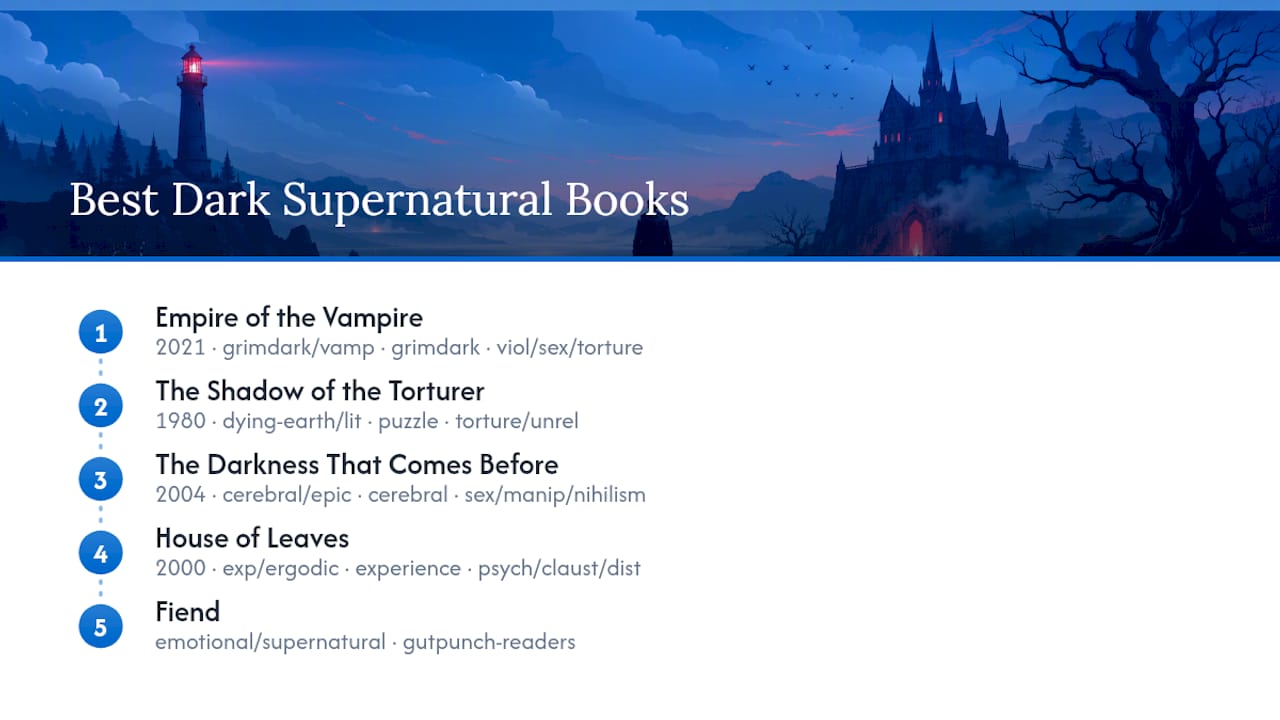
Empire of the Vampire by Jay Kristoff opens with a half-vampire priest chained and interrogated by the very church that raised him, and the flashback structure lets Kristoff stack betrayal on betrayal across a sun-starved world. It’s operatic, violent, and unapologetically long. Best for: grimdark fans who want vampire mythology married to religious horror. Content warning: graphic violence, sexual content, torture. Available in ebook, paperback, and audiobook; a 2021 release that’s become a modern grimdark benchmark.

Diagram comparing dark supernatural books by themes and audience

The Shadow of the Torturer, the opening volume of Gene Wolfe’s Book of the New Sun, follows Severian, a journeyman torturer exiled from his guild for showing mercy to a prisoner. Wolfe’s prose is dense and deliberately unreliable, and the “dying earth” setting reads as much like decayed myth as science fiction. Best for: literary readers who enjoy puzzle-box narration and slow-burn dread. Content warning: disturbing torture scenes, unreliable narration that can frustrate casual readers. A 1980 classic, still in print in paperback and ebook.

The Darkness That Comes Before by R. Scott Bakker plunges into a world of philosopher-warriors and manipulative sorcery ahead of a holy war, and its cold, clinical prose makes the horror feel almost academic. Best for: readers who want cerebral, morally bleak epic fantasy over action-driven plotting. Content warning: sexual violence, manipulation, and a genuinely nihilistic worldview. First published in 2004, available in paperback and ebook.

House of Leaves by Mark Z. Danielewski turns a hallway that’s slightly larger on the inside into one of horror fiction’s most disorienting reading experiences, using footnotes, typographic tricks, and nested narrators to mirror the house’s impossible geometry. Best for: readers who want horror that messes with the reading experience itself. Content warning: psychological breakdown, claustrophobia, disturbing imagery. A 2000 release, widely available in paperback; less suited to audiobook given its visual formatting.

Fiend by Alma Katsu uses a monstrous threat as a lens on grief and family fracture, a pattern showing up across recent supernatural fiction. Best for: readers who want their supernatural horror to double as an emotional gut-punch. Content warning: grief, family trauma, body horror. Released as a newer title, available in ebook and audiobook.

Reliquary by Hannah Whitten strands its characters on an isolated setting where family secrets and a monstrous presence in the water surface together, and the claustrophobic gothic atmosphere is the book’s real engine. Best for: gothic dread lovers who want slow-building supernatural menace. Content warning: drowning imagery, sustained psychological dread. A recent release, available in ebook, hardcover, and audiobook.

House of Salt and Sorrows by Erin A. Craig reimagines “The Twelve Dancing Princesses” as a gothic mystery where sisters die one by one in a mansion perched over the sea. Best for: readers who want gothic atmosphere without extreme gore. Content warning: death, grief, mild body horror. Published in 2019, available in ebook, paperback, and audiobook, and popular with Kindle Unlimited readers who want lighter-intensity gothic fare.

Malazan Book of the Fallen, beginning with Gardens of the Moon, by Steven Erikson throws readers into a sprawling war between empires, gods, and ascendant beings with almost no hand-holding. Best for: committed series readers who want massive scope and morally gray armies. Content warning: war violence, large body count, dense mythology that some readers find alienating early on. First published in 1999, available in paperback and ebook.

The Blacktongue Thief by Christopher Buehlman follows a debt-bound thief through a war-scarred world of goblins and witches, balancing genuine horror with sharp, dark humor. Best for: readers who want grimdark fantasy that doesn’t take itself entirely seriously. Content warning: violence, body horror, dark themes played partly for wit. Released in 2021, available in ebook, paperback, and audiobook.

Gideon the Ninth by Tamsyn Muir mashes necromancy, sword-swinging swordswomen, and a haunted-house murder mystery into one of the more inventive genre-blending dark fantasy releases of the last decade. Best for: readers who want claustrophobic secondary-world settings with bleak humor. Content warning: body horror, death, disturbing imagery.

The Nether by Nathaniel Connors builds a haunting narrative around revenge and guilt, following a protagonist whose psychological unraveling is as frightening as anything supernatural chasing him. Best for: readers who want interior, character-driven dread over external monsters. Content warning: psychological trauma, violence.

Stories of a Condemned Soul by Nathaniel Connors collects shorter dark fiction exploring redemption and the monsters people carry inside themselves, making it a strong entry point for readers who want to sample intensity before committing to a novel. Best for: readers who prefer shorter, concentrated doses of dread. Content warning: varies by story; several contain intense psychological themes.

Evolution A200: A Bubonic Apocalypse by Nathaniel Connors merges dystopian collapse with supernatural horror elements, following characters navigating a plague-ravaged world where the line between disease and something worse blurs. Best for: readers who want dystopian horror layered with supernatural dread. Content warning: disease, death, graphic survival scenarios.

“Dark fantasy typically occurs in a secondary or overtly fantastic world and often carries an implicit promise of heroism, while horror emphasizes intrusion into the mundane and pervasive dread.” This distinction, drawn by genre analyst Rachel Neumeier, explains why Malazan and House of Leaves feel like different species of dark fiction even though both traffic in horror.

Pro Tip: If you’re new to grimdark fantasy, start with The Blacktongue Thief before attempting Malazan or Empire of the Vampire. Buehlman’s humor gives you an emotional exit valve that the denser epics don’t offer.

Kindle Unlimited subscribers can find several of these titles, along with Connors’ full catalog, at no added cost, which matters if you’re testing a new subgenre before committing money to a series that might run six books deep.

How Do You Choose the Right Dark Supernatural Book for You?

Matching a book to your tolerance starts with naming what kind of fear you actually want. Do you want dread that builds slowly, or shock that arrives fast? Do you want gore, or do you want the horror to stay psychological and interior?

Consider these criteria before you commit to a 700-page grimdark epic:

  • Setting preference: secondary-world fantasy (Malazan, Empire of the Vampire) versus modern-urban intrusion horror (House of Leaves, Fiend).
  • Pacing: dense, literary pacing (Book of the New Sun) versus fast, plot-driven momentum (The Blacktongue Thief).
  • Structure: standalone reads (House of Salt and Sorrows) versus long series commitments (Malazan, Empire of the Vampire).
  • Focus: interior psychological horror (The Nether) versus external monstrous threat (Reliquary, Fiend).
  1. Identify your dread threshold: gothic unease, sustained cosmic dread, or grimdark brutality.
  2. Pick setting: fantasy world or our world with something wrong in it.
  3. Check length and format: standalone novella or multi-book commitment.
  4. Sample before buying: read the first 20 to 50 pages, or grab an audiobook sample.

Pro Tip: Use Kindle Unlimited to sample two or three titles from different subgenres in the same week. You’ll learn your actual tolerance faster than any review can tell you.

If you need lower-intensity horror, avoid books explicitly labeled grimdark, skip anything flagged for sustained body horror, and lean toward standalone gothic titles like House of Salt and Sorrows before diving into series-length grimdark.

Which Authors and Subgenres Should You Explore Next?

Once you’ve found your lane, these authors deepen it:

  • Jay Kristoff → grimdark fantasy with religious horror; read next if you loved Empire of the Vampire’s scale.
  • Gene Wolfe → literary dark fantasy with unreliable narration; read next for prose-forward dread.
  • R. Scott Bakker → philosophical, nihilistic epic fantasy; read next if cerebral bleakness appeals more than action.
  • Mark Z. Danielewski → experimental horror; explore for more form-breaking psychological terror.
  • Tamsyn Muir → necromantic dark fantasy with bleak humor; read next for genre-blending inventiveness.
  • Nathaniel Connors → psychological supernatural horror rooted in guilt and revenge; read next for interior, character-driven dread.

Each author brings a distinct strength: Wolfe’s prose density, Bakker’s philosophical bleakness, Muir’s tonal whiplash, and Connors’ focus on the monsters people build inside themselves.

What Recent Releases and Trends Should You Know About?

Dark supernatural fiction between 2024 and 2026 has leaned harder into metaphor. Contemporary titles increasingly weaponize the supernatural as a stand-in for grief, corporate greed, and buried family secrets rather than treating the monster as pure external threat.

Fiend by Alma Katsu exemplifies this shift, using its creature as a vehicle for grief and family fracture rather than a simple scare mechanism. Reliquary by Hannah Whitten does something similar, letting an isolated island setting surface long-buried family secrets alongside its aquatic horror.

The pattern is consistent enough that it’s worth naming: publishers and indie authors are increasingly releasing these titles simultaneously in ebook and Kindle Unlimited formats, making it easier than ever to sample the trend without committing to a hardcover purchase before you know if the tone fits.

E-reader device ready to read dark supernatural books

What Actually Counts as Dark Supernatural Fiction?

Dark supernatural fiction sits in the overlap between dark fantasy and horror, and the boundary comes down to setting and what the story promises the reader. When magic or the supernatural is a normalized part of the world, the story reads as dark fantasy. When something supernatural intrudes on an otherwise ordinary, modern setting, it reads as supernatural horror.

Dark fantasy also tends to carry an implicit promise: the protagonist has some agency to fight back, even if the odds are brutal. Horror, by contrast, keeps survival genuinely uncertain and centers on dread rather than heroic struggle. That’s why Malazan reads as epic dark fantasy despite its horrific violence, while House of Leaves reads as pure horror despite its fantastical premise.

“Dark supernatural” as a shelf label is broader than either term alone. It covers gothic ghost stories, psychological hauntings, grimdark epics, and cosmic horror, unified mainly by mature themes, morally compromised characters, and a supernatural element that refuses easy explanation. If you’re searching for this category and keep bumping into both “dark fantasy” and “supernatural horror” as separate shelf tags, that’s why: the umbrella term absorbs both.

Where Did Dark Supernatural Literature Come From?

The roots run through Gothic literature of the late 1700s and 1800s, when writers like Ann Radcliffe and Mary Shelley used crumbling castles and reanimated corpses to explore guilt and forbidden knowledge. Edgar Allan Poe pushed the interior psychological angle further, making the narrator’s unraveling mind as frightening as any external monster.

The twentieth century split the tradition into distinct lanes. H.P. Lovecraft introduced cosmic horror, where indifference and incomprehensibility replaced the Gothic’s moral order. Meanwhile, writers like Fritz Leiber and later Stephen King grounded horror in ordinary, modern settings, making the supernatural feel like an intrusion rather than a distant myth. Epic fantasy authors like Michael Moorcock and Glen Cook introduced moral ambiguity into secondary-world fantasy, effectively inventing the grimdark lane that authors like Kristoff and Erikson now occupy.

By the 1980s and 1990s, writers like Gene Wolfe and Clive Barker blurred the line further, treating body horror and philosophical dread as compatible with literary ambition. Today’s dark supernatural fiction inherits all three threads: Gothic atmosphere, cosmic indifference, and grimdark moral complexity, often blended within a single book.

Which Books Actually Shaped the Genre?

A handful of titles set the template that current dark supernatural fiction still follows. Frankenstein established the idea that the real monster is often human ambition and guilt, a theme that runs directly into Connors’ work on psychological monsters. Lovecraft’s Cthulhu Mythos stories established cosmic horror as a distinct mode, where scale and indifference generate more dread than any single villain.

Gene Wolfe’s Book of the New Sun, beginning with The Shadow of the Torturer, proved that dark supernatural fiction could carry the literary weight of dense, unreliable prose. Glen Cook’s Black Company series and Michael Moorcock’s Elric novels pioneered grimdark’s moral ambiguity decades before the term existed, directly influencing writers like Erikson and Kristoff. Wikipedia’s category of dark fantasy novels catalogs many of these canonical works if you want to trace the lineage further.

More recently, House of Leaves proved horror could break narrative form entirely, influencing a generation of experimental horror writers who treat structure itself as a source of dread.

How Do Dark Supernatural Themes Vary Across Cultures?

Western dark supernatural fiction leans on Gothic castles, vampires, and cosmic indifference, but the core impulse, using the supernatural to process guilt and fear, shows up globally in different shapes. Japanese horror (J-horror) fiction and film, from Ringu to countless yokai-inspired tales, favors vengeful spirits tied to unresolved social wrongs rather than external monsters, and dread tends to build through atmosphere rather than jump scares.

Latin American fiction often folds the supernatural into magical realism, where ghosts and curses coexist with ordinary life as accepted fact rather than intrusion. This changes the horror calculus: the fear comes from moral consequence, not from the supernatural’s mere existence. African diasporic horror traditions frequently center ancestral spirits and inherited trauma, using the supernatural to interrogate colonial history and generational guilt.

Slavic and Eastern European folklore contributes a darker, more fatalistic strain, visible in the “unquiet dead” tropes that influenced vampire fiction long before Bram Stoker formalized it. Reading across these traditions widens what “dark supernatural” can mean beyond the Anglo-American Gothic and grimdark defaults, and several contemporary Western authors now borrow directly from these non-Western frameworks to freshen familiar tropes.

What Motifs and Symbols Keep Showing Up?

Certain images recur across dark supernatural fiction because they carry built-in psychological weight. The haunted house or crumbling estate, seen in House of Leaves and House of Salt and Sorrows, externalizes guilt and family dysfunction as literal architecture. Water, especially drowning imagery, shows up in Reliquary and countless gothic tales as a symbol of suppressed memory and inescapable fate.

Cracked gothic window with vines and shadows

Blood and vampirism, central to Empire of the Vampire, typically represent inherited sin or corrupted legacy passed down through bloodlines. Plague and disease, the engine behind Evolution A200: A Bubonic Apocalypse, function as a metaphor for social collapse and the failure of institutions to protect the vulnerable. Mirrors and doubles appear across the genre to represent fractured identity or guilt made visible.

The condemned or cursed soul, a motif Connors returns to directly in Stories of a Condemned Soul, reflects the genre’s core preoccupation: punishment that outlasts death, and guilt that can’t be outrun no matter how far the character travels.

What Order Should You Read These Series In?

For the Malazan Book of the Fallen, start with Gardens of the Moon even though many longtime fans admit it’s the hardest entry point. Erikson deliberately withholds explanation, and the payoff across later books rewards patience more than any reading-order trick.

For Book of the New Sun, read The Shadow of the Torturer first and continue in publication order. Wolfe built the series as one continuous unreliable narration, so skipping around breaks the puzzle structure entirely.

If you’re sampling Nathaniel Connors’ catalog, start with Stories of a Condemned Soul for a shorter introduction to his tone before moving to The Nether for a full novel-length psychological descent, then Evolution A200: A Bubonic Apocalypse if you want the dystopian scale turned up.

For standalone gothic titles like Reliquary and House of Salt and Sorrows, reading order doesn’t matter since each stands alone, but pacing your reading between intense grimdark epics and shorter standalones helps prevent burnout on any single subgenre.

Why I Keep Coming Back to Dark Supernatural Fiction

What draws me to this genre isn’t the monster on the page. It’s the guilt underneath it, the psychological wreckage a character carries long before anything supernatural shows up to make it literal. My own books, including The Nether and Stories of a Condemned Soul, work from that same premise: the scariest thing in the room is usually the person, not the ghost. If you gravitated toward Connors on this list, start there. If you wanted gothic dread instead, start with Reliquary.

Want More Psychological Dread? Start Here

If the picks on this list that hit hardest were the ones built on guilt and interior collapse rather than external monsters, my own catalog sits squarely in that lane. The Nether, Stories of a Condemned Soul, and Evolution A200: A Bubonic Apocalypse all dig into the same psychological territory as House of Leaves and Fiend, just filtered through revenge and redemption instead of hauntings or plague metaphors alone.

Nathanielconnors

All three titles are available in ebook and paperback on Amazon, and readers with a Kindle Unlimited subscription can read them at no added cost, which makes them a low-risk way to test whether Connors’ brand of psychological horror fits your tolerance. If The Nether’s guilt-driven unraveling sounds like your speed, that’s the natural starting point. If you want dystopian scale layered over supernatural dread, go straight to Evolution A200: A Bubonic Apocalypse. Browse the full catalog of dystopian horror novels and pick the title that matches the mood you came here looking for.

Where to Read More on Dark Supernatural Fiction

  • Dark Fantasy vs Horror — Rachel Neumeier: a clear genre-boundary essay for readers sorting tone from setting.
  • Category: Dark Fantasy Novels — Wikipedia: a broad catalog of canonical and influential titles.
  • Gideon the Ninth — Macmillan: publisher description and sample chapter access.
  • Nathaniel Connors: author bio, full title list, and Kindle Unlimited availability notes.

Frequently Asked Questions

What makes a book “dark supernatural” instead of just horror?
Dark supernatural fiction spans both dark fantasy and straight horror. The dividing line is usually setting: supernatural elements normalized within a fantastic world read as dark fantasy, while supernatural forces intruding on a realistic, modern setting read as horror.

Are dark fantasy and supernatural horror the same thing?
Not quite. Dark fantasy often implies the protagonist has some agency to push back against the darkness, even at great cost. Horror tends to keep survival genuinely uncertain and centers on dread rather than heroic struggle.

Which book on this list is best for a horror beginner?
House of Salt and Sorrows offers gothic atmosphere without extreme gore, making it a gentler entry point than grimdark epics like Empire of the Vampire or Malazan.

Can I read these on Kindle Unlimited?
Several titles, including works by Nathaniel Connors, are available through Kindle Unlimited, letting subscribers sample dark supernatural fiction without an added purchase.

What’s the difference between grimdark and cosmic horror?
Grimdark centers on moral ambiguity and brutal consequence within an active plot, as in The Blacktongue Thief. Cosmic horror centers on humanity’s insignificance against forces too vast to understand or fight, a mode Lovecraft established and modern authors still echo.

Where should I start if I want psychological rather than gore-driven horror?
Start with The Nether by Nathaniel Connors or House of Leaves by Mark Z. Danielewski. Both build dread through interior collapse and guilt rather than explicit violence.

Sources

  • Goodreads — Fiend
  • Reliquary by Hannah Whitten | Hachette UK
  • Dark Fantasy vs Horror – Rachel Neumeier
  • Gideon the Ninth — Macmillan

Recommended

  • Books Like House of Leaves: Dark Reads for 2026
  • Best Dystopian Horror Novels: 8 Haunting Reads for 2026
  • Short Dystopian Novels for One-Sitting Dread
Dim lit writer's desk with open typed page and candle

What Does an Open Ending Mean in Storytelling?

Posted on August 18, 2026August 18, 2026 by NConnors

An open ending is a conclusion that deliberately leaves a key plot question unanswered while still resolving the story’s emotional or thematic core. Instead of tying up every loose thread, it hands the audience the last piece of the puzzle to place themselves. Think of Inception’s spinning top, the door left unopened in The Lady, or the Tiger?, or the sudden cut to black at the end of The Sopranos.

Key Takeaways

An open ending succeeds only when it pairs unresolved plot facts with a fully completed emotional or thematic arc.

Point Details
Definition anchor An open ending leaves a plot question unresolved while closing the emotional or thematic arc.
Not a cliffhanger Cliffhangers force continuation mechanically; open endings must feel earned and thematically complete.
Breadcrumbing is required Plant clues early so the ambiguous ending supports a few plausible readings, not infinite ones.
Run the new-problem test A genuinely open ending leaves the character facing a different, richer problem, not just no problem.
Reader response varies Success shows up as reread value and debate, not universal agreement on one interpretation.

Table of Contents

  • What is open ending, really, and what are its defining traits?
  • How is an open ending different from a closed ending or a cliffhanger?
  • Why do writers choose to leave the ending open?
  • What are some famous examples of open endings?
  • How do you write an open ending that feels earned?
  • What mistakes weaken an open ending?
  • How do readers usually respond to an open ending?
  • When does Nathaniel Connors choose to leave things open?
  • Why the “just leave it vague” advice gets open endings wrong
  • Where to read more on open endings
  • Frequently Asked Questions
  • Sources

What is open ending, really, and what are its defining traits?

An open ending isn’t a story that simply stops. It’s one that finishes its emotional business while leaving a factual outcome unresolved. A closed ending answers “then what happened?” An open ending answers “how did that change them?” and lets the plot question hang. The device leaves the story’s final moments in limbo, prioritizing unresolved threads and ambiguous imagery over a tidy wrap-up.

A few traits show up again and again in endings that critics label “open”:

  • Ambiguous outcome: the reader can argue for at least two plausible futures.
  • Unresolved plot threads: at least one concrete question (did they survive, did the deal happen, did she get on the train) stays unanswered.
  • Thematic closure without practical closure: the character’s arc completes even though their circumstances don’t.
  • Loaded final imagery or dialogue: the last line or shot carries symbolic weight instead of a plain statement of fact.
  • A detached or restrained narrator stance: the storyteller stops guiding interpretation right when the reader wants it most.

Picture a final scene where a character closes a door, and the camera holds on the closed door for three extra seconds. Nothing else happens. That pause is doing all the work.

How is an open ending different from a closed ending or a cliffhanger?

Writers mix these up constantly, and the confusion causes real craft problems. Here’s the cleanest way to separate them:

  • Closed ending: every major question gets answered. A courtroom drama that ends with a verdict read aloud is closed. The intent is resolution.
  • Cliffhanger: the story stops mid-tension to force the audience into the next installment. A hero dangling off a cliff as the credits roll is a cliffhanger. The intent is mechanical suspense, a hook for a sequel, not meaning.
  • Open ending: the emotional arc resolves, but a factual outcome does not. The Lady, or the Tiger? is the textbook case: the narrator refuses to say which door the princess pointed to.

The distinction matters because an open ending has to feel earned, offering real thematic payoff, while a cliffhanger survives purely on unresolved mechanics. Confuse the two in your own draft and readers will sense the difference even if they can’t name it.

Why do writers choose to leave the ending open?

Writers reach for open endings because tidy conclusions often flatten the exact uncertainty they’re trying to capture. Real life rarely closes its loops on cue, and fiction that mimics that feels truer for it.

The main reasons creators use the device:

  • Invite interpretation. The audience becomes a participant instead of a passenger.
  • Mirror real uncertainty. Big life events (a diagnosis, a breakup, a disappearance) rarely resolve neatly, and endings that acknowledge that read as honest.
  • Deepen theme. Ambiguity keeps the story’s central question alive after the last page.
  • Extend engagement. Readers reread, rewatch, and argue, which is exactly what drives long-running debate around films like Inceptionó.
  • Provoke discussion. Book clubs and film forums thrive on endings that admit more than one reading.

Open endings also shift interpretive weight onto the audience. The writer stops explaining and starts trusting the reader to do part of the meaning-making, which is the whole point of the device.

Pro Tip: Resolve the emotional arc completely before you leave the plot arc open. If both are ambiguous, readers won’t feel invited, they’ll feel abandoned.

What are some famous examples of open endings?

  • Inception: The top wobbles as the screen cuts to black. Notice the ring Cobb no longer wears. Takeaway: a single prop can carry an entire ambiguous question.
  • Blade Runner: Deckard’s uncertain humanity and the unicorn origami close the film without confirming what he is. Takeaway: withhold one fact, and the whole story gets reread through that lens.
  • The Lady, or the Tiger?: Stockton’s narrator stops at the moment of choice and never returns. Takeaway: sometimes the question is the story.
  • The Sopranos finale: The screen cuts to black mid-scene in a diner. Notice the ordinary song playing, the man in the jacket. Takeaway: ordinariness right before the cut makes ambiguity feel dangerous.
  • Hills Like White Elephants: Hemingway ends on a line of forced pleasantness with no decision confirmed. Takeaway: dialogue alone can carry an entire unresolved plot.
  • Contemporary dark fiction: Novels in the psychological horror space often close on a character’s altered inner state rather than a resolved plot, trusting readers to sit with what that transformation implies.

How do you write an open ending that feels earned?

  1. Decide the thematic question first. Know what idea the ending needs to answer before you know what plot fact it will leave hanging.
  2. Finish the character’s transformation. The emotional or internal arc has to complete even when the external situation doesn’t.
  3. Plant breadcrumbs early. Drop small, deliberate clues throughout the story so the ambiguous ending supports more than one plausible reading, not an infinite number.
  4. Run the “new problem” test. Ask whether the character now faces a different, more interesting problem than the one they started with. If not, the ending is just unfinished.
  5. Skip the sequel-bait trick. An open ending built only to justify a sequel usually reads as a cliffhanger wearing a costume.

Pro Tip: If you can’t point to at least two earlier scenes that support your ambiguous final image, you haven’t earned it yet. Go back and plant more evidence.

Pro Tip: Read your last page aloud and stop before the final sentence. If the emotional temperature already feels complete, you’re close.

What mistakes weaken an open ending?

  • The ending feels unfinished, not open. Fix: confirm the emotional arc is fully resolved before you submit the draft.
  • No thematic or emotional closure. Fix: an ending that just stops without resolving the emotional arc is a failed ending, not an open one, so rewrite until the theme lands.
  • No breadcrumbs planted earlier. Fix: revise earlier chapters to seed the clues your ending depends on.
  • Using ambiguity as sequel bait. Fix: make the book stand alone; sell the sequel with new material, not a withheld answer.
  • Mislabeling a cliffhanger as “open.” Fix: ask whether the tension is mechanical (a cliffhanger) or thematic (open) and be honest about which one you wrote.

How do readers usually respond to an open ending?

Reactions split hard. Some readers feel delighted, inspired to reread, or eager to debate; others feel cheated. Common responses include:

  • Genuine delight at the ambiguity and a desire to reread for clues.
  • Frustration when the ending feels like a dodge rather than a choice.
  • Active debate in book clubs or film forums about “what really happened.”
  • Divergent, equally defensible interpretations that never fully converge.

Judge success by emotional resonance, interpretive traction, and reread value rather than whether everyone agrees on one answer. Film forums tend to treat ambiguity as a feature to dissect; some book club readers treat it as a flaw to forgive.

When does Nathaniel Connors choose to leave things open?

I reach for an open ending when a character’s internal transformation matters more than their fate. If a protagonist has confronted the thing haunting them, I don’t always need to confirm whether they survive the night. What I need is for the reader to feel that confrontation land.

Author hands clasped reflecting in dark study

One rule I hold to: I never leave an ending open unless I’ve planted at least two moments earlier in the manuscript that make the ambiguity feel inevitable rather than convenient.

Pro Tip: If you can’t trace your ending’s ambiguity back to a specific earlier scene, it’s not open. It’s incomplete.

If you want to see that approach at work, Best Dystopian Horror Novels: 8 Haunting Reads for 2026 collects a set of dark, psychologically driven stories where the ending trusts you to finish the thought. Readers on Kindle Unlimited can dig into those titles at no added cost, and if you want something you can finish in one sitting, Short Dystopian Novels for One-Sitting Dread leans hard into that same unresolved unease.

Why the “just leave it vague” advice gets open endings wrong

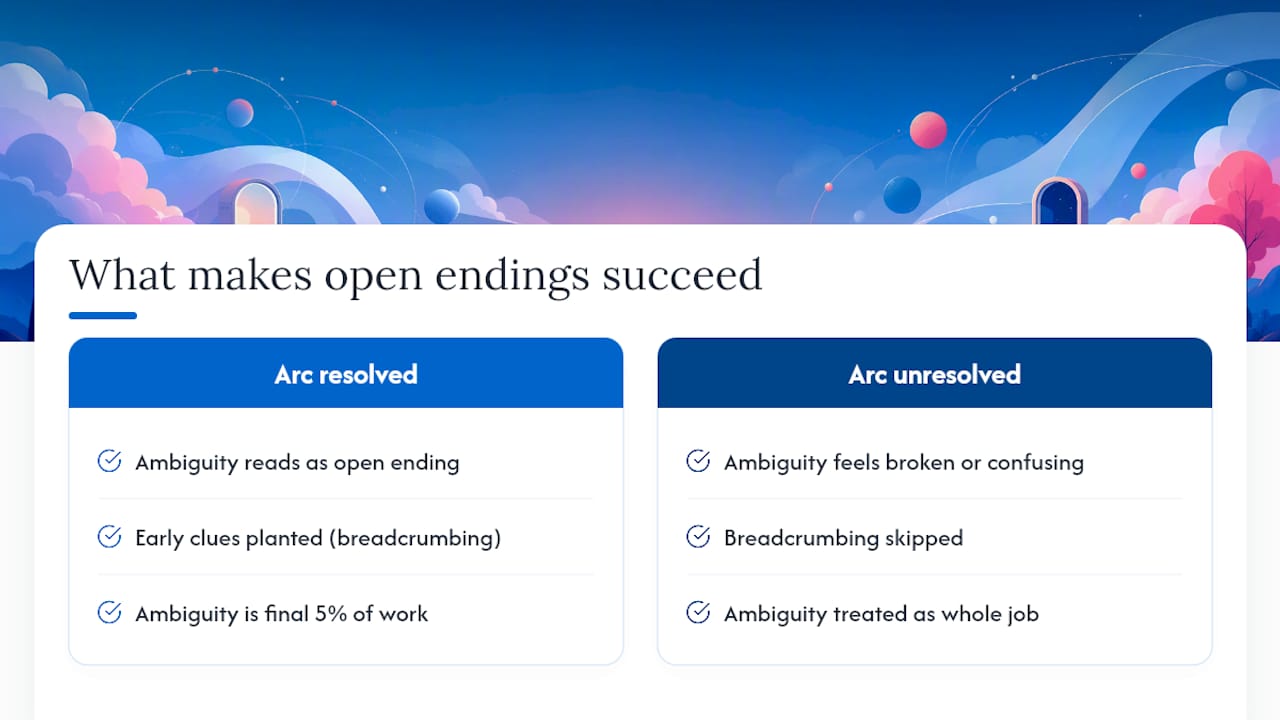
Most craft advice treats ambiguity as the whole trick: leave something out, and you’ve written an open ending. That’s backward. The research on this device consistently ties its success to emotional completion, not omission. An ending only feels open, rather than broken, when the character’s internal arc has already resolved.

Diagram of emotional arc and ambiguity impact on open ending success

The conventional wisdom undersells breadcrumbing. Writers hear “leave it ambiguous” and skip the planting work that makes ambiguity readable instead of confusing. If you take one thing from this, prioritize the emotional closure and the earlier clues before you ever touch the final ambiguous image. The ambiguity is the last five percent of the work, not the whole job.

Where to read more on open endings

  • What Is an Open Ending? How It Shapes Storytelling (clear craft definition)
  • Writing Mistakes Writers Make: Confusing Open Endings and Cliffhangers (avoids the cliffhanger trap)
  • How to Write an Open Ending: 3 Examples for Screenwriters (screenwriting-focused steps)
  • Open ending – Fiveable (concise academic framing)
  • Inception – Wikipedia (factual anchor for the film example)
  • The Lady, or the Tiger? – Wikipedia (source text background)

Frequently Asked Questions

What is the simplest open ending definition?
An open ending is a story’s close that resolves the emotional or thematic arc but leaves at least one factual plot question unanswered on purpose.

Is an open ending the same as a cliffhanger?
No. A cliffhanger stops mid-tension to force a sequel; an open ending resolves the emotional arc first and leaves ambiguity as a deliberate thematic choice.

Can an open ending feel satisfying?
Yes, when the character’s transformation is complete and earlier scenes support the ambiguity. Readers tend to feel cheated only when that emotional groundwork is missing.

Why do some readers hate open endings?
Usually because the story stopped without finishing its emotional business, which reads as unfinished rather than intentionally open.

Do open endings work better in certain genres?
They show up often in psychological fiction, literary short stories, and dystopian narratives, where uncertainty mirrors the story’s themes about identity, guilt, or survival.

Sources

  • What Is an Open Ending? How It Shapes Storytelling – Literary Devices
  • Writing Mistakes Writers Make: Confusing Open Endings and Cliffhangers
  • How to Write an Open Ending: 3 Examples for Screenwriters
  • Open ending – Fiveable (Introduction to Creative Writing)

Recommended

  • Stories of a Condemned Soul (Volume One) – Nathaniel Connors | Dystopian Horror & Thriller Fiction
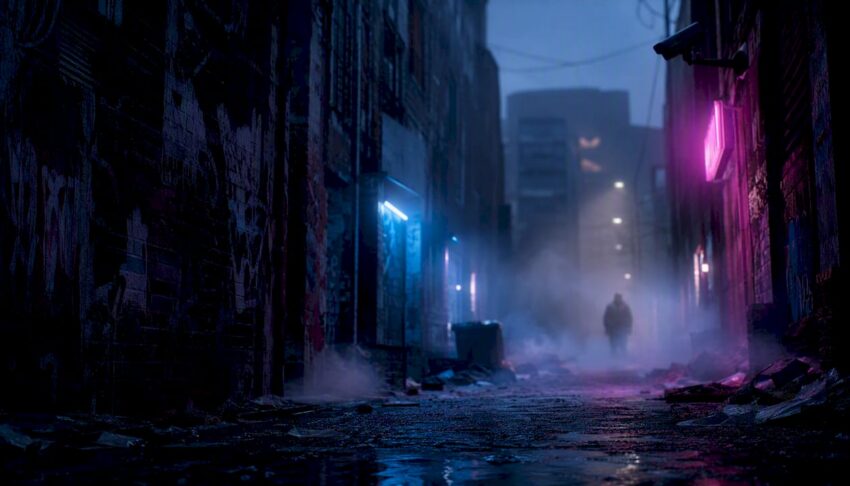
Dystopian city street at night with neon glow

Dystopian vs Post-Apocalyptic: How to Tell the Difference

Posted on August 17, 2026August 17, 2026 by NConnors

Dystopian fiction runs on a corrupt but functioning system; post-apocalyptic fiction runs on the wreckage left after that system, or the world itself, is gone. 1984 gives you a government that watches your every move and rewrites history on a whim. The Road gives you two people pushing a shopping cart through ash because there is no government left to watch anyone. The Hunger Games splits the difference: a totalitarian regime rules over a country that collapsed generations earlier.

That’s the whole distinction in one paragraph. Everything else is detail. But the detail matters if you’re trying to correctly shelve a book, pitch a manuscript, or just settle an argument about whether Mad Max counts as dystopian (it doesn’t, not really).

Before diving into examples, run your story or your favorite book through this quick check:

  • Is there a government, corporation, or ruling class actively controlling people? If yes, lean dystopian.
  • Did something catastrophic already happen, and is the plot mostly about survival afterward? If yes, lean post-apocalyptic.
  • Does the story have both, with a rebuilt society ruling over the ruins of an older one? That’s a hybrid, and it’s more common than you’d think.

Key Takeaways

Dystopian fiction is built on a corrupt but functioning system, while post-apocalyptic fiction is built on what’s left after that system, or civilization itself, collapses.

Point Details
Core test Remove the ruling institution; if the plot survives, it’s post-apocalyptic, if it collapses, it’s dystopian.
Dystopian focus Political and social control, propaganda, and rebellion against a functioning order.
Post-apocalyptic focus Scarcity, scavenging, and rebuilding after a catastrophic event has already happened.
Hybrid works Label by dominant conflict; The Hunger Games reads dystopian because the plot centers on resisting the Capitol.
Writer’s next step Fix your central conflict and timeline before drafting a single scene of worldbuilding.

Table of Contents

  • Dystopian vs Post-Apocalyptic: A Quick Comparison
  • What Makes a Story Dystopian?
  • What Makes a Story Post-Apocalyptic?
  • Why Do People Confuse the Two Genres?
  • How Genre Choice Shapes Plot and Character
  • Four Types of Dystopia Writers Should Know
  • Practical Writing Tips Backed by Craft and Experience
  • Canonical Examples Across Books, Film, and TV
  • An Editorial Take on Dystopian vs Post-Apocalyptic Fiction
  • Frequently Asked Questions
  • Sources

Dystopian vs Post-Apocalyptic: A Quick Comparison

The fastest way to sort a story is to check what’s actually driving the conflict, not what the setting looks like on the surface. A crumbling city could belong to either genre. What separates them is whether that city still answers to somebody.

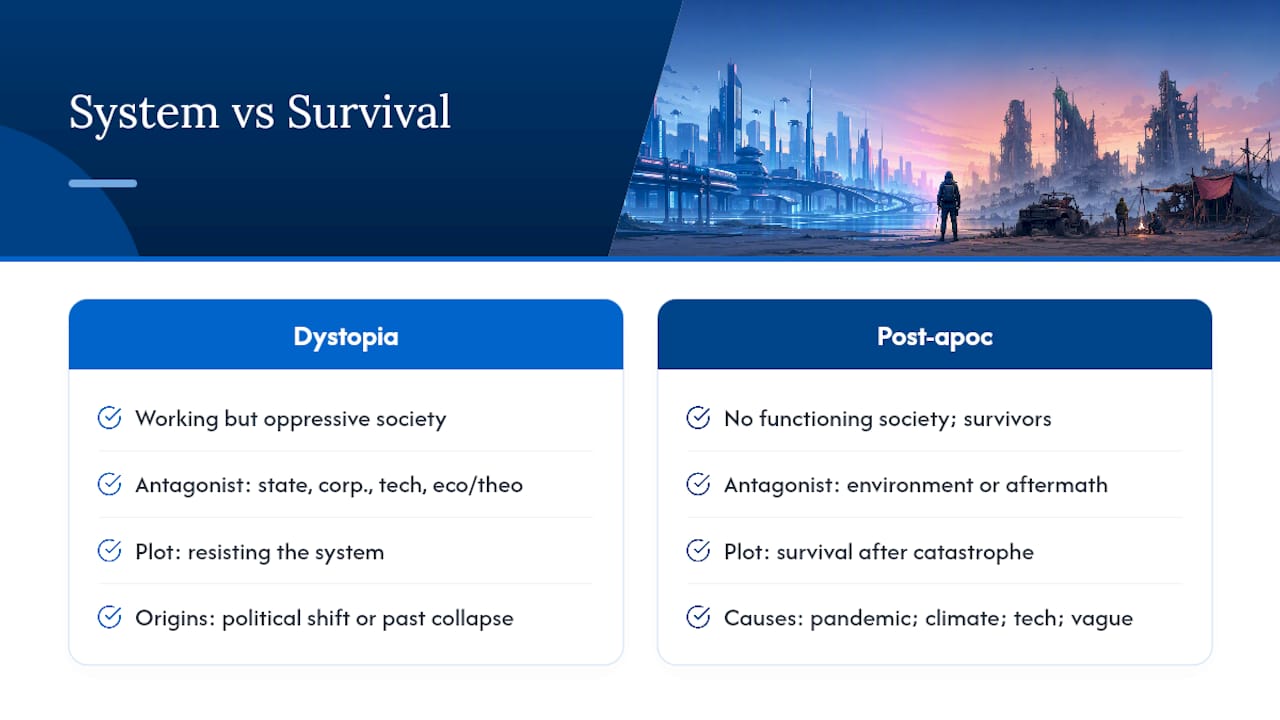
Dimension Dystopian Post-Apocalyptic
Primary driver Systemic control by an institution A singular catastrophic event
Time setting Before or under a functioning (if corrupt) society After collapse, once order has broken down
Societal structure Ordered, regulated, often bureaucratic Fractured, absent, or improvised
Themes Control, propaganda, rebellion Survival, rebuilding, grief and loss
Protagonist and goal Rebel or insider trying to expose or escape the system Survivor or scavenger trying to stay alive and find others
Common causes Government overreach, technology, social engineering Natural disaster, pandemic, war, technological failure
Tone and worldbuilding Political and social detail, ideology, institutions Logistics, scarcity, terrain, day-to-day survival

A few diagnostic questions cut through most confusion fast:

  • Is the antagonist a system, or is the antagonist the environment itself?
  • Could the government fall tomorrow and the plot keep running, or would the whole story collapse without it?
  • Are characters fighting to change society, or just fighting to see next week?

What Makes a Story Dystopian?

Dystopian fiction is defined by an existing social order, usually oppressive or unjust, that shapes the entire conflict. The society works. It has laws, hierarchies, and enforcement. That’s exactly the problem.

The hallmark traits show up again and again across the genre: surveillance that treats privacy as a threat, propaganda that rewrites truth to keep citizens compliant, and institutions that punish deviation, whether that’s a thought, a birth, or a book. Everything in a dystopia is organized. Someone designed the misery on purpose, or at least benefits from letting it continue.

Dystopian novels typically present societies that look stable and well established but are actually oppressive, and the protagonist’s job is usually to resist or expose that system rather than simply survive it. That distinction drives everything else about how these stories are built:

  • George Orwell’s 1984: a totalitarian state (Big Brother, the Thought Police) controls language, memory, and truth itself. Removing the Party would remove the entire plot.
  • Ray Bradbury’s Fahrenheit 451: books are illegal and firemen burn them; the oppression is cultural and enforced through fear of ideas, not just force.
  • Margaret Atwood’s The Handmaid’s Tale: a theocratic regime strips women of autonomy through religious law and bureaucratic control.
  • The Hunger Games: a hybrid case. The Capitol runs a functioning, oppressive government (dystopian), but that government rose out of a war that devastated the world (post-apocalyptic origin).

Ask yourself: does removing the ruling body collapse the plot? In all four examples above, yes. That’s your tell.

What Makes a Story Post-Apocalyptic?

Post-apocalyptic fiction is set after a civilization-level catastrophe, and the central conflict is usually survival, rebuilding, or coping with loss rather than fighting an institution. There’s no government to overthrow because there’s often no government at all.

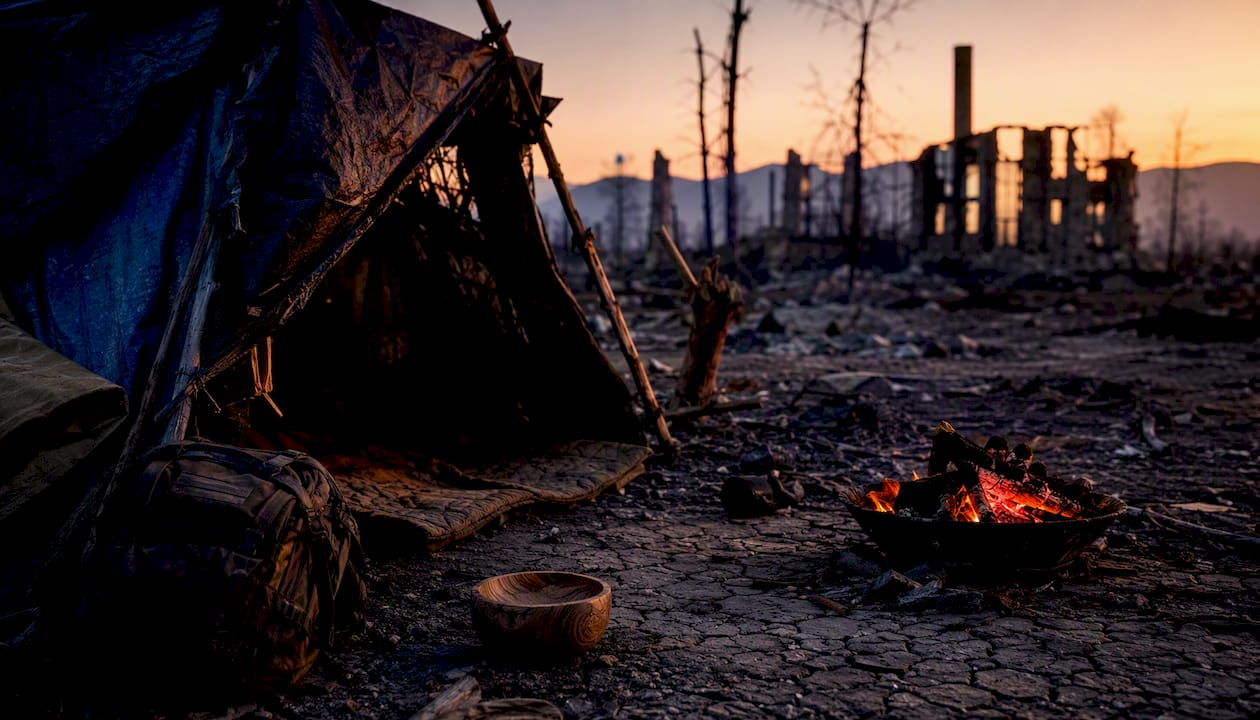
Makeshift survival camp in post-apocalyptic wilderness

The catastrophe itself, whether it’s disease, nuclear war, climate collapse, or something unexplained, isn’t the plot. It’s the reason the plot exists. What follows is an aftermath defined by scarcity: broken infrastructure, no functioning medicine or communication, and small groups of survivors improvising rules as they go.

Writers working in this genre tend to build plots around a specific set of pressures:

  • Resource scarcity: food, clean water, fuel, medicine, and who controls access to them.
  • Travel and scavenging: characters moving through dead cities or wilderness looking for supplies or other people.
  • Loss of infrastructure: no power grid, no internet, no functioning hospitals, no rule of law beyond whatever the group enforces itself.
  • Fractured communities: small bands, cults, or lone survivors replacing the nation-state entirely.

Canonical examples make the pattern obvious. Cormac McCarthy’s The Road follows a father and son walking through a burned, nearly lifeless landscape with no government of any kind, only the threat of other desperate survivors. Mad Max builds an entire mythology around fuel scarcity and gang warfare after civilization’s collapse. Emily St. John Mandel’s Station Eleven tracks a traveling theater troupe two decades after a flu pandemic wipes out most of humanity, weaving between the collapse and the fragile culture people rebuild afterward. And Mary Shelley’s The Last Man, published in 1818, gives the genre its origin story: a plague wipes out nearly everyone, decades before “post-apocalyptic” was even a term anyone used.

Why Do People Confuse the Two Genres?

The confusion isn’t accidental. Dystopian and post-apocalyptic fiction share roots in speculative fiction and overlap on themes like scarcity, despair, and warnings about where society is headed. Both genres are, at bottom, anxious about the future. They just aim that anxiety at different targets.

The clearest hybrid case is The Hunger Games. Panem is a dystopia in the present tense: the Capitol governs through fear, spectacle, and brutal enforcement. But Panem itself grew out of a catastrophe, an unnamed war that destroyed North America as we know it. Katniss isn’t fighting the aftermath of that war. She’s fighting the government that rose from it. That’s what makes it dystopian first, with post-apocalyptic scaffolding underneath.

The genres borrow from each other constantly because they’re both responding to modern anxieties about technology, climate, and power, and classification should follow the story’s central conflict rather than its surface-level setting.

Here’s the fastest heuristic for sorting a hybrid:

  • Ask what the protagonist is actually trying to accomplish by the last chapter.
  • If the goal is “escape or dismantle the ruling system,” it’s dystopian.
  • If the goal is “find safety, rebuild, or just survive another season,” it’s post-apocalyptic.

How Genre Choice Shapes Plot and Character

Picking a genre isn’t a cosmetic decision. It decides who your protagonist is, what they want, and what kind of scenes you’ll be writing for the next 300 pages.

A dystopian protagonist is usually a rebel or an insider disillusioned from within, someone who sees the machine and starts asking why it runs. Their goals are ideological: expose the lie, escape the system, spark a rebellion. Winston Smith wants the truth. Offred wants her daughter back and her name back. These goals generate scenes built around risk, secrecy, and moral compromise. Every conversation is a potential trap.

A post-apocalyptic protagonist is usually a survivor or scavenger. Their goals are physical and immediate: find water, protect the kid, make it to the next town before dark. Dystopian settings let writers dig deep into political and social structures, while post-apocalyptic settings strip characters down to basic survival instincts, and that difference changes pacing dramatically. Dystopian scenes often slow down for ideology and dialogue. Post-apocalyptic scenes tend to move fast, built around immediate physical threat.

If you’re testing an idea, ask yourself these questions:

  • Does my world need laws, ranks, or a ruling class for the conflict to make sense? (Dystopian lean.)
  • Does my world need a map, a supply count, and a body count instead? (Post-apocalyptic lean.)
  • Am I more interested in writing dialogue about ideology, or scenes about scavenging and terrain?

Neither answer is better. They just point you toward a different kind of book.

Four Types of Dystopia Writers Should Know

Dystopian fiction isn’t one flavor. Most dystopias fall into a handful of recognizable subtypes, and knowing them helps you plot, pitch, and market your story more precisely.

  1. Totalitarian surveillance state. A government monitors and punishes thought, speech, or behavior through fear and enforcement. 1984 is the defining example, with its telescreens and Thought Police.
  2. Corporate or corporatist dystopia. A company or economic system replaces the state, controlling access to resources, jobs, or even identity. Think of stories where a single corporation owns housing, food, and labor contracts, and citizens have no legal footing to resist.
  3. Technological or AI-driven control. Automation, algorithms, or artificial intelligence make decisions once reserved for humans, often stripping away agency in the name of efficiency or “optimization.”
  4. Eco or theocratic dystopia. Environmental collapse or religious law becomes the excuse for control. The Handmaid’s Tale fits here, using religious doctrine to justify a rigid, punitive social order.

Plenty of strong dystopian fiction blends two of these categories at once. The Hunger Games leans totalitarian with a heavy layer of media spectacle and corporate-style resource control over the districts.

Practical Writing Tips Backed by Craft and Experience

Nathaniel Connors has spent years writing dark supernatural and dystopian fiction, including The Nether and Evolution A200: A Bubonic Apocalypse, and one lesson keeps repeating across every draft: readers forgive a bleak world, but they won’t forgive a confused one. Pick your genre’s engine early, or your plot will wander.

A few concrete steps make that easier:

  • Decide your central conflict before your setting. Institution or catastrophe. Pick one to drive the plot, even if the other exists in the background.
  • Fix your timeline. Are we before the collapse, during the regime’s rise, or generations after everything fell apart? Readers need this anchored in the first chapter.
  • Match your worldbuilding detail to your genre. Dystopian readers want institutional texture: laws, ranks, propaganda. Post-apocalyptic readers want logistical texture: what’s left, what’s scarce, what still works.
  • Keep stakes consistent with your genre’s expectations. Readers expect dystopian fiction to deliver political critique and organized oppression, while post-apocalyptic readers expect survival logic and infrastructure collapse. Mixing signals without intention confuses your audience.
  • Give your protagonist a genre-appropriate goal. Rebellion and exposure for dystopian; survival and reunion for post-apocalyptic.

Pro Tip: Delete the ruling institution from your outline for five minutes. If the plot still works, on scavenging, travel, or survival alone, you’re writing post-apocalyptic. If the story falls apart without something to rebel against, you’re writing dystopian. This test, drawn from how genre scholars evaluate ambiguous manuscripts, catches more mislabeled drafts than any amount of outlining.

Before you query or self-publish, run this checklist:

  • Central conflict identified (system vs. catastrophe)?
  • Timeline clear within the first few pages?
  • Worldbuilding detail matches genre expectations?
  • Protagonist’s goal fits the genre (resist vs. survive)?
  • Tone consistent from opening to climax?

If you want more genre-specific inspiration, this roundup of dystopian horror novels breaks down how other authors balance oppressive systems with visceral horror.

Canonical Examples Across Books, Film, and TV

Quick labels for the works everyone brings up in this debate, and the one detail that pins each one down:

  • 1984 (book), dystopian. Big Brother’s surveillance state makes the government the entire engine of conflict.
  • Fahrenheit 451 (book), dystopian. A functioning society bans books; the fireman’s job is enforcement, not survival.
  • The Handmaid’s Tale (book/TV), dystopian. A theocratic regime controls women’s bodies through law, not chaos.
  • The Hunger Games (book/film), hybrid, dystopian-dominant. The Capitol governs a post-war world, but the plot is about resisting the regime, not surviving the original catastrophe.
  • Mad Max (film), post-apocalyptic. No government exists; fuel and water scarcity drive every scene.
  • The Road (book/film), post-apocalyptic. An unnamed catastrophe leaves no institutions at all, only two people and the road.
  • Station Eleven (book/TV), post-apocalyptic. A pandemic collapses civilization; the story tracks survival and cultural rebuilding decades later.
  • The Last Man (book), post-apocalyptic, and arguably the genre’s origin point. Mary Shelley’s 1826 plague narrative predates the modern genre by a century.

For a deeper look at post-apocalyptic creature and survival stories specifically, this tag archive of post-apocalyptic fiction collects several worth studying for tone.

An Editorial Take on Dystopian vs Post-Apocalyptic Fiction

Most guides to this topic treat it like a trivia question: name the genre, move on. That undersells what’s actually useful here. The real value isn’t in labeling 1984 correctly. It’s in understanding that genre is a decision about what kind of pressure you want to put on your characters, and that decision should come before you write a single scene.

The conventional advice tends to stop at “dystopian has a bad government, post-apocalyptic has a disaster.” True, but incomplete. It skips the part that actually helps a writer: your genre choice dictates your protagonist’s psychology. A rebel fighting a system thinks in terms of ideology, risk, and long-term consequence. A survivor fighting the wilderness thinks in terms of the next meal and the next mile. Confuse those instincts in your protagonist, and readers feel the seams even if they can’t name the problem.

What’s overrated in most discussions of this topic is the catastrophic event itself, the flood, the plague, the war. Writers obsess over making the disaster original, when readers care far more about what people do once the dust settles or the regime tightens its grip. Pick your central conflict first. Everything else, including the disaster, is set dressing.

Frequently Asked Questions

Is The Hunger Games dystopian or post-apocalyptic?
It’s a hybrid, but dystopian-dominant. The story’s central conflict is resisting the Capitol’s authoritarian government, not surviving the original war that created Panem. That war already happened generations before the story starts.

What’s the simplest way to explain the difference between dystopian and post-apocalyptic?
Dystopian means a working society that’s secretly, or openly, oppressive. Post-apocalyptic means there’s no working society left at all, only survivors dealing with what’s left.

Can a story be both dystopian and post-apocalyptic?
Yes, and it happens often. A story can open with a catastrophe and then jump forward to show a new, oppressive government that rose from the ashes. The label usually goes to whichever conflict, the system or the survival, drives most of the plot.

Why do people mix up dystopian horror with post-apocalyptic horror?
Both genres traffic in dread, scarcity, and warnings about the future, which makes them feel similar on the surface. The difference shows up in the antagonist: an institution enforcing control versus an environment or event that’s already destroyed the world.

What are the four types of dystopia?
Totalitarian surveillance states, corporate or corporatist dystopias, technological or AI-driven control systems, and eco or theocratic dystopias. Many dystopian stories combine two or more of these categories.

Frequently Asked Questions — overview diagram

Do post-apocalyptic novels always involve zombies or nuclear war?
No. The catastrophe can be a pandemic, climate collapse, technological failure, or something left deliberately vague. What defines the genre is the aftermath and the survival focus, not the specific disaster.

Sources

  • dystopian novel | Definition, History, & Examples | Britannica
  • End of the World as We Know It: Apocalyptic, Post-Apocalyptic, and Dystopian Worlds | The New York Public Library
  • Apocalyptic and post-apocalyptic fiction – Wikipedia
  • Literary Terms: Apocalyptic, Dystopian, and Post-Apocalyptic – The Masters Review
  • Utopian and dystopian fiction | EBSCO Research Starters

Recommended

  • Best Dystopian Horror Novels: 8 Haunting Reads for 2026
  • Short Dystopian Novels for One-Sitting Dread
  • post apocalyptic monster book Archives – Nathaniel Connors | Dystopian Horror & Thriller Fiction
Writer's desk with typewriter and coffee in moody light

20 Psychological Thriller Tropes Every Writer Should Know

Posted on August 16, 2026August 16, 2026 by NConnors

The essential psychological thriller tropes are: unreliable narrator, twist reveal, mind games and gaslighting, isolated setting, missing person obsession, fractured memory, escalating fixation, morally complex protagonist, ambiguous ending, intelligent manipulator, double identity, voyeurism and surveillance, trauma as motive, symbolism and motifs, and nonlinear or nested narrative structure. Each entry below gives a tight definition, the dramatic function it serves, two canonical examples, and two concrete ways to use or subvert it in your own work.


Key Takeaways

Psychological thrillers generate their tension through internal distortion — unreliable perception, fractured memory, and moral ambiguity — not external action, and every trope in the genre serves that central engine.

Point Details
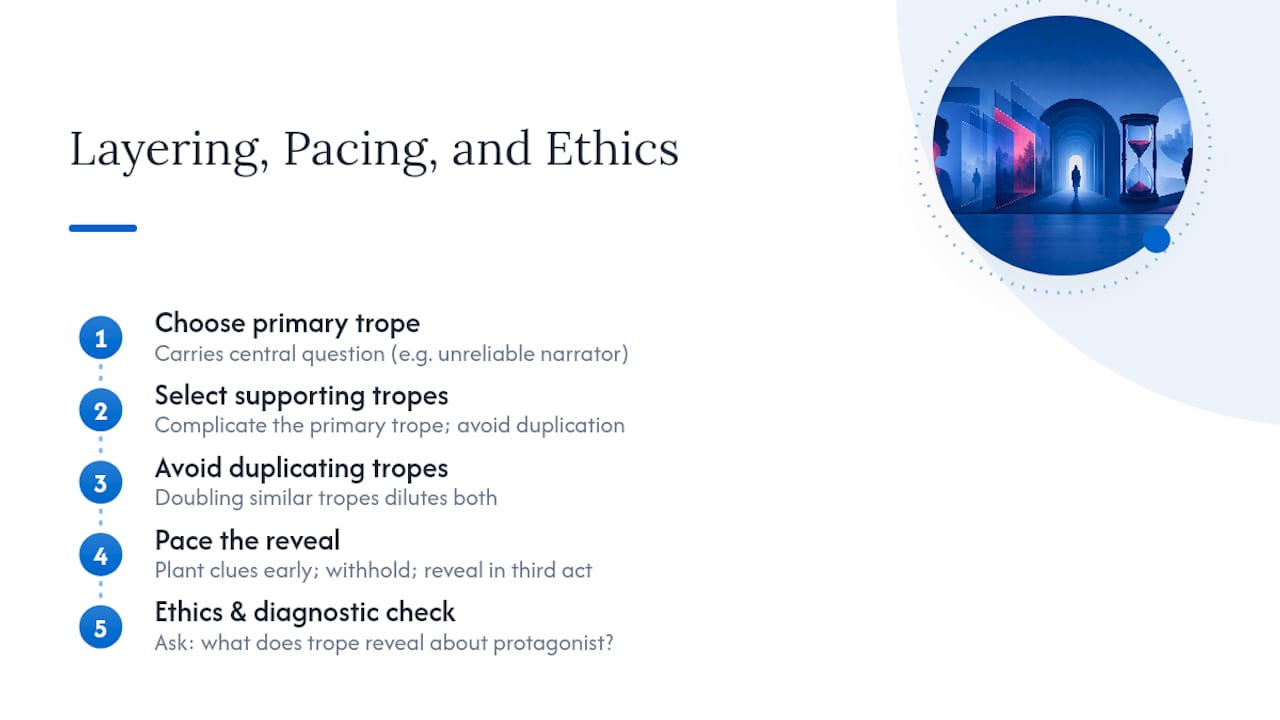
Lead with one primary trope Choose a central device (usually unreliable narrator or twist reveal) and build supporting tropes around it.
Plant clues in emotional texture Hide foreshadowing in what characters notice or ignore, not in plot mechanics, so rereaders find them naturally.
Twist reveals must reframe character A reveal that only changes plot events is a trick; one that reframes who the protagonist is earns its place.
Represent mental states through motive Show what a character wants and fears rather than labeling a diagnosis — motive-driven complexity avoids harmful stereotyping.
Nathanielconnors for tropes in action The Nether and Stories of a Condemned Soul apply obsession, moral ambiguity, and guilt-driven psychology to dark supernatural fiction.

Table of Contents

  • Psychological thriller tropes: the complete craft catalog
  • How to layer, time, and subvert tropes effectively
  • What makes a psychological thriller distinct from other thrillers
  • Internal distortion is the genre’s real engine
  • A writer’s note on using tropes responsibly
  • Dark reads that put these tropes to work
  • Sources

Psychological thriller tropes: the complete craft catalog

These fifteen tropes are the genre’s load-bearing walls. Common tropes in psychological thrillers include the unreliable narrator, missing person, ambiguous ending, isolated location, fractured memory, and the twist reveal as a central device — each generating tension through perception rather than spectacle. The catalog below treats them as craft tools, not clichés.

Pro Tip: Plant your clues in the emotional texture of a scene, not its plot mechanics. A character who notices the wrong detail, or fails to notice the right one, rewards rereaders without telegraphing the twist to first-timers.

1. Unreliable narrator

A narrator whose account the reader cannot fully trust, whether from self-deception, trauma, mental distortion, or deliberate deception. The gap between what the narrator reports and what actually happened is where the genre lives.

This device forces readers to do interpretive work, which creates active engagement rather than passive consumption. Every sentence becomes a puzzle piece that might be lying. The tension isn’t “what happens next” but “what is actually happening right now.”

Film: Fight Club (1999) — the narrator’s fractured identity is the twist the entire film has been building toward. Novel: Gone Girl by Gillian Flynn — both Nick and Amy narrate, and both are withholding.

Use it: Let the narrator’s blind spots reveal character. What they refuse to see tells the reader more than what they describe. Subvert it: Make the narrator reliable about facts but unreliable about meaning — they report events accurately but interpret them in ways the reader gradually recognizes as delusional.


2. The twist reveal

A late-act revelation that recontextualizes everything the reader believed. Done well, it feels both surprising and inevitable.

The twist works because psychological thrillers condition readers to trust a single interpretive frame, then pull it away. The emotional payoff isn’t shock alone — it’s the retroactive reread, the moment readers mentally replay every earlier scene through the new lens.

Film: The Usual Suspects (1995) — Verbal Kint’s identity reframes the entire story in its final seconds. Film: Shutter Island (2010) — the island’s psychiatric setting is itself the twist’s architecture.

Use it: Seed the reveal in plain sight. The best twists hide behind the reader’s own assumptions, not behind withheld information. Subvert it: Give the reader the twist at the midpoint, then make the real tension about whether the protagonist will accept it.


3. Mind games and gaslighting

A character systematically manipulates another’s perception of reality, making them doubt their own memory, judgment, or sanity. The term comes from the 1944 film Gaslight, and the device has been a genre staple ever since.

Gaslighting generates dread because it attacks the protagonist’s most fundamental tool: their own mind. Readers experience the disorientation alongside the character, which is more unsettling than any external threat.

Film: Get Out (2017) — the Armitage family’s manipulation of Chris is both psychological and literal, blurring the line between paranoia and reality. Novel: Gone Girl — Amy’s orchestration of Nick’s public perception is a masterclass in sustained gaslighting.

Use it: Show the gaslighter’s technique through small, deniable moments before the pattern becomes visible. Subvert it: Let the protagonist recognize the manipulation early but be unable to prove it — the trap becomes social rather than perceptual.


4. Isolated or claustrophobic setting

A location that cuts characters off from outside help: a remote island, a locked apartment, a snowbound estate, a psychiatric facility. The setting externalizes the protagonist’s psychological entrapment.

Physical isolation amplifies every interpersonal tension. When escape is impossible, the reader’s attention turns inward — to the characters’ psychology rather than to plot mechanics. NoFilmSchool notes that modern psychological thrillers favor slow-building atmospheric dread, and the isolated setting is the architecture that makes that dread possible.

Film: Shutter Island — Ashecliffe Hospital is both prison and psychological mirror. Novel: The Shining by Stephen King — the Overlook Hotel is the clearest example of a setting that becomes a character.

Use it: Make the setting reflect the protagonist’s mental state — a cluttered apartment for a paranoid character, an antiseptically clean house for a controlling one. Subvert it: Place the story in a crowded city where isolation is social rather than geographic. The protagonist is surrounded by people and utterly alone.


5. Missing person driving obsession

A disappearance — of a spouse, child, or stranger — that pulls the protagonist into an investigation that gradually reveals as much about them as about the missing person.

The missing person is a structural engine: it gives the protagonist a goal while the real story unfolds around that search. The obsession that develops tells readers what the protagonist most fears losing, or most needs to find in themselves.

Novel: Gone Girl — Amy’s disappearance is the inciting event, but the investigation exposes Nick’s marriage, his failures, and eventually his wife’s psychology. Film: Mulholland Drive (2001) — Betty’s search for the amnesiac Rita is a missing-person mystery that dissolves into something far stranger.

Use it: Make the missing person a mirror. What the protagonist discovers about them should force a reckoning with the protagonist’s own life. Subvert it: Reveal early that the “missing” person left voluntarily — then make the real mystery why the protagonist can’t accept that.


6. Fractured or repressed memory

A protagonist who cannot access, or misremembers, key events from their past. Memory gaps drive the plot and create unreliability without requiring a dishonest narrator.

Memory is the genre’s most versatile device because it is both plot mechanism and character revelation. What a character forgets, and what they remember wrong, maps their psychological damage. Psychological thriller themes consistently center memory as one of the five thematic pillars of the genre alongside identity, manipulation, obsession, and moral ambiguity.

Film: Shutter Island — Teddy Daniels’ repressed memory is the entire architecture of the film’s mystery. Novel: Before I Go to Sleep by S.J. Watson — the protagonist wakes each day with no memory of her adult life.

Use it: Let the reader recover the memory alongside the protagonist. Partial flashbacks that grow clearer as the character heals create a satisfying structural arc. Subvert it: Give the protagonist perfect recall of events but completely wrong interpretation of their meaning.


7. Obsession and escalating fixation

A character’s focus on a person, idea, or goal that intensifies past reason. Obsession is the genre’s emotional engine — it explains why characters keep going when any rational person would stop.

Obsession creates momentum. Readers stay because they want to know how far the character will go, and whether they will recognize the line they’ve crossed. The escalation must feel earned: each step should be a logical extension of the last, even when the cumulative effect is extreme.

Film: Mulholland Drive — the film’s obsessive, looping structure mirrors its protagonist’s psychological fixation. Novel: You by Caroline Kepnes — Joe Goldberg’s fixation on Beck is narrated in second person, implicating the reader in the obsession.

Use it: Track the obsession through what the character sacrifices. Each loss — a relationship, a job, a moral line — raises the stakes. Subvert it: Make the obsession entirely justified by the facts, then ask whether justification makes it healthy.


8. Morally complex protagonist

A lead character who is neither purely good nor purely bad — who lies, manipulates, or harms others while remaining the reader’s primary identification figure.

Moral complexity is what separates psychological thrillers from conventional crime fiction. Readers are asked to root for someone they wouldn’t trust in real life, which creates a productive discomfort. Writer’s Digest identifies moral ambiguity as one of the thriller writer’s most reliable tools for sustaining reader investment.

Novel: Gone Girl — both Nick and Amy are morally compromised in ways that shift the reader’s sympathy repeatedly. Film: Fight Club — the narrator’s complicity in Tyler’s violence is revealed gradually, implicating the reader.

Use it: Give the protagonist a clear, sympathetic wound that explains (without excusing) their worst behavior. Subvert it: Make the protagonist’s moral compromise the solution rather than the problem — the thing that saves everyone, at a cost.


9. Ambiguous ending

A conclusion that refuses to resolve cleanly: the reader cannot be certain whether the protagonist survived, recovered, escaped, or imagined the entire story.

Ambiguity respects the reader’s intelligence and mirrors the genre’s central concern with unreliable perception. A clean resolution would betray the premise. The ambiguous ending lingers because readers continue arguing about it — which is the point.

Film: Mulholland Drive — the film’s final act collapses its own narrative, leaving the “real” story genuinely open. Film: Shutter Island — the final line (“Which would be worse — to live as a monster, or to die as a good man?”) refuses to confirm whether Teddy has recovered or relapsed.

Use it: Plant two equally plausible readings of the final scene. The reader’s choice between them reveals something about the reader, not just the character. Subvert it: Give the ending apparent clarity, then undercut it with a single detail in the last paragraph that makes the “clear” reading impossible.


10. Intelligent and manipulative antagonist

An antagonist whose power comes from psychological acuity rather than physical threat. They understand the protagonist better than the protagonist understands themselves.

This antagonist is terrifying because they weaponize knowledge. Every interaction is a chess move. The protagonist’s intelligence becomes a liability — the smarter they are, the more the antagonist can predict them.

Film: The Usual Suspects — Keyser Söze is the genre’s definitive intelligent manipulator, constructing an entire false reality in real time. Novel: Gone Girl — Amy Dunne plans years ahead, accounting for contingencies the reader doesn’t see coming.

Use it: Give the antagonist a genuine grievance. Manipulation rooted in real pain is more disturbing than pure sociopathy. Subvert it: Make the antagonist’s intelligence their fatal flaw — they plan for every contingency except the protagonist’s irrationality.


11. Double identity or secret impostor

A character who is not who they claim to be — a false identity, a hidden past, a split self. The revelation reframes every prior interaction.

Double identity generates retroactive tension. Once revealed, readers replay every scene looking for the tells they missed. It also raises the genre’s central question: if identity is constructed, how much of any self is real?

Film: Fight Club — Tyler Durden is the genre’s most iconic split-self reveal. Film: The Usual Suspects — Verbal Kint’s real identity is the film’s entire engine.

Use it: Let the false identity be more appealing than the real one. The character’s attachment to their constructed self becomes the emotional core. Subvert it: Have the protagonist discover the impostor early, then make the real tension about why they choose not to expose them.


12. Voyeurism and surveillance

A character who watches others without their knowledge — or who discovers they are being watched. Surveillance creates paranoia and raises questions about privacy, power, and complicity.

Voyeurism implicates the reader. Watching a character watch someone else, readers become aware of their own position as observers of a private world. Codes and conventions of the genre include confined spaces and visual devices that externalize internal states — the surveillance camera, the two-way mirror, the window across the courtyard.

Film: Get Out — the Armitage family’s observation of Chris begins as social discomfort and escalates into literal surveillance. Novel: You — Joe’s stalking of Beck is narrated as romance, forcing readers to inhabit the watcher’s perspective.

Use it: Make the watcher’s observations unreliable. What they see through a window or on a screen is always partial, always filtered through desire or fear. Subvert it: Reveal that the “watcher” has been the subject of surveillance the entire time.


13. Trauma as character motive

A past wound — abuse, loss, violence, betrayal — that drives the protagonist’s present behavior in ways they may not fully understand. Trauma explains without excusing.

Trauma-driven characters feel real because their reactions are disproportionate in ways that make sense once the backstory is clear. The genre uses trauma to justify obsession, paranoia, and moral compromise — but the best psychological thrillers also show characters working against their trauma, not just enacting it.

Film: Get Out — Chris’s trauma around his mother’s death is weaponized against him by the Armitage family. Novel: The Silent Patient by Alex Michaelides — the therapist’s obsession with his patient is rooted in his own unprocessed history.

Use it: Let trauma surface through behavior before it’s explained. A character who flinches at a specific sound, or can’t enter a particular type of room, tells the reader something is wrong before the backstory arrives. Subvert it: Give the protagonist a trauma backstory that turns out to be false memory — then ask who planted it and why.


14. Symbolism and recurring motifs

Objects, colors, sounds, or images that recur throughout the story and accumulate psychological meaning — mirrors reflecting fractured identity, water suggesting the unconscious, clocks marking psychological time rather than real time.

Motifs do the work of theme without stating it. A character who keeps breaking mirrors isn’t just clumsy; the reader understands something is fracturing. Genre conventions consistently include symbolic motifs like mirrors and water that externalize internal states — a technique prose writers can translate directly from film.

Film: Mulholland Drive — the blue box and blue key are objects that carry the film’s entire metaphysical weight without ever being explained. Novel: House of Leaves by Mark Z. Danielewski — the house’s impossible geometry is a sustained architectural metaphor for psychological collapse.

Use it: Choose one motif and let it evolve. A mirror that reflects accurately in chapter one, distorts in chapter five, and shows something impossible in chapter twelve tracks the protagonist’s deterioration without a single expository sentence. Subvert it: Make the motif mundane and then reveal it was significant all along — the coffee cup the protagonist always leaves on the left side of the desk, until the day they don’t.


15. Nonlinear or nested narrative structure

A story told out of chronological order, or a story-within-a-story where the framing narrative and the embedded narrative comment on each other. Structure itself becomes a psychological device.

Nonlinear structure mimics the way traumatized or obsessed minds actually work: not in clean sequence but in loops, intrusions, and gaps. Key structural techniques in the genre include unreliable narration, non-linear structure, and psychological fragmentation — devices that build uncertainty at the level of form, not just content.

Novel: Gone Girl — Amy’s diary entries are a nested narrative that turns out to be a constructed document, not a genuine record. Film: Mulholland Drive — the film’s two-act structure is a nested story where the second act reveals the first to be fantasy.

Use it: Use the structural break as a reveal. The moment the reader realizes the timeline has been scrambled — and why — should reframe everything that came before. Subvert it: Signal the nonlinear structure explicitly from page one, then use that transparency to hide a different kind of unreliability.


Trope comparison: choosing the right device for your target effect

Trope Narrative purpose Core emotional effect Typical subversion
Unreliable narrator Destabilizes reader’s interpretive frame Paranoia, retroactive doubt Reliable facts, unreliable meaning
Twist reveal Recontextualizes the entire story Shock, then retroactive pleasure Give the twist early; make acceptance the real conflict
Gaslighting / mind games Erodes protagonist’s grip on reality Dread, helplessness Protagonist recognizes it but can’t prove it
Isolated setting Removes external escape routes Claustrophobia, inescapability Social isolation in a crowded space
Fractured memory Creates plot gaps and character revelation Unease, gradual horror Perfect recall, wrong interpretation
Obsession / escalation Drives momentum past rational limits Compulsion, complicity Obsession that turns out to be entirely justified
Ambiguous ending Refuses clean resolution Lingering unease, reader debate Apparent clarity undercut by a single final detail

How to layer, time, and subvert tropes effectively

The most effective psychological thrillers don’t run a single trope — they stack them so each one amplifies the others. An unreliable narrator paired with fractured memory creates a double layer of uncertainty: the reader can’t trust the account, and the narrator can’t trust their own recollection. Add an isolated setting and the reader has nowhere to look for a corrective perspective. That combination is the architecture of Shutter Island.

The key to layering is hierarchy. Choose one primary trope that carries the story’s central question (usually the unreliable narrator or the twist reveal), then select supporting tropes that complicate it rather than duplicate it. Gaslighting supports the unreliable narrator by giving the unreliability an external cause. Obsession supports the missing-person plot by explaining why the protagonist won’t stop. Doubling up on similar tropes — two twist reveals, two unreliable narrators — dilutes both.

Pacing the reveal matters as much as the reveal itself. Plant clues in the first third, withhold confirmation in the second, and deliver the recontextualization in the third. Partial truths are more effective than total concealment: let the reader be right about one element of the twist while being wrong about the larger picture. That partial correctness feels like earned intelligence rather than authorial manipulation. For a late twist to feel plausible rather than cheap, every clue must be present in the text before the reveal — the reader should be able to find them on a reread, even if they missed them the first time. Crime Fiction Musings makes the point directly: skilled authors subvert tropes to surprise readers without breaking plausibility.

One area where writers consistently stumble is the representation of mental illness. Fractured memory, split identity, and paranoia are powerful devices, but they carry real-world weight. Using a diagnosis as a plot twist (“she was schizophrenic all along”) reduces a lived experience to a narrative mechanism and signals to readers who share that experience that the author hasn’t done the work. The stronger approach is motive-driven complexity: show what the character wants, fears, and has lost, and let the psychological state emerge from that specificity rather than from a label. The psychological thriller genre centers on internal distortions and moral ambiguity — neither requires a clinical diagnosis to generate tension.

For writers working on a draft, the most useful diagnostic question is: what does this trope reveal about my protagonist’s psychology, not just their plot situation? A missing person who is purely a plot engine is less interesting than a missing person whose absence exposes the protagonist’s dependency, guilt, or self-deception. Every trope should do double duty: advance the plot and deepen character.


How to layer, time, and subvert tropes effectively — overview diagram

What makes a psychological thriller distinct from other thrillers

A psychological thriller centers on internal distortion rather than external threat. The danger is perception itself: the protagonist’s mind, or another character’s manipulation of it, is the primary antagonist. Where an action thriller asks “will the hero survive?”, a psychological thriller asks “can the protagonist trust what they believe?”

A working logline for the genre: A character whose grip on reality is compromised must navigate a world where the truth is actively hidden, distorted, or constructed by someone who knows them better than they know themselves.

The genre’s dominant themes — identity, memory, manipulation, obsession, and moral ambiguity — are not decorative. They are structural. A story without at least two of them is probably a crime thriller or a horror story, not a psychological thriller. The distinction matters for writers because it determines where to focus revision energy: not on plot mechanics but on the protagonist’s interiority, the reliability of their account, and the moral weight of their choices.

What separates psychological thrillers from horror is the locus of threat. Horror externalizes: the monster, the haunting, the disease. Psychological thrillers internalize: the monster is the protagonist’s own mind, or a human antagonist who has colonized it. Get Out sits at the border — the threat is both external (the Armitage family) and internal (Chris’s trauma, his inability to act on his instincts) — which is why it works in both registers.


What makes a psychological thriller distinct from other thrillers — overview diagram

Internal distortion is the genre’s real engine

That observation explains why the genre’s canonical examples keep returning to the same structural moves. Shutter Island and Fight Club are both stories about a man whose entire reality is a construction of his own damaged mind. Mulholland Drive uses the same architecture at the level of film form itself. The external plot — the investigation, the fight club, the missing woman — is the surface. The internal fracture is the story.

Here’s a short writing exercise that turns this principle into a scene:

  1. Write the scene twice. First from the protagonist’s perspective, as they experience it. Then from a neutral observer’s perspective — a security camera, a bystander — recording only what is physically visible. The gap between those two versions is your psychological thriller.
  2. Identify what the protagonist cannot see. In the neutral version, what is the protagonist missing, misreading, or refusing to acknowledge? That blind spot is the scene’s real subject.
  3. Cut the neutral version. Keep only the protagonist’s account, but let the blind spot show through their word choices, their omissions, and what they notice versus what they ignore.

NoFilmSchool’s analysis of the genre observes that modern psychological thrillers favor slow-burn dread and morally ambiguous characters, rewarding atmosphere and character-driven tension. That atmosphere is built scene by scene through exactly this kind of interiority gap — the distance between what the protagonist reports and what the reader suspects.

For writers interested in how reality-distortion works at the structural level, the books like House of Leaves roundup on Nathanielconnors explores how internal conflict and fractured form work together in some of the genre’s most formally ambitious examples.


A writer’s note on using tropes responsibly

The tropes in this catalog are tools, not shortcuts. The difference between a psychological thriller that stays with readers for years and one that feels like a clever puzzle is whether the tropes serve character or replace it.

Working on The Nether and Stories of a Condemned Soul, I kept returning to one question: does this twist reveal something true about the character, or does it just surprise the reader? Surprise without revelation is a magic trick. Revelation without surprise is a therapy session. The genre demands both at once, which is genuinely hard to pull off.

The trope I find most misused is the twist reveal. Writers often treat it as the destination — the thing the whole story is building toward. But the best reveals in the genre (the final line of Shutter Island, the last pages of Gone Girl) work because they reframe the character’s psychology, not just the plot. The reader doesn’t just think “I didn’t see that coming.” They think “of course — that’s who this person always was.”

If you’re writing a psychological thriller and the twist only changes what happened, dig deeper. It should change who the protagonist is.


Dark reads that put these tropes to work

If you want to see obsession, moral ambiguity, and fractured identity in action rather than in theory, Nathanielconnors’s fiction is a direct application of the craft principles above. The Nether works the guilt-and-repression angle hard — the kind of story where the protagonist’s psychology is the real mystery. Stories of a Condemned Soul leans into moral ambiguity and the question of whether redemption is possible for someone who has genuinely done wrong.

Nathanielconnors

Both titles are available on Amazon in ebook and paperback, and free to read for Kindle Unlimited subscribers. For a broader set of atmosphere-driven reads that demonstrate how dread is built at the sentence level, the dystopian horror novels list on the site collects titles that share the genre’s interest in psychological pressure and moral collapse. If you want something shorter, the short dystopian novels page has one-sitting reads that show how much tension a tight word count can hold.

Sources

  • Psychological thriller — Wikipedia
  • Common tropes in psychological thrillers — MovieWeb
  • 21 Popular Thriller Tropes for Writers — Writer’s Digest
  • Unpacking the psychological thriller genre — NoFilmSchool
  • Themes & Tropes of Psychological Thrillers, Explained — Mary Desch

Recommended

  • Best Dystopian Horror Novels: 8 Haunting Reads for 2026
  • Kindle Unlimited Psychological Thrillers by Nathaniel Connors
Gothic mansion interior with eerie lighting

Horror Subgenres Explained: Your Complete Genre Guide

Posted on August 15, 2026August 15, 2026 by NConnors

Horror subgenres are distinct approaches to eliciting fear, each defined by recurring themes, tone, and techniques that target a specific emotional response. Think of them the way Mental Floss frames it: just as music fans gravitate toward jazz or metal based on how they want to feel, horror fans connect to different expressions of dread. The taxonomy isn’t rigid, but it’s genuinely useful.

The major clusters break down like this:

  • Psychological and elevated/arthouse (mind-focused dread, unreliable reality)
  • Supernatural and paranormal (ghosts, demons, possession)
  • Visceral/gore (splatter, body horror, cannibal)
  • Creature and monster (animal, alien, mythological)
  • Folk, occult, and witch (ritual, community, ancient belief)
  • Speculative (sci-fi/techno, cosmic/Lovecraftian, pandemic/medical)
  • Hybrid and formal (found footage, analog horror, comedy-horror, giallo)

The canonical films that anchor this guide span more than six decades: Psycho (1960), Rosemary’s Baby (1968), Night of the Living Dead (1968), The Exorcist (1973), Halloween (1978), Alien (1979), The Shining (1980), The Thing (1982), A Nightmare on Elm Street (1984), Get Out (2017), Hereditary (2018), and The Babadook (2014). H. P. Lovecraft’s fiction anchors the cosmic horror tradition. One thing to expect throughout: most great horror films borrow from more than one subgenre, and that’s a feature, not a flaw.


Key Takeaways

Horror subgenres are the clearest map available for matching your emotional tolerance to the right film or book — and knowing the taxonomy makes you a sharper reader, viewer, and writer.

Point Details
Subgenres target different fears Psychological horror produces terror; cosmic horror produces existential dread; visceral/gore targets revulsion.
Three signals classify most films Check antagonist origin, primary emotion targeted, and visual intensity to place any film in its dominant subgenre.
Overlap is normal Most great horror films blend subgenres; identify the primary “fear engine” rather than forcing a single label.
Comfort level guides entry points Start with psychological or supernatural horror; approach body horror and splatter only after calibrating your tolerance.
Nathanielconnors maps to multiple subgenres Evolution A200 covers pandemic/dystopian horror; The Nether covers dark supernatural — both available on Kindle Unlimited.

Table of Contents

  • What actually makes something “horror”?
  • How horror evolved from Gothic novels to analog dread
  • The major horror subgenres, defined one by one
  • How to tell subgenres apart and find what fits your taste
  • Why subgenre awareness changes how you read and write horror
  • Read fiction that actually lives in these subgenres
  • Sources

What actually makes something “horror”?

Horror is defined by one core contract with the audience: it asks you to feel afraid. But the type of fear varies enormously, and those variations are what separate subgenres from each other.

The genre’s shared characteristics include:

  • Threat — something endangers a character’s body, mind, identity, or soul
  • Transgression — a boundary (natural, moral, or physical) is crossed
  • Vulnerability — the protagonist lacks full control or knowledge
  • Dread vs. startle — sustained atmospheric tension versus sudden shock

Cinematic technique shapes which of those elements dominates. Sound design is probably the most underrated tool: Bernard Herrmann’s strings in Psycho trained audiences to associate staccato violins with imminent violence. POV framing pulls viewers into the protagonist’s limited sightline, making the unknown feel immediate. Practical effects, especially in body horror, create revulsion that CGI rarely matches because the audience knows something physical was actually built.

The emotional aims also differ sharply by subgenre. Psychological horror targets terror (the anticipation of something awful). Supernatural horror often aims for uncanny dread (the wrongness of something that shouldn’t exist). Visceral/gore horror goes for revulsion and a kind of transgressive thrill. Cosmic horror produces existential dread, the feeling that the universe is indifferent and vast and you are very small.

Pro Tip: To identify a subgenre quickly, ask three questions: Where does the threat come from (human, supernatural, or unknown)? What emotion does the story primarily target (terror, revulsion, or existential dread)? How graphic is the body emphasis? Those three signals, outlined by LA Film School, will place most films in the right cluster within minutes.


How horror evolved from Gothic novels to analog dread

Horror didn’t arrive fully formed. It grew through distinct waves, each one reacting to the anxieties of its era, and understanding that arc explains why certain conventions feel dated or fresh.

Gothic literature (late 18th–19th century) gave the genre its DNA: crumbling architecture, aristocratic menace, psychological torment, and the supernatural as a metaphor for repressed desire. Mary Shelley’s Frankenstein (1818) and Bram Stoker’s Dracula (1897) established templates that still run through modern horror.

Early cinema (1920s–1930s) translated Gothic imagery to screen. Nosferatu (1922) codified the vampire film. Universal’s monster cycle — Dracula (1931), Frankenstein (1931), The Wolf Man (1941) — gave the genre its first studio infrastructure and its first recognizable subgenre: the classic monster film.

Postwar reinvention (1950s–1960s) brought science fiction anxiety into the mix. Atomic-age creature features reflected Cold War paranoia. Then Alfred Hitchcock’s Psycho (1960) broke the mold entirely: the monster was human, the violence was psychological, and the shower scene proved that suggestion could be more disturbing than explicit gore. Rosemary’s Baby (1968) and Night of the Living Dead (1968) arrived the same year, one establishing occult paranoia and one inventing the modern zombie film, as Wikipedia’s horror film history documents.

The 1970s–1980s golden era produced the films most people think of when they hear “horror.” The Exorcist (1973) defined supernatural possession. Halloween (1978) codified slasher conventions: the masked killer, the final girl, the suburban setting. Alien (1979) fused sci-fi and body horror in a way that felt genuinely new. The Shining (1980) pushed psychological horror into high art. The Thing (1982) took practical body horror to an extreme that still unsettles viewers. Filmsite’s curated horror history maps how each of these films shaped the conventions that followed.

The 1990s–2000s brought meta-awareness (Scream, 1996), found footage (The Blair Witch Project, 1999; Paranormal Activity, 2007), and a wave of J-horror (Ringu, 1998; Ju-On, 2002) that introduced new visual grammar — long black hair, jerky movement, cursed media — rooted in Japanese folklore and contemporary anxieties about technology.

The 2010s–present saw two major shifts. First, what critics call “elevated horror” (films like Hereditary, 2018, and The Babadook, 2014) prioritized grief, trauma, and atmosphere over conventional scares. Second, analog horror emerged as a digital-native subgenre, using the aesthetic of degraded VHS or public-access footage to unsettle viewers through nostalgia and format distortion.

Regional horror deserves its own note. South Korean cinema (A Tale of Two Sisters, 2003; The Wailing, 2016), Thai horror (Shutter, 2004), and Indonesian horror (Impetigore, 2019) draw on local folklore, religious belief, and social hierarchies to produce fear that feels culturally specific. These films demonstrate that horror’s emotional mechanics are universal even when the mythology is not, a point Wikipedia’s genre overview makes clearly.

Era Milestone Film Subgenre Impact
1960 Psycho Established psychological/slasher proto-conventions
1968 Night of the Living Dead Invented the modern zombie subgenre
1968 Rosemary’s Baby Defined occult/folk paranoia horror
1973 The Exorcist Set the template for supernatural possession
1978 Halloween Codified slasher structure and iconography
1979 Alien Merged sci-fi with body horror
1980 The Shining Pushed psychological horror toward literary prestige
1982 The Thing Elevated practical body horror to its peak
1999 The Blair Witch Project Launched found footage as a mainstream format
2017 Get Out Defined social/psychological horror for a new era
2018 Hereditary Anchored the elevated horror wave

The major horror subgenres, defined one by one

Blumhouse’s taxonomy categorizes significant modern horror films into roughly two dozen subgenre labels with input from industry experts. That’s a useful floor. The list below covers every major category plus notable niches, grouped into clusters where the overlap is meaningful.

Mind-focused cluster

Psychological horror targets the mind rather than the body. The threat is often internal: paranoia, guilt, grief, or an unreliable perception of reality. The Shining is the canonical example — Jack Torrance’s disintegration is as frightening as anything supernatural in the Overlook Hotel. Hereditary layers grief onto occult dread so effectively that the two become inseparable. Primary fear: terror and existential uncertainty. Typical setting: isolated house, institution, or the protagonist’s own mind.

Elevated/arthouse horror is a contested label, as CBR notes, best treated descriptively rather than as a strict category. These films prioritize atmosphere, theme, and character over conventional scares. The Babadook uses a monster as a metaphor for depression. Get Out uses social horror to examine racism. The “elevated” tag sometimes functions as marketing, but the stylistic qualities — slow pacing, literary themes, restrained gore — are real and distinguishable.

Supernatural and paranormal cluster

Supernatural/paranormal horror involves forces that operate outside natural law: ghosts, demons, curses, and entities that shouldn’t exist. The Exorcist remains the benchmark for demonic possession. Rosemary’s Baby works through slow paranoia rather than overt spectacle, making the supernatural feel like a conspiracy hiding in plain sight. Primary fear: uncanny dread, the wrongness of the impossible made real.

Gothic/haunted-house horror is supernatural horror with a specific architectural obsession. The house itself becomes a character — decaying, secretive, and malevolent. Shirley Jackson’s The Haunting of Hill House (1959) is the literary standard. The setting carries the weight of history, inheritance, and repressed trauma. For a deep dive into gothic horror’s conventions and influence, E. L. Ravenheart’s gothic horror overview is worth reading.

Occult/folk horror grounds the supernatural in ritual, community, and ancient belief. The threat comes from organized human practice rather than random haunting. Rosemary’s Baby sits here as much as in supernatural horror. Folk horror often features isolated communities, seasonal rituals, and the horror of collective belief turned violent. Primary fear: betrayal by community, the power of belief systems.

Vampire horror follows one of the genre’s oldest archetypes. The vampire is simultaneously predator, seducer, and metaphor — for disease, for aristocratic exploitation, for sexuality. The subgenre ranges from Gothic dread (Nosferatu) to romantic tragedy to contemporary action-horror. Primary fear: violation, infection, loss of will.

Visceral/gore cluster

Slasher/killer horror centers on a human or semi-human antagonist who stalks and kills, usually with a weapon rather than supernatural power. Halloween (1978) and A Nightmare on Elm Street (1984) define the form, though Freddy Krueger’s dream-world origin blurs the line with supernatural horror. The subgenre has strict conventions: the final girl, the masked killer, the body count, the suburban or rural setting. Primary fear: physical vulnerability, being hunted.

Body horror/splatter focuses on the transformation, violation, or destruction of the human body. The Thing (1982) is the apex: the alien doesn’t just kill, it assimilates and reshapes flesh into something grotesque. David Cronenberg’s Videodrome (1983) and The Fly (1986) are equally central. The emotional target is revulsion, not just fear. Primary fear: loss of bodily integrity, transformation.

Close-up of alien body horror makeup effect

Cannibal horror is a body-horror adjacent subgenre that uses consumption as its central transgression. It tends toward extreme content and often carries social commentary about civilization and savagery. Primary fear: predation, dehumanization.

Giallo is an Italian subgenre that blends slasher mechanics with stylized aesthetics: vivid color, operatic violence, mystery plotting, and a fetishistic attention to the killer’s perspective. Directors like Dario Argento (Suspiria, 1977; Deep Red, 1975) defined the form. Primary fear: voyeuristic dread, the aestheticization of violence.

Speculative cluster

Sci-fi/techno horror places the threat in science, technology, or space. Alien (1979) is the defining text: the xenomorph is a biological weapon, the corporation is complicit, and the body horror is inseparable from the sci-fi premise. Primary fear: technology out of control, the hostile universe, corporate indifference to human life.

Cosmic/Lovecraftian horror draws on H. P. Lovecraft’s foundational idea: the universe is vast, ancient, and utterly indifferent to humanity. The horror comes not from a monster that wants to hurt you but from the realization that you are cosmically irrelevant. The Thing carries Lovecraftian DNA. Annihilation (2018) is a modern example. Primary fear: existential dread, the limits of human comprehension.

Desolate landscape under eerie starry sky

Pandemic/medical horror uses disease, infection, or medical systems as the threat vector. Contagion (2011) is the clinical end of the spectrum; zombie films often overlap here when the zombie condition is framed as viral. Primary fear: contamination, loss of bodily autonomy, institutional failure.

Zombie horror began with Night of the Living Dead (1968), which used the undead as social commentary on race, consumerism, and conformity. The subgenre has two dominant modes: slow shambling dread (Romero’s model) and fast-moving viral panic (28 Days Later, 2002). Primary fear: death, infection, the collapse of civilization.

Creature and monster cluster

Monster/creature horror features a non-human antagonist that is primarily physical: a shark, a giant insect, a sea creature, a werewolf. Jaws (1975) is the template. The monster is often a displaced natural force or a metaphor for a social threat. Primary fear: predation, the unknown in the natural world.

Eco-horror frames nature itself as the antagonist, often as a response to human environmental damage. Birds, plants, insects, or entire ecosystems turn hostile. The Birds (1963) is the classic example. Primary fear: nature’s indifference or retribution.

Hybrid and formal cluster

Found footage uses the conceit of discovered or recorded footage to create documentary immediacy. The Blair Witch Project launched the mainstream wave. As CBR points out, found footage is sometimes better understood as a formal technique than a standalone subgenre — the same story could be told in found footage or conventional cinematography. What it delivers is a raw, unpolished texture that makes the threat feel real. Primary fear: authenticity, the sense that this actually happened.

Analog horror is a digital-native evolution of found footage that uses the aesthetic of degraded VHS, public-access television, or corrupted digital files to unsettle viewers. It exploits nostalgia and format distortion. The Mandela Catalogue and Local 58 are prominent examples. The label is still emerging, as CBR notes, but the emotional effect is distinct.

Comedy-horror uses humor to disarm the audience before delivering genuine scares, or uses horror conventions to generate comedy. Evil Dead II (1987) and An American Werewolf in London (1981) balance both tones. The subgenre requires precise tonal control — tip too far toward comedy and the scares evaporate.

Home invasion horror places the threat inside domestic space, the one place characters expect safety. Primary fear: violation of sanctuary, the failure of the home as refuge.

Erotic/sexual horror uses desire and sexuality as the vehicle for dread. Primary fear: violation, the body as site of danger.

Here’s a quick comparison across the broadest categories:

Category Primary fear Pace Typical antagonist Comfort level
Psychological Terror, uncertainty Slow build Internal/human Moderate
Supernatural Uncanny dread Variable Entity/demon/ghost Moderate–high
Visceral/gore Revulsion Fast Human killer or creature High (graphic)
Cosmic Existential dread Slow Unknown/incomprehensible Moderate
Creature/monster Predation Variable Animal or alien Moderate
Sci-fi/techno Loss of control Variable Technology or alien Moderate

Pro Tip: Blumhouse’s subgenre taxonomy is one of the most practical classification tools available — it maps roughly two dozen labels with short descriptions that help you identify where a specific film lands when the answer isn’t obvious.


How to tell subgenres apart and find what fits your taste

The fastest way to classify a horror film is to identify its primary “fear engine” — the thing the story is fundamentally asking you to be afraid of. A slasher and a supernatural film can share the same setting and body count, but one asks you to fear a human predator and the other asks you to fear something that shouldn’t exist. That distinction changes the entire emotional experience.

Use this checklist:

  • Antagonist origin: Human? Supernatural? Creature? Unknown/cosmic?
  • Primary emotion targeted: Terror? Revulsion? Existential dread? Uncanny wrongness?
  • Visual intensity: Implied violence? Moderate gore? Extreme body horror?
  • Typical setting: Isolated house? Urban? Wilderness? Space? The protagonist’s mind?
  • Pacing: Slow atmospheric build? Fast-cut action? Documentary texture?

Watchlists by comfort level

Low intensity (start here if you’re new or sensitive): Psychological and atmospheric horror with minimal gore. The Babadook (2014) for grief-as-monster; Get Out (2017) for social dread; Rosemary’s Baby (1968) for slow paranoia. These films earn their fear through tension and implication. For readers, books similar to House of Leaves offer the same slow-burn psychological intensity in prose form.

Medium intensity: Supernatural and classic monster films with moderate scares. The Exorcist (1973), The Shining (1980), A Nightmare on Elm Street (1984), Alien (1979). These films have iconic imagery and genuine dread but are part of the cultural mainstream for a reason — they’re crafted, not just brutal.

High intensity: Visceral, body horror, and extreme content. The Thing (1982) for practical body horror at its peak; Hereditary (2018) for a film that combines psychological devastation with genuinely disturbing imagery. These are not entry points. Know your triggers before you sit down.

Pro Tip: Many streaming platforms now include content warnings that specify whether a film contains graphic violence, body horror, or disturbing imagery. Use them. Horror is more enjoyable when you’re choosing the right intensity level for your mood, not white-knuckling through something that’s actively distressing you.

For cross-genre picks, Hereditary is the best single film for experiencing psychological horror and body horror simultaneously — the grief is real, the occult is real, and the body horror arrives without warning. Get Out is the cleanest entry point for social-psychological horror: the threat is entirely human, the pacing is controlled, and the film rewards close attention. The LA Film School’s subgenre guide offers additional starter examples organized by category for readers who want a structured sampling path.

  1. Start with psychological or supernatural horror to calibrate your baseline.
  2. Move to creature or monster films if you want more visceral tension without extreme gore.
  3. Try folk or occult horror for atmosphere and community-based dread.
  4. Approach body horror and splatter only when you know you can handle graphic transformation.
  5. Explore found footage and analog horror when you want a raw, documentary texture.
  6. Sample comedy-horror (Evil Dead II, An American Werewolf in London) when you want the genre’s conventions played with rather than straight.

Why subgenre awareness changes how you read and write horror

Horror is the genre where knowing what you’re walking into matters most. Every other genre — romance, thriller, literary fiction — gives you a general emotional contract. Horror gives you dozens of different contracts, and signing the wrong one is how you end up traumatized by a film you weren’t ready for, or bored by one that’s too mild.

What I find most interesting about the taxonomy is how it exposes the difference between fear and dread. Slasher films and body horror produce fear — the acute, adrenaline-driven response to immediate threat. Cosmic horror and psychological horror produce dread — the sustained, low-frequency unease that lingers after the film ends. Most people have a strong preference for one over the other, and they often don’t know it until they’ve sampled both. Understanding the subgenre map accelerates that self-knowledge.

For writers, subgenre conventions are tools, not constraints. The slasher’s isolation structure, the folk horror’s community betrayal, the body horror’s transformation arc — these are emotional delivery mechanisms. You can borrow the mechanism without copying the plot. Evolution A200: A Bubonic Apocalypse works in the pandemic/medical horror space by using disease as a social accelerant, pushing characters toward moral collapse rather than just physical death. That’s a subgenre tool applied to a dystopian frame. The Nether operates in dark supernatural territory, but the real horror is psychological — guilt and consequence as forces that reshape reality. Neither book is a genre exercise; both use subgenre anatomy to produce specific emotional effects.

The mistake most writers make is treating subgenre as a checklist: add a masked killer, set it in a summer camp, kill the promiscuous characters first. That’s pastiche. The better move is to identify the emotional target — what do you want the reader to feel, and when — and then select the subgenre tools that produce that effect most efficiently. Tone, sensory focus, antagonist origin, pacing: these are the actual levers, as Blumhouse’s subgenre framework makes clear when you read it as a writer rather than a viewer.

One more thing worth saying: the “elevated horror” debate is mostly a distraction. Critics who use the label to distinguish “serious” horror from “genre” horror are drawing a line that doesn’t hold up. The Thing is as thematically rich as Hereditary. Night of the Living Dead is as politically pointed as Get Out. The subgenre map is more useful than the prestige hierarchy. Know what kind of fear you’re making, make it well, and let the labels sort themselves out.


Read fiction that actually lives in these subgenres

If you’ve read this far, you already know which subgenres pull at you. The next step is finding fiction that delivers those specific emotional effects rather than generic “horror.”

Nathanielconnors

Nathanielconnors’s work maps directly onto several of the subgenres covered here. Evolution A200: A Bubonic Apocalypse sits squarely in dystopian and pandemic/medical horror — disease as the mechanism, moral collapse as the real subject. The Nether operates in dark supernatural territory with psychological horror running underneath it. Stories of a Condemned Soul explores guilt, revenge, and redemption through a lens that blurs the line between psychological and supernatural. All three are available on Amazon in ebook and paperback, and all three are included in Kindle Unlimited — meaning subscribers can read them without additional cost. If you want fiction that takes subgenre conventions seriously and uses them to produce specific, sustained emotional effects rather than cheap scares, start with the full dystopian horror reading list.


Sources

These references cover the taxonomy, history, and canonical examples in more depth than any single article can.

  • Blumhouse | HORROR SUBGENRES
  • 10 Horror Subgenres to Know Before Planning Your Next Movie Marathon
  • Horror film
  • 10 Best Horror Subgenres
  • 10 Subgenres of Horror Films Explained – LA Film School
  • Filmsite

When checking release dates, director credits, or box office figures for specific films, go directly to the film’s own Wikipedia page or IMDb entry rather than relying on aggregator lists, which occasionally carry errors.

Recommended

  • Best Kindle Unlimited Horror Books for Subscribers
Writer's desk with pen and blank notebook

Unreliable Narrator Meaning: Definition, Types, and Examples

Posted on August 14, 2026August 14, 2026 by NConnors

An unreliable narrator is a storyteller whose credibility is compromised, meaning readers cannot fully trust what they are being told. Wayne C. Booth popularized the term in The Rhetoric of Fiction (1961), and it has since become one of the most studied devices in literary theory. Two quick examples anchor the concept immediately:

  • Classic literary: In Edgar Allan Poe’s “The Tell-Tale Heart,” the narrator insists he is perfectly sane while describing how he dismembered a corpse and buried it under the floorboards. His frantic self-defense is the proof of his madness.
  • Modern film: In Shutter Island (based on Dennis Lehane’s novel), U.S. Marshal Teddy Daniels investigates a missing patient, but the entire investigation is a constructed delusion. The audience is misled alongside him.

The device is not exclusive to first-person narration. Second- and third-person narrators can be rendered unreliable through selective omniscience, framing, or deliberate omission, as experimental fiction and film regularly demonstrate.


Key Takeaways

An unreliable narrator is a structural device, not simply a dishonest character: the gap between what the narrator reports and what the text implies is where meaning, irony, and suspense are generated.

Point Details
Core definition A narrator whose credibility is compromised, coined by Wayne C. Booth in 1961.
Five main types Liar, mentally distorted, naive, biased, and self-deceptive narrators each mislead differently.
Top signals to watch Internal contradictions, memory gaps, over-justification, and implausible knowledge are the clearest red flags.
Why authors use it The device drives suspense, empathy, thematic depth, and moral ambiguity that reliable narration cannot reach.
Key craft advice Plant contradictions early, control omissions deliberately, and give the narrator a psychologically credible motive.

Table of Contents

  • What are the main types of unreliable narrators?
  • How can you tell a narrator is unreliable?
  • Canonical examples with close readings
  • Why do authors use unreliable narrators?
  • Where does the term come from, and how do scholars define it?
  • How to write an unreliable narrator
  • Why unreliable narrators matter to me as a writer
  • Sources

What are the main types of unreliable narrators?

Scholars and writing teachers typically organize unreliable narrators into five recognizable categories. Knowing the type helps you both read more critically and write more precisely.

The intentional liar

This narrator knows the truth and withholds or distorts it deliberately. The motive is usually self-protection, manipulation, or control. Amy Dunne in Gillian Flynn’s Gone Girl (2012) is the clearest modern example: she fabricates a diary, plants evidence, and narrates her own crimes as victimhood. The reader is not just misled; they are actively manipulated by a narrator who enjoys it.

The mentally or perceptually distorted narrator

Illness, trauma, or altered perception filters everything this narrator reports. Poe’s unnamed narrator in “The Tell-Tale Heart” (1843) is the archetype. His hypersensitivity, paranoia, and eventual auditory hallucinations make every observation suspect. The narrator’s mental state becomes the lens through which readers must reinterpret every “fact” in the story.

Close-up of ear in dim candlelit room

The naive or immature narrator

Youth, inexperience, or limited understanding produces a narrator who misreads the world without knowing it. Holden Caulfield in J.D. Salinger’s The Catcher in the Rye (1951) is the defining case. He calls nearly every adult a “phony,” yet his own contradictions and emotional fragility reveal a teenager who cannot see himself clearly. Readers understand more than Holden does, which is exactly where the novel’s power lives.

The biased or partisan narrator

This narrator has a stake in the story’s outcome and frames events to serve that stake. The bias may be ideological, personal, or social. Humbert Humbert in Vladimir Nabokov’s Lolita (1955) is the most disturbing version: a predator who deploys exquisite prose to aestheticize his crimes and cast himself as a romantic hero. The beauty of the language is the trap.

Partial typewriter with drink and ashtray

The self-deceptive narrator (bonding unreliability)

This narrator genuinely believes their own distorted account. They are not lying; they are wrong about themselves. James Phelan calls this “bonding unreliability” because the narrator’s self-deception can paradoxically draw readers closer, creating empathy for a flawed consciousness. The narrator in Fight Club (Chuck Palahniuk, 1996) does not know he has invented Tyler Durden. His sincerity is total, and that sincerity is what makes the reveal devastating.

Type Core trait Canonical example
Intentional liar Deliberately withholds or fabricates Amy Dunne, Gone Girl
Mentally distorted Perception warped by illness or trauma Narrator, “The Tell-Tale Heart”
Naive/immature Limited understanding, misreads events Holden Caulfield, The Catcher in the Rye
Biased/partisan Self-serving framing, ideological stake Humbert Humbert, Lolita
Self-deceptive Sincerely believes their own distortion Narrator, Fight Club

How can you tell a narrator is unreliable?

Spotting unreliability is a skill, and it gets sharper with practice. The signals fall into three layers: what the text itself shows, what the text contradicts against the real world, and what genre conventions prime you to expect.

Intratextual signals (inside the text)

  • Internal contradictions: The narrator says one thing early and another thing later, with no acknowledgment of the shift. (“I never loved her.” Three chapters later: “She was the only person I ever truly loved.”)
  • Memory gaps and vagueness: Suspiciously convenient forgetting. A narrator who cannot recall the exact words of a crucial conversation but remembers every detail of an irrelevant one is hiding something, consciously or not.
  • Inconsistent detail: The narrator describes a room as empty, but a later scene reveals a witness was present. Small mismatches accumulate into a pattern.
  • Implausible knowledge: The narrator claims to know what another character was thinking or feeling in a scene where they were not present. How do they know this?
  • Over-justification: A narrator who protests too much. “I am completely calm. I have never been calmer.” The insistence itself signals the opposite.

Extratextual signals (against the world)

  • Impossible claims: The narrator describes events that contradict established facts within the story’s world, or that defy physical possibility.
  • Genre cues: Psychological thrillers and Gothic fiction prime readers to distrust the narrator from page one. When a story opens in an asylum or a crime scene, skepticism is the correct default.

Reader-competence signals

  • Stock-character recognition: When a narrator fits a recognizable type (the obsessive, the grieving parent, the fugitive), readers bring expectations about what that type typically distorts or omits.
  • Dramatic irony: The author gives the reader information the narrator does not have, or the narrator’s tone clashes with the gravity of what they are describing.

Pro Tip: When close-reading for unreliability, keep a running margin note of every claim the narrator makes about themselves. By the midpoint of the text, contradictions in that self-portrait will be visible in a way they are not when you read straight through.


Canonical examples with close readings

These six works are the most-taught examples of unreliable narration in American literature and film. Each one uses a different mechanism.

  • Edgar Allan Poe, “The Tell-Tale Heart” (1843): The narrator opens by insisting, “I am not mad.” He then describes, in meticulous detail, how he stalked an old man for seven nights, murdered him, and dismembered the body. His proof of sanity is his methodical precision, which is itself the evidence of pathology. The unreliability is announced in the first sentence and never lets up. Type: mentally distorted.

  • Vladimir Nabokov, Lolita (1955): Humbert Humbert narrates his abuse of a twelve-year-old girl as a grand love story, deploying ornate, self-conscious prose to aestheticize every interaction. Nabokov plants signals throughout: Lolita cries every night after Humbert falls asleep, a detail he mentions once and never revisits. That single omission tells readers everything Humbert refuses to see. Type: biased/partisan.

  • J.D. Salinger, The Catcher in the Rye (1951): Holden Caulfield dismisses nearly every adult as a “phony,” yet he lies to a stranger on a train about who he is within the novel’s first fifty pages. His diagnosis of the world’s inauthenticity applies to him too, and Salinger never lets Holden notice. The gap between Holden’s self-image and his behavior is where the novel’s meaning lives. Type: naive/immature.

  • Chuck Palahniuk, Fight Club (1996): The unnamed narrator presents Tyler Durden as a separate, charismatic man who enters his life and transforms it. Every scene with Tyler is narrated with the same flat, documentary confidence as every other scene. There are no stylistic signals that Tyler is a dissociated identity until the reveal forces a re-read of every prior chapter. Palahniuk’s craft is in making the unreliability invisible until it cannot be. Type: self-deceptive.

  • Gillian Flynn, Gone Girl (2012): Flynn splits the narration between Nick Dunne and Amy’s diary entries. Nick withholds information about his affair; Amy’s diary is later revealed to be a fabricated document designed to frame him. Both narrators are unreliable, but for opposite reasons: one hides guilt, the other performs victimhood. Flynn uses the dual structure to make readers distrust both voices simultaneously. Type: intentional liar (Amy); biased/partisan (Nick).

  • Dennis Lehane, Shutter Island (2003): U.S. Marshal Teddy Daniels investigates a psychiatric facility, and the entire plot is structured around his investigation. The reveal is that Teddy is himself a patient, and the “investigation” is a therapeutic role-play designed to break through his delusion. Lehane embeds the signals in plain sight: the doctors’ behavior, the patients’ odd familiarity, the geography of the island. On re-read, the novel is a different book entirely. Type: mentally distorted.


Why do authors use unreliable narrators?

The device does specific work that a straightforward, trustworthy narrator cannot do. According to EBSCO Research Starters, unreliable narration is a deliberate strategy for exploring memory failure, subjective perception, and moral ambiguity. Here is what that looks like in practice:

  • Suspense and dramatic irony: When readers sense a gap between what the narrator claims and what is actually happening, tension builds naturally. The reader is always slightly ahead of, or behind, the narrator, and that asymmetry is uncomfortable in the best way.
  • Theme exploration: Unreliability is the ideal vehicle for themes like self-deception (Lolita), guilt (The Tell-Tale Heart), grief (Shutter Island), and the constructed nature of identity (Fight Club). A reliable narrator would flatten these themes into statement; an unreliable one embodies them.
  • Empathy and bonding: Phelan’s “bonding unreliability” captures something counterintuitive: readers often feel more attached to a narrator they know is flawed, not less. Holden Caulfield’s unreliability is inseparable from his vulnerability, and that combination is why the novel still resonates decades after publication.
  • Commentary on memory and subjectivity: Every narrator is, to some degree, unreliable, because memory is reconstructive and perception is partial. Foregrounding that unreliability is a way of making an argument about how human consciousness actually works.
  • Moral ambiguity: When readers cannot fully trust the narrator, they cannot outsource their moral judgment to the text. They have to decide for themselves what happened and what it means.

For writers working in psychological fiction and dark suspense, these effects are not incidental. They are the point. The unreliable narrator is the mechanism by which a story about guilt, paranoia, or self-destruction gets under a reader’s skin rather than sitting on the surface.


Where does the term come from, and how do scholars define it?

The term “unreliable narrator” was coined by Wayne C. Booth in The Rhetoric of Fiction (1961). Booth’s formulation is precise: a narrator is unreliable when their account departs from the norms of the “implied author,” the version of the author that a careful reader reconstructs from the text as a whole. That gap between narrator and implied author is what generates irony, and it is what gives readers interpretive work to do.

The Cambridge Dictionary offers a more accessible version: an unreliable narrator is one “who tells you what is happening in a book or film but who may not be telling the truth.” Dictionary similarly defines the term in plain language useful for quick reference.

Booth’s model has been expanded significantly since 1961. James Phelan introduced the concept of “bonding unreliability,” arguing that some narrators are made unreliable precisely to draw readers into empathy with a flawed consciousness, not to distance them from it. This is a meaningful revision: Booth’s model emphasizes the gap between narrator and implied author as a source of irony; Phelan’s model shows that the same gap can produce intimacy.

Cognitive and readership-centered theorists, particularly Ansgar Nünning, push further. Nünning argues that unreliability is not a fixed property of the text but something readers construct by comparing the narrator’s account against their own knowledge, values, and genre expectations. On this view, reliability exists on a spectrum, and different readers may draw the line in different places. The Wikipedia entry on unreliable narrators summarizes these competing models and is a useful starting point for readers who want to follow the scholarly debate.


How to write an unreliable narrator

Craft-level unreliability is harder than it looks. The goal is to mislead readers without cheating them: every signal must be present in the text, even if readers only see it clearly on a second read.

A checklist for writers:

  1. Establish a consistent voice first. Readers need to trust the narrator’s voice before they can be misled by it. Inconsistency in style or register is a different problem from unreliability; fix the former before you introduce the latter.
  2. Plant contradictions early, subtly. A detail in chapter two that contradicts a claim in chapter one should feel like a minor continuity hiccup on first read and like a flashing signal on re-read.
  3. Control omissions deliberately. What the narrator does not mention is as important as what they do. Map the gaps: what would a fully honest narrator have said here?
  4. Give the narrator a credible motive. Readers accept unreliability more readily when the narrator’s distortion makes psychological sense. Fear, shame, grief, and self-protection are all convincing engines.
  5. Scaffold the reveal. The moment readers understand the narrator has been unreliable should feel earned, not arbitrary. Every planted signal is a step in that scaffold.

Editorial exercises:

  • Take a paragraph written from a reliable, neutral perspective and rewrite it from the point of view of a narrator who has a personal stake in making the events sound better than they were.
  • Write a scene twice: once from the narrator’s account, once from what a witness would have seen. The gap between the two versions is your unreliability.
  • Write a narrator’s self-description, then list three things that description conveniently omits. Those omissions are your raw material.

Pro Tip: Pace the reveal by giving readers one clear, undeniable signal about two-thirds of the way through the story. Before that point, signals should be deniable. After it, readers will re-read everything with new eyes.

A four-step revision process:

  1. Read the draft and flag every claim the narrator makes about themselves or their motives.
  2. Map the knowledge gaps: where does the narrator claim to know something they could not plausibly know?
  3. Test plausibility: does the narrator’s distortion follow from a coherent psychological logic, or does it feel arbitrary?
  4. Stage the reveal: confirm that every signal planted earlier is genuinely present in the text, not just implied in your notes.

The Oregon State teaching resource on unreliable narrators includes exercises and examples that work well as starting points for writers who want structured practice.


Why unreliable narrators matter to me as a writer

The unreliable narrator is not a trick. It is a way of being honest about how consciousness actually works: partial, self-serving, shaped by fear and desire. When I write characters who are navigating guilt, paranoia, or the kind of darkness that does not announce itself, a fully reliable narrator would betray the material. The reader needs to feel the same uncertainty the character feels.

The craft challenge I find most interesting is not the reveal. It is the moment just before it, when a careful reader senses something is wrong but cannot name it yet. That unease is where psychological fiction lives. My advice: before you decide what your narrator is hiding, decide what they are afraid to know about themselves. The hiding follows from the fear, and readers feel the difference between a narrator who is lying and one who genuinely cannot see the truth.

For readers who want to experience this device in dark, compressed form, the short dystopian novels I recommend are built around exactly this kind of narrative pressure. And if you want to go deeper into the psychological thriller tradition that makes unreliable narration its central engine, the books like The Silent Patient list is a good next stop.


If you want to keep reading in this territory, the best dystopian horror novels list pulls together eight titles that use distorted, unreliable, or morally compromised narrators to maximum effect. Several are available on Kindle Unlimited.

Nathanielconnors


Sources

  • Unreliable narrator
  • UNRELIABLE NARRATOR | English meaning – Cambridge Dictionary
  • What is an Unreliable Narrator? || Definition & Examples
  • EBSCO Research Starters — Unreliable narrator
  • Unreliable Narrator – Definition and Examples – Poem Analysis
  • Dictionary

Recommended

  • Books Like The Silent Patient: Twists, Doubt, and Dark Reads
  • Authors Like Cormac McCarthy: Dark Reads Worth Your Time
  • Original Quotes by Nathaniel Connors – Nathaniel Connors | Dystopian Horror & Thriller Fiction
Writer's desk with pen and candlelight shadows

Grimdark vs Horror: How to Tell the Difference

Posted on August 13, 2026August 13, 2026 by NConnors

Grimdark asks who is right in a world where no one is? Horror asks what is out there, and can you survive it? Those two questions drive almost every meaningful difference between the genres. In grimdark, the supernatural tends to be a passive backdrop or a tool that human characters manipulate. In horror, it is an active, often sentient force with its own agenda, and the protagonist’s helplessness in front of it is the whole point.

Three quick signals to classify a work at a glance:

  • Central question: Is the story arguing about power, morality, or human nature? Grimdark. Is it building dread around an external threat? Horror.
  • Supernatural role: Passive instrument or atmospheric texture? Grimdark. Active antagonist with agency? Horror.
  • Protagonist agency: Characters make morally compromised choices with real consequences? Grimdark. Characters are outmatched, outrun, or outmaneuvered by something they cannot fully understand? Horror.

Writers: if you can swap your supernatural element for a corrupt institution and the story still works, you are probably writing grimdark.


Key Takeaways

Grimdark centers moral ambiguity and systemic corruption; horror centers an active supernatural threat and protagonist helplessness, and the role of the supernatural is the fastest single cue for classification.

Point Details
Central question differs Grimdark asks “who is right?”; horror asks “what is out there and can I survive it?”
Supernatural agency is the key signal Passive or human-controlled supernatural = grimdark; active, sentient threat = horror
Protagonist agency separates them Grimdark protagonists make consequential moral choices; horror protagonists are structurally outmatched
Hybrids are common and valid Works like Berserk run both registers; the primary register determines the emotional contract
Nathanielconnors sits at the border Titles like Stories of a Condemned Soul use horror’s dread to ask grimdark questions about guilt and consequence

Table of Contents

  • What grimdark actually is
  • What horror is, and what it wants from you
  • How grimdark and horror compare side by side
  • Where the labels came from and why they keep getting confused
  • How to classify a work as grimdark, horror, or both
  • When grimdark and horror genuinely overlap
  • How to write grimdark vs how to write horror
  • How Nathaniel draws the line in his own work
  • Recommended reading and viewing by category
  • The psychological weight each genre carries
  • Who reads grimdark and who reads horror
  • Why the distinction matters more than most readers think
  • Where to read Nathaniel’s dark fiction
  • Sources

What grimdark actually is

Grimdark is a subgenre built on moral ambiguity, oppressive settings, violence with real consequence, and the deliberate subversion of heroic tropes. There is no divine justice waiting to restore order. Protagonists are compromised, sometimes monstrous, and the systems surrounding them are usually worse. The genre does not argue that evil wins; it argues that the line between good and evil is too blurry to locate.

The term itself traces directly to Warhammer 40,000’s tagline: “In the grim darkness of the far future, there is only war.” Community writers and critics compressed that phrase into “grimdark” and applied it to any fiction sharing that tone, a usage that spread through forums and essays during the 2000s and solidified as a recognized label by the early 2010s.

Core traits:

  • Moral ambiguity at every level, from individual characters to governing institutions
  • Violence that carries weight and consequence rather than serving as spectacle
  • Absence of divine or cosmic justice; no guarantee that sacrifice means anything
  • Antihero or deeply compromised protagonists whose victories feel pyrrhic
  • Settings that feel oppressive by design, not as temporary obstacles

A Song of Ice and Fire by George R.R. Martin is the most-cited American example. The Red Wedding is not shocking because it is violent; it is shocking because Martin had spent three books teaching readers that heroism and loyalty should be rewarded. Grimdark systematically dismantles that expectation. Warhammer 40,000 operates at a cosmic scale of the same logic: the Imperium of Man is brutal, corrupt, and still the best available option, which is the genre’s central irony made literal.


What horror is, and what it wants from you

Horror is fiction engineered to produce fear, dread, or terror in the reader. Its structural engine is an active threat, usually supernatural or at least beyond ordinary human control, that the protagonist cannot simply outthink or outfight. T. Frohock’s analysis at Reactor draws the clearest line: horror centers protagonist helplessness against an external force with its own agency, while grimdark centers moral compromise among human agents.

Core traits:

  • An active supernatural or otherwise unknowable antagonist that drives the plot
  • Protagonist helplessness as a feature, not a flaw in the story’s logic
  • Fear and dread as the primary emotional targets, not philosophical unease
  • Survival (or failure to survive) as the central dramatic question
  • Techniques of limited knowledge, isolation, and escalating threat to manufacture dread

Cosmic horror, the tradition running from H.P. Lovecraft through contemporary writers, pushes this to its extreme: the threat is not just powerful but fundamentally incomprehensible, which makes helplessness absolute. Berserk by Kentaro Miura is a useful mixed case. The Eclipse sequence, where the God Hand sacrifice Griffith’s Band of the Hawk, operates as pure horror: the protagonists are trapped, the supernatural entity is active and malevolent, and survival is a matter of luck and outside intervention. But the rest of Berserk is grimdark, because Guts’s story is about moral consequence, systemic betrayal, and the cost of wielding violence as a tool.


How grimdark and horror compare side by side

The table below maps the two genres across the dimensions that matter most for classification. Canonical works appear in the notes column to anchor each row.

Dimension Grimdark Horror
Central question Who is right in a corrupt system? What is out there, and can I survive it?
Role of the supernatural Passive backdrop or human-controlled tool Active antagonist with its own agency
Protagonist agency High but morally compromised; choices have consequences Low; helplessness is structural
Moral clarity Deliberately absent; all sides are tainted Often clearer; threat is externalized evil
Tone and emotional target Bleak cynicism, philosophical unease Fear, dread, terror
Typical outcomes Pyrrhic victories, ambiguous resolutions, cyclical failure Survival (often damaged) or total destruction
Use of violence Consequence-driven; argues about power Shock, terror, or existential ruin
Worldbuilding emphasis Corrupt institutions, political systems, social rot Isolated settings, unknown geography, the uncanny
Reader catharsis Grim recognition of human nature Relief, release of fear, existential awe

Notes: A Song of Ice and Fire and Warhammer 40,000 anchor the grimdark column across nearly every row. The Witcher sits firmly in grimdark: Geralt operates in a world where every political faction is compromised, and the monsters he kills are often less dangerous than the humans who hire him. Berserk splits: the Eclipse and the God Hand sequences map to horror, while Guts’s ongoing war against the Apostles maps to grimdark.


Where the labels came from and why they keep getting confused

The word “grimdark” is younger than most readers assume. Warhammer 40,000 launched in 1987, and its tagline gave the community a ready-made descriptor. By the mid-1990s, authors like George R.R. Martin (A Game of Thrones, 1996) and Robin Hobb (Assassin’s Apprentice, 1995) were publishing work that fit the tone without the label. The term migrated from tabletop gaming forums to literary criticism slowly, gaining traction in online communities through the 2000s.

The confusion with horror and dark fantasy has two sources. First, all three genres share surface aesthetics: violence, darkness, morally complex characters, and settings that feel hostile. Second, dark fantasy retains a thread of hope that grimdark deliberately withholds, but that distinction is subtle enough that casual readers miss it. Horror’s emotional target (fear) is different from grimdark’s (philosophical unease), but a grimdark novel can be frightening, and a horror novel can be bleak, so the overlap is real.

Period Development
1987 Warhammer 40,000 launches; tagline coins the aesthetic
1995–1996 Martin and Hobb publish foundational grimdark novels without the label
Early 2000s Online forums adopt “grimdark” as a descriptor for tone and tropes
2010s Grimdark Magazine launches; T. Frohock and others publish essays distinguishing grimdark from horror and dark fantasy
2020 Label is mainstream; classification debates continue in communities and literary criticism

Grimdark Magazine’s analysis frames the genre’s central question as “who is right?” rather than “what is out there?” That single reframe explains most of the confusion: readers who focus on the darkness and violence see horror; readers who focus on the argument about systems and human nature see grimdark.


How to classify a work as grimdark, horror, or both

Work through these questions in order. The first “yes” that sticks usually settles the classification.

  1. What is the story’s central question? If it is about moral compromise, political corruption, or who deserves power, lean grimdark. If it is about an external threat the protagonist cannot control or fully understand, lean horror.
  2. Does the supernatural have its own agenda? An active, sentient, or cosmically indifferent force that drives the plot toward the protagonist’s destruction is a horror signal. A supernatural element that humans invoke, manipulate, or simply endure as part of a corrupt world is a grimdark signal.
  3. What is the protagonist primarily trying to do? Survive a specific threat? Horror. Navigate moral compromise and make choices that matter even when all options are bad? Grimdark.
  4. Where does the violence land emotionally? If violence produces dread or terror, horror. If it produces consequence, grief, or political fallout, grimdark.
  5. Is there a hope thread? Dark fantasy retains one. Grimdark withholds or subverts it. Horror may offer survival but rarely offers comfort.

Mini case studies:

  • Game of Thrones / A Song of Ice and Fire: Grimdark. The decisive cue is the institutional focus. The Night King is a horror element, but the series’ argument is about who deserves the Iron Throne and what power costs. The supernatural is a backdrop to a political story.
  • The Witcher: Grimdark. Geralt’s world is morally bankrupt at every level. The monsters are often sympathetic; the humans rarely are. The supernatural serves the story’s argument about prejudice and power, not its fear quotient.
  • Warhammer 40,000: Grimdark by design. The Chaos Gods are active supernatural forces, which introduces horror elements, but the franchise’s argument is about institutional corruption, endless war, and the cost of survival at civilizational scale.
  • Berserk: Hybrid. The Eclipse is horror. Guts’s quest is grimdark. Miura held both registers simultaneously, which is why Berserk is the most-cited example when readers ask whether the genres can coexist.

When grimdark and horror genuinely overlap

The overlap is real and worth naming precisely, because mislabeling a hybrid frustrates readers who showed up expecting one emotional contract and got another.

Shadowed gothic statue under moonlight

Grimdark horror is the most common hybrid. The story argues about human nature or systems (grimdark’s job) while deploying an active supernatural threat that generates genuine fear (horror’s job). Berserk fits here during its most intense sequences. The key is that the horror elements serve the grimdark argument rather than replacing it.

Horror with grimdark aesthetics is the inverse: the story is fundamentally about fear and survival, but the setting is oppressive, the protagonist is morally compromised, and there is no clean rescue. Some cosmic horror works land here. The darkness is atmospheric rather than argumentative.

Dark fantasy with hope threads is often mistaken for grimdark but is its own category. The world is dangerous and morally complex, but the narrative still promises that sacrifice can mean something. Dark fantasy retains that thread; grimdark cuts it.

For readers, the practical consequence is emotional: grimdark leaves you with a kind of grim recognition, a sense that you have seen something true about how power works. Horror leaves you with relief, or existential dread, or both. A hybrid can deliver both responses, but only if the author is deliberate about which register is running at any given moment.


How to write grimdark vs how to write horror

Writing grimdark

  • Ground every act of violence in consequence. If a character kills someone, the story should feel that death for at least a chapter.
  • Make your institutions the real antagonist. A single villain is a horror move; a corrupt system that grinds everyone down is grimdark.
  • Avoid nihilistic flatness. The best grimdark frames its darkness as an argument about human nature, not as shock value. If your story has nothing to say beyond “everything is terrible,” it will read as edgy rather than meaningful.
  • Give protagonists genuine agency, then make them regret using it. The moral weight comes from choices, not from suffering imposed from outside.

Writing horror

  • Control what your protagonist knows. Dread scales with uncertainty. The moment the threat is fully visible and understood, the fear drops.
  • Make the threat active. It should be pursuing, adapting, or at minimum indifferent in a way that feels personal. Passive evil is a grimdark tool.
  • Escalate deliberately. Each scene should narrow the protagonist’s options. Survival should feel earned, not guaranteed.
  • Use setting as a character. Isolation, unfamiliar geography, and uncanny architecture all amplify helplessness before the monster appears.

Blending both without losing the reader

The risk in blending is that you dilute both emotional contracts. Readers who came for philosophical unease get scared off by pure horror sequences; readers who came for dread get pulled out of it by political intrigue. The solution is to decide which register is primary and let the other serve it.

Pro Tip: The single most powerful decision you will make in a dark story is whether the supernatural has its own agenda. Give it agency, and you are writing horror. Keep it passive or instrumental, and you are writing grimdark. Make that choice before chapter one, and every subsequent scene will know what it is doing.


How Nathaniel draws the line in his own work

Writing dark fiction means making a constant choice about where the darkness lives. In Stories of a Condemned Soul, the horror is largely internal: guilt, psychological fracture, and the weight of choices that cannot be undone. The supernatural elements are present, but they function as externalized conscience rather than active predators. That is a grimdark move, placing the argument about human nature at the center and letting the uncanny serve it.

Evolution A200: A Bubonic Apocalypse tilts further toward horror. The threat is biological and systemic, and the protagonists’ helplessness in front of it is structural. But the story still asks grimdark questions: who survives, and what does survival cost them morally?

The line Nathaniel draws is the same one this article describes: when the story is arguing about human nature, the supernatural stays passive. When the story is building dread, the threat gets agency. Holding both at once, the way Berserk does, requires knowing which register is primary in every scene. You can read more about the craft behind these choices at Nathanielconnors.


Recommended reading and viewing by category

Grimdark

  • A Song of Ice and Fire by George R.R. Martin: The foundational American grimdark text. Available in paperback, ebook, and on Kindle Unlimited for select volumes. Start with A Game of Thrones if you want the full political argument.
  • The Witcher series by Andrzej Sapkowski: Originally Polish, now widely available in English translation. The short story collections (The Last Wish, Sword of Destiny) are the sharpest entry point for the genre’s moral logic.
  • Warhammer 40,000 fiction (Black Library): Horus Heresy novels and Eisenhorn by Dan Abnett are the most accessible. Available in ebook and paperback; some titles on Kindle Unlimited.

Horror

  • H.P. Lovecraft’s collected works: The origin point for cosmic horror’s helplessness-before-the-incomprehensible structure. Widely available in free digital editions.
  • Books like House of Leaves: For readers who want horror that uses architecture and unreliable narration as its primary tools, the books like House of Leaves list covers atmospheric horror with literary ambition.
  • Nathanielconnors’s catalog: The Nether and Stories of a Condemned Soul sit at the grimdark-horror border, prioritizing psychological dread and moral consequence. Available on Amazon and free to read via Kindle Unlimited horror titles.

Hybrids

  • Berserk by Kentaro Miura: The definitive hybrid. Read the manga; the 2016 anime adaptation covers the Eclipse arc if you want the horror sequences without the full commitment.
  • The Witcher (Netflix series): A looser adaptation that leans harder into horror aesthetics than the books, making it a useful study in how the same source material can shift registers.

Entry-level pick for readers new to both genres: Start with The Last Wish by Sapkowski. Each story is self-contained, the moral ambiguity is clear without being overwhelming, and the horror elements are present but not dominant.


The psychological weight each genre carries

Grimdark and horror produce different psychological aftereffects, and that difference is worth understanding whether you are choosing what to read or deciding what to write.

Grimdark tends to produce what some critics call “grim recognition”: a sense that the story has shown you something true about how institutions fail, how power corrupts, and how good intentions produce catastrophic outcomes. Writers like Krystle Matar describe grimdark as a “state of mind” that offers catharsis through tenacity rather than through fear. You finish a grimdark novel feeling heavier, but also more clear-eyed. The darkness was an argument, and you followed it.

Horror’s psychological mechanism is different. The fear response is physiological before it is intellectual, and horror fiction exploits that. Dread, startle, and existential vertigo are the targets. The catharsis in horror is relief: the threat is contained, or the protagonist escapes, or the story ends and you are still in your chair. Cosmic horror withholds even that relief, leaving readers with a kind of awe-tinged unease that can linger for days.

The overlap zone is where things get psychologically interesting. A story that makes you afraid and makes you think about power is doing something harder than either genre alone. That is why Berserk has the cultural staying power it does: the Eclipse traumatizes, and Guts’s ongoing story makes you think. Both responses are real, and neither cancels the other.


The psychological weight each genre carries — overview diagram

Who reads grimdark and who reads horror

The fanbases overlap more than genre purists admit, but they do have distinct centers of gravity.

Grimdark readers tend to skew toward people who came through epic fantasy and found the Tolkien-era promise of heroic restoration unsatisfying. They are often interested in political history, moral philosophy, and the mechanics of how institutions fail. The Warhammer 40,000 community is a useful data point: it is enormous, deeply engaged with lore, and explicitly interested in the franchise’s argument about the cost of civilization. Tabletop gaming, strategy games, and military fiction readers cross over heavily.

Horror readers are a broader and more demographically varied group. The genre has a long tradition of reaching readers who do not otherwise identify as genre fiction fans, partly because fear is a universal response and partly because horror has always been willing to engage with social anxieties directly. Cosmic horror draws a more literary-leaning subset; slasher and survival horror attract readers who want visceral stakes and fast pacing.

The overlap audience, readers who seek out works like Berserk, The Witcher, or dystopian horror novels that blend both registers, tends to be the most genre-literate. They are actively looking for fiction that does more than one thing at once, and they are usually the readers most frustrated by mislabeling, because they showed up for a specific emotional experience and got something adjacent instead.


Why the distinction matters more than most readers think

Labeling a work correctly is not pedantry. It is a promise to the reader about what emotional experience they are signing up for. A reader who picks up a grimdark novel expecting horror will find the supernatural elements underwhelming. A reader who picks up a horror novel expecting grimdark’s philosophical argument will find the story thin. The label is the contract.

For writers, the distinction is even more consequential. Choosing whether your supernatural element has agency is not a cosmetic decision. It determines your story’s central question, your protagonist’s relationship to the plot, and the emotional response you are engineering. Get that wrong, and no amount of craft in the prose will fix the structural mismatch.

The genres are not rivals. They are different tools for different jobs. The best dark fiction, the work that stays with readers for years, usually knows exactly which tool it is using and why.


Where to read Nathaniel’s dark fiction

If the grimdark-horror border is where you want to spend your reading time, Nathanielconnors’s catalog lives right on that line. The Nether, Stories of a Condemned Soul, and Evolution A200: A Bubonic Apocalypse each work the space between moral consequence and psychological dread, asking grimdark questions through horror’s emotional register.

Nathanielconnors

All three titles are available on Amazon in ebook and paperback. If you are a Kindle Unlimited subscriber, you can read them at no additional cost. Check the Kindle Unlimited page for current availability and start reading today.


Sources

  • Is it Grimdark, or is it Horror? – Reactor
  • Grimdark: The Illusion of Progress – Grimdark Magazine
  • What Is Grimdark? — The Genre Explained – Warhammer Guild
  • An Analysis of the Genre: Grimdark, Horror & Dark Fantasy

Community resources like Reddit’s r/Fantasy and r/grimdark surface classification debates in real time and are worth browsing alongside the essays above. Industry commentary (Grimdark Magazine, Reactor) tends to be more rigorous; community discussion is faster and more current. Both matter for understanding how the labels are actually used.

Recommended

  • Best Dystopian Horror Novels: 8 Haunting Reads for 2026
  • Best Kindle Unlimited Horror Books for Subscribers
Typewriter on desk lit by candlelight

Psychological Thriller vs Horror: How to Tell and Write Them

Posted on August 12, 2026August 12, 2026 by NConnors

Psychological thrillers make the mind the battlefield; psychological horror makes the mind the instrument of dread. That single distinction separates two genres that share a neighborhood but operate on entirely different emotional engines. Thrillers keep you leaning forward, chasing a revelation. Horror keeps you looking over your shoulder, dreading what you already sense is true. The fear spectrum places them adjacent, but the primary emotion each targets, the source of the threat, and the payoff the reader walks away with are genuinely different.

Think of Silence of the Lambs versus The Shining. Both live inside a character’s psychology. But Clarice Starling is solving a puzzle, and the suspense comes from whether she’ll crack it in time. Jack Torrance is dissolving, and the dread comes from watching a mind become the weapon. That contrast is the whole argument.


Key Takeaways

Psychological thrillers and psychological horror share techniques but target different emotional engines: suspense and intellectual resolution versus dread and visceral catharsis.

Point Details
Primary emotion decides genre Thrillers target suspense and intellectual uncertainty; horror targets dread and visceral fear.
Threat source is the first craft decision Internal manipulation pulls toward thriller; external or existential danger pulls toward horror.
POV shapes the reader’s experience Investigative or shifting POV signals thriller; locked, victim-centered POV signals horror.
Hybrids require a dominant engine Works like The Silence of the Lambs and Midsommar blend both genres but commit to one payoff.
Nathanielconnors blends both Titles like The Nether and Stories of a Condemned Soul use hybrid techniques across Kindle Unlimited and Amazon.

Table of Contents

  • What makes a psychological thriller its own genre?
  • What makes psychological horror different?
  • Where do the genres overlap, and what makes a hybrid?
  • How do the two genres compare across key dimensions?
  • Canonical examples: where does each film or novel actually land?
  • What each genre actually does to the audience
  • How to write a psychological thriller vs psychological horror
  • How to choose the right genre direction for your project
  • The line I keep returning to
  • Explore Nathanielconnors’ dark fiction
  • Sources

What makes a psychological thriller its own genre?

A psychological thriller centers on suspense generated by internal conflict, manipulation, and the instability of what a character believes to be true. The primary emotion is not fear of death but uncertainty: who is lying, what is real, and will the protagonist figure it out before it’s too late? Jericho Writers frames the genre around unreliable perception and manipulation as its core craft components, which is a useful anchor.

The hallmark traits to look for or build toward:

  • Unreliable narrator or protagonist. The reader’s information is filtered through a compromised perspective, which makes every revelation feel earned.
  • Slow-burn revelation structure. Plot turns replace jump scares. The climax resolves by exposing a truth, not by defeating a monster.
  • Moral ambiguity. Characters operate in ethical gray zones. Villains have coherent motivations; heroes make questionable choices.
  • Investigative or multiple POVs. Backstage notes that thrillers frequently shift perspective to the antagonist, building unpredictability rather than dread.
  • Stakes tied to truth, reputation, or mental stability. Survival matters, but the deeper question is whether the protagonist can trust their own mind.

Gone Girl, Shutter Island, and The Girl on the Train all follow this template. The reader is essentially a detective, and the story rewards intellectual resolution. When you finish one of these, you feel the satisfaction of a puzzle snapping into place.

Pro Tip: If your climax works best as a conversation or a document reveal rather than a physical confrontation, you’re writing a psychological thriller.


What makes psychological horror different?

Wikipedia’s entry on psychological horror defines the subgenre as one that emphasizes perception, internal states, and ambiguity to produce dread, often relying more on atmosphere than on explicit gore. The distinction from thrillers is in the emotional target: horror wants you to feel dread, not solve a puzzle.

The threat in psychological horror is often existential. It may be supernatural, ambiguous, or entirely internal, but it operates on the body and the senses rather than on the intellect. You don’t decode it; you endure it. The hallmarks:

  • Atmosphere and sustained dread. The feeling of wrongness accumulates before anything explicitly terrible happens.
  • Victim-centered POV. The reader is locked inside a consciousness that is deteriorating or being overwhelmed, with no investigative distance.
  • Confrontation structure. The climax is a reckoning, not a revelation. Something is faced, survived, or succumbed to.
  • Sensory and body-focused imagery. Physical detail escalates the sense of threat in ways that bypass rational analysis.
  • Existential or supernatural stakes. The threat is not just to reputation or truth but to sanity, identity, or survival itself.

The Shining, Hereditary, and The Exorcist sit here. The payoff is visceral and emotional: catharsis, terror, or a lingering disturbance that doesn’t resolve cleanly. When you finish a psychological horror, you don’t feel satisfied. You feel shaken.


Where do the genres overlap, and what makes a hybrid?

The Venn diagram between these two genres is substantial. One useful framing treats psychological horror as a hybrid category in its own right, where internal conflict and external threat collide. Modern storytelling increasingly blends thriller uncertainty with horror’s dread to create psychologically complex experiences that resist clean classification.

The most common crossover triggers:

  • Unreliable narrator plus external threat. When a protagonist can’t trust their own perception AND faces a real physical danger, both genres activate simultaneously.
  • Escalation from internal confusion to physical danger. A story that begins as a thriller (who is gaslighting me?) and ends as horror (I may not survive this) crosses the line mid-narrative.
  • Moral ambiguity plus survival stakes. When the ethical puzzle and the physical threat reach the climax together, neither genre fully owns the story.

The Silence of the Lambs is the canonical example of a hybrid that leans thriller. The investigation structure and Clarice’s intellectual agency keep it in thriller territory, but Hannibal Lecter’s presence and the basement scenes with Buffalo Bill generate genuine horror. Get Out runs the same play: the first act is a thriller (something is wrong here, but what?), and the third act is survival horror. Black Swan uses the thriller’s unreliable narrator to build horror’s dread, with no clean resolution between the two.

Midsommar is worth examining separately. The threat is visible from early on, the atmosphere is horror, but the protagonist’s psychological disintegration and the film’s ambiguous ending give it a thriller’s intellectual residue. The Shining does something similar in the other direction: it’s structured as horror but the slow revelation of Jack’s deterioration borrows the thriller’s revelation engine.

Pro Tip: When blending genres, decide which emotional payoff you want the final scene to deliver. If it’s understanding, foreground thriller techniques. If it’s catharsis or dread, foreground horror. The ending tells the reader which genre won.


How do the two genres compare across key dimensions?

The table below maps the primary craft dimensions where psychological thriller and psychological horror diverge. These are the axes that actually change what a reader experiences.

Dimension Psychological Thriller Psychological Horror
Primary emotion Suspense, intellectual uncertainty Dread, visceral fear
Antagonist visibility Often hidden, revealed gradually Present or ambiguous, felt before seen
Threat type Manipulation, deception, internal collapse Existential, supernatural, or bodily danger
Point of view Investigative, multiple or shifting POVs Victim-centered, locked perspective
Stakes Truth, reputation, mental stability Survival, sanity, identity
Pacing Plot-driven, revelation-timed Atmosphere-driven, dread accumulates
Core techniques Unreliable narrator, clue planting, plot twists Sensory imagery, ambiguity, confrontation
Audience payoff Intellectual resolution, “I figured it out” Emotional catharsis, “I survived that”

A quick checklist for deciding which genre a project belongs to:

  • Does the climax hinge on a truth being revealed or a threat being faced?
  • Is the protagonist’s primary problem figuring something out or enduring something?
  • Does the antagonist’s power come from knowledge and manipulation, or from force and dread?
  • Would the story collapse if you removed the mystery, or if you removed the atmosphere?

Backstage and ThrillerGuide converge on these four axes as the most reliable for writers making genre decisions. If your answers split evenly, you’re writing a hybrid.


Canonical examples: where does each film or novel actually land?

These are the works that come up in every serious discussion of the genre boundary. Each one is worth examining for the specific craft choice that places it where it lands.

  • The Shining (Kubrick/King, hybrid leaning horror). The revelation of Jack’s deterioration uses a thriller’s slow-burn structure, but the POV is victim-centered (Wendy and Danny), the atmosphere is pure dread, and the climax is survival. The Overlook Hotel’s ambiguity keeps it from being pure horror, but the emotional payoff is terror, not understanding.
  • The Silence of the Lambs (hybrid leaning thriller). Clarice’s investigative POV and the procedural structure anchor it in thriller territory. The horror elements, Lecter’s intelligence as threat, the pit scenes, are real but subordinate to the revelation engine. StudioBinder’s canonical thriller lists consistently place it here.
  • Jacob’s Ladder (psychological horror). Jacob Singer’s perception is so thoroughly compromised that no investigative framework can hold. The film’s payoff is not a solved mystery but an emotional confrontation with death. Atmosphere and bodily imagery dominate every scene.
  • Midsommar (hybrid). The threat is visible and communal, which is horror. But Dani’s psychological arc, her grief, her dissociation, her ambiguous “liberation,” gives the film a thriller’s intellectual residue. The ending doesn’t resolve; it disturbs and provokes.
  • American Psycho (hybrid leaning thriller). Patrick Bateman’s unreliable narration is the central mechanism. The violence may or may not be real, which means the reader is solving a puzzle about perception rather than simply enduring horror. The satire layer adds moral ambiguity that is distinctly thriller territory.
  • Psycho (Hitchcock, horror/thriller hybrid). The film’s famous POV switch, killing the apparent protagonist early, is a thriller technique. But Norman Bates as a figure of dread and the film’s atmosphere of wrongness push it into horror. Hitchcock himself called it a fun film, which tells you something about how genre labels resist the work.
  • Joker (psychological thriller case study). A clinical analysis published in PMC treats Joker as a psychological thriller because it centers Arthur Fleck’s deteriorating psychology and invites the audience to interpret his perception rather than simply fear him. The film provokes ethical and interpretive debate rather than visceral terror, which is a thriller’s job.

For novels specifically: Gone Girl (Gillian Flynn) is a pure thriller; House of Leaves (Mark Z. Danielewski) is psychological horror with experimental structure; We Need to Talk About Kevin (Lionel Shriver) sits in the hybrid space, using a thriller’s revelation structure to deliver horror’s emotional devastation.


What each genre actually does to the audience

The physiological and emotional responses these genres produce are genuinely different, and understanding that difference helps writers choose techniques with precision.

Shadowy corridor evoking suspense and dread

Psychological thrillers generate suspense, which is a forward-leaning state. Readers feel intellectually engaged, slightly anxious, and motivated to keep reading to resolve the uncertainty. The experience is pleasurable in the way a difficult puzzle is pleasurable. After finishing, the dominant feeling is satisfaction, sometimes admiration for the craft. The unease tends to fade.

Psychological horror works differently. Dread is not forward-leaning; it’s a weight that accumulates. Readers feel a creeping wrongness that resists rational analysis, which is exactly the point. The visceral imagery and victim-centered POV bypass the intellect and hit the body directly. After finishing, the dominant feeling is disturbance. The images linger. Hereditary is still in your head three days later not because you’re still solving it but because you absorbed it.

The payoff difference matters for writers. Thriller readers want to feel smart. Horror readers want to feel something they can’t easily name. If your story’s most powerful moment is a character understanding something terrible, you’re writing a thriller. If it’s a character experiencing something terrible, you’re writing horror.


How to write a psychological thriller vs psychological horror

The single most important decision comes before page one: choose your primary threat source. Internal threats (manipulation, unreliable perception, gaslighting) pull toward thriller. External threats (physical danger, supernatural forces, bodily harm) pull toward horror. Most hybrid failures happen when writers haven’t committed to one dominant engine before drafting.

Numbered revision checklist:

  1. Identify the threat source. Is the primary danger coming from inside the protagonist’s mind, from another person’s manipulation, or from an external force? Name it explicitly before revising.
  2. Check the POV. A thriller’s investigative POV gives the reader analytical distance. A horror’s victim POV locks them inside the dread. Make sure your chosen POV matches your emotional target.
  3. Test the climax. Does it resolve by revelation (thriller) or confrontation (horror)? If it tries to do both equally, one will feel underdeveloped.
  4. Audit the unreliable elements. In a thriller, unreliable perception should generate clues the reader can retroactively decode. In horror, it should generate atmosphere and dread that resists decoding.
  5. Measure the emotional payoff. Read the final scene aloud. Does it produce intellectual satisfaction or visceral impact? That’s your genre signal.

Jericho Writers’ craft guidance on unreliable perception is worth reading before drafting either genre, because the technique works differently in each context.

Pro Tip: Plant micro-ambiguities in early scenes, small details that could be innocent or sinister, and let the reader’s genre expectations do the interpretive work. In a thriller, readers will assume manipulation. In horror, they’ll assume dread. The same sentence lands differently depending on the emotional frame you’ve established.

Three opening prompts to jump-start a draft:

  • Pure thriller: “She’d read the email three times before she realized the timestamp was wrong by exactly one hour.”
  • Pure psychological horror: “The smell came back every night at the same time, and every night she told herself it was the pipes.”
  • Hybrid: “He knew the voice on the phone wasn’t his wife’s. He answered anyway.”

How to choose the right genre direction for your project

A few direct questions will tell you more than any genre taxonomy.

Do you want intellectual puzzle satisfaction or visceral catharsis? If your ideal reader finishes the book and immediately wants to discuss the plot mechanics, write a thriller. If you want them to sit quietly for a moment before they can speak, write horror.

Are you aiming for literary or festival attention, or for a genre-cult audience? Psychological thrillers have a stronger foothold in mainstream literary fiction and prestige television. Psychological horror has a devoted cult audience that rewards atmosphere and dread over plot resolution. Neither is a lesser goal, but they require different marketing approaches.

What’s your comfort level with violence and bodily imagery? Horror’s confrontation structure often demands physical specificity. Thrillers can operate almost entirely in the register of language, perception, and social dynamics. Be honest about where your writing is strongest.

For positioning a book or pitch: signal genre in the first page through POV choice and the nature of the first threat. A locked, victim-centered first-person voice signals horror. A questioning, investigative voice signals thriller. Cover copy should name the emotional experience directly: “a slow-burn thriller” versus “a deeply unsettling horror.” Readers in both genres are experienced enough to know when they’ve been mislabeled, and they’ll say so in reviews.

For writers interested in the grimdark vs dark fantasy space, the same logic applies: grimdark foregrounds moral ambiguity and survival, while dark fantasy foregrounds atmosphere and wonder corrupted. The dominant emotional engine is still the deciding factor.


How to choose the right genre direction for your project — overview diagram

The line I keep returning to

The question I find most useful when I’m drafting isn’t “is this a thriller or horror?” It’s “what do I want the reader to feel when they close the book?” Suspense and dread are not the same sensation, and the craft choices that produce one tend to undercut the other when mixed carelessly.

When I’m writing, I try to commit to one emotional engine early and let everything else serve it. Character truth and emotional honesty matter more to me than genre purity, but they’re easier to achieve when you know which register you’re working in. The boundary between thriller and horror is real, but it’s also a tool. Cross it deliberately, and the hybrid can be the most powerful thing you write. Cross it accidentally, and neither genre’s audience will feel fully served.

If you’re choosing a direction right now: pick the emotion you most want to produce, then build backward from the final scene. The genre will follow.


Explore Nathanielconnors’ dark fiction

Nathanielconnors

If the craft questions in this article interest you, the best way to understand how these techniques work in practice is to read them in action. Nathanielconnors’ novels sit deliberately in the hybrid space this article describes. The Nether and Stories of a Condemned Soul use psychological thriller’s unreliable perception alongside horror’s dread to explore guilt, revenge, and the monsters people carry internally. Evolution A200: A Bubonic Apocalypse pushes into dystopian horror, where the external threat and the internal collapse happen simultaneously.

All three titles are available on Amazon in ebook and paperback, and free to read for Kindle Unlimited subscribers. For curated reading lists that map to the genres covered here, browse the dystopian horror novels guide or check the full Nathanielconnors book catalog for everything currently available.


Sources

  • Psychological Thriller vs Horror: Where’s the Line? 2026 | ThrillerGuide
  • Psychological horror — Wikipedia
  • What’s the Difference Between Horror and Thriller? — Backstage
  • Good Psychological Thriller vs. Horror Differences
  • What Is A Psychological Thriller? A Full Guide – Jericho Writers
  • Analysing Joker: an attempt to establish diagnosis for a film icon — PMC
Writing desk with typewriter in moody light

How to Write Psychological Horror: A Craft Guide

Posted on August 11, 2026August 11, 2026 by NConnors

Psychological horror makes readers fear what a character believes about reality, not what actually lurks in the dark. The fastest way to start: pick one relatable emotional wound, choose a single ordinary object or routine to corrupt, then write two scenes showing the character’s perception beginning to slip. That’s the engine. Everything else is craft.

Three-step quick start:

  1. Choose an emotional wound (grief, guilt, shame, fractured identity) that your protagonist hasn’t resolved.
  2. Select one “wrongness” — a detail in their daily environment that starts behaving slightly wrong (a door that was open is now closed; a smell that shouldn’t be there).
  3. Write Scene A showing the character’s normal relationship to that space, then Scene B showing the first moment they doubt their own perception of it.

Essential tools to use from the first draft:

  • Close or first-person POV — limits what the reader can verify independently
  • Sensory microdetail — concrete, specific, slightly misaligned with expectation
  • Pacing by withholding — slow the reveal; let the reader sit in uncertainty longer than feels comfortable

Key Takeaways

Psychological horror is built from a character’s emotional wound outward: the wound determines what ordinary details become threatening, which POV choices create doubt, and how the escalation pattern maps onto the character’s collapse.

Point Details
Start with the wound Choose one unresolved emotion (guilt, grief, shame) and build every uncanny detail from it.
Use close POV to limit trust First-person or close-third narration restricts what the reader can verify, making unreliability feel organic.
Escalate in five stages Move from Normal through Unease, Doubt, Distortion, and Collapse; place reveals at the stage transitions.
Revise by cutting explanations Delete any sentence that tells the reader what a scene means; the implication is always more frightening.
Nathanielconnors as a model The Nether and Stories of a Condemned Soul demonstrate wound-first structure and strategic omission at novel length.

Table of Contents

  • How psychological horror differs from other horror subgenres
  • What every psychological-horror scene actually needs
  • Building a believable interior life and emotional stakes
  • How atmosphere and sensory detail corrupt the ordinary
  • Voice and POV: how limited perspective creates doubt
  • Plot structure and pacing for slow-burn dread
  • Sentence- and line-level tactics that produce unease
  • Common clichés to avoid and ethical handling of trauma
  • Timeboxed writing exercises to practice psychological-horror techniques
  • A revision checklist for making a draft more psychologically threatening
  • Annotated examples and craft notes from published work
  • What most writers get wrong about psychological horror
  • Psychological horror novels that demonstrate these techniques
  • Sources

How psychological horror differs from other horror subgenres

Psychological horror is a subgenre centered on mental and emotional states, where the terror comes from the erosion of perceived reality rather than from gore, monsters, or supernatural spectacle. The threat lives inside the protagonist’s mind, which means the reader can never fully trust what they’re being shown. That’s the defining mechanism: not danger, but doubt.

This distinction matters because it changes every craft decision you make, from POV to sentence rhythm to what you choose not to explain.

Subgenre Primary threat Core technique Reader experience
Psychological horror Eroding perception and emotional truth Unreliable narration, interiority, ambiguity Doubt, dread, empathy
Gore/body horror Physical destruction Visceral description, shock imagery Disgust, visceral fear
Supernatural horror External entity or force World-building, atmosphere, mythology Awe, existential fear
Thriller External antagonist with a plan Plot mechanics, escalating stakes Tension, urgency

When to choose psychological horror for your story idea:

  • The emotional core is more compelling than the plot mechanics (a character’s guilt is more interesting than the crime itself)
  • You want readers to question what’s real alongside the protagonist
  • The most frightening thing in your story is something the character believes, remembers, or fears about themselves
  • You’re drawn to ambiguity and resist tidy resolutions

What every psychological-horror scene actually needs

Atmosphere, close POV, and slow-burn pacing are the load-bearing elements, but at the scene level, five specific components keep the unease building rather than flattening out. Think of these as a checklist you run before you move to the next scene.

Scene-level checklist:

  • Interiority — the character’s internal commentary on what they perceive. Without it, the scene is just description. Example: “She told herself the window had always faced east.”
  • Ambiguous sensory cue — something the reader perceives through the character that could be real or imagined. Example: “The milk smelled of dish soap and something metallic underneath.”
  • Small contradiction — a detail that doesn’t match the established reality, planted without explanation. Example: “The chair was back at the table. She hadn’t moved it.”
  • Denial or rationalization — the character’s attempt to explain the contradiction away. This is where readers start to distrust the narrator. Example: “She must have moved it without thinking. She did that sometimes.”
  • Escalating consequence — each scene’s contradiction should carry a slightly higher cost than the last. The first anomaly is ignorable; the fifth is not.

Each element does a specific job. Interiority creates empathy. The ambiguous cue seeds doubt. The contradiction destabilizes the reader’s model of the story’s reality. Denial keeps the protagonist sympathetic rather than simply oblivious. And escalation is what separates psychological horror from a single eerie moment.

Building a believable interior life and emotional stakes

Character vulnerability is the engine of psychological horror. Without it, the uncanny details are just set dressing. The reader needs to care about what the protagonist stands to lose, and that caring has to be rooted in something specific and human, not generic.

Start with the wound. Grief, guilt, shame, and fractured identity are the most generative because they already distort perception in real life. A grieving person misidentifies strangers as the person they lost. Someone carrying guilt reads accusation into neutral expressions. Researching real psychological reactions — how trauma actually presents, how fear alters sensory processing, how the mind rationalizes what it can’t accept — produces character responses that feel earned rather than convenient.

Techniques for making interior life credible:

  • Specificity of memory — don’t give the character a vague sad past; give them one specific image they return to (the particular blue of a hospital curtain, the sound of a name being called in a certain tone)
  • Sensory triggers — link the wound to a physical sensation so the horror can activate it without explanation
  • Physiological reactions — peer-reviewed research on fear responses shows that the body reacts before the conscious mind catches up; use that lag in your prose (the character’s hands are already shaking before they understand why)
  • Cognitive distortion patterns — catastrophizing, dissociation, and hypervigilance are all real cognitive patterns that can drive a character’s unreliable perception without requiring a clinical diagnosis

Pro Tip: Before writing a character’s breakdown, spend 20 minutes reading clinical overviews of the specific psychological state you’re depicting — NCBI Bookshelf’s summaries are accessible and accurate. The goal isn’t clinical accuracy; it’s the specific, surprising detail that makes a reader think “yes, that’s exactly how it would feel.”

Psychological horror aims to make readers care about the character so the horror becomes personal. The author’s job is emotional manipulation for empathetic ends. That’s not cynical; it’s the craft.

How atmosphere and sensory detail corrupt the ordinary

Sensory detail is the primary lever for making the ordinary feel unsafe. Not dramatic description, not foreshadowing dialogue — the specific, slightly wrong physical detail that the character notices and then tries to un-notice.

The technique is what some writers call “corrupting the mundane.” You take a space the reader already trusts (a kitchen, a childhood bedroom, a familiar commute) and introduce microdetails that don’t quite fit. Making familiar things seem slightly “off” creates a sustained uncanny effect that accumulates across scenes rather than spiking and fading.

Microdetail examples that shift safe objects toward dread:

  • “The kitchen was exactly as she’d left it. Too exactly.”
  • “The hallway smelled of her mother’s perfume. Her mother had been dead for three years.”
  • “The dog wouldn’t go past the doorway. It sat and watched the room instead.”
  • “The clock read 3:14. It had read 3:14 when she left.”

Language tips for building sensory wrongness:

  • Use concrete nouns over abstract ones — “the smell of wet wool and something burnt” lands harder than “an unpleasant odor”
  • Selective omission — describe everything in a room except the one thing that should be there; the reader’s eye goes straight to the gap
  • Negative capability — leave the wrongness unexplained; the reader’s imagination will fill it with something worse than you’d write
  • Layer cues across a scene: one sensory wrongness per paragraph, building toward a moment where three or four converge

Pro Tip: The escalation pattern for sensory wrongness follows a rule of threes: the first anomaly is noticed and dismissed, the second is noticed and rationalized, the third cannot be rationalized. Building dread through small, patterned escalation rather than a single shock is what makes the horror linger after the book is closed.

Voice and POV: how limited perspective creates doubt

Close-limited POV and unreliable narrators magnify uncertainty because they restrict what the reader can verify. Choose a POV that naturally limits knowledge — a narrator who has reasons to lie to themselves, gaps in memory, or a compromised emotional state. Psychological horror works by destabilizing perception through unreliable narrators, subtle contradictions, and ambiguous timelines; the POV choice is what makes that destabilization feel organic rather than manipulative.

First person vs. close third: dos and don’ts

First person:

  • Do use it when the narrator’s self-deception is the story’s central mechanism
  • Do let the narrator’s language choices reveal what they’re avoiding
  • Don’t have the narrator describe their own face or emotional state from the outside — it breaks the intimacy that makes the unreliability work
  • Don’t make the narrator obviously unreliable from page one; the reader needs to trust them first

Close third:

  • Do use it when you want a sliver of distance — the reader can sense the gap between what the character perceives and what the narration implies
  • Do keep the narrative voice consistent with the character’s emotional state (a dissociating character narrates in flat, overly precise sentences)
  • Don’t drift into omniscience; the moment you reveal something the character couldn’t know, the tension collapses

Planting reliable-looking detail that later reads as suspect: introduce two or three concrete, verifiable-seeming facts early (a specific date, a named location, a witnessed event). Later, contradict one of them quietly, without calling attention to the contradiction. The reader who catches it will distrust everything retroactively. The reader who doesn’t will feel the wrongness without being able to name it.

Plot structure and pacing for slow-burn dread

Psychological horror earns dread with incremental, patterned escalation rather than shocks. A single frightening scene followed by calm resets the reader’s nervous system; a series of small, compounding anomalies does not.

The escalation model that works most reliably moves through five stages:

Stage What happens Pacing note
Normal Establish the character’s baseline reality and wound Spend real time here; readers need to trust the world
Unease First anomaly appears; character notices but dismisses Keep scenes short; let the dismissal feel reasonable
Doubt Second and third anomalies; rationalization starts to strain Increase interiority; the character’s explanations get longer
Distortion The character’s perception of reality is visibly unreliable Syntax can fragment here; time can compress or loop
Collapse The wound and the horror converge; resolution or disintegration Ambiguous or explicit — choose deliberately

Diagram of psychological horror plot stages and pacing

This escalation pattern maps directly onto where to place your reveals: the first reveal (something is wrong) belongs at the end of Unease; the second (the character may be causing it) belongs mid-Doubt; the third (the character cannot trust their own memory) belongs at the Distortion stage.

Ending tradeoffs:

  • Ambiguous ending — leaves the horror unresolved; works when the story’s question is about the character’s inner state rather than external events. The reader carries the dread home. Risk: readers who want closure feel cheated.
  • Explicit ending — names the truth, whether supernatural or psychological. Works when the revelation recontextualizes everything that came before. Risk: the explanation is rarely as frightening as the uncertainty was.

Checkpoints for placing key uncanny beats:

  • First wrongness detail: within the first 10% of the manuscript
  • First rationalization that strains credibility: by 25%
  • First moment the reader suspects the narrator before the character does: by 40%
  • Point of no return (the character can no longer maintain their version of reality): 65–75%

Sentence- and line-level tactics that produce unease

Small syntax choices control reader pacing and trust. The sentence is where psychological horror is either earned or lost, and most writers fix it in revision rather than drafting.

Before/after micro-snippets:

Before (tells the emotion):
“She was terrified as she walked down the hallway.”

After (implies through body and syntax):
“She walked. The hallway. Her hand found the wall.”

The fragmented syntax mimics dissociation. The reader’s body responds before their mind processes why.

Before (explains the wrongness):
“The room felt wrong, as if something had been moved.”

After (shows through specific detail):
“The lamp was on the left side of the desk. She kept it on the right.”

Syntax tips for building disquiet:

  • Sentence length variation — long, winding sentences for the character’s rationalizations; short, declarative sentences for the moments of cold clarity. The contrast itself signals that something has shifted.
  • Withhold the key noun — describe around the thing rather than naming it. “Something on the table” holds more dread than “the knife on the table” for exactly as long as you can sustain it.
  • Sound devices — consonance (hard k and t sounds) creates a percussive, unsettling rhythm; assonance (long vowel repetition) slows the reader down and creates a dreamlike unease. Neither should be obvious.
  • Punctuation as pacing — a period where a comma would be grammatically correct forces a pause the reader didn’t expect.

Quick revision checklist for a single line:

  • Does the line tell the emotion or show the physical/cognitive response?
  • Is there a concrete sensory detail that could replace an abstract descriptor?
  • Does the sentence length match the character’s mental state in this moment?
  • Is there anything the line explains that would be more unsettling left unexplained?

Common clichés to avoid and ethical handling of trauma

Avoid lazy tropes that reduce psychological horror to spectacle. The “it was all a dream” ending, the protagonist who is secretly dead, the twist that the haunting was a metaphor for grief but only stated in the final paragraph — these don’t fail because they’re overused. They fail because they let the writer off the hook. The horror evaporates the moment the reader realizes the story wasn’t playing fair.

Clichés to avoid and how to subvert them:

  • “It was all a dream” — subvert by making the dream-state indistinguishable from waking throughout, so the reveal doesn’t erase the dread but deepens it
  • The unreliable narrator who is simply lying — unreliability works when it’s self-deception, not deliberate deception; a narrator who knows the truth and hides it is a thriller, not psychological horror
  • Mental illness as pure metaphor — using a character’s psychiatric condition as a plot device without depicting the actual experience is both a craft failure and an ethical one
  • Trauma as backstory decoration — if the wound doesn’t actively distort the character’s present perception, it’s not doing its job
  • The explained ending — a character who sits down and explains what was real and what wasn’t destroys the ambiguity that made the story work

Community resources cataloging psychological-horror tropes are useful precisely for this: knowing the pattern is the first step to subverting it.

Ethical guidelines for depicting trauma and mental illness:

  • Research the specific condition or experience before writing it; clinical overviews and first-person accounts both matter
  • Sensitivity readers with lived experience of the condition you’re depicting are not optional for published work
  • Content warnings are a courtesy to readers, not a spoiler; include them
  • Ask whether the suffering in your story serves the character’s arc or only the reader’s discomfort. If it’s only the latter, cut it.

Pro Tip: The test for ethical trauma depiction is simple: does the character experience the consequences of their suffering, or does the suffering exist only to generate atmosphere? A character whose trauma shapes their decisions, distorts their perception, and costs them something real is a character. A character whose trauma is a backdrop is a prop.

Timeboxed writing exercises to practice psychological-horror techniques

Short, iterative practice produces craft gains faster than theory alone. These drills isolate one technique at a time so you can feel the difference before combining them.

  1. The corrupted kitchen (25 minutes) — Write a 250-word scene in which a kitchen becomes menacing without any external threat, no intruder, no supernatural element. The menace must come entirely from sensory microdetail and the character’s interiority. Variant: repeat with a different room and a different emotional wound.

  2. The rationalization spiral (20 minutes) — Write a single paragraph in which a character discovers a small, unexplained anomaly and talks themselves out of being frightened by it. The rationalization should be almost convincing. Read it aloud; if it sounds fully convincing, make the anomaly stranger.

  3. The unreliable memory (30 minutes) — Write two versions of the same scene: one from the character’s perspective in the present, one as a flashback to the same event. Contradict one specific detail between them. Don’t explain the contradiction. Share with a beta reader and ask: “At what point did you stop trusting the narrator?”

  4. The sensory wrongness escalation (20 minutes) — Write three consecutive paragraphs, each containing one sensory anomaly. The first should be dismissible, the second harder to dismiss, the third impossible to rationalize. Use a different sense for each paragraph. Practical drills that isolate one technique are the fastest path from understanding a concept to owning it.

  5. The syntax shift (15 minutes) — Take a paragraph you’ve already written that tells an emotion directly (“she was afraid”). Rewrite it three times using only physical sensation, fragmented syntax, and concrete objects. Compare the three versions for which produces the most unease.

Using beta readers for these drills:

  • Ask targeted questions, not “did you like it?” Try: “Where did you first feel uncertain about what was real?” and “Was there a moment you stopped trusting the narrator?”
  • Ask them to mark the sentence where the dread peaked and the sentence where it broke. Both are useful data.
  • Story activity frameworks from workshop contexts can help structure feedback sessions if you’re working with a writing group.

A revision checklist for making a draft more psychologically threatening

Revision is where psychological horror is most reliably earned. The first draft establishes the bones; the revision is where you remove every sentence that explains too much, every scene that resolves too cleanly, and every moment where the prose trusts the reader less than it should.

Step-by-step manuscript revision:

  1. Read for interiority gaps — mark every scene where the character’s internal response to an event is absent or generic. Rewrite those responses with specificity.
  2. Audit your sensory details — for each scene, identify which sense is doing the most work. If it’s always sight, add sound, smell, or tactile cues to at least two scenes per chapter.
  3. Check your contradictions — list every anomaly you’ve planted. Does each one escalate from the last? Is any one of them resolved too quickly?
  4. Test the narrator’s reliability — read only the character’s rationalizations. Do they get progressively less convincing? If they stay at the same level of strain throughout, the escalation isn’t working.
  5. Cut explanations — search for any sentence that explains what a scene “means” or tells the reader how to feel. Delete it. The scene should do that work.
  6. Check the ending — does it resolve the character’s wound, leave it open, or deepen it? Whichever you choose, make sure the choice is deliberate and consistent with the story’s emotional logic.
  7. Read the last line of every scene — the last line is where the reader’s nervous system either settles or stays activated. If more than half your scenes end on a neutral or resolved note, the pacing is too comfortable.

Red flags that your draft leans on shock or lacks emotional truth:

  • The scariest moments have no connection to the character’s wound
  • The protagonist is passive — things happen to them rather than their perception distorting around them
  • The horror is explained in dialogue
  • The reader knows more than the character at every point (this is suspense, not psychological horror)
  • The trauma is mentioned but never shown to cost the character anything

Annotated examples and craft notes from published work

Annotated before/after paragraphs show exactly how a single line-level choice shifts a scene toward psychological dread. The difference is almost always about what gets removed, not what gets added.

Example 1: Telling fear vs. implying it

Before:
“Marcus was terrified as he entered the house. Something felt wrong, and he couldn’t explain why. He was scared.”

After:
“Marcus stepped inside. The door swung shut behind him. He stood very still and listened to the house.”

The revision removes the emotion label entirely. “Listened to the house” implies the house has something to say. The reader supplies the fear.

Example 2: Explaining the wrongness vs. trusting the detail

Before:
“The photograph on the mantle had changed. Someone must have moved it, which meant someone had been in the house.”

After:
“The photograph on the mantle. She had been on the left. Now she was on the right. The glass was clean.”

The second version withholds the conclusion. “The glass was clean” is the detail that does the most work — it implies someone handled it without saying so.

Example 3: Escalating through syntax

Before:
“As the days passed, she became increasingly confused and frightened, unsure of what was real.”

After:
“Tuesday. She was sure it was Tuesday. She had written it down. The paper said Thursday.”

The fragmented syntax enacts the disorientation rather than describing it.

Craft notes: Nathaniel Connors’ fiction — particularly The Nether and Stories of a Condemned Soul — uses this principle of strategic omission throughout. The guilt and identity fractures in those narratives are never explained by the characters; they’re enacted through the specific objects the characters notice, the memories they return to, and the rationalizations that stop working. Readers who want to study longer passages of these techniques in action can find them on Nathanielconnors.

Adapting these examples to different subgenres:

  • Contemporary psychological horror: keep the setting recognizable; the wrongness should feel like it could happen in the reader’s own home
  • Dystopian horror: the distorted reality is partly external (the world is broken) and partly internal; the character’s unreliability compounds the world’s unreliability
  • Supernatural horror with psychological depth: the supernatural element should mirror the character’s wound — the ghost is what the character can’t forgive, the entity is what they’ve buried

What most writers get wrong about psychological horror

The conventional wisdom says psychological horror is about subtlety. Write quietly, imply everything, never show the monster. That’s half right, and the half that’s wrong is what kills most first attempts at the genre.

Subtlety without specificity is just vagueness. A scene that implies something is wrong without grounding that wrongness in a concrete, specific detail isn’t subtle — it’s empty. The reader doesn’t feel dread; they feel confused and then bored. The writers who do this well aren’t being subtle about the detail. They’re being specific about the wrong detail, the one that shouldn’t be there, the one that doesn’t fit. That’s a completely different skill.

The other thing writers underestimate is how much work the character’s wound has to do. Anchoring horror in a single core emotion — guilt, shame, grief — and letting the plot and imagery spin out from that anchor is the structural principle that separates psychological horror that lingers from psychological horror that’s merely unpleasant. The wound isn’t backstory. It’s the lens through which every uncanny detail is filtered. Without it, the horror is atmospheric but not personal, and personal is what makes it stay with a reader.

One more thing: the ending. Writers agonize over whether to resolve the ambiguity. The answer is almost always to resist the urge to explain. Not because ambiguity is inherently superior, but because the explanation you write will be less frightening than the one the reader has already constructed. The reader’s version is tailored to their own fears. Yours is tailored to your story. Trust them.

Psychological horror novels that demonstrate these techniques

If you’ve worked through this guide and want to see these techniques in action at novel length, the most direct path is reading fiction that uses them deliberately. Nathaniel Connors’ The Nether and Stories of a Condemned Soul both demonstrate the wound-first structure, strategic omission, and escalating sensory wrongness covered here — and both are available on Kindle Unlimited, meaning Kindle Unlimited subscribers can read them without additional cost.

Nathanielconnors

For readers drawn to dystopian settings where external and internal distortion compound each other, Evolution A200: A Bubonic Apocalypse applies the same psychological depth to a collapsing world. The best dystopian horror novels list on Nathanielconnors’s site includes these titles alongside curated recommendations that model the atmospheric and psychological techniques in this guide.

Readers who want shorter, one-sitting examples to study before committing to a full novel can find those on the Kindle Unlimited horror books page — a practical starting point for writers who want to read analytically without a long time investment.

Sources

  • Storyville: Writing Psychological Horror
  • Psychological Horror Writing That Haunts Forever | The Writer
  • PubMed article 25041744

Recommended

  • Books Like House of Leaves: Dark Reads for 2026
  • Previous
  • 1
  • 2
  • 3
  • Next
  • Facebook
  • Twitter
  • Instagram
  • TikTok
  • Linkedin

Recent Posts

  • 30 Horror Short Film Ideas You Can Shoot This Weekend With a Phone
  • Start with Nathaniel Connors’s Dark Supernatural Thrillers
  • Book Hangover Meaning: Why It Happens and How to Recover
  • Dark Revenge Quotes: Savage, Cold, and Cathartic Lines
  • Psychological Horror Quotes: A Curated Collection of Dread

Recent Comments

No comments to show.

Categories

  • Books
  • Film
  • Kindle Unlimited
  • Uncategorized
  • August 2026
  • July 2026
  • May 2026
  • April 2026
  • December 2021

Share Our Blog

©2026 Nathaniel Connors | Dystopian Horror & Thriller Fiction