Nathaniel Connors | Dystopian Horror & Thriller Fiction

Where every story begins in the dark.

Menu
  • Home
  • About the Author
  • Books
    • The Nether
    • Evolution A200: A Bubonic Apocalypse
    • Evolution A200: Radio Silence
    • Stories of a Condemned Soul (Volume One)
  • Film
    • Room 302 (Short Film)
  • Amazon Author Page
  • Goodreads
  • Original Quotes by Nathaniel Connors
    • Dark Quotes
    • What Remains
    • Where Stories Settle
Menu

Category: Uncategorized

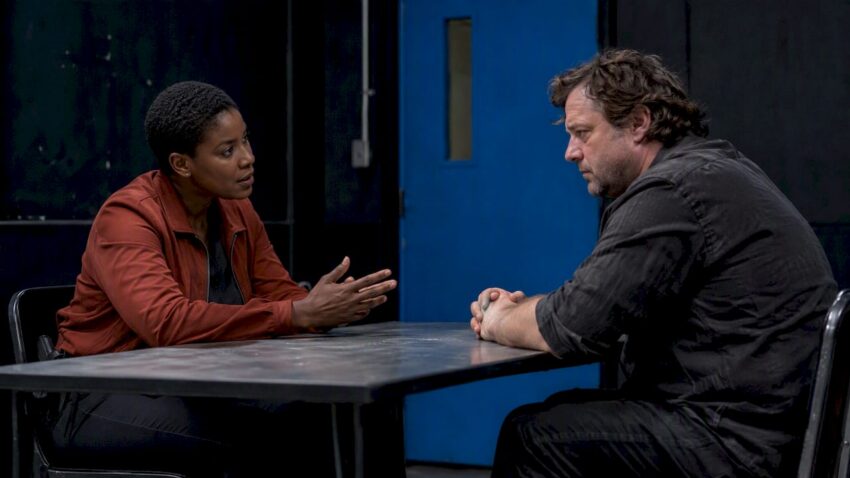
Author comparing morally different character drafts

Villain Protagonist vs Antihero: How to Tell Them Apart

Posted on November 10, 2026November 10, 2026 by NConnors

A villain protagonist is the main character and the bad guy: their goals are harmful, and the story knows it. An antihero is a main character who lacks classic heroic qualities but is still, at bottom, on the side of something good. The fastest test is not what the character does. It is why they do it and where they stop.

That sounds tidy, and in practice the two overlap constantly. Readers argue about it because both characters do terrible things while we follow them closely. Below is a clear way to sort them, with examples, a few craft tests for writers, and a note on why the distinction matters in dark fiction.

Nathanielconnors
Explore Dark Fiction’s Moral Depth
Explore dark supernatural stories shaped by revenge, guilt, redemption, and the psychological monsters within us.
Explore Nathaniel Connors’s fiction

TL;DR

  • A villain protagonist has villainous goals and is still the lead. An antihero is a flawed lead who leans toward a net good.
  • Motive and limits matter more than methods. Antiheroes usually have a line they will not cross; villain protagonists do not.
  • Point of view shapes sympathy: the closer we sit inside a character’s head, the easier it is to read them as an antihero.
  • “Antagonist” is a different axis entirely. It describes who opposes the protagonist, not who is moral.
  • Good dark fiction uses both for psychological depth, because understanding a character is not the same as approving of them.

Table of Contents

  • The short answer, side by side
  • What a villain protagonist actually is
  • What an antihero actually is
  • Motive, methods and the line: three tests that sort them
  • Famous examples, and why they spark arguments
  • Where “antagonist” fits in
  • Why the distinction matters in dark fiction
  • How to write each one well
  • How readers can use the distinction
  • Our perspective
  • Read the fiction behind the craft
  • FAQ
  • Sources

The short answer, side by side

Question Villain protagonist Antihero
Role in the story Main character Main character
Goals Openly harmful or selfish Mixed, often self-interested, sometimes aimed at a larger good
Moral limits Few or none Usually a line they will not cross
Does the story excuse them? No, the harm is not glossed over Often partly, through context or intent
What the reader feels Fascination, complicity, sometimes dread Sympathy, frustration, reluctant rooting
Typical arc Descent, triumph or downfall Irresolvable moral conflict, or a slow shift

The table is a map, not a law. Real characters sit on a spectrum, and the sections below explain how to place one.

What a villain protagonist actually is

The term combines two roles that people usually keep apart. A protagonist is the character the story follows and whose fate we care about. A villain is the character whose harmful behavior drives the plot. Put them in one person and you get a villain protagonist.

The trope is described as a story told from a villain’s point of view, where the character’s morally reprehensible actions are not glossed over or justified within the story. A community discussion on the same site puts the goals bluntly: a villain protagonist has explicitly villainous goals, such as robbing banks or taking over the world, and the work flips perspective so the audience relates to or sympathizes with them anyway.

One definition of the term describes the lead as the character blamed for a particular evil or difficulty, with the Grinch and Hamlet offered as examples, and notes they lack heroic qualities such as fortitude and kindness while carrying deep flaws like greed or boastfulness. You can quarrel with those examples (many readers would call Hamlet an antihero or a tragic hero), and that quarrel is the point: the labels bend under pressure.

Two features separate a true villain protagonist from the rest:

  1. The harm is the engine. The plot moves because the character wants something and will hurt people to get it.
  2. The story does not look away. There is no comforting reframe that turns the cruelty into heroism.

A general reference on protagonists makes the same split: a villain protagonist is unequivocally the bad guy, devoted to evildoing, yet can still be the main character and win audience sympathy.

What an antihero actually is

An antihero is also a protagonist, but one who is missing the traditional hero package. Writer’s Digest describes the antihero as a kind of protagonist who has aspects of the morality we usually associate with antagonists, yet is portrayed sympathetically even when as flawed as, or more flawed than, the people around them.

That same piece offers the most useful craft observation in this whole debate: antiheroes can be driven by self-interest and self-preservation, but there is usually a line antiheroes won’t cross. They also are not role models, though readers sometimes wish they could act the way these characters do, and their reasons can range from revenge to honor.

The antihero’s defining quality is moral friction. A different Writer’s Digest article separates antiheroes from merely flawed heroes: a flawed hero can see a moral limitation and fix it, while the antihero stands at the center of an irresolvable moral conflict with neither side convincingly winning. That unresolved tension is what keeps readers turning pages.

Motive, methods and the line: three tests that sort them

If you are staring at a specific character and cannot decide, run these three checks in order.

Test 1: Why are they doing it?

Intent and moral alignment are the cleanest divider. One breakdown of the two types says antiheroes may bend rules or do bad things to serve a good end, while a villain’s actions are consistently harmful and destructive. A character who steals medicine for a dying child and one who steals for the thrill might use identical methods. Only one of them is an antihero.

Another craft writer frames it the same way: antiheroes pursue a greater good through questionable means, and the gap between them and villains is not in what they do, but why they do it and where they draw the line.

Test 2: Where do they stop?

Ask what the character would refuse to do. If you can name something, a child they would not harm, a betrayal they would not commit, a person they would not sacrifice, you are probably looking at an antihero. If the answer is “nothing”, you are probably looking at a villain protagonist.

The limit does not have to be noble. It only has to exist. A limit gives the reader a foothold: proof that conscience is still operating somewhere in the character.

Test 3: Who is telling the story?

Viewpoint changes everything. One writing playbook offers a rule of thumb: if readers live the scene from inside the character’s head, you have an antihero, and if they watch from the hero’s point of view, you have a sympathetic villain. Its argument is that empathy comes from inhabiting someone’s interior life, not just from their moral ambiguity.

That is why a first-person narrator who confesses ugly things can feel like an antihero even when the deeds are monstrous. We understand the wound behind the act. Move the camera outside, and the same deeds read as villainy.

Famous examples, and why they spark arguments

Deadpool. A New York Times review says Wade Wilson turns into Deadpool, an antihero, and PopMatters called the film’s lead a conflicted and complex antihero. He kills freely and jokes about it, but his goals point at rescuing someone he loves and punishing a man who wronged him. Motive plus a recognizable moral target keeps him on the antihero side.

Tony Soprano. This is the case that fills forums. One analysis frames him as an antihero, explaining why audiences root for him through the way he functions within mafia culture while struggling to connect with broader norms. Yet his crimes are never excused by the show. Many viewers see a villain protagonist whose moments of vulnerability earn sympathy. Both readings are defensible, which tells you the categories describe how a story treats a character as much as who the character is.

The Grinch and Hamlet. Used in one definition of the villain protagonist, they show how elastic the term is. The Grinch begins as the cause of the problem and ends redeemed. Hamlet is blamed for much of the ruin around him but is driven by grief and a moral puzzle. Neither fits a clean box, and that is fine.

Where “antagonist” fits in

People mix up three words: villain, antagonist and antihero. They answer different questions.

  • Protagonist or antagonist is about structure: who the story follows and who opposes them.
  • Hero, antihero or villain is about moral quality.

Grammarly defines an antagonist as the character or force that opposes the protagonist, and distinguishes it from a villain, whose malicious or evil behavior is crucial to the plot. An antagonist can be a rival, a system, a storm or a person’s own conscience. Protagonists, as one reference notes, are not always good: they can be dishonest or even criminal.

So can a villain protagonist also be an antagonist? To the other characters, yes: if the lead’s pursuit of power harms a decent character, the lead functions as that person’s antagonist while still being the story’s protagonist. What one cannot be is the protagonist and the opposing force to themselves in the structural sense, though inner conflict can come close. Many of the best dark stories live on that edge.

Why the distinction matters in dark fiction

In horror, dystopia and psychological thrillers, the moral shape of your lead decides what kind of fear the reader feels.

With an antihero, the fear is “I understand why they did that, and that scares me.” The reader walks beside someone making compromises and notices the road bending toward a place they would not choose.

With a villain protagonist, the fear is “I am enjoying this person, and I should not be.” The reader becomes complicit.

Author Eric LaRocca, speaking with Writer’s Digest, argues that understanding dark characters and showing them empathy can make transgressive fiction more explosive and impactful, and that empathy matters more to him than holding a character accountable. Empathy, in other words, is a craft tool, not an endorsement.

How to write each one well

If you write fiction, here is a practical split.

Writing an antihero

  • Give them a line. Decide early what they will not do, then build a scene that tests it.
  • Keep the wound specific. Guilt, loss or a debt makes self-interest readable. Our guide on making guilt-ridden characters believable shows how to carry it through behavior instead of announcing it.
  • Resist fixing them. An antihero at the center of an unresolved conflict is more compelling than one who learns a tidy lesson. If you do want change, make it earned, as we lay out in writing redemption arcs.
  • Stay close. Interior point of view is what turns ugly choices into understanding.

Writing a villain protagonist

  • Do not launder the harm. The story should never pretend the cruelty was secretly justified.
  • Make the want human. Greed, status, belonging and fear are relatable even when the methods are not.
  • Plan the cost. Readers will follow a villain a long way if the narrative keeps its moral accounting honest, whether the ending is triumph or ruin.
  • Watch the bleakness. Without some thread of connection, readers may stop caring. The trope can lead to a bleak outcome if handled poorly, since audiences still want someone to root for, as the TV Tropes entry points out.

A quick self-check

Before you label your lead, answer four questions in one sentence each: What do they want? What will they refuse to do? Does the story excuse them? Whose head are we in? If the answers are “a larger good”, “harm to innocents”, “partly” and “theirs”, you have an antihero. If they are “power”, “nothing”, “no” and “theirs”, you have a villain protagonist whom readers will follow anyway.

Four-question comparison of antiheroes and villains

How readers can use the distinction

If you are choosing what to read next, the label predicts the experience.

  • Want to feel conflicted, wrestle with a moral puzzle and end the book unsure whether the lead was right? Look for antiheroes and stories built on unresolved moral conflict. Revenge stories are a rich seam, and our overview of why characters actually choose vengeance shows how motive tilts a character toward one side or the other.
  • Want a descent you cannot look away from? Villain protagonists deliver that unsettling pull.
  • Want fiction that tests your conscience in a broken society? Our list of dystopian ethics books is a good next stop.
  • Want endings where change feels earned rather than convenient? See our redemption arc book picks.

Our perspective

We think the most interesting question is not “is this character good or bad?” but “what is this character carrying, and what will it make them do?”

The stories we write are built around revenge, guilt and redemption, and around the psychological monsters people carry. In that territory, labels like antihero and villain protagonist are useful, but they are only a starting point. The real work is making a reader sit inside a person’s reasoning long enough to feel its pull, and then letting the consequences land.

That is why we favor deep character development and plots that linger. A reader who finishes a book and keeps turning a character’s choices over in their mind has been given something better than a verdict. They have been given a question.

If you like that kind of fiction, our dark supernatural and dystopian horror is written for you, and it is available to read free with Kindle Unlimited.

Nathaniel

Read the fiction behind the craft

If you would rather see moral ambiguity in action than read about it, start with our books. The Nether and the Evolution A200 series are dark supernatural and dystopian horror built on psychological depth and emotional weight, in ebook and paperback on Amazon, and free to read with Kindle Unlimited.
Nathanielconnors

Browse the full Nathaniel Connors book collection to pick a starting point, or begin with our guide to dark supernatural thrillers.

FAQ

What is the difference between an antihero and a villain protagonist?

Both are main characters who do wrong. An antihero lacks classic heroic traits but generally leans toward a good end or keeps some moral limit. A villain protagonist has harmful goals, and the story does not excuse them. Motive and the line they will not cross are the best tells.

Is Deadpool an antihero?

Most critics say yes. The New York Times review calls Wade Wilson an antihero once he becomes Deadpool, and PopMatters describes him as conflicted and complex. He is violent and irreverent, but his aims center on saving someone he loves and punishing the man who wronged him.

Is Tony Soprano an antihero or a villain protagonist?

He works as both, depending on how you read the show. Analysts frame him as an antihero because of his place in mafia culture and his struggle to connect outside it. His crimes are never excused, which pushes many viewers toward the villain protagonist label.

Can a villain be the protagonist?

Yes. A villain protagonist is exactly that: the lead whose goals are harmful and whose point of view the story adopts. Audiences can still sympathize with them, especially when the narrative invites them to understand the character’s wants and fears.

Does an antihero have to be a good person underneath?

Not necessarily. Antiheroes can be selfish, driven by self-preservation or revenge, and they are not role models. What marks them is that they usually have a line they will not cross, and the story gives readers a reason to follow them.

Sources

  • Anti-Hero vs. Villain (Richelle Braswell, What is a Villain Protagonist?)
  • Villain Protagonist, TV Tropes
  • Anti-Hero or Villain Protagonist? TV Tropes Forum
  • Protagonist: Definition and Examples, LitCharts
  • How to Create an Antihero That Readers Love, Writer’s Digest
  • How to Write Flawed Characters & Antiheroes, Writer’s Digest
  • A Conversation With Eric LaRocca, Writer’s Digest
  • Antiheroes vs. Villains, No Film School
  • Anti-Hero: Definition, Types & How to Write One, Alan Watt
  • Antihero archetype writing playbook, SagaScope
  • What Does Antagonist Mean in Literature? Grammarly
  • Review: Deadpool, The New York Times
  • Deadpool Sets the Stage, PopMatters
  • Why Tony Soprano Is the Ultimate Antihero, ScreenRant

Recommended

  • Grimdark vs Horror: How to Tell the Difference
  • Make Guilt Ridden Characters Believable for Writers Without Naming It
  • Psychological Thriller vs Horror: How to Tell and Write Them
  • Writing Redemption Arcs: 7 Stages to Make Change Earned in Horror
Weathered stone arches inside a ruined castle

Gothic Horror vs Supernatural Fiction: How They Differ

Posted on November 9, 2026November 9, 2026 by NConnors

Gothic horror is defined by atmosphere: decay, secrets, confinement and a past that will not stay buried. Supernatural fiction is defined by what happens: something beyond the laws of nature breaks into the real world. One describes how a story feels. The other describes what is in it. Many of the best dark stories are both, and some are only one.

Nathanielconnors
Explore Stories Where Darkness Runs Deep
Nathaniel Connors writes dark supernatural fiction exploring revenge, guilt, redemption, and the psychological monsters within us.

Visit Nathaniel Connors

TL;DR

  • Gothic is a mood and a set of settings (ruins, isolation, buried history). The supernatural is allowed but not required.
  • Supernatural fiction is any story where forces beyond natural law play a real part, usually in an otherwise ordinary world.
  • A story can be Gothic without a single ghost, and supernatural without a drop of Gothic atmosphere.
  • To classify a book, ask two questions: what creates the dread (place and secrets, or an impossible force), and is the impossible event real, ambiguous or explained away?
  • The overlap is large, which is why ghost stories in decaying houses feel like both.

Table of Contents

  • The short answer: mood versus mechanism
  • What makes a story Gothic
  • What makes a story supernatural
  • Is the supernatural necessary to Gothic fiction?
  • Side by side
  • Where they overlap
  • How to tell what you are reading
  • Gothic and supernatural in modern and dystopian fiction
  • Our perspective
  • Where to start with our books
  • FAQ
  • Sources

The short answer: mood versus mechanism

The cleanest way to separate the two is to stop treating them as rivals. They answer different questions.

Gothic answers: what does this story feel like, and where does it happen? It is a tradition with recognizable furniture: oppressive settings, hidden family or historical secrets, characters trapped by place or past.

Supernatural answers: what is the impossible thing in this story? It is a question about the rules of the world. Do ghosts, curses, demons or resurrections exist here?

Because they measure different things, one book can sit in both columns. Rebecca is the standard example of a Gothic novel that works through psychological tension and hidden secrets rather than monsters. A haunted-house novel with a literal ghost is Gothic and supernatural at once. A modern story in which a demon moves into a suburban office is supernatural, but nothing about it is Gothic.

Gothic mood and supernatural rules compared

What makes a story Gothic

The New York Public Library describes the trademark of Gothic horror as the battle between humanity and unnatural forces of evil, sometimes man-made and sometimes supernatural, inside an oppressive, inescapable, bleak landscape. Notice the hedge in that definition: the evil may be human.

Academic and editorial sources keep returning to the same set of ingredients:

  • A spooky atmosphere, along with violence, a morbid fascination with the past and with death, according to Central Michigan University.
  • Haunted or decayed settings, isolation or confinement, and characters who start doubting their own reality, as listed by Writer’s Digest.
  • Weather and darkness. BBC Bitesize notes the Gothic leans on wind, rain, thunder and night, tapping an instinctive fear of the dark.
  • A past that refuses to stay quiet. The CMU page describes Gothic as insisting that we do not know the full story, with the true history waiting to be disinterred.

Fear built from tension, not shock

Bitesize says Gothic conventions use suspense and psychological techniques to create fear, in contrast to horror stories more associated with gore and violence. Writer’s Digest puts a useful edge on this with the old terror and horror split: terror is the suspense that builds unease, and horror is what happens when the promise of that terror is delivered.

That is why Gothic reads as slow. The house, the letters, the locked room and the family that will not explain themselves all do work before anything moves. If you want to see how dread differs from splatter in practice, our piece on horror atmosphere versus gore goes through what actually scares readers.

Gothic is older than the castle

The classic Gothic novel was commonly set in a medieval space such as a ruined castle, as Encyclopedia.com’s overview of Gothic themes puts it. The same source notes that the eighteenth-century concerns with morals and manners often limited a single-minded focus on ghostly phenomena. In other words, even the earliest Gothic novels were not purely about ghosts.

What makes a story supernatural

Supernatural fiction is defined by content, not tone. Edgepedia’s overview says it involves events, beings or forces beyond the laws of nature that play a constitutive role in the story. They may be presented as real, left ambiguous or explained away. The things in question include ghosts, spirits, demons, miracles and the afterlife.

Three features help you spot it:

  1. A real-world setting. TV Tropes notes that supernatural fiction is almost invariably set in the real world, while stories set in constructed worlds are nearly always called fantasy.
  2. Ordinary viewpoint characters. The same entry observes these stories are often told from the point of view of people who do not know about the supernatural until they meet it.
  3. A small cast of impossible things. There may be only one or two supernatural elements, rather than whole communities of magical beings as in high or urban fantasy.

The tone is open. The supernatural can be terrifying, tragic, comic or even gentle. Edgepedia points out that the Gothic always calls up fear, while the supernatural may offer friendly ghosts. A story with a kindly ghost is supernatural, but it is not Gothic horror.

The supernatural and the mind

The supernatural has long had a psychological side. According to Wikipedia’s entry on supernatural fiction, in the twentieth century it became associated with psychological fiction: events that cannot be explained naturally, leaving the supernatural as the only possible explanation. The example it gives is Henry James’s The Turn of the Screw (1898).

Critics also draw a line between supernatural horror and psychological horror. As summarized in Wikipedia’s article on supernatural horror film, Mathias Clasen writes that supernatural horror involves a breach of physical law, usually through an uncanny agent such as a monster or ghost. Psychological horror features naturalistic menaces and scenarios. If that distinction is what you are after, our guide to psychological thriller versus horror takes it further.

Is the supernatural necessary to Gothic fiction?

No. The strongest statement of this is the Cambridge History distinction as relayed by Edgepedia: fear is necessarily called up by the Gothic, while the supernatural is permitted but not essential to it. The Edgar Allan Poe Society of Baltimore hosts a 1973 scholarly chapter that characterizes terror or horror as the constant element of the Gothic and the supernatural as the secondary one, whether real or fearfully imagined.

Still, the two travel together so often that the boundary blurs. CMU frames the Gothic world as always “super natural”, meaning more than we know and never gentle or kind. Even when no ghost appears, the Gothic insists that familiar life is a small part of a larger universe of threatening forces.

Is the supernatural necessary to Gothic fiction?

Vampires are the figure that most obviously straddle the line: a supernatural creature wearing Gothic clothing, from the crumbling castle to the candlelit bedroom. They have moved well beyond the page, and now even turn up in vampire roleplay scenes built around the same moody imagery.

Side by side

Question Gothic horror Supernatural fiction
What defines it? Atmosphere, setting and theme Presence of forces beyond natural law
Is the supernatural required? No, it is permitted but not essential Yes, by definition
Is fear required? Yes, fear is always called up No, tone can be frightening, gentle or comic
Typical setting Decayed houses, ruins, isolated places, buried history Usually the real, contemporary world
Source of dread Secrets, confinement, the weight of the past An impossible event or being intruding on normal life
Typical pacing Slow build of unease Varies from slow to fast
Classic example Rebecca The Turn of the Screw (also Gothic)

Where they overlap

CMU’s page says Gothic and horror overlap, but not all Gothic tales are necessarily horrifying, and not all horror stories create a Gothic atmosphere. Replace “horror” with “supernatural” and the logic holds.

The most common overlap looks like this: a ghost or curse (supernatural) inside a failing house with a family secret (Gothic). Wikipedia’s page on supernatural horror notes that such films often involve ghosts and demons, frequently with religious elements, and common themes include the afterlife, the devil and demonic possession. Put those in a candle-lit mansion and you have both labels.

The supernatural horror genre is also one branch of a larger tree. Wikipedia’s supernatural fiction entry lists supernatural horror alongside supernatural comedy, religious and thriller hybrids. So the supernatural thriller is a separate hybrid, not another name for horror. If you want the whole map, see our horror subgenres guide.

How to tell what you are reading

Use this quick checklist on any dark book.

  1. Find the source of dread. If it grows from a place, a family or a buried history, lean Gothic. If it comes from an impossible event, lean supernatural.
  2. Check the rules of reality. Does the story break them? If yes, it is supernatural. If it stays ambiguous or explains everything away, it can still be Gothic.
  3. Look at the setting. Isolation, decay and confinement point to Gothic. A normal office, suburb or highway points to contemporary supernatural.
  4. Notice the pace. Gothic is often interested in an atmosphere of mystery and apprehension rather than sudden scares.
  5. Ask whether the evil is human. Gothic can run entirely on human cruelty, obsession and secrets.
  6. Check the era of the setting. Early Gothic favored medieval spaces. NYPL notes modern Gothic may move to contemporary locations, but the place must still inspire unease or terror.

If you answer “place and secrets” and “impossible event” both, it is both. Readers who want the secrets-and-dread side without ghosts can browse our picks for slow burn non-supernatural horror.

Gothic and supernatural in modern and dystopian fiction

The Gothic did not stay in castles. The Newberry Library’s guide to the American Gothic says the tradition shifted from “long ago and far away” escapist settings toward the psychological underbelly of everyday life, emphasizing inner evils, drives and secret desires. Penguin Random House’s guide to American Gothic, which is a homegrown genre set in places like the frontier and sometimes suburbia, adds that historical sins such as slavery, genocide and the destruction of the wilderness are often part of it.

That shift is why Gothic habits now appear in places you would not expect: a collapsing society, an empty town after a plague, a bunker. The ruined castle becomes the ruined world. The buried secret becomes what a society chose to forget. The supernatural thread may or may not be present, but the dread of a past that will not stay buried is the same.

When the impossible element is present and the setting is our own world, you get the supernatural thriller. We unpack that side in how to build a supernatural thriller without gore, and in our look at character-driven horror, where the monster is only as frightening as the person it hunts.

Our perspective

We write dark supernatural fiction, so we sit closer to the supernatural side of this question. But the thing that makes our stories work is borrowed from the Gothic: dread that grows out of guilt, revenge and the past a character cannot outrun.

For us the impossible element is never the point on its own. A curse or a condemned soul matters because of what it does to a person who already carries something heavy. That is why readers tell us the stories stay with them after the last page.

Our advice to any reader choosing between the two labels is to stop worrying about the label and follow the feeling. If you want the slow press of atmosphere, look for Gothic. If you want the floor of reality to give way, look for supernatural. If you want both, look for stories where the psychological monster and the literal one are the same.

Nathaniel

Where to start with our books

If this comparison made you curious about dark supernatural and dystopian horror with psychological depth, our books are built around exactly those themes of revenge, guilt and redemption. The Nether and the Evolution A200 series are the best entry points, and our titles are available on Kindle Unlimited, so subscribers can read them at no added cost.

Nathanielconnors

Browse the full list on our books page, start with The Nether, or read our guide to dark supernatural thrillers to choose where to begin.

FAQ

What is the main difference between Gothic horror and supernatural horror?

Gothic horror is defined by atmosphere, setting and theme: decay, isolation, secrets and a haunting past. Supernatural horror is defined by an impossible force, such as a ghost or demon, that breaks natural law. Gothic can be entirely human and psychological, while supernatural horror always needs the impossible element.

Is the supernatural a Gothic element?

It is a common one, but not a required one. Scholarship summarized by Edgepedia describes it as permitted but not essential to the Gothic, which always calls up fear. Ghosts appear in a lot of Gothic fiction, yet novels like Rebecca build their dread from secrets and psychology instead.

Can a story be both Gothic and supernatural?

Yes, and many classics are. A haunted house with a real ghost and a buried family secret is both. The Turn of the Screw is a frequently cited example of a story where the supernatural is the only possible explanation, inside a Gothic setup.

Is supernatural horror the same as a thriller?

No. Wikipedia lists supernatural horror and supernatural thriller as separate hybrid genres under the wider supernatural umbrella. Horror aims to frighten you, while a thriller aims to keep you gripped by suspense and stakes, and a supernatural story can do either or both.

What are the main Gothic elements?

The core ones are an atmosphere of mystery and fear, haunted or decayed settings, isolation, hidden secrets, a fascination with death and the past, and characters who doubt what is real. Supernatural events are often present but optional.

Sources

  • A Brief History of Gothic Horror, The New York Public Library
  • What are Gothic stories?, Central Michigan University
  • Gothic literature guide, BBC Bitesize
  • What Is Gothic Horror in Fiction?, Writer’s Digest
  • Gothic Themes, Settings, and Figures, Encyclopedia.com
  • Supernatural fiction, Edgepedia
  • Supernatural Fiction, TV Tropes
  • Supernatural fiction, Wikipedia
  • Supernatural horror film, Wikipedia
  • Poe’s Gothic chapter, Edgar Allan Poe Society of Baltimore
  • The American Gothic, Newberry Library
  • So You Want to Read American Gothic, Penguin Random House
  • Vampire roleplay scenes

Recommended

  • 3 Craft Tests to Tell Dark Fantasy From Horror for Readers and Writers
  • Grimdark vs Horror: How to Tell the Difference
  • Psychological Thriller vs Horror: How to Tell and Write Them
  • Horror Subgenres Explained: Your Complete Genre Guide
Writer drafts a horror logline by hand

Horror Logline Examples That Work, and How to Write Yours

Posted on November 8, 2026November 8, 2026 by NConnors

A good horror logline is one or two sentences that name a protagonist, a threat, a conflict and the cost of failure, and leave the reader wanting to know what happens next. Below you will find examples from well-known films, the formula that sits under them, and original rewrites for psychological and dystopian horror, the territory we write in.

Nathanielconnors
Explore Psychological Horror
Nathaniel Connors writes dark supernatural fiction shaped by psychological monsters, revenge, guilt, and redemption.
Visit Nathaniel Connors

TL;DR

  • A horror logline is one sentence (two short ones at most) with a protagonist, a threat, a goal and stakes.
  • Aim for roughly 25 to 40 words, and tease the reader instead of summarizing the plot.
  • Psychological horror works best when the logline names what is wrong inside the character, not just the monster outside.
  • The most common failures are a vague goal, no antagonist, no stakes and a crammed synopsis.
  • Use the fill-in template and the before/after table below to draft three versions, then keep the one that raises the best questions.

Table of Contents

  • What a horror logline actually does
  • Horror logline examples from famous films
  • The formula behind a horror logline
  • Psychological horror loglines: the fear is inside
  • Original examples: weak version, strong version
  • Common mistakes that sink a horror logline
  • A five-step process for drafting yours
  • Where to use a logline once you have it
  • Perspective: why we write with the logline in mind
  • See these ideas in full-length fiction
  • FAQ
  • Sources

What a horror logline actually does

A logline is a sales sentence. It tells a producer, reader, editor or friend what your story is and why they should care, fast. The BBC Writers’ guidance on loglines treats it as both a description and a persuasion tool: specific enough to make the premise distinctive, short enough that it does not turn into a synopsis.

In horror, the job is a little different. Comedy loglines can lean on tone. Horror loglines have to promise dread. The reader should feel a small chill and a specific curiosity. Producer Jeffrey Reddick, as summarized by Act Four Screenplays, suggests the best horror loglines work as a tease that makes people ask excited follow-up questions, not questions about what the premise even means.

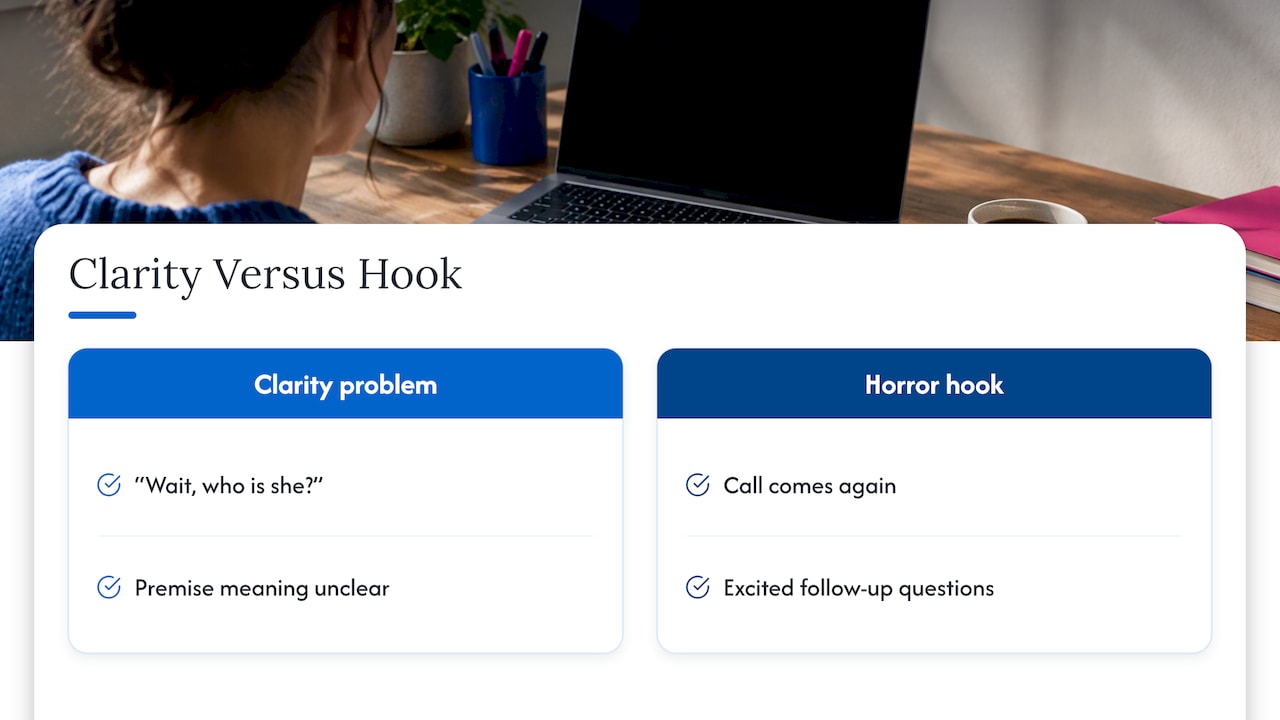
That distinction is the whole craft. “Wait, who is she?” is a clarity problem. “Wait, what happens when the call comes again?” is a hook.

What a horror logline actually does

Horror logline examples from famous films

These are paraphrased from published collections, so you can see how the pros compress a movie into a sentence. The wording below is ours; the linked pages hold the full lists.

Film What the logline gives you What it leaves out on purpose
The Exorcist A mother turns to two priests when her young daughter is possessed How the possession escalates, what the priests sacrifice
Psycho A secretary steals money, runs, and lands at a remote motel run by a man dominated by his mother The twist that defines the film
The Babadook A single mother and her child spiral into paranoia after a strange children’s book appears in their home Whether the creature is real or grief made visible
Paranormal Activity A couple in a new suburban home is increasingly disturbed by a nightly demonic presence Any explanation of why
The Blair Witch Project Three film students vanish in the Maryland woods while making a documentary about a local legend, leaving only their footage What the footage shows
Night of the Living Dead A group hides from bloodthirsty zombies in a farmhouse Everything except the siege

The first two come from FilmDaily’s horror logline list, where the Psycho line even includes the $40,000 the secretary takes. The Babadook line follows Killer Shorts’ 2020 breakdown, which also covers Funny Games, The Silence of the Lambs, It, The Thing and Green Room. The Paranormal Activity, Blair Witch and Night of the Living Dead lines appear in a StoryAlity analysis of low-budget, high-return films. For more phrasing of The Exorcist, see Neil Chase’s logline collection.

What these examples have in common

Read the table again and notice the pattern.

  1. The protagonist is one person or a tight unit. A mother, a secretary, a couple, three students. Never “a group of various people.”
  2. The threat is named or clearly implied. A possession, a demonic presence, a legend.
  3. The setting is small. A farmhouse, a motel, a suburban home, a patch of woods. Horror loves contained spaces. One screenwriting critic on a horror logline pitch challenge notes that the genre works best in isolated scenarios with few ways out, because characters are forced to face what scares them.
  4. Nothing is explained. The best lines hold back the answer to the central mystery.

The formula behind a horror logline

Most professional guidance reduces to one skeleton. Hollywood Writers Group gives it as: when an inciting incident happens, a protagonist must pursue a goal, before the stakes or ticking clock hit. Adapted for horror, think of it as five slots:

  1. Trigger: the event that breaks normal life.
  2. Protagonist: one specific person, with a defining flaw or wound.
  3. Threat: the monster, presence, system or secret.
  4. Goal: what the protagonist must do.
  5. Stakes or clock: what is lost, and by when.

Template:

When [trigger], a [flawed protagonist] must [goal] before [threat achieves its cost].

How long should it be?

Short. Killer Shorts describes the ideal as one to two sentences that include the main character, the conflict or antagonist, and time and place if they matter. The BBC’s guidance says a logline is normally a single sentence, with two short ones acceptable when necessary. One screenwriting guide for horror pitches puts the sweet spot at about 25 to 40 words, and that matches what we see in the examples above. If you hit 60, you are writing a synopsis.

Psychological horror loglines: the fear is inside

Psychological horror shifts the question from “fear of” a monster to “fear that” something is wrong: with the house, the mind, the marriage, the memory. That framing comes from Scriptease’s guide to psychological horror screenplays, which says the aim is lingering dread. A logline for this subgenre has to plant that doubt in a single sentence.

The formula changes in two places:

  • The protagonist’s vulnerability becomes the engine. Guilt, grief, addiction, a lie they told. A craft guide on scary stories advises tying the threat to a flawed protagonist’s vulnerability, with consistent rules for the threat, an everyday trigger, escalating costs and a difficult sacrifice.
  • The threat is ambiguous. Is it supernatural, or is the character coming apart? The logline should keep both readings alive.

If you want the longer craft argument for building dread without gore, we cover it in how to write psychological horror that sticks, and the line-level tactics are in our psychological horror craft guide.

Original examples: weak version, strong version

The following loglines are ours, written for this guide to show the revision process. They are not from published books or films.

Weak draft Why it fails Stronger version
A woman is haunted by her past and must face her fears. No trigger, no threat, no stakes. Could describe any story. After her husband’s funeral, a widow finds his handwriting in notebooks she never bought, each entry predicting a death she can still prevent.
A scary thing happens in a hospital and a nurse has to deal with it. “Scary thing” is a placeholder. No wound. A night-shift nurse who buried a fatal mistake starts hearing the dead patient’s call light ring every night, each ring leading her closer to the one person who knows the truth.
In a dystopian future, people lose their memories and one person fights back. Generic world, generic hero, no cost. In a city that rations memories, an archivist discovers her own signed confession to a crime that has not happened yet, and has three days to learn whom she is protecting.
A plague hits a town and people try to survive. A premise, not a story. No decision. When plague returns to a quarantined island town, a ferry captain must choose who to leave on the dock before the last boat departs at dawn.

What changed each time:

  • A concrete trigger replaced a mood. “Haunted by her past” became handwriting in notebooks.
  • A cost appeared. A death she can prevent, three days, the last boat.
  • A choice sits at the center. Horror lands harder when the protagonist must sacrifice or betray, not just run.

A dystopian horror twist

Dystopian horror has one extra trap: the world eats the story. Writers pour words into the setting (“in a future ruled by…”) and forget the person. Put the world in a subordinate clause and the person in the main one. In the memory example above, the rationing is a clause; the archivist’s confession is the engine.

Common mistakes that sink a horror logline

Research-minded screenwriting sources keep naming the same problems. One field guide on loglines lists a vague goal, no antagonist, no stakes and a crammed synopsis. Feedback from a horror logline pitch challenge adds endings that drift, setups that cover only the first act, unclear links between story details, and concepts that strain belief.

Here is how to spot each in your own draft:

  • Vague goal. If the verb is “deal with,” “survive” or “face,” pick something the reader could film. “Burn the notebooks.” “Find the buyer.”
  • No antagonist. Even in psychological horror, something opposes the protagonist. It can be a memory, a person, a rule, a version of herself. Name it.
  • No stakes. Ask what happens if she fails. If the answer is “nothing much,” there is no horror.
  • Crammed synopsis. Two subplots and a twist in one sentence reads as noise. Cut to the spine.
  • Explaining the mystery. If the logline resolves the central question, the reader has no reason to continue.

A five-step process for drafting yours

  1. Write the messy version. Three sentences, no limits. Say what actually happens.
  2. Circle the single decision. The moment where your protagonist has to choose is your center.
  3. Fill the template. Trigger, flawed protagonist, threat, goal, stakes. One slot, one phrase.
  4. Cut to 25 to 40 words. Remove names (use a role), remove backstory, remove adjectives that tell instead of show.
  5. Test the question. Hand it to someone and ask what they want to know. If they ask what the premise means, rewrite for clarity. If they ask what happens next, you are done.

Write three different versions, each emphasizing a different element: one on the threat, one on the wound, one on the clock. Then pick whichever raises the most interesting follow-up question.

If your story is a short film, the logline is also the first step toward structure. Our horror short film outline turns a premise into a 6 to 10 page beat sheet, and our guide on coming up with a concept for a horror short helps before the logline stage.

Where to use a logline once you have it

A logline travels. You will use it in several places, and each wants a slightly different cut:

  • Query letters and pitch emails. The first line after the greeting. Keep the full 25 to 40 words.
  • Contest and script-platform submissions. Often capped by character count. Keep a 20-word version ready.
  • Book blurbs and store pages. The logline becomes the first line of the description, then the blurb expands on it.
  • Conversation. The version you can say aloud without looking at notes. If you stumble, simplify.

Keep a file of versions. A tight logline is also a diagnostic: if you cannot write one that excites you, the story may not have found its center yet, and that is useful to learn before you write 80,000 words or 90 pages.

Perspective: why we write with the logline in mind

Every story we publish started as a single uncomfortable question. In The Nether and the Evolution A200 books, the question was never “what is the scariest thing we can show?” It was “what does this person carry that the threat can use?”

That is why we lean on revenge, guilt and redemption. A monster is a plot device. A character who cannot forgive himself is a story. When we shape a premise, we test it the way a logline demands: who is this, what is coming for them, what will it cost, and what do they have to give up?

We think readers of dark supernatural and dystopian fiction want exactly that: dread with a pulse, plots that stay with you after the last page. If your logline can promise that in 30 words, you are already writing the kind of horror people remember.

Nathaniel

See these ideas in full-length fiction

If you would rather read horror built on psychological stakes than study it, our books are a good place to start. The Nether series and the EA200 series cover dark supernatural fiction and dystopian horror, and they are free to read for Kindle Unlimited subscribers, with ebook and paperback formats on Amazon. For a post-collapse story, begin with Evolution A200: A Bubonic Apocalypse.

Nathanielconnors

Not sure which to pick? Our list of dark supernatural books for readers who want real dread is a good map, and our Kindle Unlimited tips help you get the most from a subscription.

FAQ

How long should a horror logline be?

One sentence is the norm, and two short sentences are acceptable when necessary. In practice, 25 to 40 words is a comfortable range. Anything longer starts to read as a synopsis and loses the tease.

What should every horror logline include?

A protagonist, a threat or antagonist, a goal, and stakes. Time and place help when they sharpen the premise, such as a quarantined island or a remote motel. Leave out the ending and the twist.

How is a psychological horror logline different from a monster-movie logline?

It centers the character’s inner wound and keeps the threat ambiguous. Instead of naming only what chases the protagonist, it hints at what is wrong in her mind, memory or relationships. The reader should be unsure whether the danger is outside or inside.

Can I use the same logline for a novel and a short film?

Yes, the structure is identical. A short film premise usually needs a narrower situation and a single decisive moment, so check that your logline could plausibly play out in a handful of scenes before you commit.

Should the logline include the protagonist’s name?

Usually not. A role or defining trait (a widow, a night-shift nurse, a ferry captain) is more vivid in one sentence and saves words. Names mean nothing to a reader who has not met the character yet.

Sources

  • Writing Loglines, BBC Writers
  • 12 Horror Loglines You Can Learn From, Killer Shorts
  • 28 Suspenseful Horror Logline Examples, FilmDaily.tv
  • StoryAlity: Examining the Loglines of the Top 20 RoI Films
  • 25+ Original Logline Examples, Neil Chase Film
  • 10 Takeaways from 4 Horror Producers, Act Four Screenplays
  • How to Write a Psychological Horror Screenplay, Scriptease
  • Screenwriting Logline Tips, Hollywood Writers Group
  • How to Write a Horror/Scary Story, Drafts Rush
  • The Horror Logline Pitch Challenge, Scriptshadow
  • How to Write a Logline, One More Draft

Recommended

  • How to Write a Horror Short Film That Actually Scares People
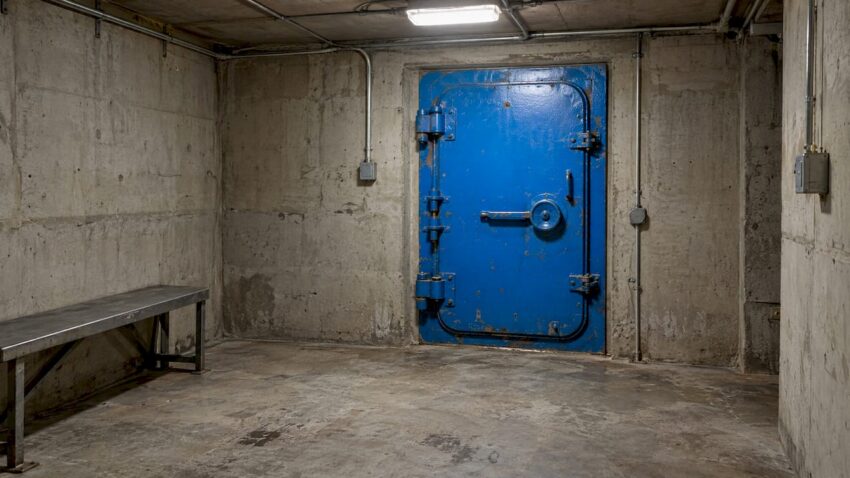
Empty bunker room with a heavy blue hatch

Single Location Horror Ideas: 15 Premises That Trap You

Posted on November 7, 2026November 7, 2026 by NConnors

The best single location horror ideas pair one place with one reason nobody can leave and one secret that gets worse the longer they stay. Below are 15 premises you can write as a story or shoot as a short, plus a method for turning any of them into a complete draft.

Nathanielconnors
Explore Horror That Lingers
Nathaniel Connors writes dark supernatural fiction with intricate plots and psychological depth, exploring revenge, guilt, and redemption.

Explore Nathaniel Connors’ books

TL;DR

  • A single-location story needs a primary location, a short time span and a limited cast, and its engine is conflict, not a small budget.
  • Decide what keeps people inside: a physical cage (a bunker, a car) or a situational one (obligation, hierarchy, a promise).
  • Escalate by changing the danger, the personal cost or what the character understands, never by repeating the same attack.
  • Pick two or three sensory details and one impossible detail, and the familiar room turns uncanny.
  • The 15 premises below are starting points: each lists the room, the cage and the secret.

Table of Contents

  • What counts as a single-location horror story
  • Start with the cage, not the monster
  • 15 single location horror ideas
  • How to choose between these premises
  • Make a familiar room unsettling
  • Keep tension rising when nobody can leave
  • Give the people inside conflicting goals
  • From idea to full story in six steps
  • Perspective
  • Read how contained dread feels on the page
  • FAQ
  • Sources

What counts as a single-location horror story

People search for this under several names. A single-location movie is usually called a contained film, while a chamber film puts the weight on concentrated psychological conflict and interpersonal pressure rather than on the physical space alone. For horror, the distinction is useful: a contained story traps bodies, a chamber story traps relationships, and the strongest ideas do both.

No Film School describes a contained story as one with a primary location, a short time span and a limited cast, and it adds that the dramatic engine should be intensified conflict rather than merely a smaller scale. Keep that sentence in mind. A cheap set does not make a good premise. A good premise makes the set unavoidable.

Start with the cage, not the monster

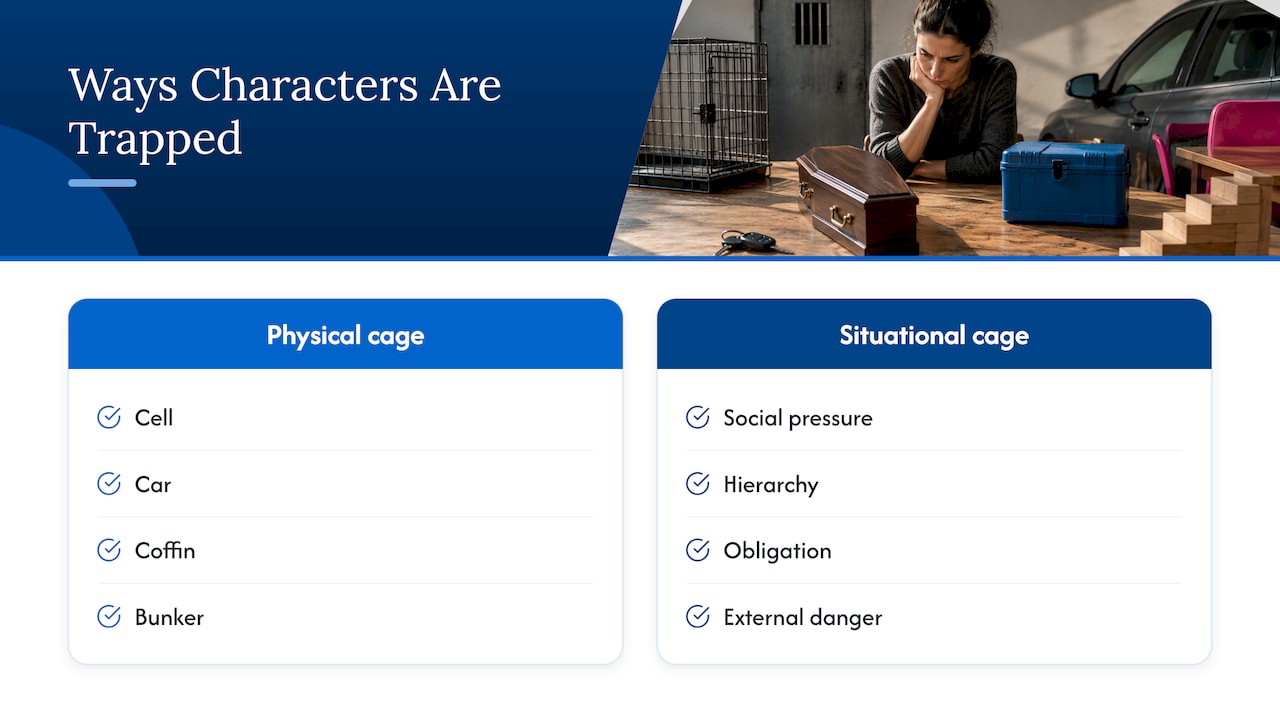
Before you pick a room, pick the reason nobody walks out. No Film School separates a physical cage, such as a cell, car, coffin, bunker or locked room, from a situational cage built from social pressure, hierarchy, obligation or external danger.

Physical and situational ways to trap characters

The same source says to make the cage feel airtight without contrivance by planting and paying off every element that prevents departure. If a reader asks “why don’t they just leave?” and your answer arrives late, the tension leaks. Answer it in the first pages.

The second decision is how remote the place feels. Writer’s Digest notes that a strong setting anchors the story in a specific time and location, and that physical remoteness can make escape nearly impossible while emotional isolation can imprison a character in anger, grief or trauma. You can use either, or let one hide inside the other.

15 single location horror ideas

The first seven are adapted from the contained concepts in Raindance’s seven-room shoot, which show that sound, playback, a closed door, a required confession, an empty chair or a repeating room can sustain escalation without a conventional monster. The rest are our own variations on the same principle.

Rooms where something is wrong with the evidence

  1. The home recording studio. A musician plays back last night’s session and hears a prediction. Cage: a storm and a dead phone. Secret: the voice knows what she did.
  2. The house of photographs. Every new print shows an event that has not happened yet. Cage: the photos show what is outside. Secret: the last frame shows the viewer.
  3. The empty flat. A new tenant hears a voice behind a locked bedroom that the landlord swears does not exist. Cage: a lease and no money to leave. Secret: the voice knows the previous tenant.
  4. The emergency-line training office. A trainee runs a night of practice calls, and one caller is not part of the script. Cage: a lockdown policy. Secret: the caller reports a crime inside the building.

Rooms where the relationships are the trap

  1. The funeral room. Siblings gather and face their mother’s last request. Cage: the will, and the body in the room. Secret: she asked for something none of them can say aloud.
  2. The rehearsal room. A theater troupe notices that applause from an empty house answers only true statements. Cage: opening night. Secret: someone has been lying to the whole company.
  3. The dining room. A family keeps an empty chair at the table. Tonight it is not empty. Cage: a ritual nobody dares break. Secret: who sat there last.
  4. The wedding suite. A couple locked in a hotel room before the ceremony finds notes under the door in the groom’s handwriting. Cage: a fire door that will not open. Secret: he wrote them years ago.
  5. The cabin for two. A getaway meant to repair a marriage. Horror here is relational: Osgood Perkins describes his film Keeper as exploring the strangeness of intimate relationships inside a familiar cabin frame. Cage: snow. Secret: only one of them remembers the last visit.

Places built to confine

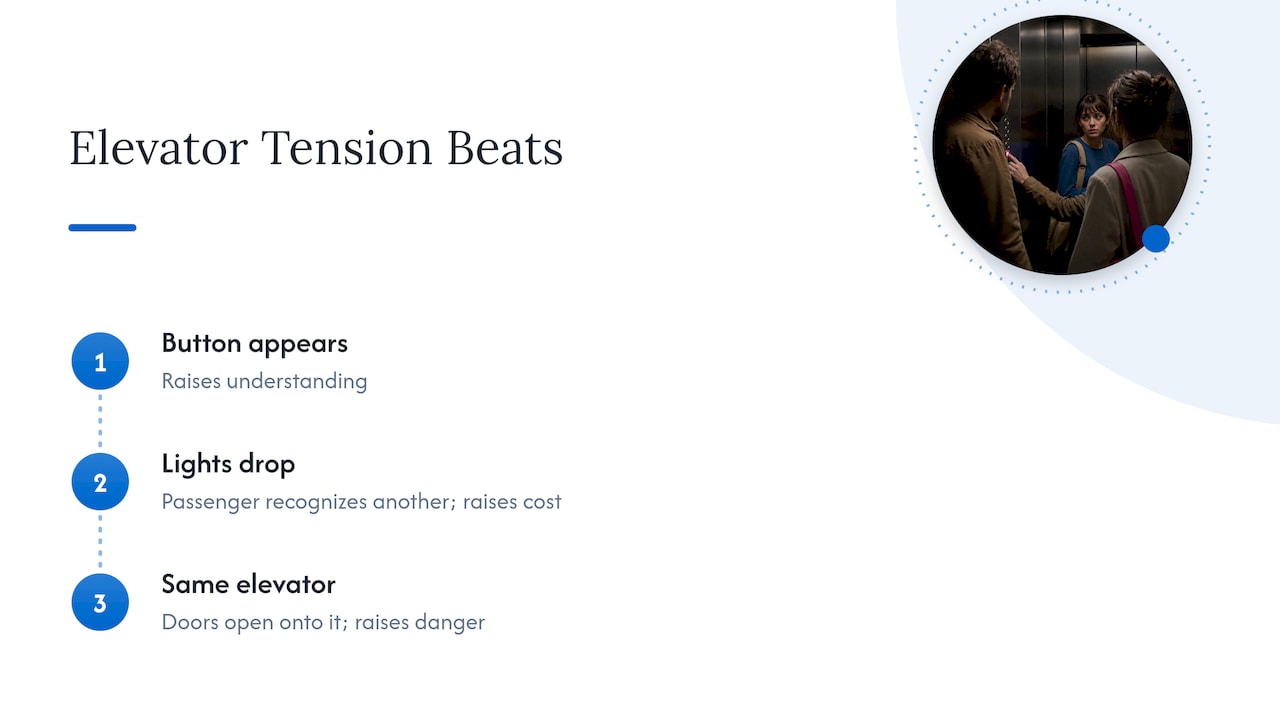
  1. The elevator at 3 a.m. Four strangers, one stalled car, and a floor button that should not exist. Cage: steel and a dead signal. Secret: all four were on the same incident report.
  2. The moving boat. Writers Online calls a boat a useful contained setting because it supplies confined space and many hazards: breakdown, getting lost, sinking, fire, poisonous gas. Add a passenger count that is off by one.
  3. The night-shift laundromat. Fluorescent light, one clerk, a dryer that tumbles something nobody put in. Cage: a locked front door with the key on the other side.
  4. The secluded farm. Writer’s Digest uses a secluded, menacing farm to show how routine can be disrupted. Try a harvest crew where the daily count of workers never matches.
  5. The bunker. A couple of survivors, a hatch that only opens from outside, and a radio that repeats their own conversations an hour later.
  6. The parked car. Two people, one night, a locked door and a passenger window that shows a different street each time they look.

How to choose between these premises

Run each idea through four quick filters:

  • Cage: can you explain in one sentence why they cannot leave?
  • Cast: can you tell it with two to five people?
  • Secret: is there hidden information that gives each person something to lose?
  • Clock: is something running out, such as air, daylight, battery, a deadline?

If an idea fails two of the four, change the room or the people before you write a word. Our own story on writing horror shorts for a low budget goes deeper on shooting these with almost no money.

Make a familiar room unsettling

Atmosphere Press recommends sensory detail, meaning sound, texture, smell, temperature, light and shadow, and transforming a familiar place into a frightening one. Mark Watson’s advice is narrower and more useful: choose two or three details instead of cataloguing every surface, and add one impossible detail.

Try it on the laundromat. Don’t describe every machine. Give the hum, the warm plastic smell, and one dryer door that is cold to the touch while the drum spins. That is enough.

L. Marie Wood suggests treating the space as an active threat with personality, with limitations, consequences, history, textures, smells and sounds, rather than a neutral box. Give your room rules the characters slowly learn.

For more on the craft of fear without blood, see our piece on horror atmosphere versus gore and our guide to writing dread.

Keep tension rising when nobody can leave

This is where most contained stories sag. Three habits help.

Shrink the options slowly. Wood recommends narrowing choices gradually while still offering possible exits or tools, and making every attempted solution costly or risky. She also describes escalating from inconvenience to danger: a sticking door or missing phone signal first, then failing lights, altered air, repeated sounds and vanishing exits.

Establish, then interrupt. Writer’s Digest advises first familiarizing readers with the setting, then interrupting its patterns so ordinary events become strange. Show the dinner ritual twice before the chair fills.

Escalate three ways. Hillshire Media says each major event should raise danger, personal cost or understanding, and the strongest scenes do all three and force a harder decision. Repeated attacks alone make a contained story feel repetitive.

A worked example with the elevator: first the button appears (understanding), then the lights drop and one passenger recognizes another (cost), then the doors open onto a floor that is the same elevator (danger). Each beat changes something.

Keep tension rising when nobody can leave

Give the people inside conflicting goals

A room full of people who want the same thing is a lecture. No Film School recommends conflicting goals, clashing values and hidden information, which produce turning points and shifts in leverage and power. In the funeral room, one sibling wants the request honored, one wants it buried, one wants to leave. Each also knows something the others do not.

Haunted places work best as metaphors for the relationship under strain. Writer’s Digest reads the ghosts of American Horror Story as the Harmon marriage’s betrayal and guilt. Ask what your room is a metaphor for, then let it punish exactly that.

Point of view matters too. One horror writer argues that readers need mental, emotional and physical connection with the viewpoint character, so stay close inside one head.

From idea to full story in six steps

  1. Find your fear. Atmosphere Press suggests listing five personal fears, choosing one, and sketching protagonist, antagonist and stakes.
  2. Write the premise line. Hillshire Media’s formula joins a vulnerable protagonist, a disturbing force, an immediate objective, personal stakes, an irreversible loss and a constraint that blocks easy escape.
  3. Lock the cage. Plant every reason they cannot leave in the first act.
  4. Map the space. Sketch rooms and objects so each one can be used, broken or turned against someone later.
  5. Set a clock. A short time span keeps pressure high.
  6. Pay off the secret. Reveal it when it costs the most.

If you are headed to the screen, our notes on horror short film structure and coming up with a concept pick up from here.

Perspective

We write dark supernatural fiction about guilt, revenge and redemption, and we keep coming back to the same lesson: the scariest room is the one a character carries with them. A locked door is only a door until someone inside has something to hide.

That is why we lean on psychological pressure over spectacle. When the cage is a memory, a promise or a person, the reader cannot skim past it, and the story lingers after the last page. Our books are built around that idea, with characters who are their own worst haunting.

If you are choosing between a clever setting and a wounded character, pick the character. The setting will find its teeth on its own.

Nathaniel

Read how contained dread feels on the page

If you learn by reading, our dystopian horror and dark supernatural fiction shows psychological pressure at work. Start with The Nether, or browse the Nether and EA200 series in ebook or paperback on Amazon, or read them free with Kindle Unlimited.

Nathanielconnors

For more reading in this vein, see our list of claustrophobic horror books with trigger notes.

FAQ

What are single location movies called?

Most often they are called contained films. A chamber film is a close cousin that focuses on concentrated psychological conflict between a few characters rather than on the space itself. Many strong horror stories are both.

What makes a good single location horror idea?

A good idea has a believable reason nobody can leave, a small cast with conflicting goals, and hidden information that surfaces over time. The location should shape the fear, not just hold it.

Can a single location horror story work without a monster?

Yes. Sound, playback, a confession, an empty chair or a repeating room can drive escalation on their own. Relationship tension, guilt and grief often supply the threat.

How long should a contained horror story be?

The format suits short stories and short films especially well, because a limited cast and short time span stay tight over a small number of pages. Longer work needs more reversals in danger, cost and understanding.

Sources

  • Seven Rooms. Seven Nightmares. Seven Days to Shoot. (Raindance)
  • Chamber Films vs Contained Movies (Creative Screenwriting)
  • How to Write (and Direct) a Contained Story (No Film School)
  • Dark Corners: 4 Strategies for Developing Horror Settings (Writer’s Digest)
  • Unlocking the locked-room mystery (Writers Online)
  • How to Write a Horror Novel (Atmosphere Press)
  • Writing Scary Settings (Mark Watson Books)
  • The Horror of Being Trapped (L. Marie Wood)
  • Osgood Perkins and Tatiana Maslany on Keeper (Collider)
  • Horror Stories: 6 Keys to Writing Stories That Will Scare (Writer’s Digest)
  • How to Write a Horror Book That Keeps Readers Hooked (Hillshire Media)
  • What makes a great horror story? (Winding Road Stories)

Recommended

  • 12 Claustrophobic Horror Books With Trigger Notes and Author Picks
  • 30 Horror Short Film Ideas You Can Shoot This Weekend With a Phone
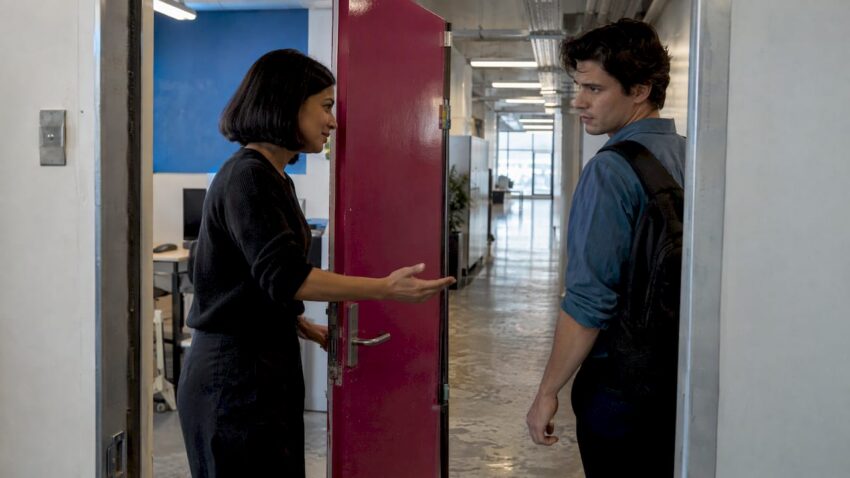
Woman waves colleague through doorway first

Survivor Guilt in Fiction: How Stories Make It Feel True

Posted on November 6, 2026November 6, 2026 by NConnors

Survivor guilt in fiction is the feeling of wrongness a character carries for living when others did not, even when they bear no logical blame. Good stories turn that feeling into behavior: a rule the character lives by, a debt they try to repay, a night they replay until it breaks them. This guide explains how the device works, shows how published authors and critics have used it, and gives writers a practical way to build it. Readers who want to find it in their next book will find that here too.

Nathanielconnors
nathanielconnors.com
Explore Guilt and Survival in Dark Fiction
Nathaniel Connors’s supernatural and dystopian stories explore guilt, survival, and the psychological monsters people carry within them.

Explore Nathaniel’s books

TL;DR

  • Survivor guilt is the sense of having done wrong by surviving. In fiction it works best as a private rule that drives what the character does next.
  • Two classic responses: endless “if only” rumination, or guilt redirected into purposeful action. Strong stories know which one they are showing.
  • Guilt targets an action (“I made the wrong call”). Shame attacks identity (“I am a coward”). Mixing them up flattens a character.
  • Horror, dystopian and ghost stories are natural homes for the theme because extreme settings expose what characters already carry.
  • Our own books, including the Evolution A200 series, explore guilt and survival, and they are available on Kindle Unlimited.

Table of Contents

  • What survivor guilt is, and why fiction keeps returning to it
  • How guilt drives a character’s choices
  • Guilt is not shame
  • Books and stories that explore survivor guilt
  • How to write survivor guilt without reducing a character to it
  • Why dark genres suit the theme
  • Where to read stories about guilt and survival
  • FAQ
  • Sources

What survivor guilt is, and why fiction keeps returning to it

In psychology writing aimed at general readers, survivor guilt is described as feeling wrong for surviving when others did not, even when the survivor had no logical responsibility. Travis Langley’s Psychology Today essay uses that definition and then does something useful for storytellers: it shows how two famous fictional characters, Batman and Spider-Man, respond to it in opposite ways.

That is the key for fiction. The feeling itself is static. What a character does with it is the story.

There are three reasons the theme earns its place in dark fiction.

  1. It creates an invisible antagonist. The danger has passed, but the character is still being hunted, by memory and by their own verdict on themselves.
  2. It makes survival morally expensive. Living is not a victory. Every day alive is a day the character has to justify.
  3. It gives plot a engine that does not need a villain. A guilty character will pick fights, refuse help, take risks or hide the truth, all without anyone forcing them to.

Horror adds one more ingredient. A Psychology Today piece on reading horror describes how the genre lets readers experience danger vicariously while staying safe, and how it can work as a mirror for the psyche. Survivor guilt is exactly the kind of inner material that a mirror like that reflects well.

How guilt drives a character’s choices

The most believable portrayals show guilt through action, not through a character announcing it. Two patterns appear again and again.

Rumination: the replayed night

Langley’s analysis notes that counterfactual rumination, the repeated “if only I had…” loop, can intensify depression and guilt. On the page, this is the character who keeps returning to the same decision point. They rehearse a different version of events, and each rehearsal costs them more than the last. It makes for claustrophobic, intimate fiction, because the character is trapped in a single moment while the plot moves around them.

Compensation: the debt that must be paid

The same analysis says future-oriented plans can restore a sense of agency and reduce helplessness. That is where guilt becomes a motor. Langley reads Batman as responding by preparing for every contingency, while Spider-Man repeatedly remembers the robber who escaped and pushes himself to help others. Same wound, two different action patterns. The lesson for writers is that guilt does not produce one standard behavior.

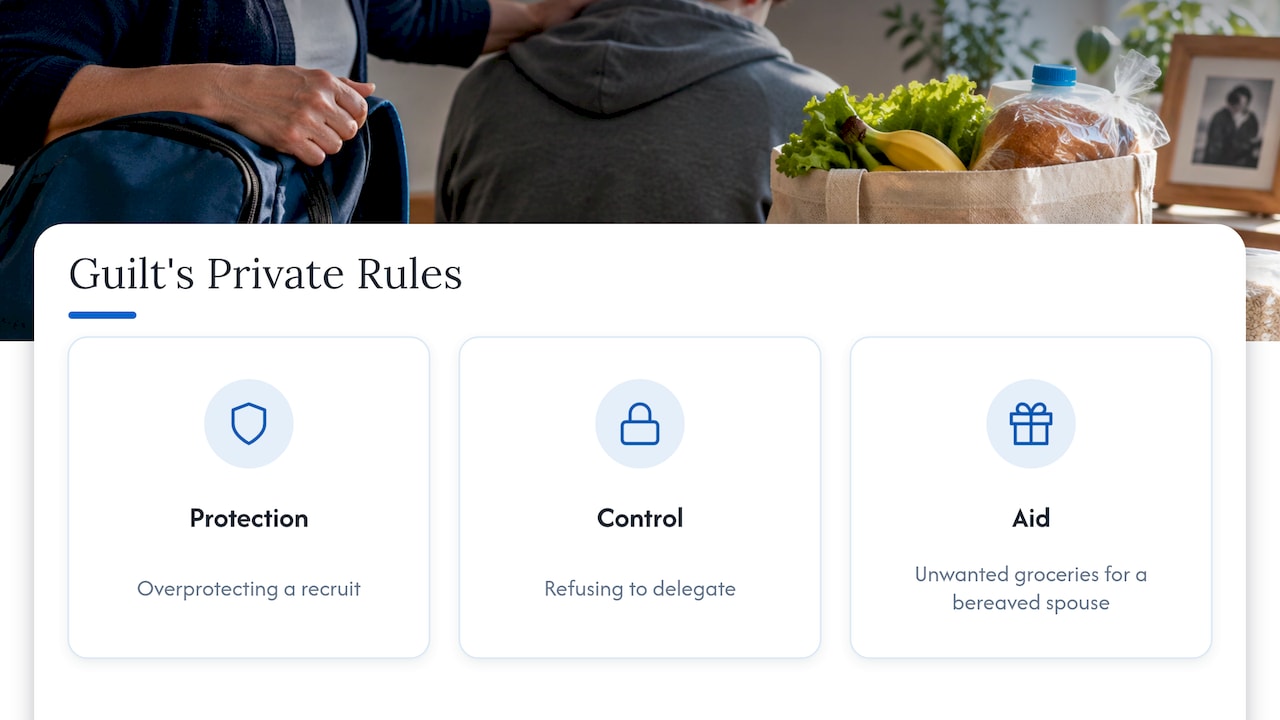
A craft guide from NovelOS frames this as a private rule: the character decides, often without admitting it, how survival must be repaid or punished. From that rule come small, telling behaviors. The guide’s examples include overprotecting a recruit, refusing to delegate, or delivering unwanted groceries to a bereaved spouse. None of these says “I feel guilty.” All of them show it.

Compensation: the debt that must be paid

Relationships show the cost

The same guide points out that relationships reveal the wider costs of a guilt-driven rule. A character who will not delegate exhausts their team. A character who hovers over the family of the dead can become an unwelcome reminder of the loss. The guilt looks noble from inside and intrusive from outside, and that gap is where scenes come from.

Guilt is not shame

This distinction separates convincing writing from melodrama. NovelOS’s craft model separates guilt (“I made the wrong call”) from shame (“the person who survived is a coward”). Guilt targets an action. Shame generalizes the judgment to identity.

Why does it matter on the page?

  • Guilt can be acted on. An action can be confessed, repaired, avenged or atoned for. That gives the plot somewhere to go.
  • Shame tends to hide. A character who believes they are fundamentally bad avoids witnesses, which shapes dialogue, silence and isolation.
  • Characters move between them. A strong arc may begin with guilt over one decision and curdle into shame about who the character must be. Or the reverse: the character learns to separate the act from the self.

For a deeper look at how guilt differs across stories, see our guide to four types of guilt in literature.

Books and stories that explore survivor guilt

This is not a ranked list. It is a set of reference points across horror, speculative fiction and the ghost story, each tied to a published source.

The Unveiling by Quan Barry

Barry’s novel follows disaster survivors on an Antarctic cruise and explores abandonment, guilt and survival. In her Psychology Today interview, she describes using an extreme setting to expose the resources and inner demons characters already have, and says adversity can produce either self-knowledge or self-deception. That last point is a useful writing prompt: a guilty character can learn from the disaster or build a flattering lie about it.

Linghun by Ai Jiang

A Locus review of Linghun reads the novella as a story about grief avoided. Its characters keep the dead present instead of confronting loss, and the reviewer ties guilt to the temptation to undo the past at any cost. It is a good example of guilt expressed as a refusal to let go.

Melmoth by Sarah Perry

In a Longreads interview, Perry explains that Melmoth explores complicity and guilt through Helen’s self-imposed exile and austerity after an unspecified wrongdoing. The monster, she says, embodies witnessing human atrocity. Here the guilt is lived as a way of life: the character’s whole daily existence is the penance.

Severance and the monster as mirror

An academic reading in the Vassar Critical Journal interprets Severance as showing characters projecting despised traits, such as passivity, onto the posthuman, turning it into the Other. The article also cautions that psychological readings of speculative fiction have limits. Still, the idea is handy: in dark fiction, the monster is often the thing the character cannot forgive in themselves.

A ghost story built on survivor guilt

The British Psychological Society’s April 2026 interview describes “Regret, and Other Keepsakes” as a transgressive ghost story framed around survivor guilt. The same feature presents horror as a way to examine grief, guilt, paranoia, anxiety and addiction through fictionalized manifestations of distress.

If you want more titles where guilt meets survival, our lists of post-apocalyptic survival books and dystopian ethics books are good next stops.

How to write survivor guilt without reducing a character to it

The risk with any trauma-driven trait is that it swallows the person. A character who is only their guilt is a symbol, not someone readers can love or fear. These steps keep the person intact.

  1. Separate what happened from what the character believes. The NovelOS guide recommends keeping apart the facts, what the character learned later, the imagined alternative action, the self-accusation and the present-day rule used to repay or punish survival. Map these five layers before you draft. Many weak portrayals blur them into one vague sadness.
  2. Build a chronological backstory. In the BPS interview, the author argues that realistic characters need backstories laid out in order, so that behavior becomes understandable even when readers disapprove. Understanding is not forgiveness, and your reader can hold both.
  3. Choose the response, then commit. Decide whether this character is trapped in counterfactual loops, redirected into action, or moving between the two. Langley’s analysis shows both are dramatically useful, and they produce very different scenes.
  4. Show the rule in small behavior. Overprotection, refusal to accept help, a gift nobody asked for. Let the reader work out the rule before any character states it. Our post on writing guilt-ridden characters without naming the guilt goes deeper on this.
  5. Give the character other wants. Humor, appetite, vanity, curiosity, a favorite song. Guilt colors a life. It does not replace one.
  6. Let relationships push back. Someone should tell the character that the rule is not working, or that it hurts the people it is meant to honor. The character may refuse, but the scene exists.
  7. Decide what the ending says about guilt. Redemption, acceptance, or a continuing weight are all honest options. What fails is an ending where one speech dissolves years of self-punishment.

A quick worked example

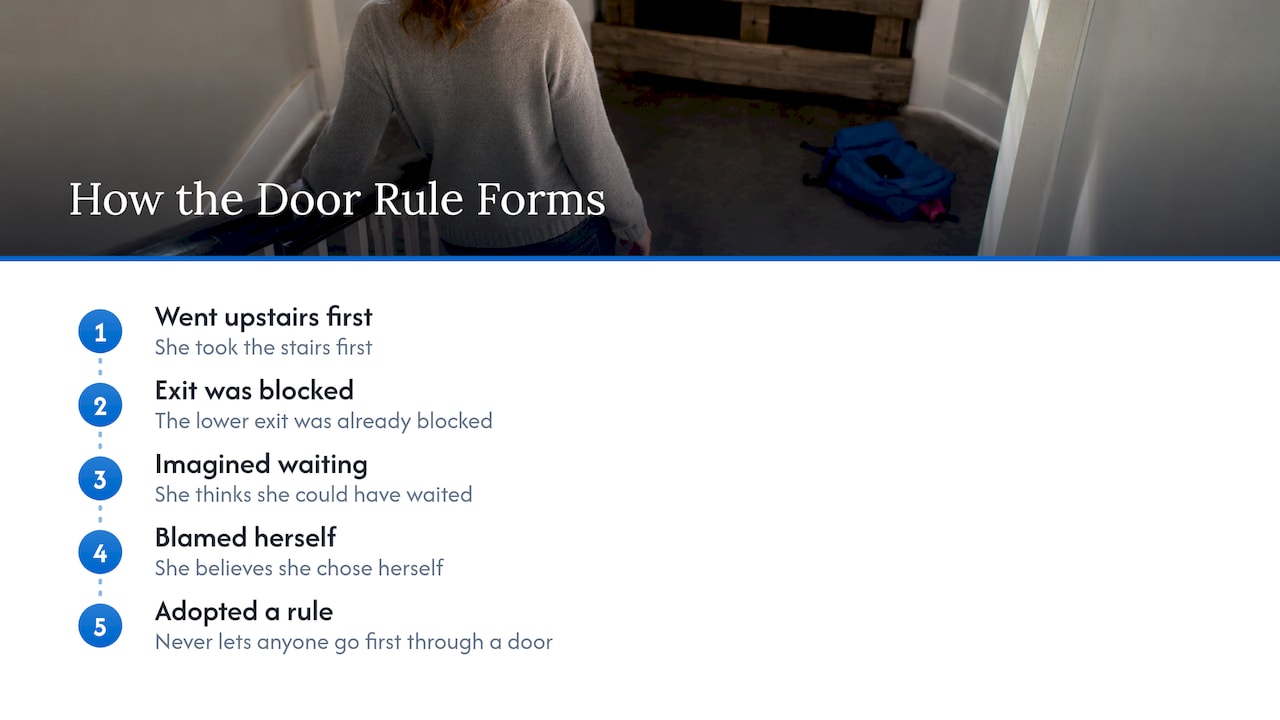
Take a character who survived a flood that killed a coworker. Fact: she went up the stairs first. Later knowledge: the lower exit was already blocked. Imagined alternative: she could have waited. Self-accusation: she chose herself. Present-day rule: she never lets anyone else go first through any door.

Five stages from survival to a door rule

No line of narration needs to say “survivor guilt.” The door rule does it. Add a scene where a new hire is irritated by being waved ahead, and the cost to relationships appears. Add a scene where she catches herself and cannot stop, and you have the character, not the diagnosis.

Why dark genres suit the theme

Horror and dystopia strip away ordinary comfort. When society is damaged, rescue is uncertain and choices are brutal, survival decisions are real, not abstract, which means guilt has something concrete to attach to. The BPS feature frames horror as a mirror held up to society, and survivor guilt is one of the things it reflects.

There is also an honest reason readers return. Reading about a character who lives with the unforgivable lets us rehearse our own responses to loss from a safe distance. The Vassar critic argues that studying characters’ defenses and their othering of others can encourage readers to examine their own insecurities. A frightening story can be a quiet form of self-inspection.

Our perspective

When we write, guilt is rarely a subplot. It is the thing that decides who a character becomes once the danger is over. In our books, including the Evolution A200 series and The Nether, we are drawn to the psychological monsters that a person carries long after the event itself has ended: the choice they replay, the debt they feel they owe, the revenge or redemption they convince themselves will settle it.

We try to let readers feel guilt through behavior, not explanation. A character who cannot accept help, or who keeps counting the cost of one decision, tells you more than a paragraph of confession. That is how we aim to build rich characters and plots that stay with a reader after the last page.

If you like stories where survival is never simple, you will find that thread running through our work. Our Evolution A200 analysis looks at guilt, plague and survival in that series.

Nathaniel

Where to read stories about guilt and survival

If you want to see these ideas in practice, our fiction is built around them. The Nether series and the Evolution A200 series are dark supernatural and dystopian horror stories that explore guilt, revenge and redemption, with the psychological side of survival always in the foreground. Books are available as ebook and paperback on Amazon, and subscribers can read them free with Kindle Unlimited.

Nathanielconnors

Start with Evolution A200: A Bubonic Apocalypse if you want dystopian horror, or browse all of our book series to pick your entry point. If you want to see how a line of dialogue can carry guilt, our horror quotes about guilt show it in miniature. Kindle Unlimited readers can also check our subscription tips.

FAQ

What is survivor guilt in fiction?

It is a character’s sense of having done wrong by surviving when others did not, even without logical responsibility. Writers use it to explain behavior, such as taking on danger, refusing help or replaying one decision. It works best when shown through action instead of stated outright.

How do you show survivor guilt without saying it?

Give the character a private rule and let it leak into small behavior. Examples include overprotecting a recruit, refusing to delegate, or bringing groceries nobody asked for. Readers infer the guilt from the pattern, which is more convincing than a confession scene.

What is the difference between guilt and shame in a character?

Guilt attaches to an action, such as “I made the wrong call.” Shame attaches to identity, such as “I am a coward.” Guilt can lead to repair or atonement, while shame tends to produce hiding and isolation, so they drive different scenes.

Which genres handle survivor guilt best?

Horror, dystopian and speculative fiction and ghost stories are especially strong because extreme settings force hard choices and expose inner conflict. Authors such as Quan Barry have said extreme situations reveal the inner demons characters already carry.

Can survivor guilt have a hopeful resolution?

Yes. Analysis of fictional heroes shows guilt can be redirected into future-oriented, meaningful action that restores a sense of agency. Resolution works best when it is earned across the story, not delivered in a single speech.

Sources

  • The Spider, the Bat, and Heroic Varieties of Survivor Guilt, Psychology Today
  • How Reading Horror Novels Unveils the Human Psyche, Psychology Today
  • Writing Survivor Guilt in Fiction with Care, NovelOS Blog
  • Alex Brown Reviews Linghun by Ai Jiang, Locus
  • Sarah Perry on Melmoth, Monsters, and Making Her Readers Feel Responsible for Mass Atrocity, Longreads
  • Repulsion as Repression: Psychological Defense and the Posthuman Creature, Vassar Critical Journal
  • Horror is the mirror by which we hold society to account, The Psychologist (BPS)

Recommended

  • Make Guilt Ridden Characters Believable for Writers Without Naming It
  • 4 Types of Guilt in Literature and How to Write Them Believably
  • Evolution A200 Analysis: Guilt, Plague and Survival
  • Evolution A200 Quotes: Guilt and Survival in Story Context
Survivors share water in a hidden station alcove

Found Family in Dystopia: Why Chosen Bonds Matter Most

Posted on November 5, 2026November 5, 2026 by NConnors

Found family in dystopia is a group of unrelated characters who take on the roles blood relatives cannot or will not fill, and who do it under a system built to isolate them. The bond works as a survival strategy and as a quiet act of defiance. In the best stories it also becomes the place where characters are changed, for better or worse. This guide explains what the trope means, why dystopian settings suit it so well, how to spot a convincing one, and what to read next.

Nathanielconnors
Explore Darker Dystopian Stories
Nathaniel Connors writes dystopian horror with emotional depth, exploring guilt, redemption, and the psychological monsters within us.

Visit Nathaniel Connors

TL;DR

  • Found family means a chosen group that provides belonging, purpose and understanding when a character’s biological or legal family cannot.
  • Dystopias intensify the trope because oppressive systems break ordinary family ties and force people to build secret, loyal alternatives.
  • The most convincing chosen families grow through small, ordinary moments and real conflict, not through crisis alone.
  • Readers who want psychological depth should look for bonds that change characters, including bonds that carry guilt.
  • Our dark dystopian books are free to read with Kindle Unlimited, so you can explore the themes without extra cost.

Table of Contents

  • What found family means in dystopian fiction
  • Why the theme resonates in dystopian settings
  • How oppressive systems shape the bonds
  • What makes a dystopian found family feel real
  • A reader’s checklist for psychologically deep dystopias
  • When the family itself is dark
  • Our perspective
  • Start reading the dark stuff
  • FAQ
  • Sources

What found family means in dystopian fiction

A found family, sometimes called a chosen family, is a group of people who form deep, familial connections without blood relations. According to The Indiependent’s guide to the trope, this usually happens in response to loss, rejection or displacement from the biological family.

An academic thesis from Penn State’s honors program gives a more precise definition. It describes a found family as a group that supplies material and emotional needs, such as belonging, purpose and understanding, when a person’s existing family is unable or unwilling to. The same work separates two forms:

  • Substitutional families replace the blood or legal family entirely.
  • Supplemental families meet the needs that the biological family leaves unmet.

That distinction is useful when you read dystopian fiction. A character who has lost every relative to a plague, a purge or a prison camp needs a substitutional family. A character who still has parents but lives under a regime that demands those parents inform on them needs something supplemental, a place where the real self is safe.

Why the dystopian version is different

In a contemporary novel, a found family is often a warm refuge. In a dystopia, it is also a risk. Belonging to the wrong group can be illegal. Trusting the wrong person can be fatal. That tension makes every act of loyalty carry weight, and it is why the trope shows up so often in dark speculative fiction.

If you are still sorting out the genre itself, our guide to how dystopian and post-apocalyptic stories differ explains why the same trope behaves differently in a controlling society than in a collapsed one.

Why the theme resonates in dystopian settings

There are a few reasons chosen family and dystopia fit together so well.

It mirrors real experience. The Indiependent notes that the trope reflects the lives of marginalized people who look for safe havens beyond their biological roots. It offers a model of connection based on choice, loyalty and empathy instead of rigid labels or biological obligation. Dystopias exaggerate the pressures that make such havens necessary, so the metaphor lands harder.

It answers the central dystopian threat. Dystopian regimes work by isolating individuals: severing loyalties, replacing them with loyalty to the state, and making every neighbor a potential informant. A chosen family is the direct counter-move. It is a loyalty the state did not authorize.

It raises the stakes of survival. Novelist Justin Cronin, in an interview with Publishers Weekly, argued that family bonds strengthen the survivability of the human species. Even if you read that as one author’s perspective rather than settled science, it explains why so many survival stories turn on who travels together.

It lets characters change. A craft essay on the author Lauren DeStefano observes that found families can help characters grow, face their weaknesses and develop new strengths beyond simple support. In a dystopia, where the old self is often the first casualty, that transformation is the emotional payoff readers come for.

Four reasons chosen family resonates in dystopia

How oppressive systems shape the bonds

The surrounding danger does more than push characters together. It shapes what the family looks like, how it behaves and what it costs.

Secret networks under surveillance

One academic study of trauma and intimacy in Margaret Atwood’s Gilead describes how characters form clandestine support networks that give emotional and practical help, easing trauma and creating belonging under an oppressive regime. Notice the word clandestine. The family has to hide, so intimacy becomes coded: a glance, a shared task, a whispered name.

Kinship as survival and resistance

Indigenous-authored speculative fiction treats this theme with particular depth. A 2025 article on care and liberation in apocalyptic fiction argues that in Cherie Dimaline’s The Marrow Thieves, networks of kinship are key to Indigenous survival in an apocalyptic setting.

A second 2025 study goes further. It finds that in Indigenous-authored dystopias, intergenerational care and Elder mentorship work as a form of resistance against the extractive violence of settler colonialism. The same study reports Dimaline’s view that peoples who have already survived an apocalypse make ideal protagonists for redefining kinship as resistance.

This reframes the trope. A found family is not only a comfort. It can be a way of carrying culture, memory and obligation forward when a system is trying to erase them. Kinship stories are also built through shared telling, and collaborative storytelling shows how a group can construct a narrative together, much as these characters construct a family.

Kinship as survival and resistance

Shared adversity as the starting point

Craft guidance from River Editor notes that found families often form through shared adversity and shared goals, with vulnerability and support slowly building trust and intimacy. That is the template most dystopian novels follow: a mission, a hiding place or a journey puts strangers in the same danger, and the bond grows from what they endure together.

What makes a dystopian found family feel real

Anyone can put five survivors in a bunker and call them a family. The difference between a convincing bond and a decorative one comes down to a handful of choices.

Small moments, not only crisis

The craft essay on DeStefano’s work argues that these relationships feel believable when they are built through accumulated small, ordinary moments rather than dramatic events alone. Think of sharing the last of the water, noticing who sleeps badly, or learning someone’s habits well enough to predict them. A gunfight can show courage, but only routine can show closeness.

Friction before trust

The same source stresses that characters should be able to resist or clash before the connection develops, and that found families should not bond too quickly. In a dystopia this is natural, because survivors often hold different strategies. One wants to hide. One wants to fight. One wants to bargain. Conflict that comes from those differences feels earned.

Conflict that requires repair

River Editor’s guide says realistic found-family dynamics include conflicts that must be repaired through actions and conversations rather than simple apologies. A character who betrays the group and is forgiven in one line has not been forgiven in any way a reader believes. A character who spends three chapters earning it has.

Different bonds for different people

Lynn Krueger of Lynn’s Author Studio observes that the strongest chosen families avoid uniform relationships. One member may bond intellectually with another, protectively with a third and emotionally with a fourth, each meeting a different need. When every pair in the group relates the same way, the family reads as a cast list.

Voluntary and maintained

Chandler Supple of River Editor notes that these bonds feel more meaningful because they are voluntary and actively maintained. He adds that physical comfort and small non-verbal cues often say more than words about deep, platonic intimacy. A hand on a shoulder at the right time can do more than a speech.

A reader’s checklist for psychologically deep dystopias

If you want dystopian stories where the found family carries emotional weight, here is what to look for as you browse.

  1. A bond that changes someone. Does the group force a character to grow, confront a weakness or become someone new? Transformation is the sign that the family matters to the plot, not just the mood.
  2. Specific needs. Does each member need something different from the group? Look for characters who are drawn together for distinct reasons, not just proximity.
  3. Everyday texture. Are there quiet scenes of ordinary care between the set pieces? Those are the moments that make the loss scenes hurt.
  4. Conflict with consequences. Do arguments leave marks that have to be repaired, or do they vanish by the next chapter?
  5. The system as pressure. Does the oppressive world actively shape the family, through secrecy, scarcity or fear, instead of serving as a backdrop?
  6. Moral weight. Do the characters face choices where loyalty to the group costs them something? Our list of dystopian ethics books is built around exactly those tests of conscience.

Where to go next

How much dread you want, and for how long, will shape your pick. If you like your tension compressed, start with short dystopian novels you can finish in a sitting, or sample the form through dystopian short stories. If you want the horror to lead, our roundup of dystopian horror novels is the place to start. And if the question that interests you is who you would travel with after everything falls, the post-apocalyptic survival books list and our look at apocalyptic survival ethics follow that thread.

When the family itself is dark

Found family is usually written as warmth, but dystopian horror has room for the shadow side. A chosen family can be a place where guilt is shared, where a group keeps a terrible secret together, or where loyalty is demanded at a price. The craft sources above point to the same truth from the opposite direction: a bond that has been tested, strained and repaired reads as real, and a bond that has never been uncomfortable does not.

This is also where psychological depth enters. Horror that works on the mind is less interested in what the monster does than in what the group does to itself under pressure. If that distinction interests you, our piece on psychological thriller versus horror draws the line, and the explainer on what dystopian horror means shows how a society itself can become the monster the family has to survive.

Our perspective

We write dark supernatural and dystopian fiction about revenge, guilt and redemption, and we keep coming back to one conviction: the most frightening thing in a ruined world is rarely the ruin. It is what people do to one another, and what they will do for one another, once the old rules are gone.

That is why we put so much work into character. A bond between two people in a dark story only matters if we know what each of them is carrying. Our books aim for rich character development and plots that linger, so the relationships are not decoration. They are where the psychological pressure shows up.

We also think readers deserve access without a barrier. Our books, including The Nether, Stories of a Condemned Soul and Evolution A200: A Bubonic Apocalypse, are available on Kindle Unlimited, so subscribers can read the whole story without paying extra. If you came here looking for dystopian fiction where emotion runs as deep as the dread, we wrote it for you.

Nathaniel

Start reading the dark stuff

If you want dystopian horror where the psychology matters as much as the plot, our books are built for that. The Nether and the Evolution A200 series are available as ebooks and paperbacks on Amazon, and they are free to read with a Kindle Unlimited subscription. Browse the full Nathaniel Connors book collection to pick your starting point.

Nathanielconnors

Starting with the apocalypse? Evolution A200: A Bubonic Apocalypse is where that series begins. Prefer something more haunted and personal? Try The Nether. If you are a subscriber, our Kindle Unlimited tips will help you get more from your membership.

FAQ

What is found family in a dystopian story?

It is a group of characters who are not related but act as family, usually because their real families are gone, hostile or controlled by the regime. Academic work divides these groups into substitutional ones, which replace blood family, and supplemental ones, which fill gaps the biological family leaves. In a dystopia, the bond is often secret and risky.

Why do dystopian novels use found family so often?

Oppressive systems tend to break up natural loyalties, so a chosen family becomes the clearest form of resistance and survival. It also mirrors real experiences of people who seek safety beyond their biological roots. And it gives characters someone to change alongside, which makes the story more emotional.

How do you make a found family feel believable?

Let trust build through small, ordinary moments instead of one big rescue. Give characters different survival strategies so they can clash. Make conflicts require real repair through actions, not a quick apology. Craft guides from River Editor and Lynn’s Author Studio both make these points.

Can a found family be a source of horror?

Yes. A chosen group can share guilt, keep dangerous secrets or demand loyalty at a cost. That is where psychological horror often lives, in the pressure between people rather than in an external threat. Those stories ask what loyalty is worth when the world has no rules.

Where can I read dark dystopian fiction on Kindle Unlimited?

Our Nathaniel Connors books, including The Nether and Evolution A200: A Bubonic Apocalypse, are available on Kindle Unlimited. Subscribers can read them without an additional purchase. You can also buy them as ebooks or paperbacks on Amazon.

Sources

  • Penn State Honors College thesis on found family (2021)
  • A Deep Dive Into Tropes: Found Family, The Indiependent
  • PW Talks with Justin Cronin, Publishers Weekly (2012)
  • How Lauren DeStefano Creates Authentic Relationships, Lynn’s Author Studio
  • The Legacy of Trauma and Intimacy: Intergenerational Impact (2024)
  • Care and Liberation in the Black Anthropocenes (2025)
  • Care as Resistance: Indigenous Feminist and Queer perspectives (2025)
  • How to Write Found Family Dynamics That Feel Earned, River Editor (2026)

Recommended

  • Dystopian Ethics Books: Novels That Test Your Conscience
  • Short Dystopian Novels for One-Sitting Dread
  • Best Dystopian Horror Novels: 8 Haunting Reads for 2026
  • The Best Dystopian Short Stories: Classics to Modern Reads
Detective questioning a suspect across a table

The Nether Analysis: Themes, Characters and Meaning

Posted on November 4, 2026November 4, 2026 by NConnors

The Nether is Jennifer Haley’s play about a virtual world built for people’s most forbidden desires, and it works as both a crime story and a moral argument. It asks whether an act that harms no physical person still carries consequences, and it refuses to hand the audience an easy answer. Below you will find what the play is about, how its structure works, what it says about identity and responsibility online, and what to know before you watch or read it. Because our own novel shares the title, we also explain how the two differ.

Nathanielconnors
nathanielconnors.com
Explore Connors’ Dark Supernatural Fiction
Nathaniel Connors’ novel The Nether is a separate work, exploring guilt, revenge and redemption through dark supernatural fiction.

Explore The Nether

TL;DR

  • The Nether is a play by Jennifer Haley that blends a police procedural with a science-fiction thriller, set in a future where life has largely moved online.
  • Its central question is whether a virtual act with no physical victim is harmless, or whether fantasy shapes the person who lives it out.
  • The investigator’s interrogations drive the plot, and each conversation tests a different answer to that question.
  • The play contains disturbing material involving the sexualization of children in a virtual setting. Read the content warnings below before you decide.
  • Nathaniel Connors’ novel The Nether is a separate work of dark supernatural fiction with the same title.

Table of Contents

  • What The Nether is about
  • The characters and how the investigation unfolds
  • The central themes
  • What critics and the playwright say
  • How to read The Nether
  • Content warnings
  • Our perspective
  • Where to find our novel
  • If you want more stories that test your conscience
  • FAQ
  • Sources

What The Nether is about

According to a study guide published by a Toronto theatre company, The Nether is part police procedural and part sci-fi thriller. A rookie detective investigates a man named Sims and a virtual realm called the Hideaway, where users can have sex with and murder children. The same guide notes that the play premiered in 2013 at Center Theatre Group’s Kirk Douglas Theatre in Los Angeles.

That summary is blunt because the play is blunt. The setup is a crime story: a detective, a suspect, an interrogation room and a trail of evidence. The material inside that frame is something most audiences would rather not look at. Haley’s choice to wrap an uncomfortable subject in a familiar genre is the first thing to understand about the work. The procedural form promises that a crime will be named, a culprit found and a verdict reached. The play then keeps asking whether the verdict is as simple as the form suggests.

The world outside the screen

The same study guide describes the play’s setting as a dystopian future in which social and professional life has moved predominantly online. Environmental degradation has alienated people from the natural world, and people are increasingly disconnected from one another.

This background matters more than it first seems. The virtual world is not just a place where bad things happen. It is where a lonely, depleted population goes to feel something. Nobody in the play has a good reason to stay in the physical world, and that makes the appeal of the Hideaway easier to understand and harder to dismiss. The audience is never allowed the comfort of thinking the users are a different kind of people from everyone else.

How the Hideaway works

The study guide explains that the Hideaway recreates the sights, sounds, smells and feelings of an innocent time gone by. The play asks what is attractive about a consequence-free existence, and whether taboo virtual activity could be a harmless outlet.

The design is the quiet horror of the piece. The Hideaway is not drawn as a dungeon. It is warm, ordered and nostalgic, with a surface of gentleness over the thing it permits. The gap between the pleasant setting and the activity it hosts produces much of the play’s unease. A reader or viewer is invited to feel the pull of the place before understanding what it is for.

The characters and how the investigation unfolds

The main characters, per the same study guide, include Detective Morris, Sims (whose avatar is Papa), Doyle, Iris and Woodnut. Morris investigates Sims and interrogates Doyle to get information about the Hideaway.

Think of the cast as a set of positions in an argument:

Character Role in the story Position in the argument
Detective Morris The investigator who questions Sims and Doyle The law, and the belief that harm must be answered
Sims (avatar: Papa) The figure behind the Hideaway The case that the realm is a controlled, humane outlet
Doyle A man questioned for information about the Hideaway The user, whose answers show what the place means to those inside it
Iris A character connected to the virtual world The way the fantasy touches a person, not a concept
Woodnut Another figure tied to the Hideaway A reminder that the world is populated by people, not only ideas

The table sketches roles only, and we leave the finer details of the plot to the play itself. That is deliberate. The Nether depends on what the audience learns and when, and a summary that spoils the sequence would flatten the work.

Why the interrogation structure works

A play that debated virtual ethics in the abstract would feel like a seminar. Haley instead gives each idea a person who needs something. The detective wants a confession and access. The suspect wants to defend a place he believes in. The user wants to protect what he has found there. Each argument is spoken by someone with a stake, which makes it sound less like a thesis and more like a defense.

Interrogation scenes also let the play control information. In a procedural, the audience learns as the detective learns. That shared ignorance makes the audience complicit in the investigation, and it means the moral discomfort arrives at the same pace as the facts.

The central themes

Does a virtual act have consequences?

This is the question everything else orbits. The study guide frames it as whether virtual sexual and violent fantasies have consequences, and the play combines its dystopian setting and police-procedural structure to raise questions about online ethics and virtual relationships.

There are two broad positions, and the play lets both speak. One says that without a physical victim there is no crime, and that giving a harmful impulse a contained outlet is better than denying it. The other says that rehearsing an act shapes the person, and that a virtual world designed to make a violation feel real has already crossed a line. Haley does not pick a side for the audience. She makes each side persuasive enough to be uncomfortable.

Two ethical arguments about virtual acts compared

Identity, anonymity and privacy

The study guide also notes that the play asks whether online anonymity and identity can free people from consequences, whether virtual relationships are real, and whether there are legal or moral limits to online interaction.

The avatar is the key device. Sims becomes Papa inside the Hideaway, and the split between name and avatar is the play’s way of dramatizing a familiar online habit: becoming someone else where nobody can see you. In an interview with Time Out London, Haley questions whether inhabiting an online identity fundamentally changes a person or simply reveals a different, darker side of who they already are. The two readings are very different. In the first, the world creates the monster. In the second, it only lets him out.

Privacy is the other half. The detective’s job is to look into a space its users consider private. The play lets you feel both the instinct to protect that privacy and the revulsion at what it shelters, and it never lets one cancel the other.

Identity, anonymity and privacy

Escape and nostalgia

The Hideaway sells an innocent past that no longer exists in the play’s damaged physical world. That is a theme that reaches well beyond the story’s single, disturbing use of it. People go to virtual places for comfort, for control and for the version of life they believe they lost. Haley takes that ordinary impulse and points it at its worst possible object, so the audience sees how the same machinery that produces a harmless game could also produce something monstrous.

What critics and the playwright say

Critics have often read The Nether as a moral examination. The New York Times review describes it as a disturbing look at moral responsibility and the boundary between physical and virtual reality, and suggests it functions as a parable for the future of the internet. In that reading, the play forces audiences to face uncomfortable truths about their own digital lives.

The playwright’s own account of how the piece began is useful context. In her Time Out conversation, Haley says she came across child avatars used in sexual situations in Second Life. It outraged her, and it changed the play from an intellectual exercise into something with real anger behind it. That origin explains the tone. The play is not a detached thought experiment about technology. It is a response to something she found disturbing and could not dismiss.

In remarks on winning the 2014 Francesca Primus Prize, reported by the American Theatre Critics Association, Haley says the ideas came from a subconscious place, and that her research turned up material about living out our imaginations. She also cites Carl Jung’s view that the world of dreams and imagination is as real as physical reality as a thematic anchor. That idea sits at the heart of the play’s argument. If imagination is real in its own way, then a fantasy built in full sensory detail cannot be dismissed as nothing.

How to read The Nether

A few approaches help whether you are studying the play, writing about it or preparing to see it.

  1. Track who is asking the question. Each major scene gives one character a stake in a particular answer. Notice what each person stands to lose.
  2. Watch the setting. The warmth of the Hideaway and the bleakness of the outside world are in deliberate contrast. Ask what each one is selling.
  3. Separate the genre from the ethics. The procedural structure promises resolution. Ask whether the ending delivers moral resolution or only narrative closure.
  4. Notice the language of avatars. The difference between a person’s name and their avatar’s name is where the play locates responsibility.
  5. Resist the neat verdict. If you leave the play certain, reread it. It is built to unsettle certainty in either direction.

Common mistakes in writing about it

Students and reviewers often reduce the play to a single thesis, such as “technology is dangerous” or “fantasy is harmless.” Neither fits. The play is more interested in how people justify what they do when nothing external stops them. Another frequent error is to treat the shocking subject as the point. The subject is the pressure applied to the ideas. The point is what the ideas do under pressure.

Content warnings

The play is disturbing, and you should know what it contains before you go. According to American Theatre, it includes a scene implying sexual contact between a young girl and an older man, and it depicts an online community of people posing as children and pedophiles. The study guide’s own summary of the plot adds that users of the Hideaway can have sex with and murder children in the virtual realm.

If that material is a firm no for you, that is a reasonable decision, and you can get the play’s ideas through the commentary quoted above without sitting through the staging. If you want a fuller warning list for our novel, see our guide to The Nether trigger warnings, which covers the novel, the play and the Minecraft dimension that shares the name.

Our perspective

We get asked about the title more than almost anything else. Readers type “The Nether” and find a celebrated play, a game dimension and our novel, and each one means something different. We want to be clear about that, because a reader deserves to know which one they are about to open.

Haley’s play is a work we respect for what it does well: it takes a technological question and makes it a moral one. What stays with us is the way it treats guilt. The people in it are not cartoons. They are people who have built reasons for what they do, and the play’s pressure comes from watching those reasons come under examination.

Our own book comes from a different tradition. We write dark supernatural fiction about revenge, guilt and redemption, and about the psychological monsters that sit deeper than any single villain. Our novel is a separate story and not an adaptation, a response or a retelling of the play. If the play’s questions about conscience and consequence draw you in, you will find the same seriousness about the human cost of darkness in our fiction, in a supernatural register rather than a virtual one.

We write slowly and with attention to character, because the horror we care about is the kind that lingers after the last page. That is the experience we are trying to give readers, and it is why every title is available to Kindle Unlimited subscribers at no added cost.

Nathaniel

Where to find our novel

If the analysis above has you curious about dark fiction that treats guilt and consequence seriously, you can read about our novel on its own page, The Nether by Nathaniel Connors. The books are available as ebooks and paperbacks, and they are free to read for Kindle Unlimited subscribers.

Nathanielconnors

Browse the full catalog, including The Nether Series and the EA200 Series, on our books page. If you are deciding between subscribing and buying, our Kindle Unlimited versus buying ebooks guide lays out the trade-offs. For a spoiler-safe read on our book, see the author-sourced review of The Nether.

If you want more stories that test your conscience

Readers who value the play’s moral weight often ask where to go next. The play’s central pull is an ethical dilemma dressed as a thriller, and a good deal of speculative fiction works the same ground. We have collected novels built around hard ethical choices in dystopian ethics books, and if you want to know who populates our own story, see the characters of our novel. If you came looking for lines to quote, our page on The Nether quotes separates the novel from the play.

FAQ

What is the main message of The Nether?

There is no single message, which is part of the point. The play asks whether virtual acts carry real consequences, whether online anonymity frees people from responsibility, and whether a fantasy lived out in full sensory detail is harmless. Critics such as the New York Times reviewer read it as a parable about the future of the internet.

Who are the main characters in The Nether?

The main characters include Detective Morris, Sims (whose avatar is Papa), Doyle, Iris and Woodnut. Morris investigates Sims and questions Doyle to learn about the Hideaway, the virtual realm at the center of the story.

Is The Nether based on a real event?

The play is fiction, but Haley has said that finding child avatars used in sexual situations in Second Life outraged her and changed the piece from an intellectual exercise. The story and characters are invented, while the unease behind them is drawn from real online behavior she encountered.

Is the play suitable for everyone?

No. It includes a scene implying sexual contact between a young girl and an older man, and it depicts an online community of people posing as children and pedophiles. Many theatres issue their own advisories, so check the one for the production you plan to attend.

Is Nathaniel Connors’ The Nether the same as the play?

No. Our novel is a separate work of dark supernatural fiction that shares the title. It is not an adaptation of Haley’s play, and you can read it free with a Kindle Unlimited subscription.

Sources

  • The Nether study guide, Studio 180 Theatre (2018)
  • Review: Jennifer Haley’s ‘The Nether’ Explores the Dark Side of the Web, The New York Times
  • Jennifer Haley on portraying the horrors of the digital age, Time Out London
  • Jennifer Haley wins 2014 Francesca Primus Prize, American Theatre Critics Association
  • Virtual Reality, Real Vices in ‘The Nether’, American Theatre

Recommended

  • The Nether Quotes: The Novel, the Play, and Where to Find Them
  • Free on Kindle Unlimited: Nathaniel Connors’ The Nether Characters
  • The Nether Trigger Warnings: Novel, Play and Minecraft
Older and modern novels compared on a table

Pandemic vs. Plague Fiction: How the Two Differ

Posted on November 3, 2026November 3, 2026 by NConnors

Pandemic fiction and plague fiction both tell stories about disease, but they usually ask different questions. Pandemic fiction tends to look at modern, global outbreaks and the systems that respond to them. Plague fiction tends to lean on older pestilences, allegory and moral reckoning. Readers and scholars often use the terms interchangeably, so think of them as two ends of one spectrum rather than two sealed shelves.

This guide shows where the line falls, where it blurs, and which books sit on each side. It also helps you pick what to read next, depending on whether you want procedure and science, history, or dread.

Nathanielconnors
Explore Dystopian Horror with Emotional Depth
Nathaniel Connors writes dark supernatural fiction, including Evolution A200: A Bubonic Apocalypse, exploring psychological darkness and human emotion.

Visit Nathaniel Connors

TL;DR

  • Pandemic fiction is usually read through modern global outbreaks. Plague fiction often carries historical or allegorical weight. The labels overlap heavily.
  • The “outbreak narrative” follows identification, spread and professional containment. The pandemic narrative is global and apocalyptic, and it rarely offers redemption.
  • Both use disease to expose fear, mortality and how communities treat outsiders.
  • Start with the question you want answered: how do we stop it, what does it do to us, or what does it mean?
  • If you want the psychological, dystopian end of the spectrum, we publish it, and our books are free with Kindle Unlimited.

Table of Contents

  • What readers mean by each label
  • The outbreak narrative and the pandemic narrative
  • Why plague stories feel older and heavier
  • Where pandemic fiction does its best work
  • Where the two genres overlap
  • Why readers turn to these stories in a crisis
  • How to choose what to read
  • Our perspective
  • Where to start with our books
  • Reading these stories well
  • FAQ
  • Sources

What readers mean by each label

Search for either term and you’ll find the same shelves: novels about epidemics, outbreak thrillers, historical fiction with a medical twist, and apocalypse stories. A 2022 academic discussion of plague fiction and reading during COVID-19 describes these as sub-genres that deal with the societal, psychological and medical impact of widespread disease. The same source notes that pandemic fiction is often viewed through the lens of modern global outbreaks, while plague fiction sometimes carries more historical or allegorical associations. It also notes that the terms are frequently swapped.

In practice, readers use the words like this:

  • Pandemic fiction means the disease is a present-tense, worldwide event. Think airports, supply chains, hospitals, governments, and the question of how a connected world fails.
  • Plague fiction means the disease is a pressure chamber. The pestilence may be historical, supernatural or symbolic, and the story is as interested in guilt, faith and punishment as in biology.

Neither definition is official. A story about a modern virus can feel like a plague story if it is about moral collapse, and a story set in a medieval city can read like a pandemic story if it is about institutions failing.

The outbreak narrative and the pandemic narrative

The sharpest distinction comes from academic work on the outbreak narrative. A 2022 analysis, COVID-19 and Contagion: Reassessing the Outbreak Narrative, notes that scholars such as Priscilla Wald define it as a formulaic plot: the disease is identified, its means of spread is traced, and professionals respond to contain it. The same analysis sets that against the pandemic narrative, which is implicitly global and apocalyptic rather than redemptive. It treats the film Contagion as a work that balances elements of both.

That gives you a useful working test:

  1. Does the story end with containment? If the experts find the cause and the crisis closes, you are reading an outbreak narrative.
  2. Does the story assume the world is already lost or changing for good? Then it is closer to a pandemic or apocalypse narrative.
  3. Does the disease serve as a symbol of something else? Then it has moved toward the plague end.

The outbreak story is a procedural. The pandemic story is a survival story. The plague story is often a morality play wearing a survival story’s clothes.

Why plague stories feel older and heavier

Plague fiction has a long lineage, and that history gives the word “plague” its weight. The 2021 academic overview New ways: the pandemics of science fiction lists examples that include Mary Shelley’s The Last Man, H. G. Wells’s “The Stolen Bacillus,” Albert Camus’s The Plague, Octavia Butler’s “Speech Sounds,” José Saramago’s Blindness and Kim Stanley Robinson’s The Years of Rice and Salt. That list crosses centuries, genres and styles, which is the point: the plague is a flexible container.

History shows up in the details. Alessandro Manzoni’s 1827 novel The Betrothed captures frustration with incompetent officials and lax enforcement during the 1630 plague in Milan, according to a 2020 New York Times opinion essay on great pandemic novels. The pattern is familiar to anyone who lived through the early 2020s. The same anger at authority can sit in a book from 1827 and in a news cycle today.

Plague fiction also allows the fantastical. A Literary Hub survey of literary plagues points out that fictional diseases range from true to life to wildly invented. Its example is Dragonscale, which causes tattoo-like marks and spontaneous combustion. Joe Hill’s The Fireman uses that fantastical plague to critique intolerance, violence and conformity. When the disease is invented, the author can aim it at anything.

Why plague stories feel older and heavier

Where pandemic fiction does its best work

Pandemic fiction tends to be strongest when it asks what happens to ordinary systems under stress. Saramago’s Blindness (1995) uses a sudden, unexplained epidemic to strip away what the author treats as a veneer of civilization, then explores power, food supply and exploitation, as the 2021 science fiction overview describes. Notice that the story never needs a cure plot. It only needs a world that stops working.

The same overview describes how real-world outbreaks feed the genre. Norman Spinrad’s Journals of the Plague Years (1988) critiqued the American corporate response to the AIDS epidemic. Historical epidemics, including the Black Death and AIDS, have inspired fiction that critiques colonialism and corporate interests. COVID-19, the source adds, drove a surge in pandemic fiction sales.

So modern pandemic fiction often has a political edge. It asks who profits, who is left behind and who decides.

Where the two genres overlap

The overlap is large, and good authors use it on purpose. Both genres raise the stakes of life and death. The Literary Hub piece notes that plague stories force characters to face mortality under extreme urgency. Both also work as mirrors. A 2020 article in The Conversation argues that apocalyptic fiction helps us deal with anxiety, and that contagion narratives often reflect existing, half-formed fears such as globalization and cultural change rather than predicting the future. The same piece says Station Eleven shows survivors building a new society to accommodate shared trauma while exploring fears about community identity and outsiders.

Another shared trait is the enemy. A BBC piece on writers who predicted today observes that pandemic fiction joins people against a non-human enemy, with no good guys or bad guys and every character holding an equal chance of survival. That leveling is why the genres feel so intimate: the disease does not care who is deserving.

Here is a side-by-side view.

Feature Pandemic fiction (typical) Plague fiction (typical)
Scale Global, connected, modern Often a city, a community, or a symbolic world
Main question How do systems and people cope? What does this say about us?
Tone Procedural, political, sometimes apocalyptic Allegorical, moral, sometimes supernatural
Disease Usually plausible science Can be historical, invented or symbolic
Ending Containment or collapse Reckoning, guilt or survival with a cost
Example touchstones Blindness, Station Eleven The Plague, The Fireman

Treat the table as a tendency, not a rule. Blindness is arguably as allegorical as any plague novel, and The Plague has plenty to say about institutions.

Why readers turn to these stories in a crisis

The BBC article suggests pandemic fiction can be a therapeutic tool during crises, comforting readers by showing humanity has survived large-scale catastrophes before. That is one reason these books surged in 2020. The Conversation offers a complementary view: the stories are less prophecy than a safe place to rehearse fear.

There is also a craft reason. Disease is a perfect horror antagonist because it is invisible, patient and indifferent. It removes the villain’s motive and leaves only human response. What the characters do with that response is where the best writing happens: the lies, the loyalty, the rationing, the secrets.

How to choose what to read

Pick by the question you want answered.

You want to know how it spreads and who stops it. Look for outbreak narratives. Expect investigation, institutions and a ticking clock.

You want to see what a collapsing world does to people. Choose pandemic or post-apocalyptic fiction. Our guides to pandemic apocalypse books and post-apocalyptic survival books are good places to start.

You want meaning, dread and moral weight. Choose plague fiction in the older, allegorical sense. Our three reading paths for plague apocalypse novels split the field into art, science and history.

Four reading questions matched to fiction paths

You are not sure whether a book is dystopian or post-apocalyptic. That is a separate distinction, covered in how to tell dystopian from post-apocalyptic.

For a cleaner decision, ask three quick things before you open a book. Is the disease explained or unexplained? Is the viewpoint a scientist, a survivor or a sinner? Does the blurb promise an ending where the crisis is solved? Your answers tell you which end of the spectrum you are about to read.

Our perspective

We write at the dark end of this spectrum, and we think the difference between pandemic and plague fiction comes down to where the fear lives. In pandemic fiction, the fear is outside: the virus, the system, the failure of the people in charge. In plague fiction, the fear is also inside, in what the survivors will do and what they will have to carry afterward.

That is the territory our books return to: revenge, guilt and redemption, and the psychological monsters that outlast any outbreak. A plague is only the setting where those monsters get room to move. We would rather leave you thinking about a character’s choice for a week than explain a pathogen to you for a chapter.

If you like the idea of disease as a mirror, read for the people, not the plot mechanics. The best of these stories ask what you would have done, and the honest answer is usually the unsettling part. Our analysis of guilt, plague and survival in Evolution A200 goes deeper into that idea.

Nathaniel

Where to start with our books

If this comparison made you curious about the darker end, Evolution A200: A Bubonic Apocalypse is where the plague strand of our work begins. It pairs a historic pestilence with a dystopian setting and a close look at guilt and survival. The sequel, Evolution A200: Radio Silence, continues it. If you prefer a supernatural, psychological take, The Nether is the place to begin.

Nathanielconnors

All of our books are available in ebook and paperback on Amazon, and they are free to read for Kindle Unlimited subscribers. Browse the full lineup on our books page, or read about the plague spreading across both Evolution A200 novels. For a first look at the bubonic angle, see bubonic plague in fiction, or go straight to Evolution A200: A Bubonic Apocalypse.

Reading these stories well

A few habits make the genre richer.

  • Read one from each end. Pair a procedural outbreak story with an allegorical plague story. The contrast teaches you more than either book alone.
  • Notice the authority figures. Whether it is Milan in 1630 or a modern fictional government, the way officials behave tells you what the author fears.
  • Track the outsider. Many of these stories test how a community treats those it suspects of carrying the sickness. That is usually where the theme sits.
  • Check the ending’s promise. If the story gives you containment, it is an outbreak tale. If it gives you a changed world, it is closer to pandemic or plague apocalypse.
  • Mix in the survival ethics. Stories that put characters on short rations and short trust raise questions we explore in our five questions for apocalyptic survival ethics.

If you like your dread slow and psychological rather than gory, our guide to slow burn non-supernatural horror on Kindle Unlimited is a natural next step.

FAQ

Is a plague novel the same as a pandemic novel?

Not exactly, but the terms overlap. Pandemic fiction is usually read through modern, global outbreaks. Plague fiction often carries historical or allegorical associations. Many readers and scholars use them interchangeably, so check a book’s description rather than its label.

What is an outbreak narrative?

It is a formulaic plot in which a disease is identified, its spread is traced and professionals work to contain it, as scholars such as Priscilla Wald describe it. Stories that follow that arc usually end in containment. Pandemic narratives, by contrast, tend to be global and apocalyptic.

Which classic novels should I read first?

For the plague tradition, try Camus’s The Plague or Manzoni’s The Betrothed. For the modern, systems-level view, try Saramago’s Blindness or Emily St. John Mandel’s Station Eleven. Pick one from each side to feel the difference.

Can plague fiction be supernatural?

Yes. Fictional plagues range from realistic to fantastical. Joe Hill’s The Fireman, for example, uses a fantastical disease to critique intolerance and conformity. Supernatural plague stories let authors aim the disease at a theme, which is why they suit horror readers.

Sources

  • Plague Fiction: Reading About Epidemics During Covid-19
  • COVID-19 and Contagion: Reassessing the Outbreak Narrative
  • New ways: the pandemics of science fiction
  • On Literary Plagues, Literary Hub
  • Apocalyptic fiction helps us deal with the anxiety of the coronavirus pandemic, The Conversation
  • The plague writers who predicted today, BBC Culture
  • What the Great Pandemic Novels Teach Us, The New York Times

Recommended

  • Bubonic Plague in Fiction
  • 3 Reading Paths for Plague Apocalypse Novels: Art, Science, History
  • Dystopian vs Post-Apocalyptic: How to Tell the Difference
  • The Plague Has Spread: Both Evolution A200 Novels Are Available Now
Barely open blue door in a quiet hallway

Writing Dread: How to Make Readers Fear What Hasn’t Happened

Posted on November 2, 2026November 2, 2026 by NConnors

Dread is the reader’s certainty that something terrible is coming, held for a long time before it arrives. To write it, you plant a small sign of wrongness early, withhold the full shape of the threat, make the setting slightly off, and let a believable character feel it too. Then you wait longer than feels comfortable. This guide walks through each of those moves with examples you can try on your own pages today.

Nathanielconnors
nathanielconnors.com
See Dread at Work in Dark Fiction
Explore Nathaniel Connors’s supernatural stories, where psychological depth and haunting narratives keep the darkness close.

Explore the stories

TL;DR

  • Dread is anticipation, not shock. The reader must be sure something is coming and unable to stop it.
  • Hint at the threat in the first pages, then delay the confrontation.
  • Use small, almost-normal wrong details instead of explanations. Let the reader’s imagination supply the worst.
  • Give your characters real emotions and give the supernatural real costs, so the threat feels credible.
  • Escalate with structure (countdowns, clocks, rising consequences) and pay off the promise you made.

Table of Contents

  • What dread is, and how it differs from fear and surprise
  • Open with a pinprick of foreboding
  • Foreshadow and withhold
  • Make the setting almost normal, then not quite
  • Control the pace
  • Write characters who feel it
  • Give the supernatural rules and a price
  • Escalate and land the ending
  • A 20-minute dread exercise
  • Perspective
  • See dread at work in Nathaniel Connors’s books
  • FAQ
  • Sources

What dread is, and how it differs from fear and surprise

Fear is a reaction to something present. Surprise is a jolt that ends as fast as it starts. Dread sits between them and lasts longer than either: you know the door will open, you just don’t know when, or what will be behind it. One craft guide puts it as the reader’s certainty that something is coming, held long before it arrives.

Fear, surprise, and dread compared by timing

The distinction is old. An academic survey of cinematic fear notes that in Ann Radcliffe’s 1826 account, terror (the anticipatory state we are calling dread) expands the soul and awakens the faculties, while horror is the revulsion that follows the encounter. The same paper cites philosopher Noel Carroll’s observation that dread narratives often lack a concrete object of fear and instead push the audience to entertain unknown, perhaps unavowable threats.

For a writer, that has a practical consequence. Every time you show the monster clearly, you convert dread into horror, and horror is a shorter emotion. If you want to keep the reader in the tense, anticipatory state, you have to protect the unknown. It is also why dread is not the same as mystery. In horror, the goal is not to let the reader solve a puzzle ahead of the protagonist but to sustain tension while the character faces something they cannot yet name.

If you want a longer look at how this plays against blood and shock, our piece on atmosphere versus gore covers what scares readers when nothing graphic is on the page.

Open with a pinprick of foreboding

Dread cannot start in chapter ten. Writer’s Digest advises introducing the horror early, or at least hinting at it with a pinprick of foreboding, then delaying the ultimate confrontation with details such as hesitant footsteps, wind, shadows and a world that feels slightly off-kilter.

Here is what that looks like in practice. Compare two openings:

  • Marta moved into the old house on Tuesday. It was big and quiet.
  • Marta moved into the old house on Tuesday. By Thursday she had stopped asking why every clock in it ran four minutes slow.

The second tells you nothing about the threat, yet you already expect one. A character is noticing something and trying to rationalize it. That is the whole mechanism.

A few rules for the first page:

  1. Name the core fear for yourself. Know whether the book is about being watched, being replaced, being forgotten or being punished. You do not have to say it, but every detail should point at it.
  2. Give the reader someone to worry about. Opening guides recommend a relatable character in the first paragraph and a threat signaled through symptoms instead of an explicit reveal, as in this step-by-step opening guide.
  3. Raise a question in the first lines. An active scene with a distinct voice makes the reader lean in before they know why.

Foreshadow and withhold

Foreshadowing builds dread by using subtle, off-kilter details or objects that suggest something is fundamentally wrong without stating the threat. That is the view of a professional mystery writers’ chapter in its piece on tension in psychological suspense. The same article explains that gradual reveals give readers time to absorb each unsettling fact, which keeps them engaged and anxious as they connect the pieces.

Withholding does the other half of the work. When the protagonist and the reader are both unsure of the nature or the true scale of the threat, the mind fills the gap. The Kennedy Center’s teaching resource on the skeleton of a scary story lists fear of the unknown, dark and isolated settings, deteriorating settings, ominous repetition and a twist showing that things were not what they seemed as the main engines of suspense.

A useful method is the three-step escalation of a single sign:

  1. Dismissible. A dog refuses to enter one room. Anyone could explain it.
  2. Persistent. The dog now waits outside that door every night, facing it.
  3. Demanding. One night the dog is gone, and the door is open an inch.

The progression follows the idea that dread should build through a small, dismissible disturbance that grows into a sign the character cannot ignore and that forces curiosity. Notice that at no point did you explain anything.

One caution on withholding: it only works if the reader trusts you will pay off. Ambiguity lets readers fill gaps with their own suspicions about the danger, but a reader who senses the author has nothing behind the curtain will stop worrying.

Make the setting almost normal, then not quite

Atmosphere is where most dread lives on the sentence level. Specific, concrete rendering of a place, claustrophobic or isolating spaces, and sensory description that makes the mundane feel off are the building blocks listed in this breakdown of what makes a story scary. The advice to describe your setting as if it were alive is a good prompt: ask what the room wants, what it hides, what it has been waiting for.

The most efficient tool is the small disturbance. Writer’s Digest notes that minor disruptions, like objects slightly out of place, work as persistent interruptions that heighten anxiety once an established pattern is broken. That means you first have to establish the pattern. Show the reader your character’s morning routine, the order of the kitchen, the sound of the street. Then move one cup.

Try these kinds of wrongness:

  • Time: clocks, schedules or seasons that don’t line up.
  • Sound: a noise that stops when the character stops.
  • Repetition: the same stranger, phrase or number appearing in unrelated places.
  • Decay: a building that is a little worse each time the character returns.
  • Absence: the thing that should be there and isn’t, such as birdsong or a neighbor’s light.

We go deeper on sentence-level techniques in our guide’s section on line-level tactics that produce unease.

Control the pace

Dread needs an unhurried, deliberate buildup, with information parceled out slowly, as the mystery writers’ article on psychological suspense describes. Most writers rush because silence on the page feels like nothing is happening. In dread, that silence is where the happening is.

Practical pacing choices:

  • Lengthen the approach. If a character walks toward a basement, give the walk three beats before the door: a sound, a thought, a hesitation.
  • Shorten the sentences as the moment nears. Rhythm tells the body what to feel. Neil Lerner, a professor at Davidson College, says that in film music accelerating rhythms and rising volume can signal to the brain that something is hunting, triggering an instinctive fight-or-flight response. Prose can borrow the same trick with sentence length and white space.
  • Cut passive filler. One horror editor argues that passive construction dilutes dread and suggests hunting for stray “was” and “is” constructions in your self-edit.
  • Break the slow rhythm once, late. A long stretch of quiet followed by a single disruption resets the reader’s nerves and makes the next quiet worse.

Write characters who feel it

Readers borrow dread from characters. If your protagonist shrugs at a thing that should frighten them, so will the reader. Writer’s Digest makes the point that realistic emotional reactions to unreal events help the unreal feel real. So let people be afraid in specific, human ways: they over-explain, make bad jokes, check the lock twice, avoid the topic with their spouse.

Stakes matter as much as reactions. The reader should care about the character as a whole person rather than a future victim, which makes the coming danger feel personal. Give them a job they are bad at, a debt, a sister they haven’t called. Then threaten those things.

The same craft source frames horror as depending on believable vulnerability: readers fear the threat, its agenda, and the characters’ limited control over their fate. Limited control is the key phrase. A competent character with a plan reduces dread. A competent character whose plan quietly fails increases it.

Our pieces on character-driven horror and on building a believable interior life and emotional stakes look at this in more depth.

Give the supernatural rules and a price

A threat with no logic feels arbitrary, and arbitrary things are hard to dread. If your ghost, curse or creature can do anything, the reader cannot anticipate anything. Craft discussions of fantasy and supernatural elements recommend that abilities carry consequences, ramifications and limitations, and that a personal cost forces characters to weigh what they can do against what they must live with afterward.

For a supernatural thriller, one guide suggests revealing the rules gradually through the protagonist’s investigation, keeping them consistent, and making each use or encounter cost something real and progressively harder to recover from. In practice:

  • Decide what the threat cannot do. A ghost that cannot cross running water gives your characters a plan, and a reason to leave the water.
  • Decide what each encounter takes: memory, sleep, a relationship, a year of life.
  • Let the reader learn the rules before the character fully admits them. That gap is dread.

If you are working on this particular subgenre, our guide on building a supernatural thriller without gore goes further.

Escalate and land the ending

Dread needs a trajectory. Structural cues like countdown headings, which measure distance, time or resources, work as a promise to the reader that a climax is approaching. A chapter titled “Eleven days” tells the reader that a clock exists, and every scene after it is read against that clock.

Time pressure also helps. Literal ticking clocks or implied limits force urgent action and raise suspense. The trap is making the clock merely decorative. Each time it ticks, something should be lost.

A few habits for the ending:

  • Raise cost, not volume. Make the third incident worse because of what it takes, not because it is louder.
  • Pay off the first sign. Whatever you planted in the opening pinprick should come back, changed.
  • Reveal late and partially. When the threat finally appears, show enough to satisfy and keep enough to haunt. The reader should close the book still imagining the part you did not describe.
  • Use the quiet after. A short, flat aftermath scene often disturbs more than the climax.

Filmmakers face the same problem in a tighter format; our look at horror short film structure shows how one fear can carry three acts.

A 20-minute dread exercise

Set a timer and write one scene of about 400 words using this recipe:

  1. Pick an ordinary place: a laundromat, a hallway, a parked car.
  2. Write two minutes of routine so the pattern is clear.
  3. Add one wrong detail, and have your character explain it away.
  4. Add a second, related detail, and have the character stop explaining.
  5. End before anything happens.

Then read it aloud and mark every place where you named the threat. Cut those lines. For more drills like this, see our timeboxed writing exercises for psychological horror, and for the full toolkit, our craft guide to psychological horror.

It also helps to study how dread works in finished books. Our list of slow burn horror books is a good place to start reading like a writer.

Perspective

When I build a story, I begin with the question of what my character is most afraid to admit, and then I let the world slowly agree with them. That is where dread comes from for me: the monster outside is rarely as frightening as the one that guilt has been feeding inside.

In our books, revenge, guilt and redemption are not themes added on top of the plot. They are the engine. A reader who senses that a character has earned what is coming, and that the character knows it, will wait through a lot of quiet pages. That is why we favor character development and intricate plots over shock. We want the reader to put the book down and keep thinking.

If you write dark supernatural fiction, trust the slow approach. Give the reader a reason to care, a rule to fear and a price to watch being paid. Then resist the urge to show the whole face too soon.

Nathaniel

See dread at work in Nathaniel Connors’s books

If you would rather read dread than diagram it, start with The Nether, a dystopian horror novel built on guilt and consequence, or Evolution A200: A Bubonic Apocalypse, where the threat is known long before it arrives. Both are available on Amazon in ebook and paperback, and free to read for Kindle Unlimited subscribers.

Nathanielconnors

You can browse every title on the books page, or read about how Kindle Unlimited works for our readers.

FAQ

How do you start writing a scary story with dread?

Open with an ordinary scene and one small wrong detail, and give the reader a person to care about. Hint at the threat in the first page without explaining it. Then delay any confrontation so the anticipation has room to grow.

What is the difference between dread and suspense?

Suspense is the tension of waiting for an outcome, often a specific one. Dread is the sense that something terrible is coming and cannot be stopped, often without a defined object. Dread usually leans on the unknown, while suspense can come from a known danger with an uncertain result.

Can you write dread without a monster or gore?

Yes. Dread depends on foreshadowing, withheld information, off-kilter settings and believable characters, not on showing violence. Small disturbances, like objects slightly out of place, can unsettle readers more than explicit scenes because the reader’s imagination supplies the worst.

How long should dread build before the payoff?

There is no fixed length, but the buildup should feel slightly longer than comfortable and should escalate throughout. Use countdowns, time limits and rising costs so the reader feels progress, and make sure each stage changes something for the character.

What should I do when I dread writing itself?

Shrink the task. Set a short timer, write one rough scene using a recipe like the exercise above, and edit nothing until it ends. Many writers find that lowering the stakes of a single session makes the blank page less threatening.

Sources

  • How to write horror (Kanonara)
  • Defining Cinematic Fear: Horror, Shock, Dread and Terror
  • Writing Nail-Biters: How to Write Suspense in Horror (Dabble)
  • 7 Tricks for Writing Terrifying Horror Fiction and Monster Stories (Writer’s Digest)
  • How to Start a Horror Story: 5 Simple Steps + 4 Examples
  • Dialing Up the Tension in Psychological Suspense (MWA Midwest)
  • The Skeleton of a Scary Story (Kennedy Center)
  • How to Write Scary Ghost Stories (James Colton)
  • What Makes a Story Scary (Cornett Fiction)
  • Dark Corners: 4 Strategies for Developing Horror Settings (Writer’s Digest)
  • Your Brain on Music: Chills and Thrills (Kennedy Center)
  • Hurts So Good: How to Make Your Horror More Interesting (Writer’s Digest)
  • How to Write Scary Novels Infused With Fun and Humor (Writer’s Digest)
  • Writing Excuses Episode 15: Costs and Ramifications of Magic
  • How to Write Supernatural Thrillers (iWrity)

Recommended

  • Horror Atmosphere vs Gore: What Actually Scares Readers
  • Write Psychological Horror That Sticks: Create Dread Without Gore
  • 3 Craft Tests to Tell Dark Fantasy From Horror for Readers and Writers
  • How to Write a Horror Short Film That Actually Scares People
Reader browsing books on a Kindle

Kindle Unlimited Tips: Get More From Your Subscription

Posted on November 1, 2026November 1, 2026 by NConnors

The best way to get value from Kindle Unlimited is to treat it as a place to try books, not a pile to hoard. Turn on the subscription filter when you search, read the sample and the one-star reviews before you borrow, keep a running list so you never hit the 20-title cap blind, and return anything that isn’t working. Below are the habits that make the biggest difference, with notes for readers who want dark, psychological and dystopian fiction.

One naming note first. Amazon’s current help pages describe the service as Kindle+, and many readers still say Kindle Unlimited or KU. This guide uses both names for the same membership.

Nathanielconnors
Find darker reads for your KU list
Explore Nathaniel Connors’s psychological horror and dystopian fiction, with stories of revenge, guilt, and redemption available on Kindle Unlimited.
Explore his books

TL;DR

  • Use the subscription filter in the Kindle app and search by sub-genre or trope, not just by “horror” or “thriller.”
  • Read the sample, the description and the one-star reviews before borrowing. Returning a book costs you nothing, but your time still counts.
  • You can hold up to 20 titles at once, with no due dates. Keep a separate list of what you want next.
  • Check your real reading month against the catalog before you decide to keep or cancel.
  • If you like dystopian horror and psychological dread, our books are free to read with the subscription.

Table of Contents

  • What the subscription actually includes
  • Find included books faster
  • Find psychological horror and dark speculative fiction
  • Sample, skim and check reviews before you borrow
  • Manage the 20-title limit
  • Build a reading list that survives the catalog
  • Use reading features that keep you in the story
  • Give yourself permission to quit
  • Decide whether to keep or cancel
  • Perspective: why we think KU suits dark fiction
  • Start with a dark series on your subscription
  • FAQ
  • Sources

What the subscription actually includes

Knowing the rules makes every other tip easier. According to Amazon, subscribers can borrow digital books, audiobooks, comics, manga and magazines, look for the badge on eligible titles, download them, and return current selections when they want something new.

Two details matter most:

  • No due dates. As long as the subscription stays active, a borrowed title doesn’t expire. You return it when you choose.
  • Any device. Amazon says you can read on Kindle devices, phones, computers and tablets using the free Kindle app.

In the U.S., the membership normally costs $11.99 a month plus taxes, a figure Amazon published in 2024. Check your account for the current price before you subscribe, since prices and trials change.

If you are still deciding whether this model fits you, our comparison of Kindle Unlimited vs buying ebooks walks through the math, and a separate piece on Prime Reading vs Kindle Unlimited covers the other Amazon option many people confuse it with.

Find included books faster

The catalog is enormous, so the first skill is narrowing it down. Three habits do most of the work.

Turn on the filter

Amazon says you can find eligible titles in the Kindle Store and your library by switching on the Kindle+ filter in the Kindle app. Do this before you search. Otherwise you will waste time on books you would have to pay for, fall in love with a premise, and only then discover it isn’t included.

On any single book page, the eligibility badge is the quickest check. Keep an eye out for it as you scroll.

Search by trope, not by genre

A search for “horror” returns thousands of results that look alike. Editors at one reading site argue the catalog’s real problem is sameness rather than scarcity, and that searching by specific trope is a highly effective way to cut through it.

For dark fiction, that means swapping the broad label for something precise. Try:

  • “slow burn psychological horror”
  • “post-apocalyptic survival with a pandemic”
  • “haunted by guilt” or “revenge supernatural”
  • “dystopian thriller with a conspiracy”
  • “unreliable narrator”

The narrower the phrase, the less the algorithm can hide behind bestsellers. If you want a head start on the horror side, we keep a running list of Kindle Unlimited horror books for subscribers.

Use your dashboard, but steer it

Reedsy’s review of the service notes that the dashboard tailors suggestions to your browsing history. That cuts both ways. If you only click on one kind of book, you will only see that kind. Browse deliberately outside your usual lane once in a while, and the recommendations widen with you.

Find psychological horror and dark speculative fiction

Dark fiction is where the sameness problem bites hardest. Gore-heavy slashers, cozy-ish paranormal romances and genuine psychological dread all sit under the same shelf label. A few ways to separate them:

  1. Read the first paragraph of the description for what the book is about, not what it resembles. A blurb built around a character’s guilt or a moral choice tends to signal psychological horror. A blurb built around a body count signals something else.
  2. Search for the emotion you want. Dread, paranoia, isolation and guilt are better search terms than “scary.”
  3. Check the series order before you start. Series in the dystopian and supernatural space often run several books. Start at book one.
  4. Decide whether you want the supernatural or not. If you prefer horror that comes from people, our guide to slow burn non-supernatural horror on Kindle Unlimited is a good place to begin. If you want real dread from the other side, try our picks of dark supernatural books.

We also wrote a short piece on what to expect from psychological thrillers on Kindle Unlimited, which helps you tell the sub-genres apart.

Sample, skim and check reviews before you borrow

Borrowing is free, but starting and abandoning books is still time you don’t get back. A short routine saves it.

Read the sample

Subscribers can read a sample before borrowing, much like browsing in a physical bookstore. Judge the first few pages on voice and pacing. If the prose doesn’t grab you in the sample, it rarely improves.

Read the one-star reviews first

This one is counterintuitive and it works. One-star reviews often name the exact thing a reader disliked, rather than offering a generic complaint. In horror, that is gold. A one-star review that says “too slow” might be a five-star recommendation for you, and one that says “too graphic” tells you whether to skip it.

Ask what you are in the mood for

Before you press borrow, say it in one sentence: “I want something bleak and tense that I can finish in a week.” If the book doesn’t match the sentence, keep scrolling.

Manage the 20-title limit

Manage the 20-title limit

Amazon states that members can hold up to 20 titles at a time, counting books and magazine issues. If you go over, Amazon automatically returns the excess to bring you back under the cap. That means a title you meant to keep can disappear if you borrow carelessly.

Some practical ways to stay in control:

  • Borrow in small batches. Keep three to five books in your library, not twenty. A smaller shelf makes it easier to pick what to read next.
  • Return finished books. There are no due dates, so nothing forces you to tidy up. Do it anyway after each finish.
  • Use box sets strategically. One reader’s guide notes that a multi-book set in the catalog counts as a single title, so a whole series can fit in one slot.
  • Park future reads somewhere else. A dedicated wish list can keep future borrows organized once you reach the limit.

Build a reading list that survives the catalog

The most common regret among subscribers is losing track of a book they spotted three weeks ago. A simple system fixes it.

Tool Best for Effort
Amazon wish list named “KU” Keeping everything inside Amazon Low
Kindle Collections Sorting borrowed books on your device Low
Book-tracking app shelf Reading goals, ratings and series order Medium
Spreadsheet Readers who like data and comparisons High

The options above come from one reading blog’s guide to organizing KU recommendations, which suggests rotating your borrows weekly and tracking them with a shelf, spreadsheet, Collections or a wish list. A third-party app can also help you build a dedicated to-be-read list just for KU.

Pick one tool and stick with it. Whichever you choose, add a one-line note on why a book caught your eye. In two weeks, that note will be the difference between “I want this” and “why did I save this?”

Use reading features that keep you in the story

Kindle itself has tools worth using with borrowed books. X-Ray, for instance, may show details about the plot, locations and characters in the book you are reading. In a long dystopian series with a big cast, that is a fast way to remember who a minor character was without leaving the page.

For audio, look for the headset icon: Amazon says narration on eligible titles is marked “with Narration” on the book’s details page. That is useful if you want to switch between reading and listening on a commute.

Give yourself permission to quit

The lower commitment of a subscription changes how you should read. One reader’s guide points out that it makes it easier to stop reading books you aren’t enjoying. Use that.

A workable rule: give a book 10 percent, or about 50 pages. If you are not curious by then, return it and borrow the next one. The same sort of thinking appears in another reader’s take that the subscription lowers the cost of trying a book and leaving it unfinished.

Decide whether to keep or cancel

A subscription only pays off if you use it. Run a quick test before you commit or renew.

  1. Write down the next five books you genuinely expect to read.
  2. Check how many are included. One reader-focused guide suggests exactly this: list the next five books you expect to read and count how many are currently in the catalog.
  3. Compare the number to your monthly reading pace.

As a rough guide, readers who get through several books a week or enjoy indie titles tend to get the most from a membership, while people who read only a few books a year may spend less buying titles one by one, according to that same subscriber guide. Some readers report reduced-price offers when they cancel, but those are not guaranteed.

If you want to go deeper on this decision for dark fiction in particular, see whether Kindle Unlimited is worth it for horror.

How to cancel without losing access early

You can cancel any time from the Memberships and Subscriptions page on Amazon.com, and access continues until the end of the current billing cycle. So there is no reason to cancel late in the month out of caution. Do it when you decide, then use the remaining days.

Perspective: why we think KU suits dark fiction

We write dark supernatural and dystopian fiction about revenge, guilt and redemption, and we have thought a lot about how readers find books like ours. Our honest view: Kindle Unlimited is one of the best ways to meet a new horror author.

Psychological horror asks for a little trust. You have to give a writer a few chapters before the dread builds. A subscription removes the price from that trust. You can open a book, see whether the voice works, and keep going or move on, with nothing lost but a few minutes.

That is why we keep our books available for subscribers. If you want a story that stays with you after the last page, borrow one, read the sample first, and tell us what you think.

Nathaniel

Start with a dark series on your subscription

If you want to put these tips to work right away, our books are free to read for Kindle Unlimited subscribers, and they are also sold as ebooks and paperbacks on Amazon. You will find them on our books page.

Nathanielconnors

Two places to begin: The Nether for dystopian horror and a thriller edge, or Evolution A200: A Bubonic Apocalypse if you want a pandemic apocalypse story. Our page for Kindle Unlimited subscribers explains how to find them, and how Kindle Unlimited works for our readers covers the borrowing steps.

FAQ

How do I find Kindle Unlimited books?

Turn on the Kindle+ filter in the Kindle app, then search. Amazon says the filter works in both the Kindle Store and your library. You can also look for the badge on a book’s page to check whether it is included.

How many books can I borrow at once?

You can have up to 20 titles at a time, including books and magazine issues. If you go over, Amazon returns the extra ones automatically. There are no due dates, so you can keep a book as long as you stay subscribed.

Is Kindle Unlimited worth it?

It depends on how much you read. Heavy readers and fans of indie authors tend to get the most value, while light readers may save money buying single books. A quick test: list the next five books you want and see how many are included.

Can I read Kindle Unlimited books without a Kindle?

Yes. Amazon says you can read on Kindle devices, phones, computers and tablets with the free Kindle app. Your library follows your account, so you can pick up where you left off on another device.

Can I cancel at any time?

Yes. You can cancel from the Memberships and Subscriptions page on Amazon.com, and access continues until the end of your current billing cycle. Reduced-price offers at cancellation are reported by some readers but are not promised.

Sources

  • Understanding the Kindle+ subscription and benefits (Amazon Help)
  • Understanding the Kindle Unlimited subscription (Amazon Help)
  • Prime Day Kindle Unlimited deal (Amazon News)
  • Kindle features that make reading more fun (Amazon News)
  • Best Books on Kindle Unlimited: How to Find Them (Margin & Muse)
  • Kindle Unlimited: Is It Worth the Subscription? (Reedsy)
  • How to Use Kindle Unlimited (Theresa Christine)
  • How to Organize Kindle Unlimited Recommendations (What To Read Next)
  • How Does Kindle Unlimited Work? (Spin My Read)
  • Is Kindle Unlimited Worth It? (Spin My Read)
  • How to Cancel Kindle Unlimited (Reverbico)

Recommended

  • Kindle Unlimited vs Buying Ebooks: 2026 Decision Guide
  • Prime Reading vs Kindle Unlimited: Which Is Worth It?
  • How Kindle Unlimited Works for Nathaniel Connors Readers
  • Kindle Unlimited vs Scribd: Best Pick for Dark Fiction Fans
  • 1
  • 2
  • 3
  • 4
  • Next
  • Facebook
  • Twitter
  • Instagram
  • TikTok
  • Linkedin

Recent Posts

  • Villain Protagonist vs Antihero: How to Tell Them Apart
  • Gothic Horror vs Supernatural Fiction: How They Differ
  • Horror Logline Examples That Work, and How to Write Yours
  • Single Location Horror Ideas: 15 Premises That Trap You
  • Survivor Guilt in Fiction: How Stories Make It Feel True

Recent Comments

No comments to show.

Categories

  • Articles
  • Books
  • Film
  • Kindle Unlimited
  • Social Media
  • Uncategorized
  • November 2026
  • October 2026
  • September 2026
  • August 2026
  • July 2026
  • May 2026
  • April 2026
  • December 2021

Share Our Blog

©2026 Nathaniel Connors | Dystopian Horror & Thriller Fiction