Nathaniel Connors | Dystopian Horror & Thriller Fiction

Where every story begins in the dark.

Menu
  • Home
  • About the Author
  • Books
    • The Nether
    • Evolution A200: A Bubonic Apocalypse
    • Stories of a Condemned Soul (Volume One)
  • Film
    • Room 302 (Short Film)
  • Amazon Author Page
  • Goodreads
  • Original Quotes by Nathaniel Connors
    • Dark Quotes
    • What Remains
    • Where Stories Settle
Menu

Category: Uncategorized

Woman comparing e-reader and paperback in cozy living room

Kindle Unlimited vs Kobo Plus: Best Pick for Dark Fiction

Posted on July 27, 2026July 27, 2026 by NConnors

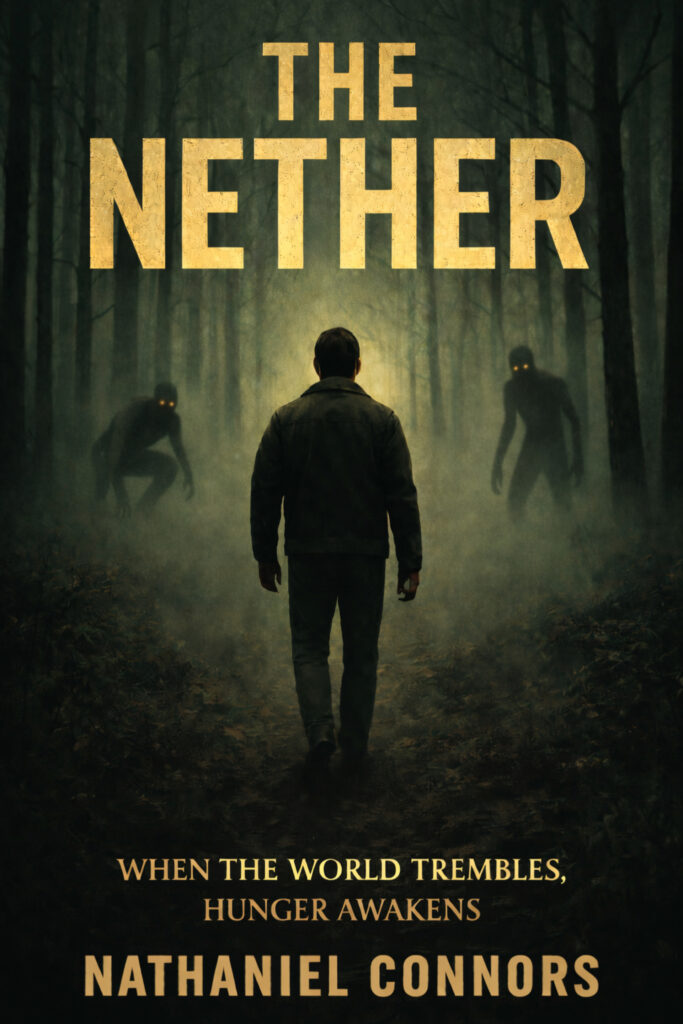
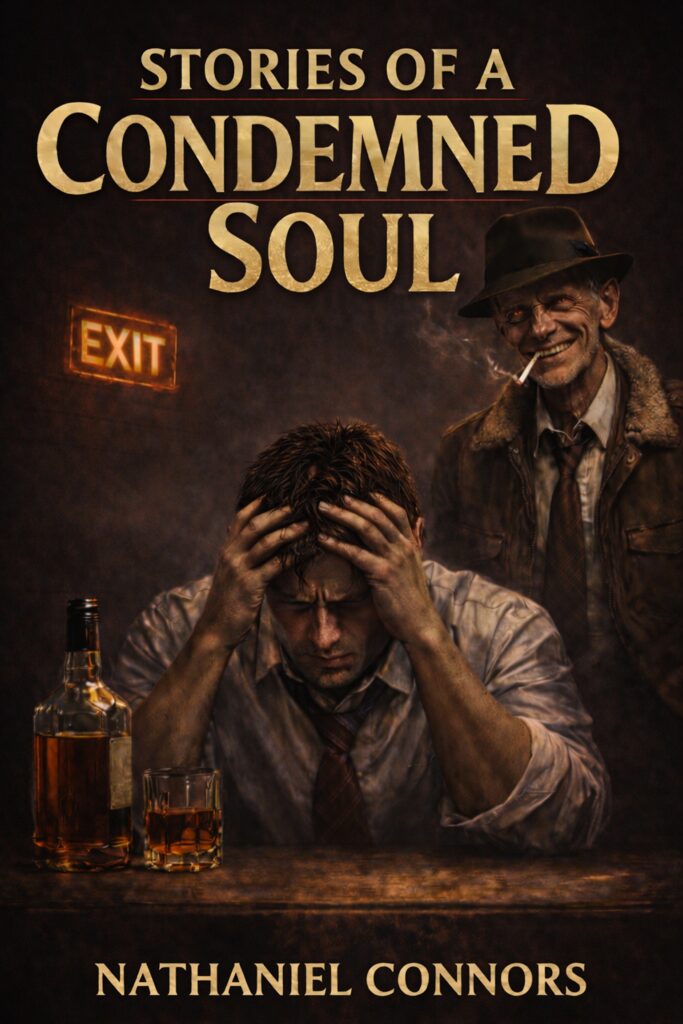
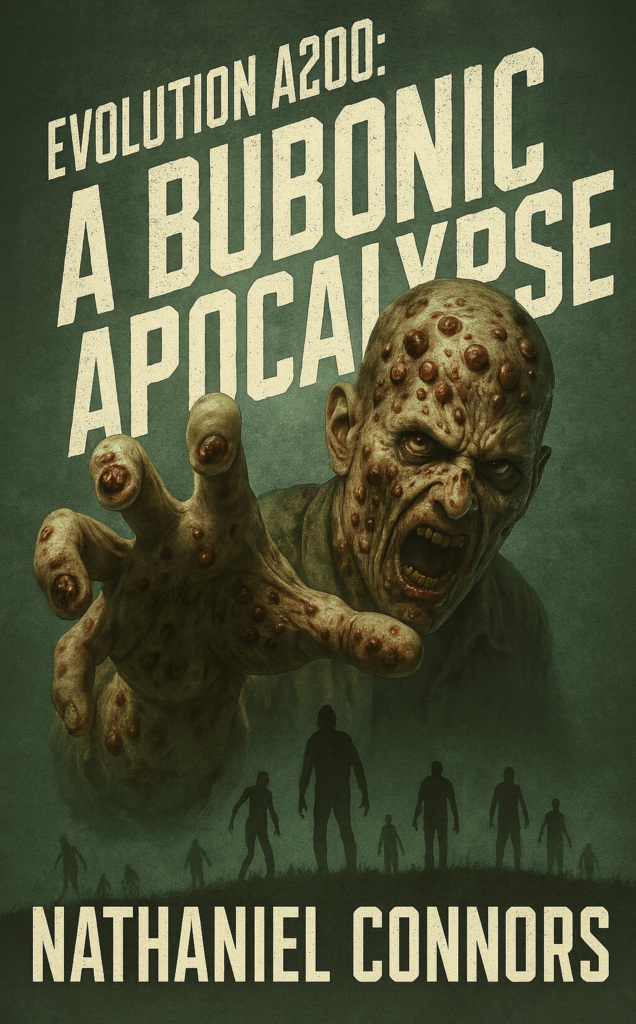
If you read Nathaniel Connors, the choice between Kindle Unlimited and Kobo Plus is straightforward: Kindle Unlimited is the platform you need. Connors’ dark supernatural fiction, including The Nether, Stories of a Condemned Soul, and Evolution A200: A Bubonic Apocalypse, is available exclusively on Kindle Unlimited. Kobo Plus simply does not carry his titles. That said, the two services differ in meaningful ways worth understanding before you subscribe.

Here’s the quick breakdown:

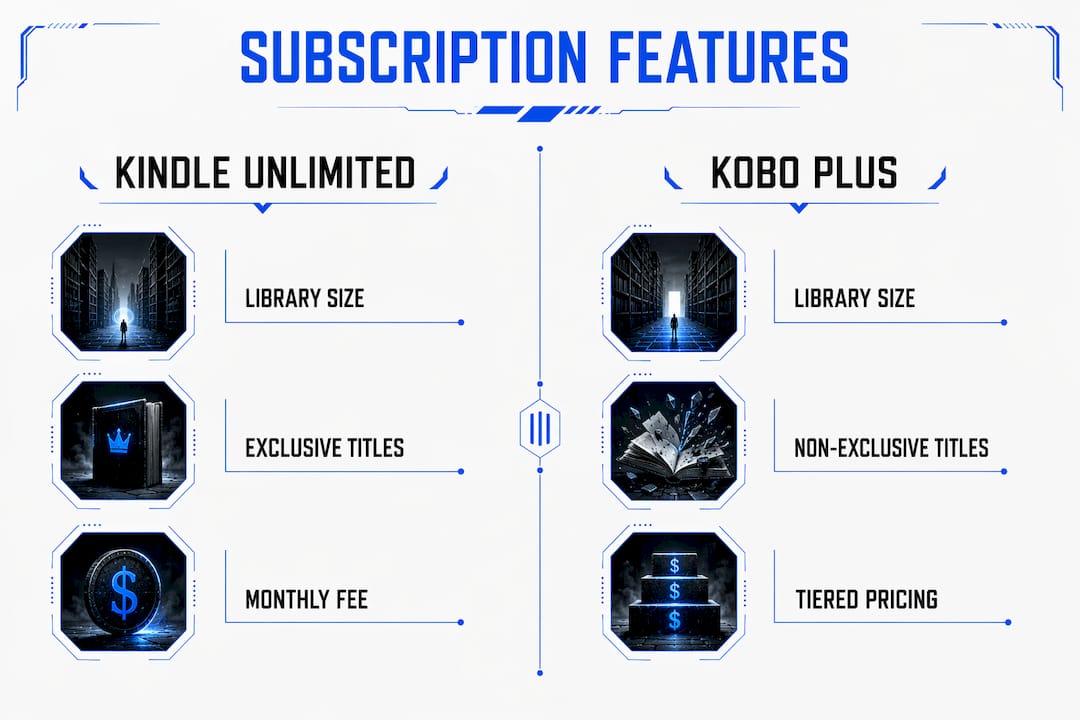
  • Library size: Kindle Unlimited offers a very large number of titles, including exclusive self-published works; Kobo Plus provides access to a substantial but smaller collection of ebooks and audiobooks.
  • Author exclusivity: Kindle Unlimited requires authors to enroll through KDP Select, which means many independent titles, including Connors’, exist only there.
  • Pricing: Kobo Plus begins with flexible, affordable monthly plans; Kindle Unlimited requires a flat monthly fee that is somewhat higher.
  • Device compatibility: Kindle Unlimited integrates with Amazon’s ecosystem; Kobo Plus is built for Kobo eReaders and its app.
  • Borrowing limits: Kindle Unlimited caps you at 10 borrowed titles at a time; Kobo Plus has no borrowing cap.

Table of Contents

  • How do Kindle Unlimited and Kobo Plus actually compare?
  • Why author exclusivity matters for Nathaniel Connors readers
  • How to choose between Kindle Unlimited and Kobo Plus for your reading habits
  • What does each subscription actually cost?
  • Which service fits your reading style?
  • Nathanielconnors’ dark fiction is waiting on Kindle Unlimited
  • Key Takeaways

How do Kindle Unlimited and Kobo Plus actually compare?

The differences between these two services go deeper than price and catalog size. Here’s how they stack up across the features that matter most.

Feature Kindle Unlimited Kobo Plus
Library size Very large collection including exclusive works Substantial collection of ebooks and audiobooks
Monthly price Flat fee, higher than some alternatives Tiered pricing starting at a lower fee
Free trial Approximately one month Between two weeks and one month
Borrowing limit Limited number of titles at a time No set borrowing limit
Device support Kindle devices and apps Kobo eReaders and apps
Author exclusivity Yes (authors must enroll exclusively) No (authors may distribute widely)
Nathaniel Connors titles Available exclusively Not available
Audiobooks included Some audiobooks via special features Dedicated audiobook subscription available
Magazines Available Not available

Infographic comparing Kindle Unlimited and Kobo Plus features

Kindle Unlimited’s exclusivity requirement is the defining structural difference. Authors who enroll in KDP Select cannot distribute their ebooks elsewhere during the enrollment period, which concentrates a huge volume of independent fiction inside Amazon’s catalog. Kobo Plus takes the opposite approach, letting authors publish across multiple platforms. That openness benefits discoverability but means Kobo’s catalog misses a significant slice of the independent fiction world.

One practical note: not every title in either store is included in the subscription. Only books marked “Read for $0.00 with Kindle Unlimited” or “Read with Kobo Plus” are accessible through the monthly fee, and those catalogs shift frequently.


Why author exclusivity matters for Nathaniel Connors readers

For fans of dark supernatural fiction, the exclusivity question is not abstract. It directly determines what you can read.

  • Connors’ titles are enrolled in KDP Select, making Kindle Unlimited the only subscription service where you can read them at no extra cost.
  • Kobo Plus allows multi-platform publishing, which means some independent authors appear there but not on Kindle Unlimited. Connors is not among them.
  • Readers who subscribe to Kobo Plus hoping to find his work will come up empty. The exclusive access is a deliberate authorial choice, not a gap that will close soon.
  • For genre readers who follow specific independent authors rather than browsing broadly, this exclusivity concentrates real value in Kindle Unlimited.

KDP Select exclusivity ensures that Kindle Unlimited is rich with unique works by independent authors. For readers of dark supernatural and psychological fiction, that means a concentrated catalog of titles you genuinely cannot find anywhere else — and for Nathaniel Connors fans specifically, it means Kindle Unlimited is the only subscription that delivers his work.

Industry analysis from 2026 confirms Kindle Unlimited is the stronger pick for readers who consume large volumes of exclusive genre content, while Kobo Plus suits those who want flexible audiobook or ebook-only plans at a lower price point.


How to choose between Kindle Unlimited and Kobo Plus for your reading habits

The right service depends on three things: what you want to read, what device you own, and how much you read each month.

  • Reading volume: Kindle Unlimited’s flat fee is advantageous for readers consuming multiple books per month. Lighter readers may find Kobo Plus’s lower-price ebook-only plan more economical.
  • Device ecosystem: Already using a Kindle or the Amazon app? Kindle Unlimited is frictionless. If you own a Kobo eReader, Kobo Plus integrates more naturally with your hardware.
  • Format preferences: Kobo Plus lets you subscribe to ebooks only, audiobooks only, or both. Kindle Unlimited bundles audiobooks through Whispersync on select titles, but it is not a dedicated audiobook service.
  • Author priorities: If Nathaniel Connors is on your reading list, this is settled. His titles are only accessible through Kindle Unlimited.
  • Catalog verification: Before committing to either service, check that the specific titles you want are currently marked as subscription-eligible. Catalogs change, and availability can shift without notice.

Pro Tip: Both services offer a 30-day free trial. Start with Kindle Unlimited if Connors’ fiction is your primary goal. You can search his titles directly in the Kindle store, confirm they’re included, and read the first book before your trial ends.


What does each subscription actually cost?

Kobo Plus offers three tiers in the US: Read only at $7.99/month, Listen only at $7.99/month, and Read & Listen at $9.99/month. That structure works well for readers who want one format without paying for the other.

Kindle Unlimited charges a flat $11.99/month with no tiered options. The higher price reflects the larger catalog and the concentration of exclusive independent titles. Amazon occasionally extends trial periods during Prime Day and Black Friday, so timing your signup around those events can stretch your free access.

Neither service locks you into a long-term contract. Both are month-to-month, and cancellation takes effect at the end of the billing cycle.


Which service fits your reading style?

Kobo Plus suits readers who are budget-conscious, own a Kobo device, and want the flexibility to pay only for ebooks or only for audiobooks. Its open ecosystem also appeals to readers who follow international literary fiction or authors who publish across multiple platforms.

Overhead view of hands holding Kobo e-reader at desk workspace

Kindle Unlimited fits readers who consume genre fiction heavily, want access to the largest independent catalog available, and read on Kindle devices or the Amazon app. For anyone specifically interested in dark supernatural fiction from independent authors like Nathaniel Connors, the free read with Kindle Unlimited model makes the value case clearly. The 10-title borrowing cap is worth knowing, but for most readers working through a series or an author’s backlist, it rarely becomes a real constraint.


Nathanielconnors’ dark fiction is waiting on Kindle Unlimited
Nathanielconnors

If psychological horror, dystopian dread, and characters haunted by guilt and revenge are what you read for, Nathanielconnors has built exactly that catalog. The Nether, Stories of a Condemned Soul, and Evolution A200: A Bubonic Apocalypse are all available to Kindle Unlimited subscribers at no additional cost beyond the monthly fee. You get the full reading experience, including rich character work and plots that stay with you, without paying per title.

The free trial period allows you to start reading with zero financial commitment. Head to nathanielconnors.com to see the full catalog, then activate your Kindle Unlimited trial and start with whichever title pulls you in first.


Key Takeaways

Kindle Unlimited is the only subscription service that carries Nathaniel Connors’ dark supernatural fiction, making it the clear choice for his readers despite its higher monthly price.

Point Details
Kindle Unlimited library size Over 4 million titles, including exclusive independent fiction unavailable elsewhere.
Kobo Plus pricing flexibility Three tiers from $7.99–$9.99/month suit readers who want ebooks or audiobooks separately.
Kindle Unlimited flat rate $11.99/month with a 30-day free trial; no tiered options.
Author exclusivity impact KDP Select enrollment means Connors’ titles exist only on Kindle Unlimited, not Kobo Plus.
Nathanielconnors on Kindle Unlimited All titles by Nathaniel Connors are exclusively readable through Kindle Unlimited at no extra cost.

Recommended

  • Kindle Unlimited Subscribers! – Nathaniel Connors | Dystopian Horror & Thriller Fiction
Person reading ergodic literature at vintage desk

Books Like House of Leaves: Dark Reads for 2026

Posted on July 27, 2026July 27, 2026 by NConnors

The best books like House of Leaves, ranked for psychological depth

If you finished House of Leaves and immediately wanted more, you already know what you’re after: stories that disorient on purpose, narrators you can’t fully trust, and an atmosphere that feels genuinely threatening. The four titles below are the strongest starting points, each pulling from the same well of narrative complexity and dread.

  • “S.” by J.J. Abrams and Doug Dorst — A novel arrives with handwritten margin notes from two readers piecing together its secrets. You’re reading three stories at once: the printed text, the students’ scrawled conversation, and the mystery underneath both. Physically, the book includes postcards and newspaper clippings tucked between pages.
  • “The Raw Shark Texts” by Steven Hall — Eric Sanderson wakes up with no memory and discovers he’s being hunted by a conceptual shark that moves through meaning rather than water. Hall uses white space, photographs, and fragmented text to make the threat feel genuinely surreal.
  • “Night Film” by Marisha Pessl — A journalist obsesses over a reclusive horror director whose daughter has died under strange circumstances. Pessl embeds fake screenshots, documents, and photographs into the print edition, blurring the line between investigation and fiction.
  • “Piranesi” by Susanna Clarke — A man lives alone in an infinite house of halls and statues, writing careful journal entries about a world he barely understands. The horror here is quiet and slow, built entirely through the narrator’s limited, unreliable perspective.
  • “The Shining” by Stephen King — The closest traditional horror parallel to House of Leaves, recommended for its dark atmosphere and psychological complexity. Jack Torrance’s unraveling mirrors the obsessive descent that defines Danielewski’s novel.

Table of Contents

  • What is ergodic literature, and why does it matter here?
  • Structural puzzlers vs. atmospheric dread: which type fits you?
  • Nathanielconnors: dark supernatural fiction for the same reader
  • How to read ergodic and complex novels without losing the thread
  • Key takeaways
  • Where to go next if these books are your kind of dark

What is ergodic literature, and why does it matter here?

The term “ergodic” comes from literary theory and describes texts that require nontrivial effort to read. Not effort as in dense prose, but physical, structural effort: rotating the book, tracking footnotes that lead to other footnotes, or following multiple narrative layers that never quite sync up.

House of Leaves is the clearest example in popular fiction. Its footnotes within footnotes and typographical shifts force you to physically interact with the page, and the story’s structure is inseparable from its horror. The house’s impossible geometry is mirrored in the book’s impossible layout. That’s not a stylistic flourish; it’s the whole point.

The narrative structure simulates losing your way to mirror the protagonist’s madness. Readers who respond to that experience tend to want it again, which is exactly why “S.” and The Raw Shark Texts land so well for this audience. Both use the physical form of the book as a storytelling tool, not just a container.

Pro Tip: When reading ergodic novels, keep a separate notepad for tracking narrative threads. The disorientation is intentional, but your own notes can reveal patterns the text hides in plain sight.

Structural puzzlers vs. atmospheric dread: which type fits you?

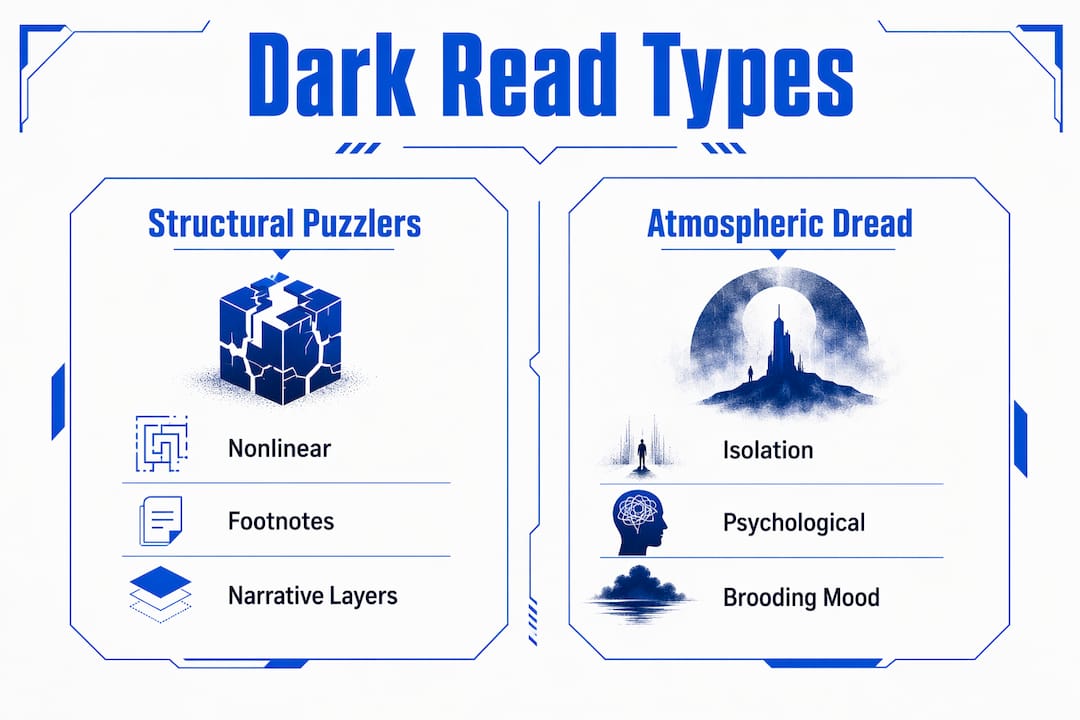
Infographic comparing structural puzzlers and atmospheric dread books

Novels similar to House of Leaves split cleanly into two camps, and knowing which one you prefer saves you from picking up the wrong book.

Structural puzzlers

These books foreground their own construction. The format is the puzzle, and solving it is part of the pleasure.

  • “S.” — Three interlocking stories told through margin notes, inserts, and a printed novel-within-a-novel.
  • “The Raw Shark Texts” — Fragmented chapters, image sequences, and a flip-book section hidden near the end.
  • “Hopscotch” by Julio Cortázar — Chapters can be read in multiple sequences; the author provides a “Table of Instructions” for a nonlinear path.
  • “The Unfortunates” by B.S. Johnson — A novel in a box: 27 unbound sections with only a labeled first and last chapter. Every reader’s experience is different.

Atmospheric dread

These novels prioritize mood and psychological pressure over formal experimentation. The horror is in the feeling, not the format.

  • “Piranesi” — Isolation and a reality that slowly reveals itself to be something other than what the narrator believes.
  • “Night Film” — Obsession and paranoia build through accumulating detail rather than structural tricks.
  • “The Shining” — A confined space, a deteriorating mind, and dread that compounds with every chapter.
  • “The Haunting of Hill House” by Shirley Jackson — Psychological isolation and the breakdown of a protagonist’s mental state, handled with the same oppressive atmosphere that defines House of Leaves.

Themes of isolation and psychological breakdown run through both categories. The difference is delivery: structural puzzlers make you work for the horror; atmospheric dread novels let it seep in. Readers who loved the footnote maze of House of Leaves usually gravitate toward structural puzzlers first, while readers drawn to its claustrophobic mood often prefer the atmospheric camp.

Nathanielconnors: dark supernatural fiction for the same reader

Man reading dark atmospheric novel in café

Nathaniel Connors writes dark supernatural fiction built around the same psychological territory that defines the best novels in this genre: revenge, guilt, redemption, and the monsters people carry inside themselves rather than the ones that come from outside.

His titles include:

  • The Nether — A haunting narrative that presses into the psychological space between guilt and consequence.
  • Stories of a Condemned Soul — Short, sharp explorations of human darkness, each story a self-contained descent.
  • Evolution A200: A Bubonic Apocalypse — Dystopian horror that combines biological catastrophe with deep character study, echoing the survivalist dread found in books like I Am Legend.

What connects Connors’ work to the novels above is the emphasis on interiority. His characters don’t just face external threats; they face themselves. That’s the same engine driving Piranesi’s unreliable narrator and the obsessive descent in Night Film. All of his books are available in ebook and paperback on Amazon, and Kindle Unlimited subscribers can read them at no additional cost.

How to read ergodic and complex novels without losing the thread

Approaching a structurally unconventional novel the same way you’d read a thriller will frustrate you. These books reward a different posture.

Read slowly and out of sequence when the text invites it. “S.” is designed to be read at least twice: once for the printed novel, once tracking only the margin conversation. Piranesi rewards rereading specific journal entries after the full picture emerges. Resist the urge to race toward resolution.

Pay attention to what the format is doing, not just what the text says. In House of Leaves, the shrinking text blocks and color-coded words are part of the story. In The Raw Shark Texts, the white space is silence and threat simultaneously. The form carries meaning the prose alone cannot.

Accept unreliable narrators as collaborators, not obstacles. The narrator’s gaps and distortions in Piranesi, Night Film, and Connors’ own work are where the real psychological tension lives. A narrator who doesn’t fully understand their own situation forces you to read between the lines, which is exactly the kind of active engagement ergodic fiction demands.

Key takeaways

The strongest books like House of Leaves share one quality: they treat the reader as an active participant, not a passive audience.

Point Details
Ergodic fiction demands active reading Non-linear layouts, footnotes, and physical interaction are core features, not stylistic extras.
Two distinct categories exist Structural puzzlers foreground format complexity; atmospheric dread novels prioritize psychological immersion.
Isolation drives the best titles Themes of psychological breakdown and outsider perspective connect House of Leaves to Piranesi, Night Film, and I Am Legend.
Approach matters as much as selection Reading slowly, tracking format choices, and embracing unreliable narrators improves comprehension of complex novels.
Nathanielconnors fits this tradition Connors’ dark supernatural fiction explores guilt, redemption, and psychological horror, available on Kindle Unlimited.

Where to go next if these books are your kind of dark

If the novels above are your reading territory, Nathanielconnors belongs on your list. His fiction sits at the intersection of psychological horror and dark supernatural storytelling, with the same emphasis on character interiority and thematic weight that makes House of Leaves linger long after you’ve finished it.

Nathanielconnors

Evolution A200: A Bubonic Apocalypse delivers the survivalist dread of post-apocalyptic fiction with the psychological depth of literary horror. Stories of a Condemned Soul offers the kind of concentrated darkness that hits hardest in short form. All titles are available now, and Kindle Unlimited subscribers read them free. Start with Blackout for a direct entry point into Connors’ world.

Woman using Kindle Unlimited on sofa

Kindle Unlimited vs Buying Ebooks: 2026 Decision Guide

Posted on July 26, 2026July 26, 2026 by NConnors

Which is better: Kindle Unlimited or buying ebooks?

Top view of devices comparing Kindle Unlimited and ebooks

Kindle Unlimited wins for readers who finish two or more books per month in genre fiction. Buying ebooks wins for everyone else. That’s the short version, and it holds up across every scenario worth examining.

Kindle Unlimited costs a monthly fee and gives you access to a massive catalog of ebooks, audiobooks, and comics. The math is simple: if you read two books a month from its catalog, you’re nearly breaking even compared to buying individually. Read three or more, and the savings become obvious. But the catalog skews heavily toward romance, sci-fi, thrillers, and indie fiction. Literary fiction readers, nonfiction fans, and anyone chasing the latest bestsellers will find the library frustrating more often than not.

Buying ebooks, by contrast, means paying $8–$15 per title but owning it permanently. No subscription, no access cutoff, no catalog restrictions.

Man reading purchased ebook at desk

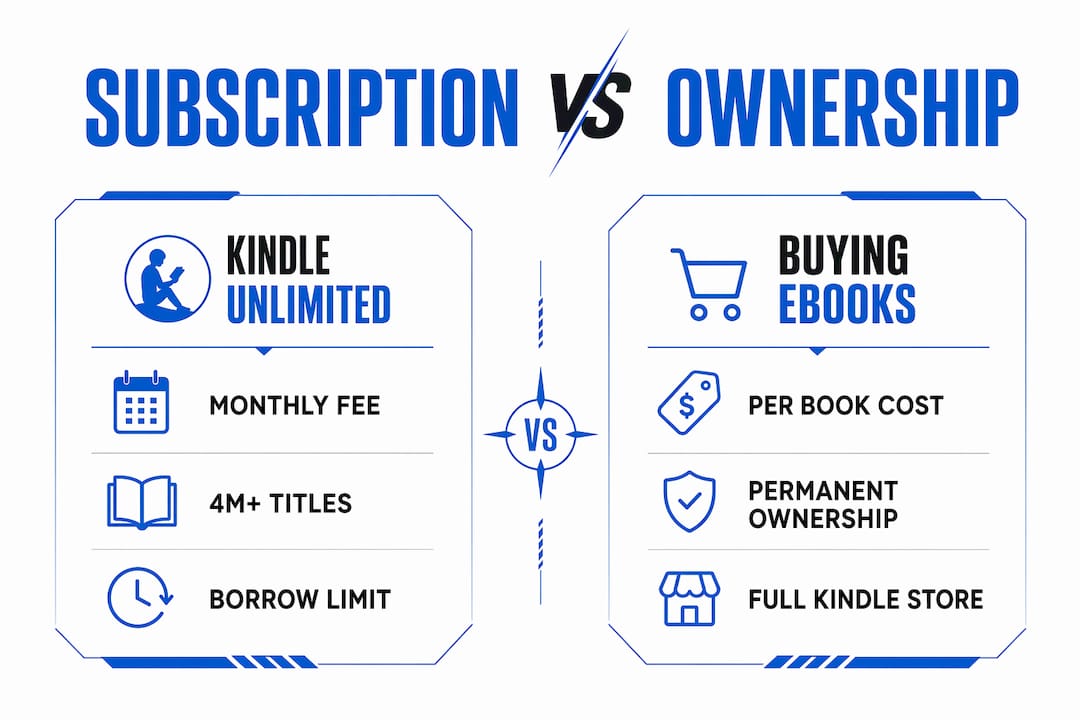
Dimension Kindle Unlimited Buying Ebooks
Cost $11.99/month $8–$15 per book
Content selection 4M+ titles, genre-heavy Full Kindle Store
Ease of use Borrow and return anytime Purchase and keep
Ownership No (borrowed access only) Yes (permanent)
Best for Frequent genre readers Selective or occasional readers

Infographic showing Kindle Unlimited vs buying ebooks

The concurrent borrow limit sits at 20 titles at once, with no due dates. That’s generous for most readers, though you lose everything if you cancel. Bought ebooks stay in your library forever, regardless of any subscription status.


1. What does Kindle Unlimited actually include?

Kindle Unlimited costs $11.99 per month in the US and requires no Amazon Prime membership to access. You can sign up independently, and the free Kindle app runs on iPhone, iPad, Android, Fire tablets, and any Kindle e-reader, so you don’t need to buy a device.

What’s in the catalog:

  • Over 4 million ebooks, with a strong focus on romance, romantasy, thrillers, sci-fi, fantasy, and cozy mysteries
  • Hundreds of thousands of audiobooks included at no extra charge
  • Thousands of comics, manga, and magazine issues
  • Deep series fiction from indie and self-published authors enrolled through Amazon’s KDP Select program

Subscription mechanics:

  • Borrow up to 20 titles concurrently with no fixed due dates
  • Return any title at any time to free up a slot
  • Sync reading progress across all devices automatically
  • 30-day free trial for new subscribers
Feature Details
Monthly price $11.99 USD
Annual cost $143.88
Catalog size 4M+ ebooks, 700K audiobooks
Borrow limit 20 titles at once
Due dates None
Devices Kindle e-readers, iOS, Android, Fire tablets
Free trial 30 days

One thing worth knowing: the catalog is almost entirely made up of titles enrolled in KDP Select, Amazon’s indie publishing program. Major publishers like Penguin Random House and HarperCollins have largely kept their frontlist titles out of Kindle Unlimited. If you want the latest releases from established authors, you’ll need to buy those separately.


2. What do you actually get when you buy an ebook?

Buying an ebook grants permanent ownership. The title stays in your Amazon library indefinitely, whether or not you ever subscribe to Kindle Unlimited, and you can reread, annotate, and highlight it whenever you want.

Ownership advantages:

  • Permanent access with no ongoing fees after purchase
  • Full annotation and highlighting tools available at any time
  • Books remain in your library even if you cancel any Amazon subscription
  • Access to the complete Kindle Store, including new releases and bestsellers from major publishers
  • No borrowing limits or catalog restrictions

Pricing and flexibility:

  • Average ebook prices range from $8 to $15 depending on publisher and release date, with bestsellers typically at the higher end
  • Indie and backlist titles often run $3–$7
  • Works on all the same devices as Kindle Unlimited: Kindle e-readers, the Kindle app on iOS and Android, and Fire tablets

Considerations:

  • Costs add up fast for high-volume readers
  • No way to sample a book before committing financially
  • Discovering new authors carries more financial risk than borrowing

The ownership model suits readers who build a personal library, return to favorite books, or read titles outside the Kindle Unlimited catalog. For someone who finishes one or two carefully chosen books per month, buying outright often makes more financial sense than paying a monthly subscription fee.


3. Pros and cons of Kindle Unlimited

Pros:

  • Readers who finish 3 or more books per month save meaningfully compared to buying individually
  • Massive genre fiction catalog, especially romance, fantasy, sci-fi, and thrillers
  • Indie and self-published catalog enables risk-free sampling of new authors
  • 700,000 audiobooks included, compared to Audible’s per-credit model
  • Works across all devices with no hardware purchase required
  • No due dates; return books at your own pace

Cons:

  • No ownership. Cancel the subscription and every borrowed title disappears
  • Major publisher frontlist titles are largely excluded from the catalog
  • Kindle Unlimited’s payment model pays authors per page read, which can incentivize longer, sometimes padded books
  • Tied entirely to Amazon’s ecosystem; no exporting titles to other platforms
  • At $11.99/month, casual readers who finish one book or fewer per month pay more than they would buying outright
Factor Kindle Unlimited
Best for Frequent readers in genre fiction
Catalog strength Romance, sci-fi, fantasy, thrillers
Catalog weakness Literary fiction, new major-publisher releases
Ownership None
Cost efficiency Strong at 3+ books/month
Audiobooks Included

Content rotation is another real consideration. Titles can leave the Kindle Unlimited catalog, which means a book you started might disappear before you finish it. That doesn’t happen often, but it’s a genuine limitation that buying doesn’t share.


4. Pros and cons of buying ebooks

Pros:

  • Permanent ownership with no subscription required
  • Access to the full Kindle Store, including every new release and bestseller
  • No borrowing restrictions, waitlists, or catalog limitations
  • Books stay in your library regardless of any subscription changes
  • Better for rereading, annotating, and building a personal collection
  • No financial lock-in; buy only what you want, when you want it

Cons:

  • Per-book cost adds up quickly for avid readers
  • No risk-free way to sample new authors before committing
  • Buying 3–4 books per month costs significantly more than a Kindle Unlimited subscription
Factor Buying Ebooks
Ownership Permanent
Catalog access Full Kindle Store
Best for Selective or occasional readers
Cost at low volume Efficient
Cost at high volume Expensive
New releases Always available
Discovery risk Higher per-book cost

The biggest practical advantage of buying is access. If you want a specific book, you can get it immediately without worrying about whether it’s in a subscription catalog. That matters most for readers who follow prize lists, book club picks, or specific authors whose publishers don’t participate in Kindle Unlimited.


5. Who benefits most from each option?

Your reading habits determine which model actually saves you money and frustration.

Kindle Unlimited fits you if you:

  • Finish 2 or more books per month consistently
  • Read primarily in romance, romantasy, fantasy, sci-fi, thrillers, or cozy mysteries
  • Enjoy binge-reading series fiction, where the KU catalog runs especially deep
  • Like sampling indie authors without financial risk
  • Listen to audiobooks regularly and want them bundled with your reading subscription
  • Read on multiple devices and want seamless syncing

Buying ebooks fits you if you:

  • Read one book per month or fewer
  • Follow literary fiction, nonfiction, or prize-listed titles that major publishers keep out of KU
  • Want to own your books permanently and build a personal digital library
  • Read specific authors whose new releases aren’t in the Kindle Unlimited catalog
  • Prefer not to pay a recurring monthly fee

**The hybrid approach works well for many readers. Use Kindle Unlimited for genre reading, series binging, and author discovery. Buy the specific titles you know you’ll reread or that fall outside the subscription catalog. This way, you get the volume savings of a subscription without sacrificing access to the books that matter most to you.

Pro Tip: Before committing to Kindle Unlimited, browse the catalog in your favorite genres first. If you can find 6 or more books you genuinely want to read, the subscription will likely pay for itself within the first month.


6. How to decide between Kindle Unlimited and buying ebooks

The decision comes down to five factors, and most readers can answer them in under two minutes.

Key decision factors:

  • Reading volume: Do you finish 2 or more books per month? If yes, Kindle Unlimited’s math works in your favor. If not, buying individually is almost always cheaper.
  • Genre alignment: Romance, fantasy, sci-fi, and thrillers are well-represented in Kindle Unlimited. Literary fiction, nonfiction, and major-publisher new releases are not.
  • Ownership preference: If keeping books permanently matters to you, buying is the only option. Kindle Unlimited is borrowing, not owning.
  • Budget flexibility: At $143.88 per year, Kindle Unlimited is a real recurring cost. If you read sporadically, that fee can feel wasteful during slow months.
  • Device habits: Both options work on the same devices, so this rarely tips the decision either way.

One underused strategy: take the 30-day free trial seriously. Don’t just borrow one book. Browse your actual preferred genres, check whether your favorite authors are enrolled, and borrow 4–5 titles. If you can’t fill your queue with books you genuinely want to read, cancel before the trial ends.

Public library digital lending through apps like Libby is also worth factoring in. It’s free with a library card and covers many new releases that Kindle Unlimited doesn’t. The trade-off is waitlists, which can run weeks or months for popular titles. If you’re patient and your library system has solid digital holdings, Libby handles a lot of what Kindle Unlimited charges $11.99 per month for.


7. Cost comparison: subscription fees vs. buying individual ebooks

Kindle Unlimited breaks even at moderate reading volumes compared to average ebook prices.

Average Kindle ebook prices run $8–$15 for newer releases, with indie and backlist titles often lower. Using a mid-range estimate of $12.99 per book:

Books Per Month Cost if Buying Kindle Unlimited Cost Monthly Savings
1 $12.99 $11.99 ~$1 (breakeven)
2 $26 $11.99 —
3 $39 $11.99 —
4+ — $11.99 —

At three books per month, the savings become clear. At one book per month, you’re essentially breaking even, and the lack of ownership makes buying the smarter call for most readers at that pace.

Annual perspective: Kindle Unlimited costs $143.88 per year. A reader who buys just one $12.99 ebook per month spends $155.88 annually, which is only marginally more. But a reader buying three books per month spends $467.64 per year versus $143.88 for the subscription. That’s a real difference.

Discounts and promotions can shift the math. Amazon periodically offers two months of Kindle Unlimited for $4.99, and promotional pricing appears around Prime Day and Black Friday. If you catch one of those deals and read heavily during the promotional period, the value improves further.


8. Reading dark supernatural fiction on Kindle Unlimited with Nathanielconnors

Kindle Unlimited’s catalog runs especially deep in the genres where dark fiction thrives: horror, supernatural thrillers, dystopian fiction, and psychological suspense. That’s where Nathanielconnors operates, and it’s where the subscription model makes the most sense for readers who want to explore the genre without buying blind.

Nathaniel Connors writes dark supernatural fiction that sits at the intersection of psychological horror and dystopian narrative. His titles, including The Nether, Stories of a Condemned Soul, and Evolution A200: A Bubonic Apocalypse, are available to Kindle Unlimited subscribers at no additional cost. These aren’t light reads. They explore revenge, guilt, and the psychological weight of moral failure, with the kind of character depth that stays with you after the last page.

Pro Tip: If you’re new to dark supernatural fiction or want to explore Nathanielconnors’ catalog risk-free, Kindle Unlimited is the ideal entry point. You can read the full series without committing to individual purchases, then buy the titles you want to own permanently.

For readers already subscribed to Kindle Unlimited, Nathanielconnors’ dark fiction is immediately accessible. The catalog includes both standalone titles and series fiction, which plays directly to one of Kindle Unlimited’s strongest use cases: binge-reading a connected story world without per-book costs stacking up.

https://nathanielconnors.com

If you’re a Kindle Unlimited subscriber looking for your next psychological thriller or dystopian horror series, explore Nathanielconnors’ titles and start reading immediately at no extra cost.


9. How refunds, returns, and exchanges work for each option

The policies differ significantly between Kindle Unlimited and purchased ebooks, and understanding them before you commit saves frustration later.

Kindle Unlimited: There are no returns in the traditional sense because you never purchase anything. You borrow titles and return them whenever you’re ready, with no penalty and no deadline. If you borrow a book and dislike it after 10 pages, you return it and grab something else. That’s the model working as intended. Canceling your subscription ends access to all borrowed titles immediately, but you’re never charged for individual books.

Purchased ebooks: Amazon’s standard policy allows returns on Kindle book purchases within seven days of the original transaction, provided you haven’t read a significant portion of the book. The refund goes back to your original payment method. This window is narrow, and Amazon monitors return patterns, so repeatedly returning books you’ve read through is likely to get flagged. There are no exchanges for ebooks; you return for a refund and repurchase if needed.

The practical difference: Kindle Unlimited lets you sample freely with zero financial risk per title. Buying gives you ownership but a tight return window if the book isn’t what you expected.


10. How DRM affects your reading experience

Digital Rights Management, or DRM, controls how you can use ebooks after you obtain them. Both Kindle Unlimited and purchased Kindle ebooks use Amazon’s DRM system, but the implications differ depending on how you access the content.

For Kindle Unlimited: DRM is built into the borrowing model. You can only read borrowed titles through Amazon’s ecosystem: Kindle devices and the Kindle app. You cannot export a borrowed title to a non-Amazon reader or convert it to another format. When you return a book or cancel your subscription, the DRM ensures the title is no longer accessible. This is by design, not a bug, but it does mean you’re fully committed to Amazon’s platform for as long as you subscribe.

For purchased ebooks: Bought Kindle titles also carry Amazon’s DRM by default, which means they’re tied to your Amazon account and readable only through Kindle apps and devices. The key difference is permanence: your purchased library stays accessible as long as Amazon maintains its platform and your account remains active. Some ebooks are sold DRM-free, typically from indie publishers or authors who opt out, and those can be transferred to other devices and formats freely.

The practical takeaway: if you want to read on non-Amazon devices or keep books in a format you fully control, buying DRM-free titles from publishers who offer them is the only path that gives you real flexibility. For most readers using Kindle devices or the Kindle app, DRM is invisible day-to-day, but it becomes relevant if you ever want to switch ecosystems.


Prime Reading vs. Kindle Unlimited: are they the same?

They are not. Prime Reading is included with an Amazon Prime membership and covers roughly 3,000 rotating titles. Kindle Unlimited is a separate $11.99/month subscription with a catalog of over 4 million titles. The two services work the same way mechanically, but the scale difference is enormous.

Prime Reading suits casual readers who finish one or two books per month and already pay for Prime. It’s a free bonus, not a reading service worth subscribing to on its own. Kindle Unlimited is the full service, with the depth and genre breadth that makes a subscription financially defensible for frequent readers.

One common misconception: Amazon Prime does not include Kindle Unlimited. You can have Prime without Kindle Unlimited, Kindle Unlimited without Prime, or both. They’re independent subscriptions with separate billing.

Feature Prime Reading Kindle Unlimited
Included with Prime Yes No
Separate monthly fee No $11.99/month
Catalog size ~3,000 rotating titles 4M+ titles
Borrow limit Not currently specified 20 at a time
Best for Casual readers with Prime Frequent genre readers

If Prime Reading consistently leaves you wanting more, that’s your signal to upgrade to Kindle Unlimited. If Prime Reading covers your monthly reading without issue, the extra subscription cost is hard to justify.


Key Takeaways

Kindle Unlimited pays for itself at two or more books per month in genre fiction, while buying ebooks is the smarter choice for selective readers who value permanent ownership or read outside the subscription catalog.

Point Details
Break-even point Reading 2 books per month at average ebook prices makes Kindle Unlimited cost-neutral versus buying.
Genre fit matters Kindle Unlimited’s catalog is strongest in romance, sci-fi, fantasy, and thrillers; weakest in literary fiction and major-publisher new releases.
Ownership difference Bought ebooks stay in your library permanently; Kindle Unlimited titles disappear if you cancel.
Prime Reading is separate Prime Reading (~3,000 titles) is included with Amazon Prime; Kindle Unlimited (4M+ titles) costs $11.99/month extra.
Hybrid approach works Using Kindle Unlimited for genre reading and buying only titles you want to keep permanently maximizes value for many readers.

Recommended

  • Kindle Unlimited Subscribers! – Nathaniel Connors | Dystopian Horror & Thriller Fiction

Article generated by BabyLoveGrowth

Promotional social media banner featuring author Nathaniel Connors in a black hoodie against a dark dystopian city backdrop with fiery orange lighting. Bold text reads “Connect With Me On Social Media,” alongside Facebook, Instagram, and X icons with his handles: Facebook @NathanielConnors, Instagram @ncrevelation, and X @NCRevelation. The design has a cinematic horror-inspired aesthetic with dramatic contrast and post-apocalyptic atmosphere.

Let’s Connect

Posted on May 3, 2026May 23, 2026 by NConnors

Books may be where the stories begin… but they are far from where the conversation ends.

Beyond the novels, these spaces are where I share the thoughts behind the darkness, the writing process, new ideas taking shape, personal reflections, horror inspiration, and the creative world that exists outside the page.

If you enjoy storytelling, dystopian worlds, psychological depth, or simply want to connect beyond the books themselves, join me across social media.

Let’s talk writing, horror, imagination, and everything in between.

Facebook: @NathanielConnors
Instagram: @ncrevelation
X: @NCRevelation
TikTok: @ncrevelation

Because sometimes the most interesting stories are the ones still being written.

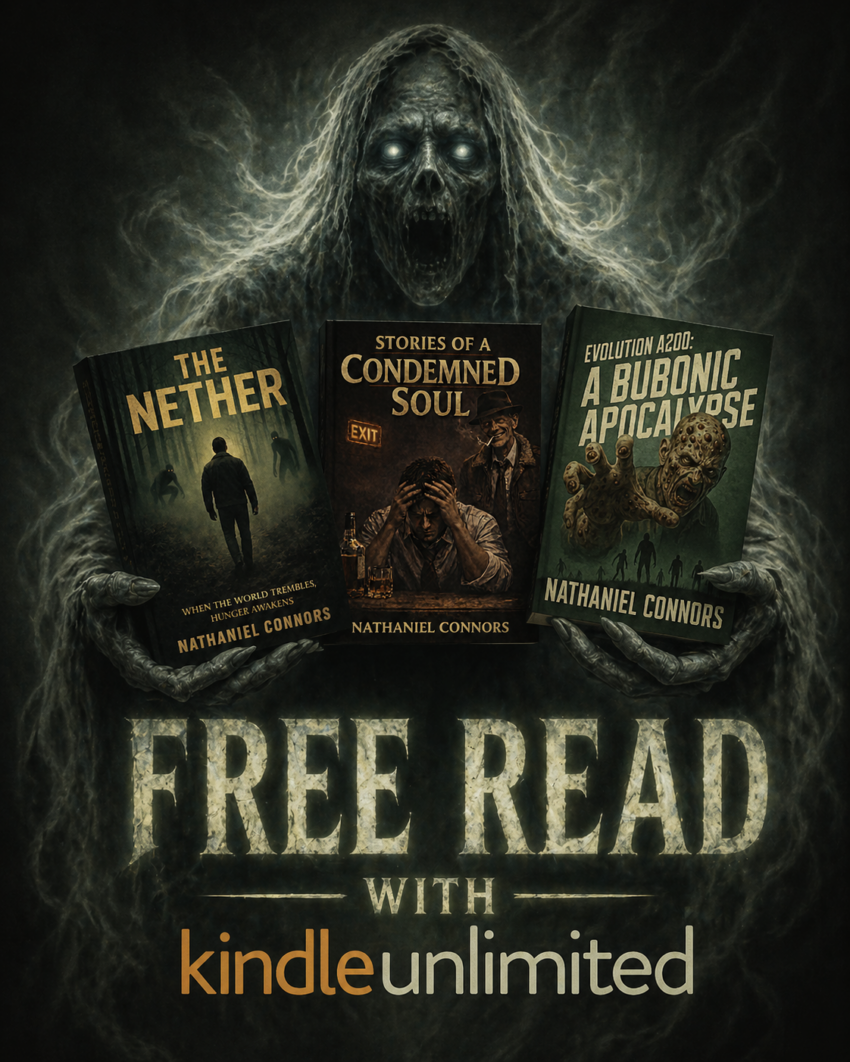
Dark horror promotional image featuring a ghostly skeletal figure with glowing eyes emerging from shadow while holding three Nathaniel Connors books: The Nether, Stories of a Condemned Soul, and Evolution A200: A Bubonic Apocalypse. Large distressed text reads “Free Read” above Kindle Unlimited branding, creating a haunting supernatural advertisement for free Kindle Unlimited access.

Free Read With Kindle Unlimited: Enter the Worlds of Nathaniel Connors

Posted on May 2, 2026May 2, 2026 by NConnors

Some stories entertain. Others linger.

If you’re drawn to dystopian horror, psychological unraveling, post-apocalyptic survival, and the darker corners of speculative fiction, Kindle Unlimited offers free access to the haunting worlds of Nathaniel Connors.

Step into three distinct nightmares:

The Nether

A dystopian horror experience where societal collapse, grief, vengeance, and the monstrous unknown converge beneath a broken world.

Stories of a Condemned Soul

A psychological descent into fractured identity, inner torment, and the hidden darkness buried within the human mind.


Evolution A200: A Bubonic Apocalypse

An ancient plague. A mutating virus. A town forced to evolve or die as civilization unravels beneath contagion and fear.


Whether you crave creeping dread, psychological tension, or survival against impossible odds, these stories were written for readers who aren’t afraid to explore what waits in the shadows.

Read Free With Kindle Unlimited

Subscribers can dive into these titles at no additional cost and discover the stories that haunt long after the last page.

Darkness is waiting. The only question is which nightmare you’ll enter first.

  • Previous
  • 1
  • 2
  • 3
  • Facebook
  • Twitter
  • Instagram
  • TikTok
  • Linkedin

Recent Posts

  • Unreliable Narrator Meaning: Definition, Types, and Examples
  • Grimdark vs Horror: How to Tell the Difference
  • Psychological Thriller vs Horror: How to Tell and Write Them
  • How to Write Psychological Horror: A Craft Guide
  • The Best Horror YouTube Channels: 23 Picks by Scare Type

Recent Comments

No comments to show.

Categories

  • Books
  • Film
  • Kindle Unlimited
  • Uncategorized
  • August 2026
  • July 2026
  • May 2026
  • April 2026
  • December 2021

Share Our Blog

©2026 Nathaniel Connors | Dystopian Horror & Thriller Fiction